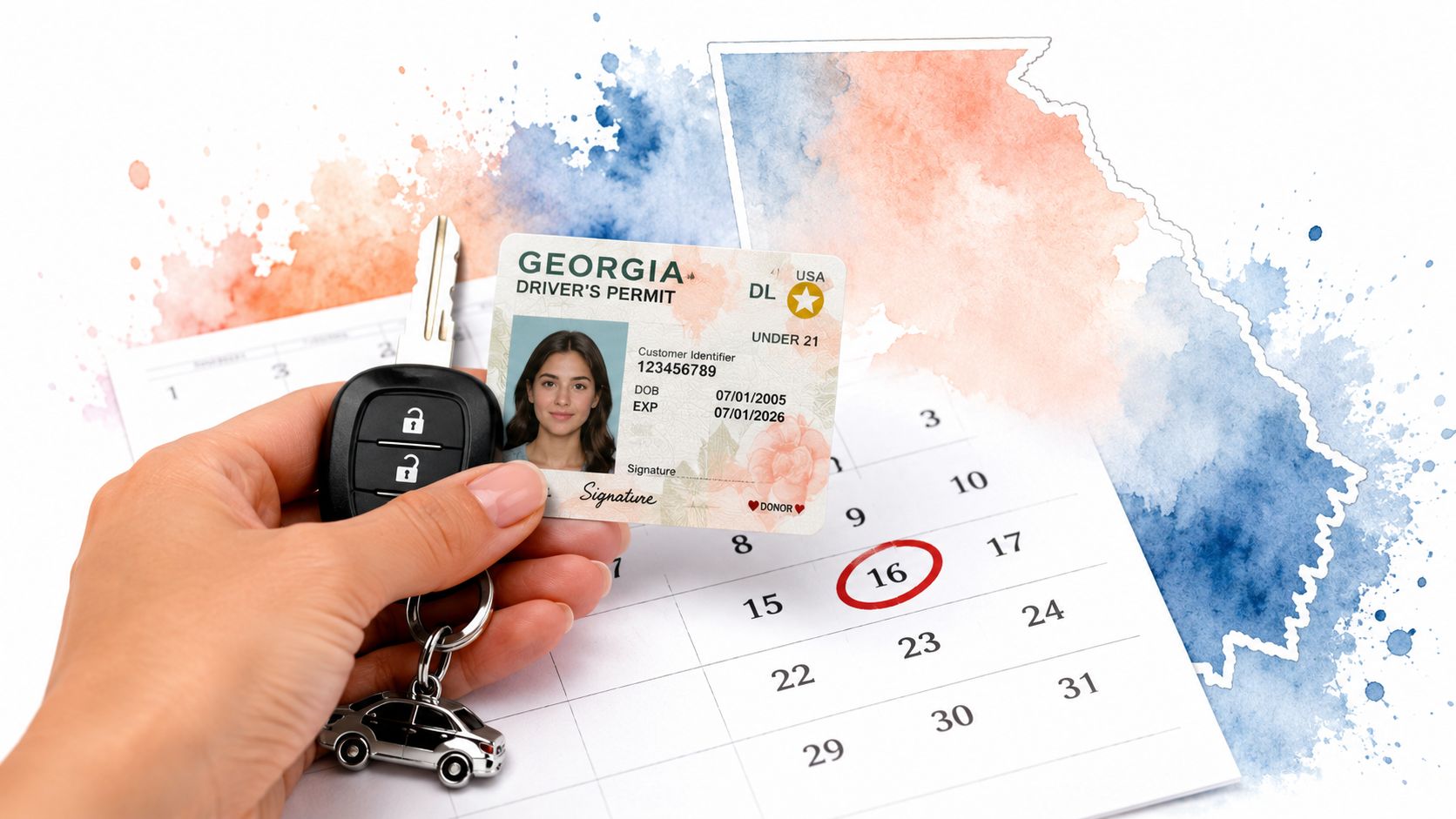
Your teen has finished driver education, earned a Georgia learner's permit, and is ready for the Class D road test. Then you open the DDS calendar and find no convenient appointment near Atlanta, Marietta, Alpharetta, or Conyers. Refreshing the portal harder won't solve the problem. You need the right eligibility date, a clean document file, a compliant vehicle, and a backup plan that can include professional lessons and an alternate testing location.
Georgia's appointment-only system makes booking part of the licensing process. The playbook below shows how to schedule drivers test GA appointments through DDS, when a phone call makes sense, and why a driving lesson package can be more than preparation. It can also give your family another route to the road test.
The Road Test Booking Reality for Georgia Drivers
Georgia road tests aren't walk-in services at the locations that require appointments. The Georgia DDS road test page states that walk-ins aren't accepted, and its online appointment system covers automobile, motorcycle, and commercial road tests. That makes a reservation a formal requirement, not a convenience you can handle after arriving at a service center.
For Atlanta-area families, that distinction changes the entire strategy. A full calendar doesn't mean your teen can't test soon. It means you need to search intelligently, check more than one location, and prepare for cancellations instead of relying on a single nearby office.

Start with the appointment, not the driving
A sensible booking plan has several parts:
- Confirm eligibility: Teens must satisfy the permit timeline and Joshua's Law requirements before the road-test date.
- Search broadly: Check service centers beyond the closest office, especially when metro locations show no useful openings.
- Prepare the paperwork: A missing permit, insurance document, or required completion record can waste the appointment.
- Inspect the vehicle: DDS requires the test vehicle to pass its safety inspection, and unsafe equipment can end the test before driving begins.
- Build a backup route: A qualified driving school may offer lessons and road-test services at select locations, giving you an alternative to the DDS calendar.
The biggest mistake I see is treating the road test as a single booking problem. It's a readiness problem and a logistics problem at the same time. A student who books early but arrives with an unacceptable vehicle still loses the appointment. A student who's fully prepared but waits until the last minute may find that the calendar doesn't match school, work, or family schedules.
Instructor's rule: Don't refresh the DDS portal until you've checked the eligibility date, gathered the documents, and decided how far you're willing to travel.
Georgia's digital reservation model has been established for years. The Georgia Technology Authority's documentation described DDS adoption of online scheduling software that lets customers view available dates, times, and locations before choosing an appointment. The current DDS requirement confirms that appointment-based access remains the operating model.
Booking Your GA Road Test Online Through DDS
The DDS portal is the direct route for reserving a state service-center road test. Use it when you want the state appointment system, and don't wait until every part of your preparation is finished to investigate availability. The calendar itself can influence whether you choose a nearby location, a less familiar route, or a school-based alternative.
Open the DDS appointment area and sign in to your MyDDS account, or create an account if you don't already have one. Enter the identity details the system requests, including the permit information and date of birth, then select the road-test service rather than a permit or identification transaction. Read the eligibility information carefully before choosing a date. The portal can show availability, but it doesn't replace your responsibility to confirm that the date is lawful.

Search locations like an instructor
Begin with the service center that makes the most sense for your family, then widen the search when the calendar is full. Don't reject an opening just because it isn't in your preferred suburb. A longer drive to a practical appointment can be cheaper and less stressful than postponing lessons, missing school obligations, or waiting for an uncertain cancellation.
Have these details ready before you search:
- Permit information: Keep the permit nearby so you can enter the details accurately.
- Personal identification details: Use the same information associated with the DDS record.
- Location choices: Pick several acceptable service centers before you begin.
- Calendar flexibility: Consider different weekdays and times instead of holding out for one ideal slot.
- Confirmation details: Save the appointment confirmation as soon as the reservation is complete.
DDS road-test appointments are handled through the state's online scheduling system, but the exact payment and confirmation screens can vary. Follow the amount and instructions displayed by DDS rather than relying on advice from an old forum post. Save the confirmation number and appointment details in more than one place, such as the account dashboard and your family calendar.
Families managing several appointments can also learn from broader scheduling systems. For a useful look at how automated reminders and booking workflows work in another service context, review AI for home service booking. The principle is simple: capture the confirmation, share the appointment with the people responsible for the car and paperwork, and set reminders early enough to act if plans change.
Use the phone route strategically
The DDS contact center can help when the portal creates confusion or when an adult applicant needs assistance with the booking process. Have the permit details, date of birth, and preferred service locations in front of you before calling. An agent can't manufacture an opening, so the call works best when you're ready to accept several reasonable options.
Adults age 18 and older should ask how their road-test appointment is categorized, because adult booking procedures can differ from teen scheduling. Don't spend the call searching for a perfect date. The objective is to secure a valid appointment, record the confirmation number, and then prepare for the specific location and vehicle requirements.
When You Can Legally Schedule Your Test
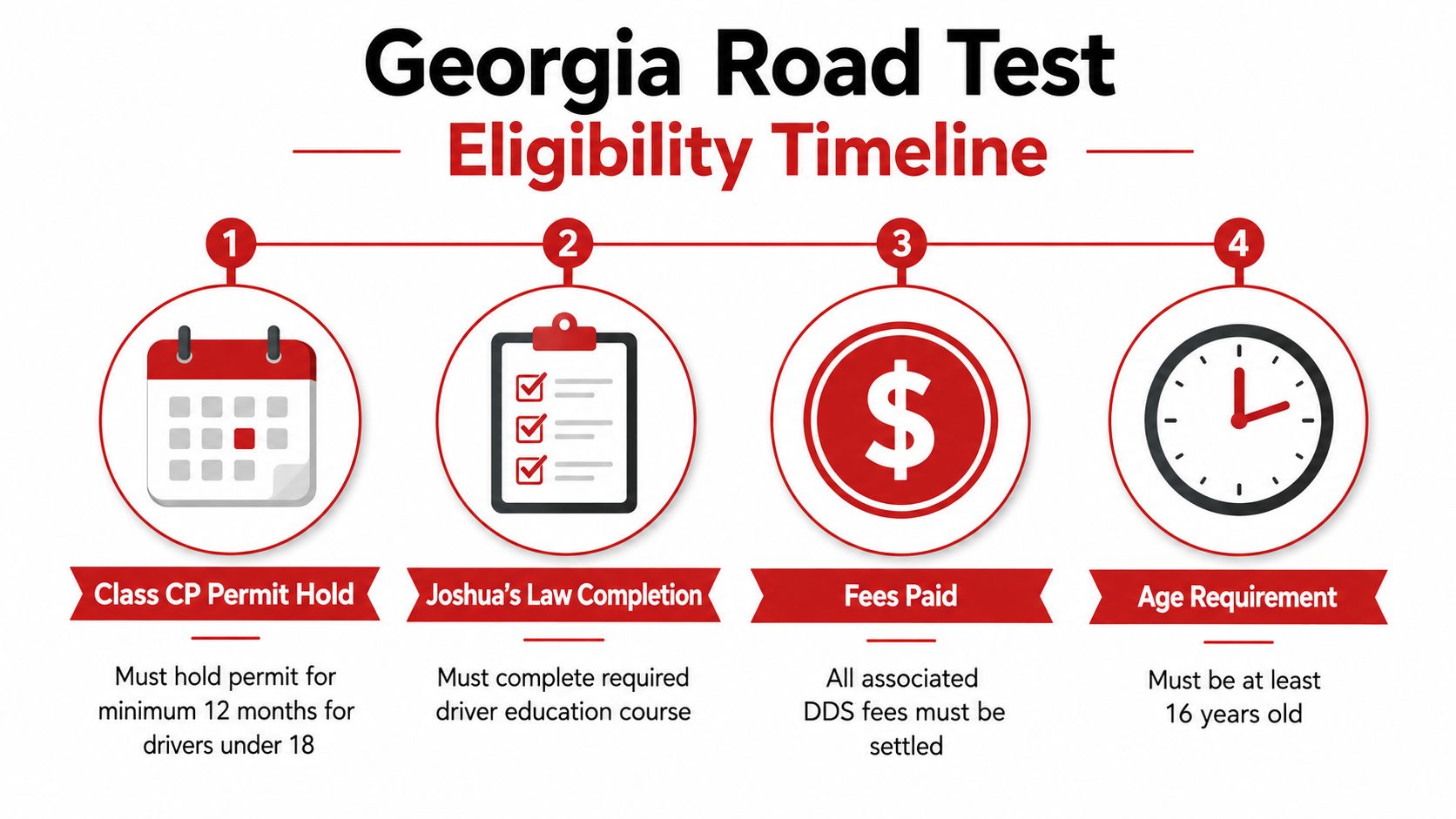
The date on the calendar matters. For teen drivers, Georgia's timing rule is clear: the earliest date to schedule the actual road test is 12 months and 1 day after the permit issue date, as reflected in the DDS-related first-license guidance (Georgia DDS first-license brochure). Count from the permit's issue date, not from the day your teen completed class, started lessons, or began supervised driving.
A teen also needs the required licensing foundation before moving to the road-test stage. Georgia's Joshua's Law requirements require 16- and 17-year-olds applying for a Class D license to complete an approved driver education course and 40 hours of supervised driving with a parent or guardian, including 6 hours at night.
Joshua's Law has two education paths
The approved course can be completed through either of these routes:
- Traditional instruction: At least 30 hours of classroom instruction and 6 hours behind the wheel at a DDS-approved school.
- Online instruction: 30 hours of online instruction and 6 hours behind the wheel at a certified school.
DDS confirms the “30 and 6” structure in its Driver Education FAQs. An online course is convenient, but it doesn't eliminate the behind-the-wheel requirement. Your teen still needs supervised practice and instructor-led driving preparation before the road test.
Adults age 18 and older follow a different scheduling path. They don't use the teen waiting-period timeline, but they still need the appropriate valid learner's permit and must meet DDS requirements for the service they're booking. If the applicant is transferring an out-of-state credential, check the current DDS instructions directly instead of assuming the teen pathway applies.
The Georgia Driver's Education Grant Scholarship Program can help eligible families pay for qualifying training. The state rules describe eligibility for Georgia residents ages 15 to 17 who are actively enrolled in school and hold a valid Georgia instructional permit or driver's license, with training consisting of classroom and behind-the-wheel instruction (Georgia Driver's Education Grant Scholarship Program rules). Ask the school about the application process before paying for a course.
Documents and Vehicle Prep for Test Day
A road-test appointment doesn't guarantee a test. Bring the required records, and use a vehicle that can pass inspection. DDS says the vehicle must have valid liability insurance, and the examiner may reject it when required equipment is missing or unsafe. Weather or other unsafe conditions can also cancel the drive test, so leave room in your plan for a rescheduled appointment.
Use this checklist the day before, not in the parking lot:
| Bring to the Appointment | Vehicle Must Pass Inspection |
|---|---|
| Valid Georgia permit and required identification | Valid liability insurance |
| Proof of completed driver education when applicable | Working turn signals and brake lights |
| Required parent or guardian documents for a minor | Safe tires, mirrors, horn, and windshield |
| Insurance information for the test vehicle | No unsafe condition that prevents testing |
| Appointment confirmation | Current registration and usable controls |
A-1's vehicle inspection checklist is useful for reviewing the car before leaving home. Pay close attention to turn signals, brake lights, mirrors, tires, the horn, windshield condition, warning indicators, and the driver-side wiper. Fix small issues early. A replacement bulb or a working horn is far less disruptive than arriving for a test the car can't legally support.
How to Actually Land the Slot You Want
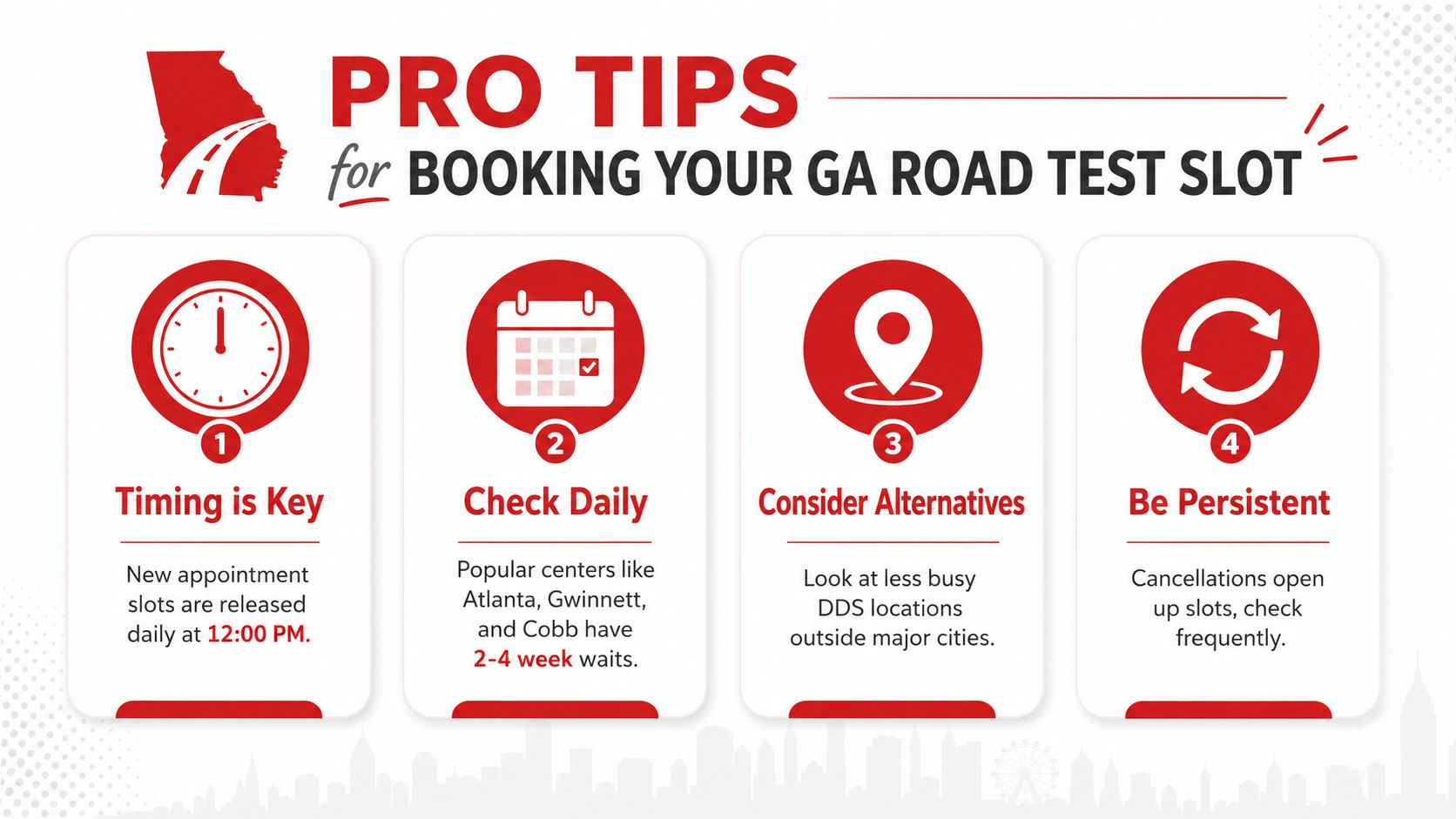
Stop searching only one office. The Atlanta metro area has multiple DDS locations, and a practical family will compare distance, appointment time, road familiarity, and availability. A slot at a less convenient center may be the right decision if your teen is ready and the route can be practiced in advance.
Use a disciplined search routine:
- Keep one signed-in session: Multiple tabs can create confusion or stale appointment information.
- Check cancellations: Openings can appear when another applicant changes plans.
- Search different locations: A wider location list gives you more ways to match the date.
- Practice the route: Once you have a location, drive nearby roads and identify lane changes, intersections, signs, and parking areas.
- Book the workable slot: Don't hold out for the perfect time if the student is prepared and the vehicle is ready.
The DDS system is appointment-only, so persistence matters. But persistence without preparation is just repeated frustration. If the calendar isn't cooperating, a lesson package that includes road-test support can change the equation by providing access to an alternate test setting at select school locations.
A school-based option can also let the student practice in the vehicle used for testing and learn the local environment before the exam. That's the key trade-off. DDS may be the direct state route, while a driving school may combine instruction, vehicle access, and testing assistance into one plan.
Review the same-day road test option when a DDS queue doesn't fit your schedule. Confirm current availability, locations, eligibility, and required documentation directly with the provider before booking.
Cancellation and Reschedule Policies
Treat a DDS appointment as a commitment. If your teen isn't ready, the vehicle fails inspection, or a family emergency makes attendance impossible, change the appointment as soon as you know. Don't wait until the appointment day and hope the system will overlook the absence.
Use the DDS account's appointment-management area to review the reservation and follow the available cancellation or rescheduling instructions. If the online route doesn't work, contact DDS through its published support channels. Keep the confirmation number available because it helps staff locate the appointment quickly.
Before changing anything, read the current terms displayed by DDS. Policies can depend on the timing and type of appointment, and an old social-media post isn't a reliable substitute for the agency's current instructions. For families who coordinate multiple calendars, a general reference on cancellation rules for calendar sync can help explain why shared appointment records should be updated immediately after a change.
Recover without losing momentum
If practice reveals a serious weakness, don't force the test because it's booked. Reschedule, add targeted lessons, and keep searching for the next suitable opening. Focus the extra practice on the specific problem, such as lane positioning, stop-sign control, turns, or vehicle handling, rather than paying for unfocused seat time.
Use the driver's test change service when you need help adjusting a school-supported testing appointment. The practical rule is straightforward: cancel early when necessary, rebook promptly, and keep the student driving while waiting for the new date.
Why Driving Lessons Double as a Scheduling Hack
Driving lessons shouldn't be viewed only as instruction. The right package can solve three problems at once: preparation, vehicle access, and test scheduling. Georgia-approved driving schools may operate as DDS-authorized third-party testers, allowing eligible applicants to take the official road test through the school rather than waiting for a state service-center opening.
That option is valuable when a family has already hit a crowded DDS calendar. A student can complete a Joshua's Law course, take behind-the-wheel lessons, practice the required maneuvers, and then ask whether the school offers testing at a qualifying location. Availability, eligibility, and school procedures vary, so confirm those details before purchasing.
Choose lessons that fix actual test weaknesses
A multi-lesson package has more value when the instructor evaluates the student instead of driving around familiar neighborhoods. The instructor should observe:
- Three-point turns: The student should control the vehicle, check surroundings, and complete the turn without rushing.
- Reverse parallel parking: The student should use controlled steering and observation rather than guesswork.
- Straight-line backing: The vehicle should remain controlled while the student checks mirrors and surroundings.
- Smooth stops: Braking should be deliberate and controlled, not abrupt.
- Left and right turns: The student needs correct lane position, speed control, and awareness of nearby traffic.
- Lane changes: The turn signal comes before the lane change, followed by mirror checks and a head check.
- Stop signs: The vehicle must stop fully. Don't roll through while looking for a gap.
- Merges and intersections: The student should scan, yield correctly, and maintain a safe position.
- Speed control: Stay within the posted limit and adjust for traffic, visibility, and conditions.
The DDS has emphasized that the Road Rules portion of the teen exam had a 68.02% pass rate, which means knowledge preparation deserves attention alongside driving practice (DDS tips for teens). Don't assume a student who can steer smoothly automatically understands the rules being evaluated.
Use a test-morning checklist
Before leaving home, confirm:
- License or identification: Bring the valid credential DDS or the testing provider requires.
- Parent documentation: A minor should have the required signed consent or affidavit.
- Insurance and registration: Keep the current documents in the test vehicle.
- Vehicle controls: Test the turn signals, brake lights, horn, mirrors, and driver-side wiper.
- Student readiness: Review full stops, head checks, lane positioning, and speed control without cramming.
The strongest package is the one that fits the student's weak points and the family's calendar. Online driver education can handle the classroom portion, while in-car lessons build the physical skill. The Georgia Driver's Education Grant Scholarship Program may help eligible families pay for qualifying training, so ask about the program before selecting a course.
Families juggling school, sports, work, and appointments should put the permit date, class completion, lessons, practice sessions, and test appointment into one shared calendar. A resource on how to streamline your family calendar can help organize reminders, but the driving plan still needs a human check before every appointment.
A-1 Driving School offers in-person and online driver education, Joshua's Law courses, driving lessons, lesson packages, and road-test assistance at select locations. Its course and lesson combination is a practical option for families that want instruction first and a possible alternate testing route instead of relying only on the DDS portal.
A-1 Driving School can help you complete Georgia driver education, arrange Joshua's Law training, build skills through driving lessons and packages, and prepare for road testing at select locations. Visit A-1 Driving School to review course options, lesson packages, scholarship information, and available road-test services.