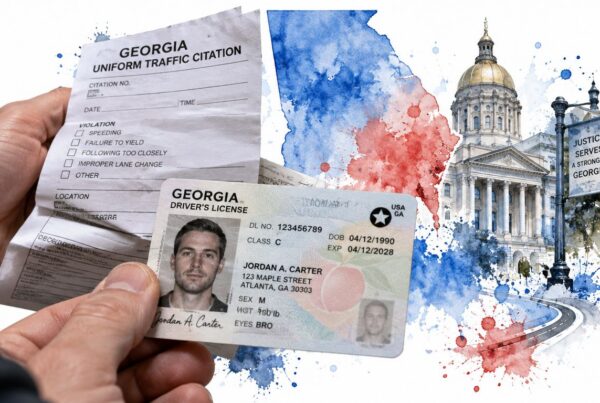

Georgia's traditional road test requires at least 75% to pass, and examiners score both specific maneuvers and overall driving behavior, not just whether you completed each task. That means your preparation should focus on how you park, turn, stop, and observe traffic, rather than only getting through the route.
You're sitting in the car, waiting for instructions, and suddenly wondering whether your last practice drive was enough. Your hands feel tense on the steering wheel, and parallel parking seems harder than it did yesterday. A useful way to steady yourself is to replace “I hope I pass” with something concrete: “I know what safe, controlled performance looks like.”
What the Driving Test Rubric Measures
At the start of a road test, an examiner watches how you manage the car and respond to what is happening around you. The driving test rubric sets standards for those observable actions. Completing a maneuver is only part of the task. The examiner also considers whether you use appropriate observation, positioning, and control.
Georgia DDS evaluates parking and backing along with driving behaviors such as signaling, following distance, and vehicle control. Its road-test skills and examination standards describe the skills applicants are expected to demonstrate. In practice, that means you can rehearse each action in a lesson, then ask whether your behavior matches the same standards an examiner observes.
For example, reaching the correct street after a turn shows that you completed the route change. The examiner can also watch whether you approached at a controlled speed, chose an appropriate lane, and checked for people crossing your path. Those details are the difference between completing a maneuver and driving it safely.
Learn the language without counting mistakes
These terms can help you understand feedback. They are general descriptions, not a formula for predicting your score:
- Pass mark: The minimum overall performance required for a passing result.
- Demerit: A general term for a deduction associated with an error. Errors may not carry the same weight.
- Safety-critical fault: An error that creates a serious safety concern, rather than making a maneuver less polished.
A slightly awkward movement and a choice that puts another road user at risk are different kinds of errors. Some noncritical errors may fit within a passing performance, while a serious safety failure can be decisive. Focus on safe, repeatable habits rather than trying to calculate an allowance.
Practice mindset: Notice what is happening, choose a safe response, and control the car. Each action should serve a real driving purpose.
During a lesson, ask your instructor to name the behavior that needs work. “Your braking started too late” gives you a specific action to practise. “You need confidence” does not explain what to change. A-1 lessons can use this kind of concrete feedback to connect practice behind the wheel with the standards listed by DDS.
Parents can use the same approach. Praise an observable behavior, such as spotting a pedestrian early or holding a steady lane position, instead of judging the whole drive as good or bad.
How the 75% Pass Threshold Works
On a Georgia road test, the examiner observes how you handle the drive and reviews the completed score sheet. Applicants need at least 75% to pass, according to DDS traditional road-test scoring guidance. The sheet records the result and can help identify what to practise next.
That threshold is not a fixed allowance for mistakes. Without the scoring weights and rules for critical errors, counting how many deductions you can “spend” would give you a false sense of security. Aim for safe, consistent driving. In A-1 lessons, practise each skill as an observable action, then ask your instructor to connect feedback to the relevant DDS category.
Read the categories as connected skills
The DDS assessment covers:
- Parallel parking: Position and control throughout the maneuver.
- Backing: Check your surroundings and reverse with control.
- Stopping for signs or signals: Recognize the requirement and stop appropriately.
- Turnabouts: Change direction while staying aware and in control.
- Turning: Manage your approach, movement, and exit.
- Lane positioning: Keep the vehicle in the appropriate place.
- Signaling: Communicate your intended movement.
- Following distance: Leave enough room behind the vehicle ahead.
- General vehicle control: Coordinate steering, acceleration, and braking.
These skills work together, much like parts of one routine. A turn may require you to signal, manage speed, hold your lane position, and check for other road users. Rehearse the whole sequence, not just the steering movement.
The visual below presents assessment components conceptually. It is not a reproduction of Georgia's official score sheet.
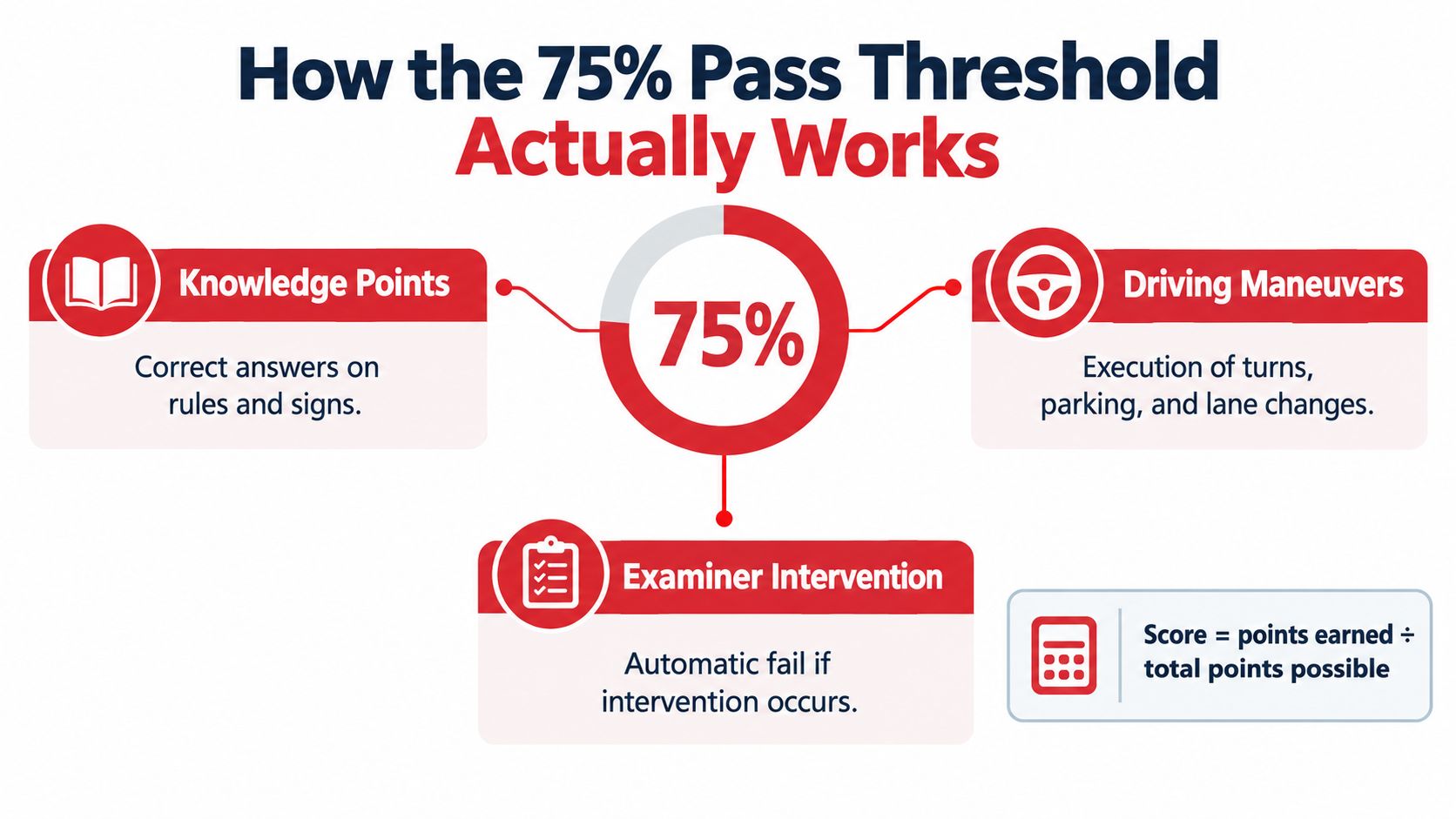
Knowledge testing and road-skills testing are distinct. The graphic's knowledge branch does not mean written-answer points are added to your Georgia road-test score. Its intervention label also does not replace the examiner rules that apply in Georgia.
A routine maneuver that looks awkward is different from a decision that creates a safety risk. Neat performance elsewhere does not cancel a serious safety failure.
After a practice drive or test, ask which category and specific behavior need attention. “Check your surroundings before backing” gives you something concrete to rehearse against the same kind of standard the examiner observes.
Each Scored Maneuver and Its Measurement
A parking space can look wide enough and still miss the target. Georgia DDS specifies a traditional parallel-parking space 22 feet long and 10 feet deep. The vehicle should finish midway between the standards and less than 18 inches from the curb. For backing, the requirement is approximately 50 feet, traveled slowly and smoothly while looking behind, according to the published maneuver requirements.
“Less than” gives you a clear limit, not a rough suggestion. During supervised practice, ask your instructor or supervising adult to measure the parked car's position after it is safely secured. That check shows whether your reference points work in the car you are driving.
Turn measurements into rehearsal targets
| Maneuver or behavior | What to make observable during practice |
|---|---|
| Parallel parking | Finish centered between the standards and close enough to the curb, using controlled steering and movement. |
| Backing | Look behind, keep a slow pace, and guide the car smoothly along its path. |
| Stopping | When required, stop before the pedestrian crosswalk. |
| Turnabouts | Check the area before changing direction, then control each forward or reverse movement. |
| Turns | Prepare before the corner, steer smoothly, and finish in the appropriate lane. |
| Lane position | Hold a steady position without drifting or making abrupt corrections. |
| Signals | Signal before moving so others can understand your intention. |
| Following distance | Leave room to respond without braking suddenly. |
| Vehicle control | Coordinate steering and pedals without sudden, unnecessary inputs. |
Use A-1's parallel parking step-by-step guide alongside supervised practice. The sequence can help you remember what to do, while your instructor checks the result the examiner can see: where the car ends up and how you control it.
A steering reference is useful only when it puts the car in the right position. If the car repeatedly ends up too far from the curb, adjust the reference rather than repeating it unchanged.
Practice the entire maneuver
Rehearse the approach, observation, positioning, and safe departure, not just the final movement. Each part gives your instructor a chance to check the same visible behaviors the examiner scores.
For example, a parking practice should include checking for approaching traffic before pulling out. During backing practice, check the area before the car moves, then continue looking behind as you travel. These habits make the maneuver a complete routine rather than a single steering exercise.
What Georgia, the UK, and California Agree On
A beautiful parking job can't make an unsafe traffic decision acceptable. Georgia, the United Kingdom, and California use different assessment structures, but their criteria share an important teaching principle: risk management matters alongside technical execution.
In the United Kingdom, a candidate may pass with no more than 15 ordinary driving faults, but must have zero serious or dangerous faults. Examiner intervention is separately recorded as an “examiner took action” event in the UK explanation of car driving-test results.
That allowance belongs to the UK system. It isn't a Georgia mistake budget, and you shouldn't apply it to your DDS test.
Understand the difference in severity
The British distinction is useful in plain language: a serious fault involves potential danger, while a dangerous fault involves actual danger. The assessment also considers observation, approach speed, positioning, lane discipline, control, following distance, and hesitation.
California's standardized driving-performance criteria similarly identify highly consequential errors involving examiner intervention, avoidable contact, driving over a curb or sidewalk, passing a school bus with flashing red lights, or failing to stop for an emergency vehicle.
| Assessment approach | What a Georgia learner can take from it |
|---|---|
| Georgia's threshold model | Prepare across the full range of maneuvers and driving behaviors. |
| The UK's fault categories | Distinguish an ordinary imperfection from an error that creates danger. |
| California's consequential errors | Recognize that other road users and lawful responses matter more than finishing a task neatly. |
Consider a hypothetical turn. You steer smoothly and finish in the intended lane, but enter while a pedestrian is crossing your path. The steering was tidy; the decision wasn't safe.
The opposite misunderstanding also matters. Waiting indefinitely when a clearly suitable opportunity exists doesn't necessarily demonstrate good judgment. Your instructor can help you distinguish patient observation from hesitation caused by uncertainty.
Instead of asking, “Did I complete the turn?” ask, “Did I check, choose an appropriate opportunity, and leave room for others?” That question prepares you for unfamiliar roads as well as the test route.
A Sample Scoring Checklist for the Car
A useful practice checklist records what happened, not how confident you felt. Have your parent or instructor complete it after the drive, when the car is parked. Don't ask them to read prompts while you're negotiating traffic.
This is a teaching checklist, not an official DDS scoring form. Use it to identify habits that need attention, rather than assign invented point values.
Check the car and the driver first
Before moving, adjust your seat and mirrors, secure your seat belt, and locate the controls you'll need. Use A-1's vehicle inspection checklist to organize the vehicle-preparation portion of practice.
Then review these observable actions:
- Lane changes and merging: Check mirrors, observe the blind spot, signal, select a suitable gap, and move without abrupt steering.
- Turns: Communicate early, manage approach speed, check the intersection, and finish in the appropriate lane.
- Stops: Bring the vehicle to a complete stop in the required position, then observe and yield before proceeding.
- Parking and backing: Check the surrounding area, control speed, and assess the finished position.
- General awareness: Monitor signs, pedestrians, traffic conditions, and available space ahead.
- Speed and control: Follow posted limits and adjust appropriately for school areas, residential streets, and changing conditions.
The following visual can serve as a reminder of observation, signaling, and stopping habits.
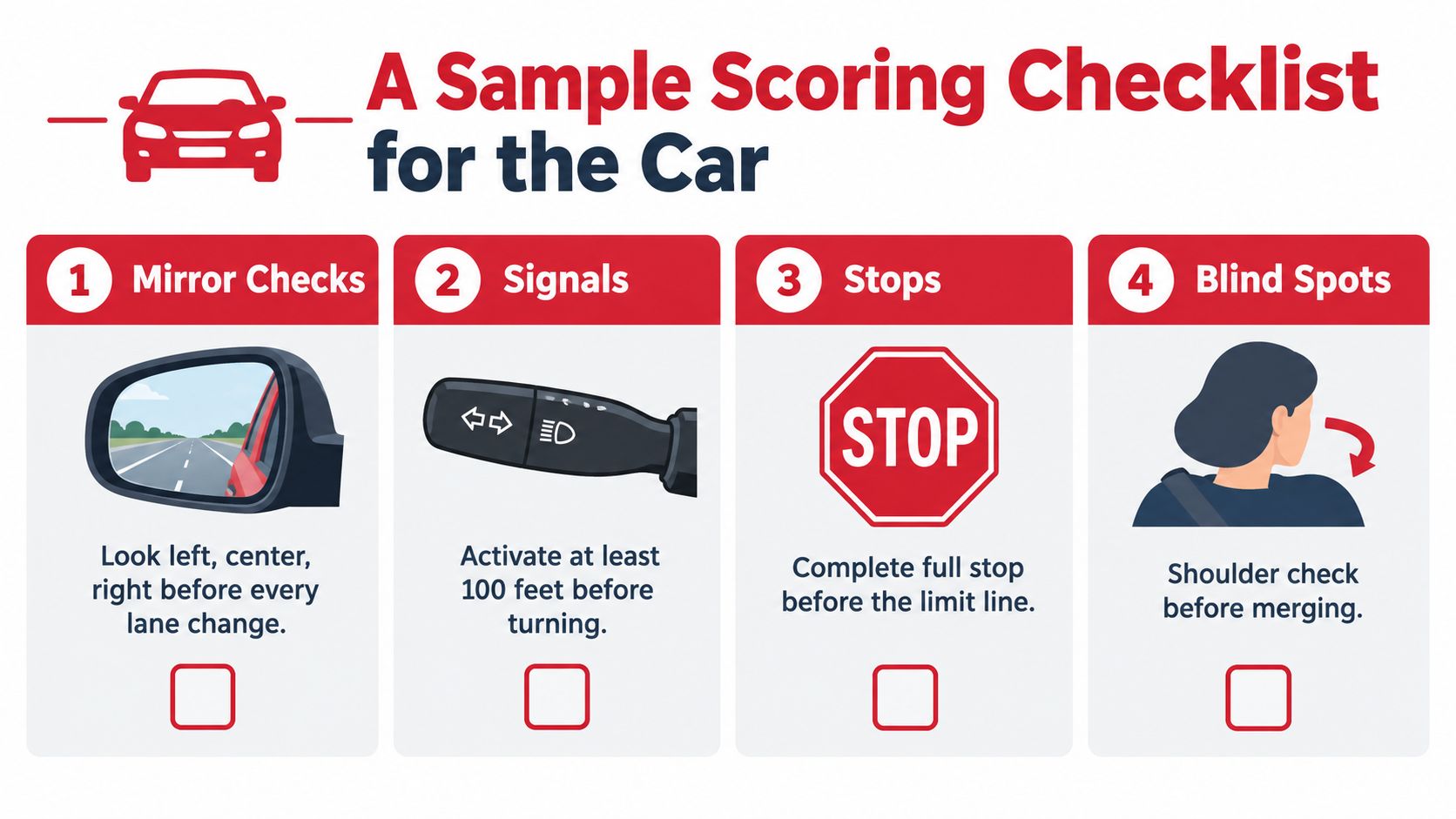
Treat the graphic as a practice aid, not the authoritative source for Georgia signaling distances or a universal mirror-check sequence. Follow current DDS guidance and your instructor's directions.
Record the cause, not just the error
Write “started braking after reaching the stop position” rather than “bad stop.” Write “checked mirrors but omitted the blind-spot observation” rather than “bad lane change.”
Those notes tell your instructor where to begin the next lesson. If the same error appears repeatedly, isolate that skill before adding more complex traffic situations.
A parent can also note whether the action happened independently or only after a reminder. Readiness means performing the behavior without coaching, not completing it correctly after someone supplies the missing step.
How Each Lesson Package Maps to the Rubric
A teen may know the right-of-way rule in class, then hesitate when a car approaches an intersection. Classroom instruction builds understanding; supervised lessons let students apply it while steering, observing traffic, and making decisions. A useful package connects both kinds of practice, rather than treating course completion as proof of road readiness.
Georgia's Joshua's Law applies to 16- and 17-year-olds seeking a Class D license. The standard instructor-led route requires 30 hours of classroom instruction, 6 hours of certified behind-the-wheel training, and 40 hours of supervised driving, including 6 at night, according to DDS Joshua's Law requirements.
Choose training by the skill you need
A-1 Driving School offers classroom and online Driver's Education, customized driving lessons, and road-test preparation and testing assistance. Families can review the school's training and course options and select instruction that matches the student's needs.
- Joshua's Law instruction: Use classroom or online learning to understand signs, right-of-way, and the reasons behind driving rules.
- Behind-the-wheel lessons: Practice applying those rules through turning, stopping, observation, positioning, and vehicle control.
- Additional lesson packages: Request focused practice for parking, lane changes, speed management, or another skill that is not yet consistent.
- Road-test preparation: Rehearse a full assessment without continual prompts, then use the results to choose what to practice next.
Ask what the package will accomplish
Review A-1's road-test lessons and preparation options and ask how lessons can address your assessment notes. Before booking, confirm arrangements for A-1-administered road testing, eligibility, and vehicle use.
For comparison, Lendrum's Driving School describes its driving lesson package options. Its UK packages are not Georgia licensing guidance, but they can help families ask clear questions about lesson structure.
Ask about the Georgia Driver's Education Scholarship Grant Program before paying for training. It may cover eligible training costs for qualifying students. Confirm current eligibility, covered services, and application arrangements rather than assuming a particular package is included.
Common Demerits and How to Stop Making Them
Errors worth targeting aren't always signs that you don't understand driving. Sometimes you know the correct action but haven't learned to perform it consistently while managing everything else.
The image below highlights the connection between observation and responding to road signs.

Replace vague corrections with a rehearsal task
These are useful patterns to address, not a ranked list of Georgia deductions:
- Rolling stops: Practice recognizing the vehicle's complete stop, then observe before proceeding. Don't substitute a hurried pause for stopped movement.
- Late or missing signals: Identify the upcoming maneuver sooner so signaling becomes part of preparation, not an afterthought.
- Incomplete observation: Rehearse mirror and blind-spot checks with a qualified instructor in an appropriate practice setting.
- Speed creep: Add brief speedometer checks while maintaining attention ahead, especially when the road feels wider or quieter.
- Wrong-lane finishes: Identify the intended exit lane before starting the turn and adjust your steering approach.
- Freezing after an error: Return attention to the road, maintain control, and respond safely to the next instruction.
Ask your A-1 instructor to isolate the behavior you're missing. Repeating an entire route may be less useful than practicing the relevant approach and decision until you can perform them without prompts.
Build consistency across different drives
A systematic review of on-road driving assessments identified 36 relevant articles and reported Washington/Rhode Island test inter-rater reliability values of 0.85–0.96, with test–retest correlations of 0.53–0.76. Explicit scoring can support examiner agreement, but performance can still vary between occasions.
That research doesn't prove a particular lesson package guarantees passing. It supports using specific observations and checking performance across separate drives.
Reset cue: Keep your attention on the next safe action, not on estimating whether the previous action cost you the test.
For an additional visual practice resource, review this video with your instructor and discuss how its demonstrations relate to current DDS expectations.
Your Path From First Lesson to the Pass Sheet
Start with your Instructional Permit and a training plan that combines education, professional instruction, and supervised practice. Don't leave all the maneuver work until the appointment is approaching.
A Georgia Class D applicant must be at least 16, have held an Instructional Permit for 1 year and 1 day, and arrive with a licensed accompanying driver who is at least 21, according to the DDS road-test appointment requirements. Applicants must also satisfy the training and supervised-driving requirements, bring the required Class D documents, and pass the vision and road-skills examinations.
Follow the sequence without confusing completion with readiness
Complete your Joshua's Law classroom or approved online instruction, arrange behind-the-wheel training, and continue supervised practice. Include the required nighttime experience rather than treating daytime familiarity as preparation for every condition.
Georgia permits approved online theoretical instruction and practical training through a certified instructor or the Parent/Teen Driving Guide. Its Driver Education FAQs explain that a driving log isn't required, but a parent, guardian, or qualifying certified instructor must affirm the supervised experience.
A personal practice record is still useful. Record the skill practiced and whether you performed it independently, so your next lesson has a clear purpose.
Use a final readiness checklist
- Confirm eligibility: Check your permit holding period, age, education completion, and supervised experience.
- Gather documents: Use the current DDS Class D document requirements instead of relying on someone else's appointment experience.
- Arrange accompaniment: Confirm that your licensed accompanying driver meets the state's requirement.
- Check the vehicle: Georgia's traditional test requires an applicant-supplied four-wheel vehicle. Clarify separate arrangements with your testing provider.
- Rehearse independently: Complete varied mock drives without coaching and without critical safety violations.
- Review funding: Ask whether the Georgia Driver's Education Scholarship Grant Program can cover eligible tuition before enrolling.
Set a practice benchmark stronger than merely scraping through. Look for repeated, independent performance in different conditions.
After the test, use the examiner's feedback as behavior-specific information. Passing is the licensing milestone; keeping those observation and control habits is the ongoing responsibility.
A-1 Driving School offers Joshua's Law Driver's Education, online and classroom course options, driving lesson packages, and road-test preparation and testing assistance. Visit A-1 Driving School to discuss the rubric skills you need to practice, choose suitable lessons, and ask about scholarship eligibility before booking.