
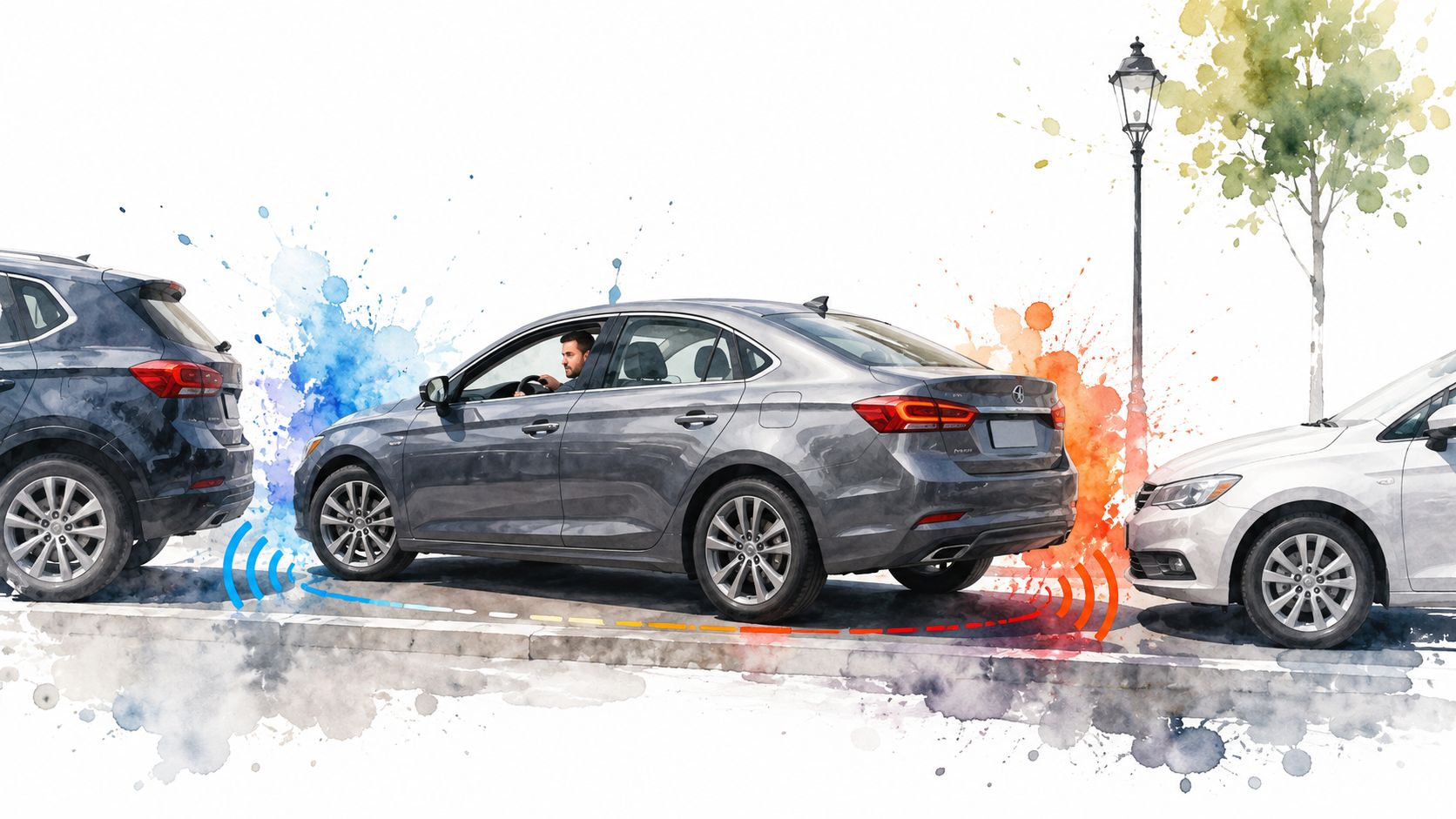
If you're reading this right before a lesson, a road test, or another practice session with a parent in the passenger seat, you're probably feeling the same thing most students feel. Parallel parking looks harder than it should. You have to judge space, control speed, turn at the right time, watch mirrors, and stay calm while traffic waits behind you.
That pressure is real. The good news is that parallel parking isn't a talent you're born with. It's a sequence. Once you learn the reference points and the timing, the move becomes repeatable.
This guide teaches parallel parking step by step with a Georgia road test focus. The goal isn't just to get the car into the space. The goal is to do it the way an examiner expects, with clean setup, steady control, and safe final positioning.
Why Parallel Parking Feels So Hard and How to Fix It
Parallel parking feels difficult because you're doing several jobs at once. You're steering in reverse, tracking two parked cars, judging your distance from the curb, and trying not to freeze when the angle changes. Most beginners don't fail because they can't drive. They struggle because they don't yet have a reliable pattern.
The fix is simple. Stop thinking of parallel parking as one giant move. Think of it as a short routine with clear checkpoints. When students break it into setup, first turn, straighten, and final turn, they stop guessing.
What usually confuses students
A few things trip people up again and again:
- They start in the wrong spot. If the car isn't lined up correctly before reversing, every step after that gets harder.
- They turn too early or too late. A small timing mistake changes the whole angle.
- They move too fast. Speed removes your ability to correct.
- They stare at only one mirror. Parallel parking works best when you check multiple reference points, not just the curb.
Practical rule: A good parallel park starts before the car goes into reverse.
That's why experienced instructors teach method before repetition. Random practice creates random results. Structured practice creates confidence.
The mindset that helps most
You don't need to force the car into the space. You guide it through a shape. That shape is an S-curve. Once you understand that path, the maneuver stops feeling mysterious.
If you get nervous, reduce the task. Say the steps out loud in your head: line up, turn in, straighten, turn in again, center. That kind of self-coaching keeps your attention on the process instead of on the pressure.
Slow and accurate beats fast and shaky every time on a road test.
Students often improve quickly once they stop trying to "wing it." A repeatable method is what turns parallel parking from a dreaded skill into a manageable one.
Setting Up for Success Before You Park
You spot an open space on test day, pull up too quickly, and suddenly the whole maneuver feels off. That usually starts with setup, not steering. At A-1 Driving School, we teach students to treat the setup like placing a puzzle piece before you slide it into position. If the starting position is clean, the car has room to follow the path you want.

Pick a space you can actually use
A space can look fine from a distance and still be a poor choice once you pull beside it. The easiest spaces give your car enough room to arc in without forcing sharp corrections. For the Georgia road test, that matters because examiners are watching control, positioning, and judgment. Choosing a workable space is part of the skill.
Use a quick visual test before you commit:
- Check the full opening. You want enough room for your car to fit without crowding the cars in front or behind.
- Notice how the parked cars are positioned. If one car is sticking far out from the curb, your entry gets tighter.
- Look at the curb line. A clean, visible curb makes it easier to judge your final position.
- Give yourself a little margin. A beginner-friendly space helps you focus on the method you practiced.
Students sometimes ask, "How big is big enough?" A simple rule is this: if the space looks tight before you even start, keep going. On a road test, forcing a difficult spot usually creates more errors than it proves skill.
For test prep, good parking starts before the maneuver even begins. Reviewing a simple Georgia vehicle inspection checklist before the test helps many students settle their nerves and feel more prepared once they get behind the wheel.
Line up the car the right way
This is the part many new drivers rush, and it costs them.
Pull up beside the car in front of the space and make your car parallel to it. Keep a modest side gap so you have room to turn in, but do not drift so far away that the car swings wide. The setup should feel calm and even, like two straight lines beside each other.
Use this checklist before you shift into reverse:
- Signal early. Show other drivers what you are doing.
- Pull up evenly beside the front car. Your car should be straight, not pointed toward the curb.
- Leave a small, comfortable side gap. Enough room to turn, not so much that you lose your angle.
- Pause and confirm your position. A two-second check here can save a messy correction later.
A good way to remember it is: signal, straighten, space, stop.
If you crowd the parked car, the back of your vehicle has no room to swing. If you start too far away, you will likely finish too far from the curb. Georgia test examiners notice both.
Set your mirrors before reversing
Mirrors give you reference points. They help you track the curb, the cars around you, and the shape your vehicle is making as it backs into the space. A student who uses mirrors well looks more controlled because they are more controlled.
Check them with purpose:
| What to check | Why it matters |
|---|---|
| Driver-side mirror | Helps you monitor your car's position alongside the front vehicle and check traffic |
| Passenger-side mirror | Helps you judge how close you are getting to the curb as the car settles in |
| Rear view | Helps you watch the space behind you and keep track of the rear corner of your vehicle |
Do one more thing before you move. Sit tall, slow your breathing, and cover the brake. That small reset helps many students avoid rushing the first few feet, which is where parking attempts often start to unravel.
At A-1 Driving School, we teach students to build the maneuver from reference points they can repeat under pressure. That is what helps on the Georgia road test. You are not hoping the car lands in the space. You are setting it up to go there correctly.
The A-1 Method A Step-by-Step Guide to the Maneuver
Once the setup is right, the maneuver becomes much more predictable. The method many instructors teach is the S-curve. You start straight, arc into the space, pause your turning to let the car travel back, then turn the other way to bring the front end in.
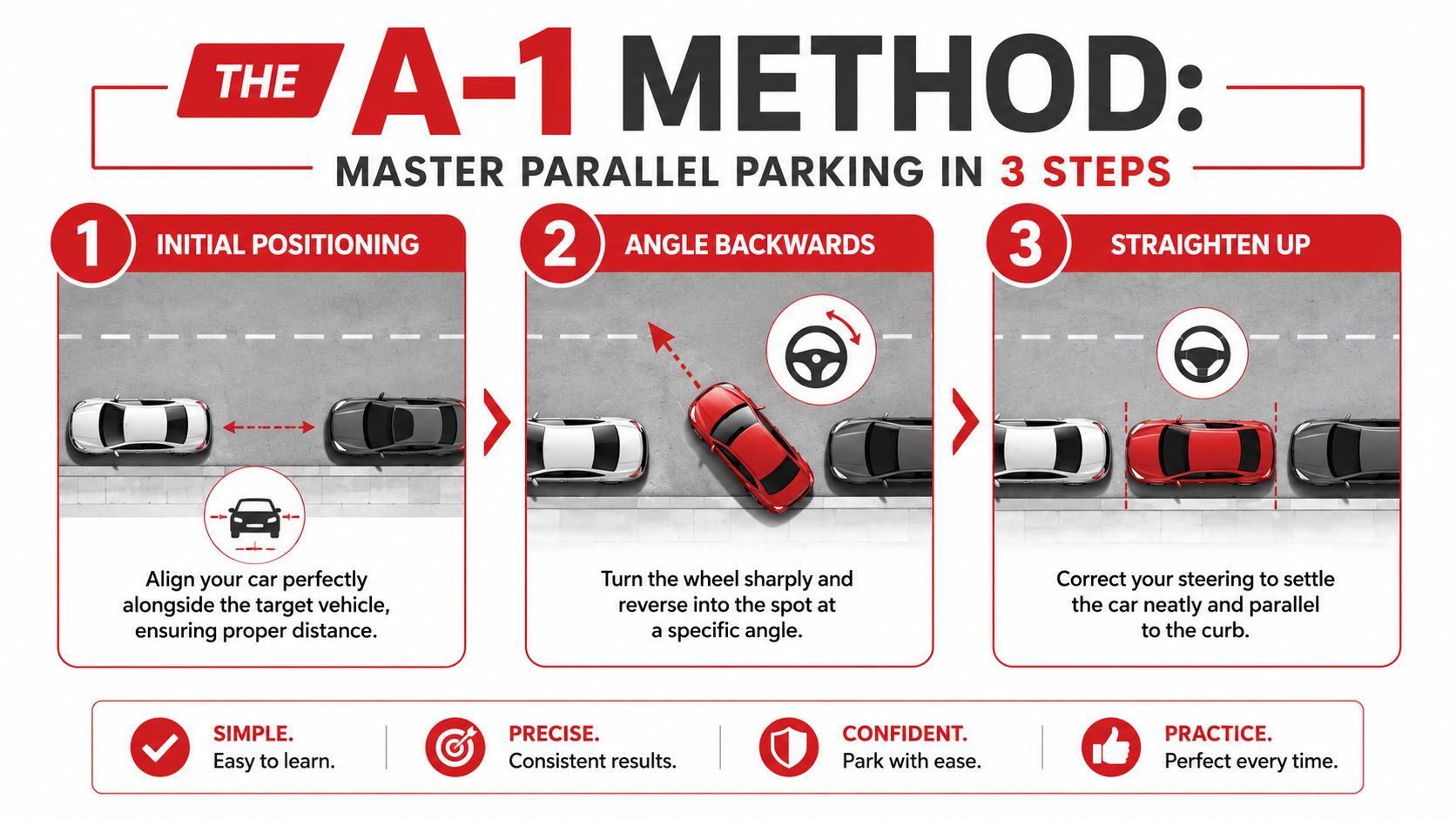
A commonly taught version of this technique says drivers should pull up 2 feet parallel to the front vehicle with rear bumpers aligned, then turn right and reverse until the car reaches a 45-degree angle toward the curb, then straighten and finally turn fully left to pivot into the space, as described in Central MA Safety's step-by-step guide.
Phase 1 get the car on the angle
Start with your foot covering the brake. Put the car in reverse and begin moving slowly. Turn the steering wheel to the right and let the back of the car enter the space.
What are you looking for? The car should begin pointing toward the curb at a clear diagonal. You're not trying to dive straight in. You're creating the first half of the S-shape.
Helpful cues:
- Keep reversing slowly. Slow movement gives you time to see the angle form.
- Watch your rear corner. It should move into the space without rushing toward the curb.
- Aim for a controlled diagonal. Too sharp and you'll crowd the curb. Too shallow and you won't clear the front car.
The first turn places the rear of the car. The second turn saves the front of the car.
Phase 2 straighten and continue back
Once you've reached the entry angle, straighten the wheel. This is the part many beginners miss. They keep turning too long, which makes the car fold in too sharply.
With the wheel straight, continue backing slowly. This lets the car move deeper into the space while keeping the body of the vehicle under control. Think of this phase as creating room for the front end to come around.
A lot of students improve quickly when they stop trying to force the whole maneuver with one turn. Parallel parking works because the steering changes in stages.
To stay aware of traffic and side movement during maneuvers like this, it helps to review how to check blind spots while driving. Those habits matter even at low speed.
Here's a short demo if you learn best by watching the wheel and vehicle path in motion.
Phase 3 bring the front end in and finish
Now turn the wheel left and continue reversing. This pivots the front of the car into the space and brings you parallel to the curb. Keep the speed low and watch both mirrors.
Your passenger-side mirror becomes especially useful here because it helps you judge your curb distance. The car should settle into the space, not snap into it.
Use this finishing checklist:
- Turn left smoothly. Don't jerk the wheel.
- Watch the front corner. Make sure it clears the car in front.
- Track your curb distance. You want a neat final position, not a diagonal stop.
- Center the car in the space. Leave room in front and behind.
A simple way to remember it
If your mind goes blank during the test, remember this sequence:
| Phase | What you do | What it accomplishes |
|---|---|---|
| Angle in | Turn right while reversing | Moves the rear of the car into the space |
| Slide back | Straighten the wheel | Creates room and controls position |
| Tuck in | Turn left while reversing | Brings the front end in and straightens the car |
That's the core of parallel parking step by step. Not magic. Just timing, angle, and patience.
Common Parallel Parking Mistakes and Quick Fixes
Most bad parallel parks don't come from one huge mistake. They come from one small error at the beginning that grows as the car moves. That's good news, because small errors are usually fixable.
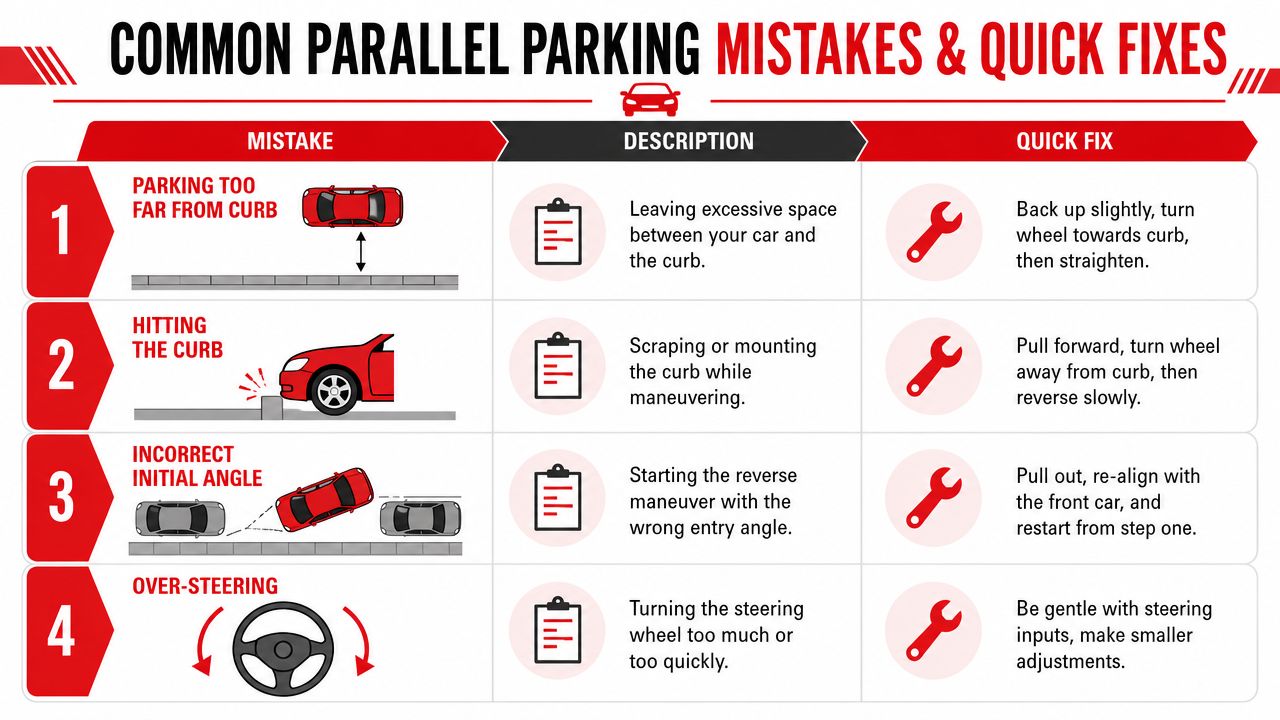
Structured teaching matters here. Reported success rates rise from 45% in novice learners to 92% after structured training, with common pitfalls including reversing too slowly, linked to 30% of curb collisions, and misaligning mirrors initially, linked to 25% of failures, according to this driving instructor report in the Mirror.
Mistake one you hit the curb
This usually means you turned too sharply, too early, or kept turning too long during the first phase. It can also happen when you stop checking the passenger-side mirror near the end.
Try this fix:
- Pull forward a little. Give the car room to reset its angle.
- Turn the wheel away from the curb. This moves the tires off the curb line.
- Reverse slowly again. Use smaller steering input than before.
Students often think hitting the curb means the attempt is over. It doesn't. A calm correction is better than panic.
Mistake two you're too far from the curb
This is one of the most common test-day problems. Usually the cause is an overly wide setup or a shallow first turn. If you start too far from the parked car, your final position often stays too wide.
A quick correction can help:
- Back up slightly if space allows.
- Turn the wheel toward the curb.
- Straighten once the car moves closer.
A car that finishes too far from the curb usually started too far from the parked car.
If that doesn't solve it, it's often faster to pull out, line up correctly, and restart rather than making a series of messy adjustments.
Mistake three you're crooked in the space
Sometimes the car gets in the space but doesn't end up parallel. The rear may be too close while the front sticks out, or the opposite happens. That usually means the middle phase was rushed or skipped.
Look for these signs:
- Front end still angled out. You probably didn't turn left soon enough in the final phase.
- Rear too deep, front not in. You may have reversed too far before beginning the final turn.
- Vehicle sitting diagonal. The steering wasn't straightened at the right moment.
A correction table makes this easier to remember:
| Problem | Likely cause | Quick response |
|---|---|---|
| Rear too close to curb | First turn was too aggressive | Pull forward and reduce steering input |
| Front sticks out | Final turn happened too late | Reverse slowly and turn left sooner |
| Whole car sits wide | Setup was too far from parked car | Restart with a tighter lineup |
Mistake four you freeze and overthink
This one isn't mechanical, but it affects everything. A hesitant driver sometimes creeps so slowly that the steering changes stop matching the vehicle movement. That can throw off the angle and create curb trouble.
When that happens, simplify the task. Stop. Breathe. Check mirrors. Then make one correction, not five.
Clean parallel parking doesn't come from perfect instincts. It comes from clear decisions made one at a time.
Ace Your Georgia Road Test Parallel Parking Tips
On test day, parallel parking feels different. The space can look smaller, your hands can feel quicker than your brain, and one small mistake can seem bigger than it is. What helps is knowing exactly what the examiner is watching for in Georgia, then practicing that standard until it feels familiar.
A-1 instructors teach students to treat the maneuver like a checklist, not a guess. The examiner is not looking for a fancy move. The examiner wants a safe setup, steady control while backing, good observation, and a final position close enough to the curb to show accuracy without touching it. If your car ends up reasonably straight and properly placed, you are doing the job the test is designed to measure.
What examiners usually want to see
Road test scoring usually rewards the same habits your instructor asks for in practice:
- A clear, safe setup. You signal, position the car correctly, and begin with control.
- Continuous observation. You check mirrors, look over your shoulder, and stay aware of the space around the vehicle.
- Slow, steady backing. Your speed stays calm enough that each steering change has a purpose.
- Timely steering corrections. You turn, straighten, and finish the maneuver at the right moments.
- A proper finish. The vehicle is close to the curb, inside the space, and straight enough to show control.
That last point confuses many students. "Close to the curb" does not mean "scraping the curb." A good target is neat and controlled. If you can park close without contact, you are showing the kind of accuracy examiners want.
Practice for the Georgia test standard
Georgia students often prepare for two things at once. They need to meet the state education requirement, and they need to perform the driving skills well under pressure. For teen drivers, all 16- and 17-year-olds must complete a DDS-approved 30-hour Driver's Education course before applying for a Class D license, whether the course is online or in person, according to this Joshua's Law overview for Georgia teens.
The classroom part covers rules and decision-making. The parking part is different. It improves through repetition, feedback, and clear reference points. That is the A-1 angle. Students are taught where to look, when to turn, and how to judge the car's position the way Georgia test prep should be taught, with test-day scoring in mind, not just general parking advice.
If you want a clear picture of what examiners expect beyond parking, Georgia road test tips from A-1 Driving School can help you prepare for the full testing experience.
Choose the kind of help you actually need
Some students need to satisfy Joshua's Law. Some already have that covered and need more time behind the wheel. Others are close to ready but want a few sessions focused on parallel parking, turns, lane changes, and test-day routines.
This breakdown makes the choices easier:
| Need | Useful training option |
|---|---|
| Joshua's Law requirement | DDS-approved Driver's Education course, online or in person |
| Parallel parking confidence | Driving lessons with repeated parking practice |
| Road test familiarity | Road test prep and testing support |
| Lower training cost | Georgia Driver's Education Scholarship Grant Program, if eligible |
For many families, cost matters. The scholarship program can make formal driver training easier to access.
If parallel parking is the one part of the test that keeps bothering you, focused practice with feedback usually helps faster than repeating the same mistake alone.
From Practice to Perfection Drills and Final Tips
Parallel parking becomes dependable when your hands and eyes learn the pattern together. That's why short, focused drills work better than one long session where everything starts to blur.
Practice drills that actually help
Try practicing in an empty lot with cones, bins, or other soft markers. Set up a pretend curb line and two "cars" so you can repeat the same maneuver several times without traffic pressure.
Useful drills include:
- Same setup, repeated five times. Practice only the lineup and first turn.
- Middle-phase drill. Start from the diagonal position and work on straightening at the right moment.
- Finish-position drill. Focus only on ending straight and close to the curb.
- Different space sizes. Once the motion feels familiar, try tighter and roomier spaces so you don't depend on one exact layout.
Practicing on quiet streets later is helpful, but the lot drill builds the muscle memory first.
Don't forget the exit
A lot of guides teach how to get into the spot and then stop there. That's incomplete. One safety point often missed is checking mirrors and blind spots before opening the door after parking. That omission is linked to 18% of side-door collision incidents in urban parking zones, based on a 28-month analysis of Georgia DMV crash data discussed in this article on parking safety blind spots.
That reminder matters for the test and for everyday driving. Before you open the door or pull out again, check around you. Look for traffic, bikes, and pedestrians. Then signal and leave the space with the same control you used to enter it.
Final reminders to keep in your head
- Go slowly enough to think.
- Use reference points, not guesses.
- If the setup is bad, restart.
- Finish straight, centered, and close to the curb.
Confidence doesn't come from hoping. It comes from repetition with good habits.
If you want more guided practice with parking, road test prep, Joshua's Law Driver's Education, online course options in Georgia, or help exploring driving lesson packages and the Georgia Driver's Education Scholarship Grant Program, visit A-1 Driving School.