

Could you pass a defensive driving course exam and still miss the result you needed? Yes. A passing result doesn't automatically resolve a citation, remove existing points, restore a license, or qualify a teen for a road test.
Start with the outcome you want. For a new Georgia driver, the right choice may be Joshua's Law Driver's Education and driving lessons, not a defensive driving class.
What the Defensive Driving Course Exam Really Measures
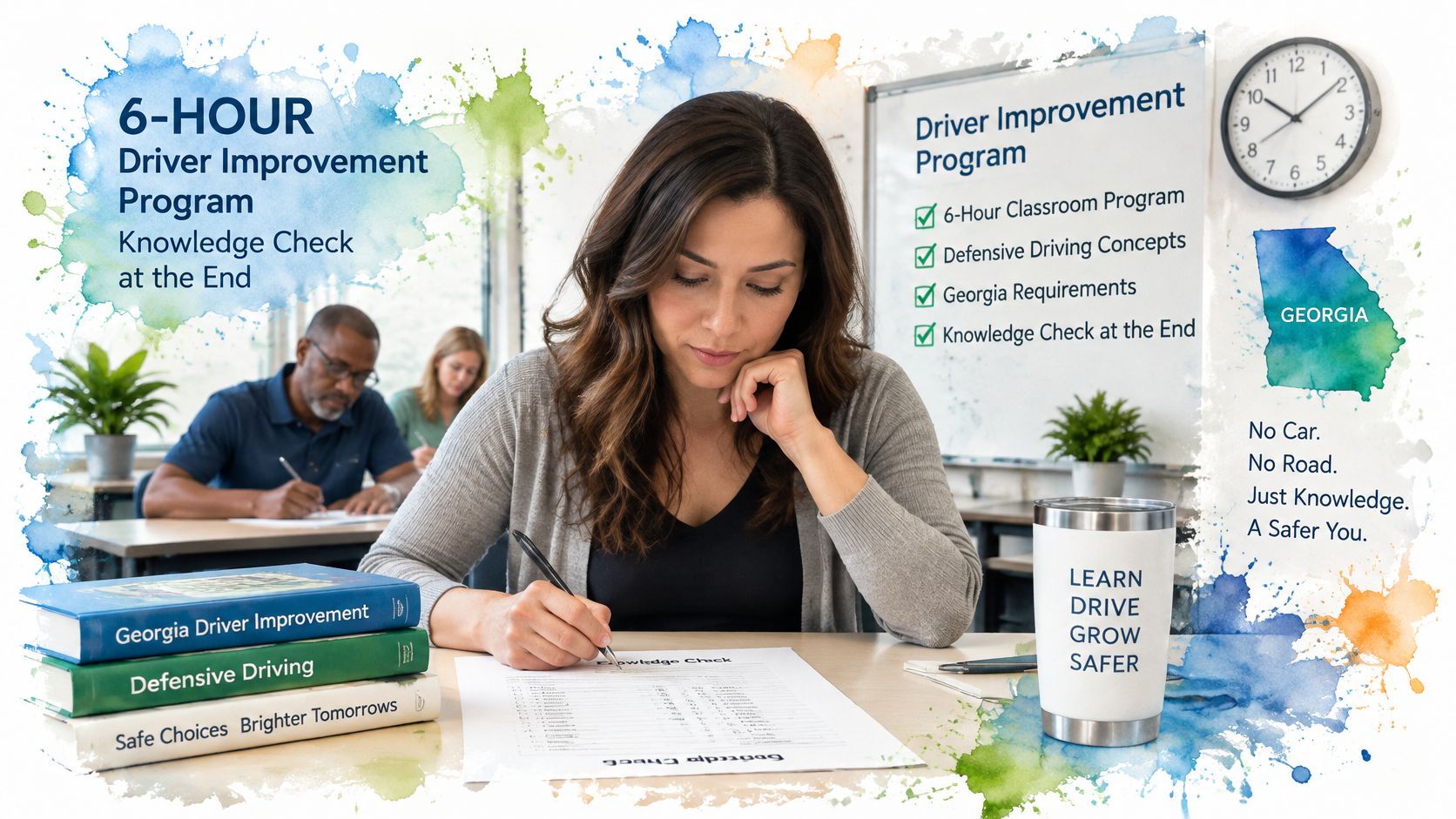
In Georgia, the defensive driving course exam is a knowledge check within a six-hour Driver Improvement program, not a driving test. The Georgia Department of Driver Services Driver Improvement guide describes approved instruction as classroom-only, without practical or behind-the-wheel training.
Think of the course as a pre-flight safety briefing that ends with a quiz. The road test is the flight itself: you must demonstrate what you can do, not just explain the safest choice.
Drivers commonly enroll because of a citation, existing points, a reinstatement requirement, or an insurance goal. That purpose determines which approval and paperwork matter after completion.
The classroom setting reflects the kind of assessment you're preparing for.
Which course or test applies in Georgia
| Program or test | Who needs it | Where it happens | Behind-the-wheel practice |
|---|---|---|---|
| Defensive driving course (Driver Improvement) | Drivers with a citation, points to reduce, a reinstatement requirement, or an insurance goal | Six-hour classroom course at a DDS-certified provider; confirm acceptance of in-person or online delivery | No |
| Joshua's Law driver's education | Georgia teens working toward a Class D license | Approved classroom or certified online instruction, followed by practical training | Yes, through a certified school or an approved parent-taught route |
| Class D road test | Teen applicants who have met permit, education, and supervised-driving rules | Georgia DDS or an authorized driving-school testing program | Yes, the test itself, rather than a practice lesson |
Knowledge and vehicle control are different skills
For the classroom exam, practice recognizing hazards, applying traffic rules, and choosing a lower-risk response. For driving lessons, practice steering, braking, observation, positioning, and making decisions while the vehicle is moving.
Practical rule: A course certificate proves completion of a particular program. It isn't a driver's license or proof that every licensing requirement has been met.
Exam Format, Time Limits and Proctoring in Georgia
The classroom-only rule tells you what this exam isn't: it isn't an instructor grading your parallel parking or lane changes. It doesn't establish a universal question count, passing score, or retake policy.
Before paying, ask the provider for its current exam rules in writing. Don't assume that an online practice quiz describes the assessment you'll take.
Georgia defensive driving exam delivery at a glance
| Feature | Georgia defensive driving course | What to confirm |
|---|---|---|
| Course length | Six hours | DDS program requirement |
| Instruction type | Classroom instruction only, no behind-the-wheel training | DDS program requirement |
| Delivery mode | In person or online through a DDS-certified provider, subject to acceptance | Provider's certification and approval for the delivery offered |
| Passing score | Obtain the current required score before enrolling | Provider or DDS |
| Number of questions | Obtain the current exam question count | Provider |
| Time limit | Request the written assessment timing rules | Provider |
| Proctoring for online sessions | Ask how attendance and identity are verified | Provider's identity and time-on-task checks |
| Retake policy | Request the rules for another attempt, including any charge | Provider |
| Proof of completion | Original completion certificate | Whether the court, DDS, or insurer accepts it |
“Online” isn't a complete description of a course. Ask whether you must attend a live session, use a camera, show identification, or complete attendance checks. Those are questions to resolve, not features to assume.
Also distinguish the class schedule from the exam time limit. A provider may have separate procedures for attendance, breaks, technical interruptions, and assessment completion.
Questions to ask before paying
- Certification: Is this exact program currently DDS-certified for my purpose?
- Delivery: Is the advertised online option accepted by the agency handling my case?
- Assessment: Can you send the passing requirement, timing rules, and retake policy?
- Documentation: When will I receive the certificate, and how is it delivered?
- Acceptance: Should I obtain approval from my court, DDS, or insurer before enrolling?
Save the answers with your registration confirmation. If the provider can't explain a requirement clearly, resolve it before you commit to a class or make plans around a completion date.
Topics the Exam Tests and What Each One Looks Like
Prepare to explain why an action is safer, not just identify a familiar phrase. The following are practice scenarios, not quoted exam items; the provider determines the actual assessment wording and question count.
Start with the conflict, not the answer choices
- Hazard perception: A car ahead brakes suddenly on a wet, multilane road. The conflict is rapid slowing with reduced grip; the exposure includes vehicles beside and behind you. Ease off early, brake progressively as needed, and maintain control. Don't swerve into a lane you haven't checked or delay necessary braking because you're searching for an escape.
- Risk recognition: You're waiting to turn left across oncoming traffic at dusk. An approaching vehicle's speed is difficult to judge, and glare reduces visibility. Waiting for a clearly safe gap is better than treating uncertainty as permission to turn.
- Traffic-law application: You approach an intersection where another driver signals for you to proceed. Check signs, signals, pedestrians, and conflicting traffic yourself. A friendly wave doesn't establish that every movement is safe or lawful.
- Defensive decision-making: A vehicle stays close behind while you're approaching an exit. Avoid accelerating into an unsafe gap or braking to punish the other driver. Keep your movements predictable and create space ahead.
- Behavioral countermeasures: You're stopped at a red light and reach for your phone. Your attention shifts away from pedestrians, cyclists, and changing traffic. Put the phone away before moving, rather than trying to finish the message as the light changes.
The same reasoning applies when a question involves speeding, impairment, or following too closely. Identify what reduces your ability to see, decide, or respond, then choose the action that preserves a safety margin.
Explain why the tempting answer fails
A rushed answer often solves only the most obvious problem. Swerving may avoid the braking vehicle ahead but create a collision with a vehicle beside you. Accelerating through a doubtful turn may shorten your time in the intersection while making the consequences of a mistake worse.
The IPDE process gives you a useful vocabulary for organizing these decisions: identify, predict, decide, and execute. Use it to explain your reasoning rather than memorize a slogan.
The safest answer accounts for the surrounding traffic, not just the vehicle directly ahead.
Prioritize judgment and traffic-law application over memorizing fine amounts or rule numbers. Your course materials remain the guide to the provider's specific assessment.
How to Study for the Exam Step by Step
Study actively. Reading a paragraph until it feels familiar isn't the same as being able to apply it when a question changes the road conditions or adds another vehicle.
Use the course notes, a notebook, and any practice material your provider supplies. Keep unofficial quizzes separate so you don't mistake their wording or scoring for your provider's rules.
Build a repeatable study routine
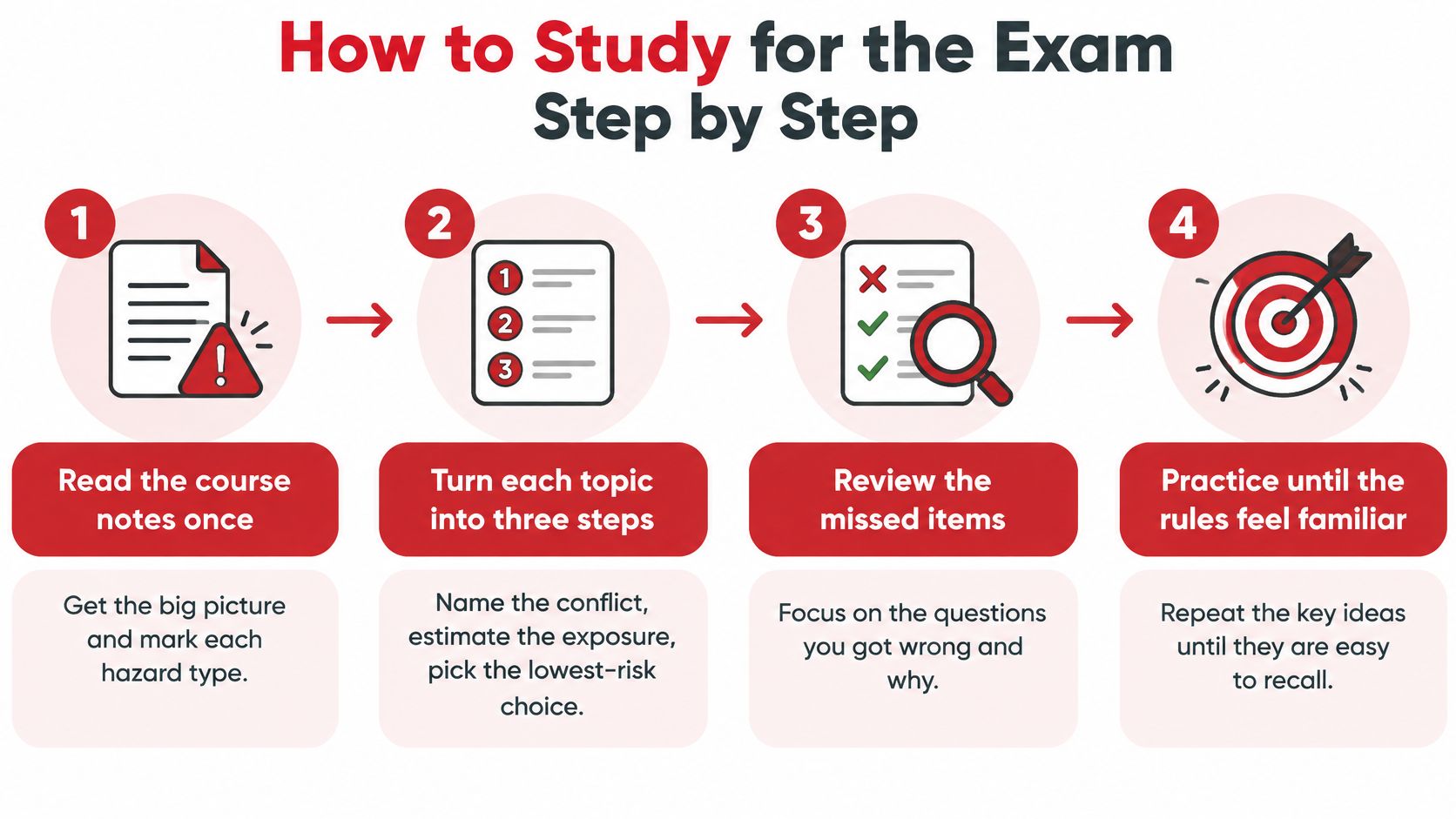
Read the course notes for the big picture. Mark hazard types such as limited visibility, reduced traction, distraction, and crowded intersections. Connect each topic to a decision a driver must make.
Turn each topic into a decision sequence. Name the conflict, estimate your exposure, and select the lowest-risk response. For example, a blocked view at an intersection calls for better observation and a safe position, not a faster entry.
Explain the wrong options aloud. Say what could happen if you choose each alternative. “This puts me into an unchecked lane” is a stronger explanation than “that answer sounds wrong.”
Review traffic-law applications. Focus on right of way, signaling, following space, and speed appropriate for conditions. Separate what you must legally do from an additional precaution that helps you avoid a collision.
Use a provider practice set if available. Follow its timing instructions and record recurring mistakes by topic. If you repeatedly miss intersection questions, review the underlying rule instead of memorizing answer positions.
Confirm the practical arrangements before class. Check the start time, delivery mode, identification requirements, and any proctoring steps. For online attendance, test the equipment the provider says you'll need.
Keep the routine simple enough to repeat.
Avoid the most common study traps
Don't substitute memorized penalties for an understanding of safe choices. Don't choose an answer merely because it gets the driver through the situation fastest, and don't skip reviewing questions you answered correctly by guessing.
A useful notebook entry has a topic, your mistaken reasoning, and the safer principle. For a wet-road question, that might be: “I focused on getting around the stopped traffic; I needed to preserve traction and check adjacent space.”
For teens, keep exam preparation separate from practical training. Being able to describe a mirror check doesn't mean you've developed the habit of checking without drifting out of position.
A-1 Driving School offers DDS-approved defensive driving classes in person and online. Confirm current delivery options and assessment procedures directly rather than assuming a particular passing score, exam format, or retake arrangement.
Using Your Passing Certificate the Right Way
Passing isn't the finish line. The agency receiving your certificate decides whether you've completed the steps required for your intended result.
For a moving-violation case, the Georgia DDS defensive driving FAQs describe a possible 20% fine reduction and no points assessed, subject to the court process; for existing points, they allow up to seven points removed once every five years, with the original certificate submitted to DDS in person or by mail, and state that Driver Improvement records are retained for only three years.
Where the passing certificate goes, by purpose
| Purpose | What to submit | Who receives it | Key limit or deadline |
|---|---|---|---|
| Court or citation | Original completion certificate | The court | Court deadline may come before the DDS deadline; fine reduction and no points are possible, subject to the court process |
| Point reduction | Original completion certificate | DDS, in person or by mail | Subject to the point-reduction allowance and frequency restriction |
| License reinstatement | Certificate, as DDS instructs | DDS | Confirm your specific reinstatement requirements and submission steps |
| Insurance premium reduction | Certificate, as the insurer requires | The insurer | Insurer decides eligibility, not DDS |
For a citation, ask the court clerk how to submit the original and whether you must still attend the hearing. Completing a course doesn't authorize you to ignore a court date.
For existing points, distinguish preventing new points from removing points already recorded. The guide to reducing points on a license can help you organize the questions to take to DDS, but the court's handling of a citation and DDS point reduction are separate processes.
For reinstatement, request your individual requirements directly from DDS. A course certificate may satisfy a requirement without completing every condition needed to restore driving privileges.
For insurance, contact the insurer before enrolling. Ask whether it accepts the course, whose policy eligibility matters, and what documentation it needs; DDS doesn't award the discount.
Protect the document and track the handoff
- Keep a copy: Scan the certificate before submitting the original.
- Record the destination: Note the court, DDS office, or insurer receiving it.
- Confirm receipt: Keep mailing evidence or a submission acknowledgment.
- Verify the outcome: Check that the agency processed the intended request.
Keep your own course records. Don't assume a future replacement will be readily available.
Say your court date is approaching and you also want existing points reduced. Handle the court submission first if its deadline is earlier, then check the DDS process separately. If both recipients require an original, ask how to obtain acceptable documentation before sending away your only original.
Joshua's Law Is a Different Path for Teen Drivers
A defensive driving course doesn't fulfill Joshua's Law. A teen preparing for a Class D license needs approved driver's education, practical training, supervised experience, and the required licensing examinations.
Families should settle that distinction before choosing a course.
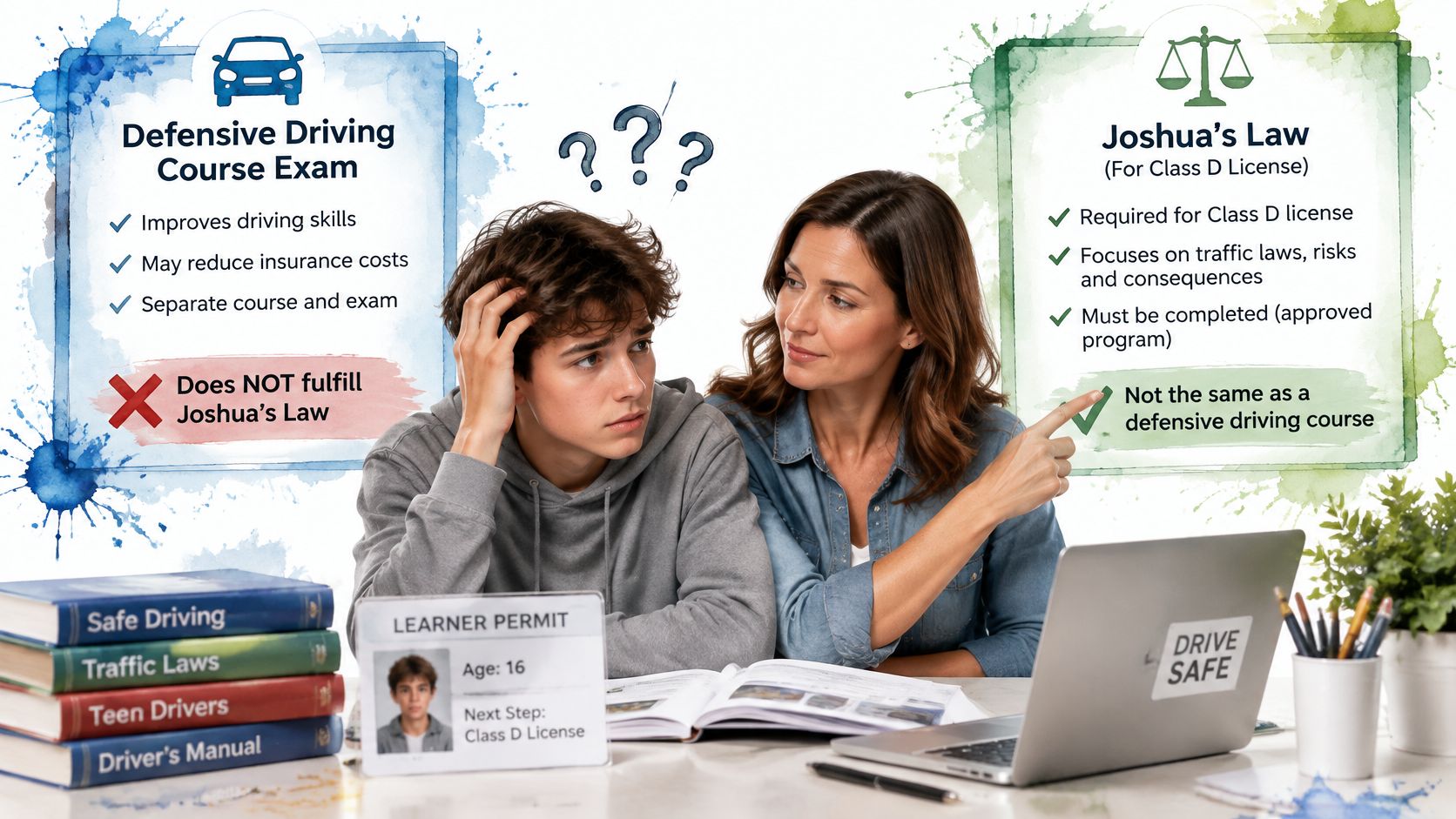
The Georgia DDS Joshua's Law requirements describe the pathway for 16-year-olds: 30 hours of approved instruction, six hours of school-based behind-the-wheel training or the permitted parent-taught alternative, and 40 hours of supervised driving including at least six nighttime hours; the permit must be held for one year and one day.
Joshua's Law requirements by pathway
| Requirement | Standard school pathway | Online pathway |
|---|---|---|
| Driver education course | 30 hours of classroom instruction | 30 hours through a certified virtual program |
| Behind-the-wheel training | 6 hours with a certified school | 6 hours with a certified school, or parent-taught |
| Supervised driving | 40 hours, including at least 6 at night | 40 hours, including at least 6 at night; confirm documentation for the parent-taught route |
| Learner's permit | Held for 1 year and 1 day | Held for 1 year and 1 day |
The permit is also required before behind-the-wheel instruction begins. Use the Joshua's Law requirements guide to organize your questions, then confirm the selected pathway and paperwork with the school or DDS.
Why driving lessons deserve their own plan
Online instruction can fit around school and family commitments, but it doesn't provide physical practice. During driving lessons, an instructor can identify late braking, inconsistent observation, poor lane positioning, or difficulty judging a turn.
Choose driving lesson packages around the learner's needs, not just course completion. Ask whether lessons can progress from quiet streets to intersections, lane changes, and road-test preparation, with clear feedback for home practice.
A-1 Driving School offers customized teen driving lessons and lesson packages and holds the Fulton County Board of Education contract for Driver's Education across Fulton County Schools. The Georgia Driver's Education Scholarship Grant Program may help eligible families; confirm current eligibility, funding availability, covered training, and application steps before booking.
Use this video as another starting point for a family discussion about training.
When comparing packages, ask what is included, how pickup works, how instructors report progress, and whether road-test preparation is separate. Explore Driver's Education and driving lesson packages with those questions ready, and request current pricing directly.
Confirm the Right Course Before You Enroll
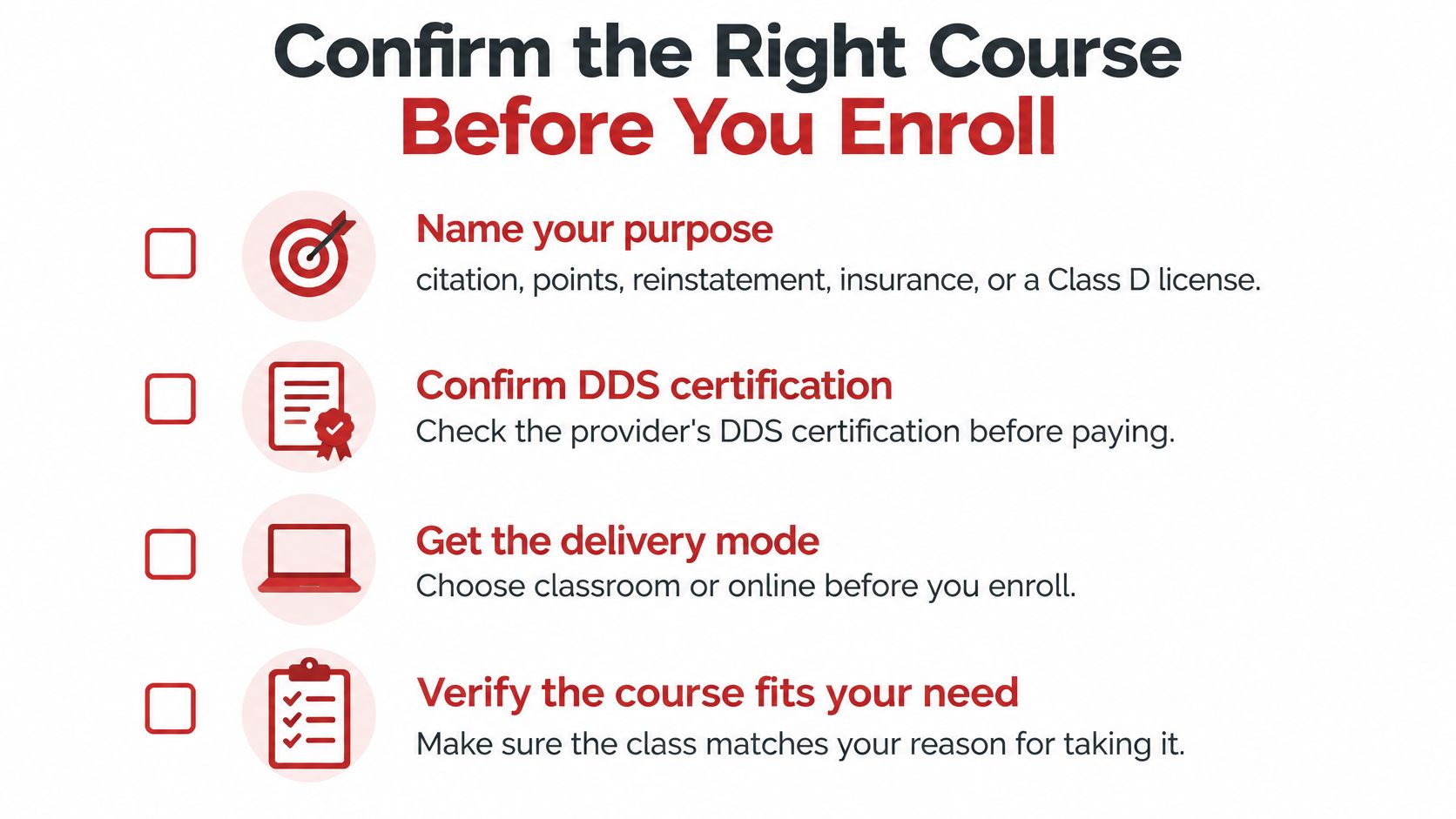
What do you need the course to accomplish? A passing exam is not automatically the legal or financial result you want. A course for a citation, points, reinstatement, or an insurance discount may have different acceptance rules than driver's education for a Class D license. Confirm the purpose first, then check that the provider and program fit it.
- Name your purpose. Identify whether you need to address a citation, existing points, reinstatement, insurance, or a Class D license.
- Check DDS certification. Verify that the specific program meets the requirement before paying.
- Get the rules in writing. Confirm the delivery format, passing requirements, timing, and any proctoring procedures.
- Ask about deadlines. The court and DDS may have separate submission requirements. Confirm each directly.
- Protect your certificate. Make a copy and ask where the original must go.
Treat the certificate like a key: it only opens the door it was issued for. Keep a final checklist before registering.
Prepare for the practical test separately
For a teen applicant, plan driver's education, instructor-led training, and supervised practice before choosing a test date. Ask the school to assess readiness, not just whether the training calendar is complete.
The Georgia DDS road-test guide lists requirements including a valid learner's permit, applicable Joshua's Law completion, and an affidavit documenting 40 supervised hours, including six at night. It also specifies a 75% minimum passing score, a four-wheel vehicle with valid registration and a license plate, and an accompanying licensed driver aged 21 or older. During the test, only the applicant and that driver may be in the vehicle.
Certain temporary dealer tags also require proof of purchase. Before traveling, confirm vehicle and appointment instructions, including the testing site's procedure for accompanying drivers.
Book training that addresses the remaining gap
A-1 offers road-test preparation, road testing, and testing assistance. Confirm eligibility, appointment availability, and required documents directly. If the learner still needs frequent prompts about observation or positioning, ask about additional driving lessons rather than using the test as another practice session.
Ask A-1 whether its Scholarship Grant Program applies to the training you're considering, and confirm eligibility before purchasing. Then verify the provider and book the first step that matches your purpose.
A-1 offers classroom and online Driver's Education, customized teen and adult driving lessons, lesson packages, and road-test preparation and testing assistance. Visit A-1 Driving School to enroll online, explore multiple time slots at 18+ locations including Athens, and ask about scholarship eligibility and a lesson package for your next step.