
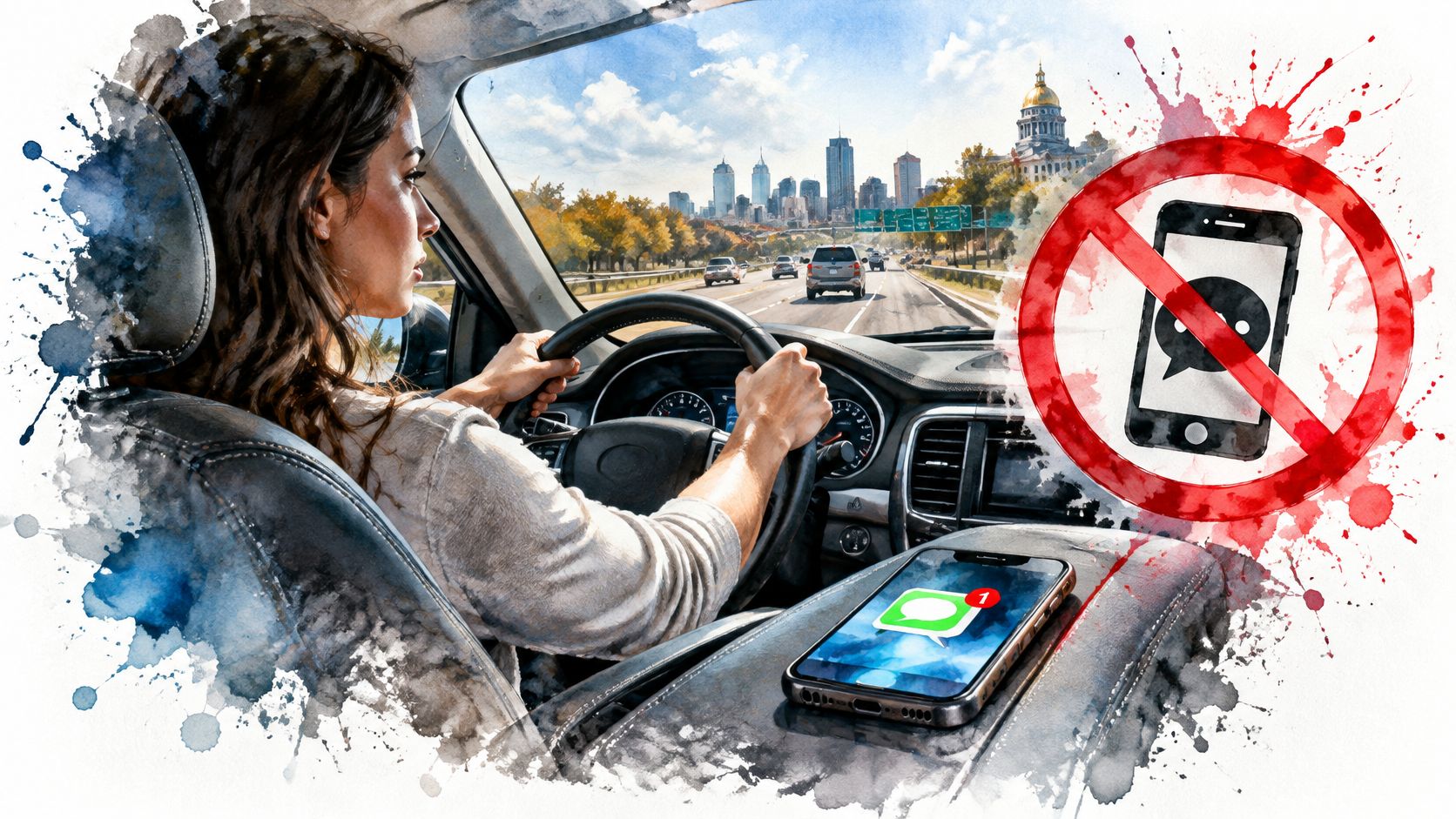
Yes, texting while driving is illegal in Georgia. Drivers may not hold a phone or type, read, or send messages while the vehicle is in traffic, and that includes a stop at a red light.
The risk is larger than a quick look suggests. Analysis of the SHRP2 naturalistic-driving dataset found texting associated with a crash odds ratio of 6.1 compared with baseline driving, and simulator research summarized by NHTSA found that texting drivers can spend up to 400% more time looking away from the roadway. A message, a map change, and a notification all do the same thing. They take a hand, your eyes, and your attention at once.
For a new Georgia driver, don't drive and text is a habit you practice the way you practice a lane change. It also belongs inside the Joshua's Law path that leads to a Class D license, not in a one-time warning.
Georgia's Phone Rules for Drivers at a Glance
Georgia bans texting for every driver. The Hands-Free Law goes further. You may not hold a phone, and you may not type, read, or send a message while the vehicle is in traffic. Stopped at a red light still counts as driving.
Other states write the same idea in their own statutes. The Law Office of Bryan Fagan's guide is a clear walk-through of a handheld ban in Texas, which helps you see why "I'll just hold it for a second" fails in more than one state. On a Georgia road, Georgia's rule is the one that applies. Lawmakers have also moved to close gaps drivers used as excuses, which is why the vote to close a distracted-driving loophole matters to anyone who thought a pause in traffic made the phone legal.
| Phone use while driving | Status in Georgia | Safe alternative |
|---|---|---|
| Reading or typing a text | Prohibited | Pull into a legal, safe spot or let a passenger handle it |
| Holding a phone to the ear for a call | Prohibited | Use a single-touch call through Bluetooth or a mount |
| Handheld use at a red light | Prohibited | Keep the phone out of reach until parked |
| Voice-to-text dictation | Permitted | Keep it brief, since dictation still draws attention |
| Single-touch or voice-activated navigation | Permitted | Set the destination before you start driving |
| Phone use in a legally parked vehicle | Permitted | Stop out of traffic before messaging |
| Provisional license under age 18 | Stricter limits | Confirm current DDS rules before driving |
A mounted, single-touch call or a voice prompt can be legal. Holding the phone, scrolling, or typing is not. Dictation is allowed and still splits your attention, so keep it short. Drivers under 18 on a provisional license face stricter limits, and those details change, so confirm the current DDS rules before the first solo trip.
Practical rule: If a hand leaves the wheel to touch the phone while the car is in traffic, that action is not allowed.
What Texting While Driving Costs in Georgia
A driver who gets pulled over usually asks about the ticket first. That number is only the opening line of the bill. Georgia's hands-free law sets a base fine that rises with each offense, and court costs and surcharges stack on top. Check the current schedule with the statute and your local court, because the total depends on where the citation is handled.
| Offense | Base fine | Added costs |
|---|---|---|
| First hands-free violation | A base fine set by law | Court costs and surcharges |
| Second violation | A higher base fine | Court costs and surcharges |
| Third or later violation | A higher base fine again | Court costs and surcharges |
| Texting in a crash causing injury or death | No fixed base fine | Heavier charges and civil claims possible |
What stacks after the citation
Consider a driver glancing down at a green light because a message just landed. A pedestrian steps off the curb. The driver brakes late.
- Repairs and medical bills arrive before the court date is even set.
- Heavier charges can follow if someone is hurt, along with civil claims from the people injured.
- Insurance premiums can stay higher for years, and a teen's violation can slow the permit and license process while the family's rate climbs.
The full phone routine carries the same risk. A handheld scroll, a navigation tap, or a notification check can produce the same stack as a typed text.
The base fine looks small next to a body shop estimate. Structured driver education on the Joshua's Law path and scheduled driving lessons cost less than that stack of repairs, court dates, medical bills, and premiums after one violation. The lesson is cheaper than the crash.
What National Crash Data Says About Texting Drivers
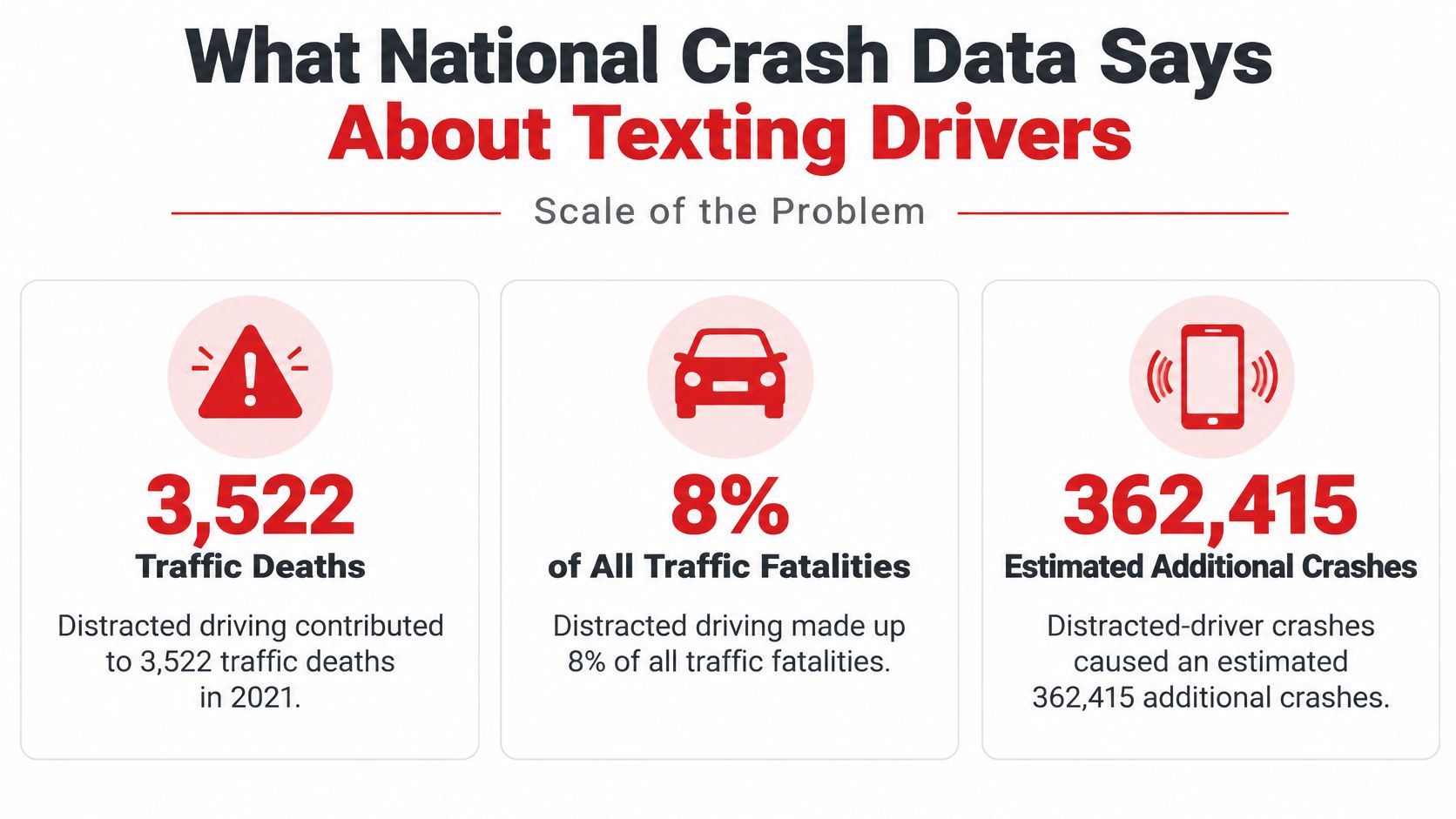
Nationally, these crashes follow a pattern. In 2021, distracted driving contributed to 3,522 traffic deaths, 8% of all traffic fatalities, and distracted-driver crashes caused an estimated 362,415 additional injuries, according to NHTSA's countermeasures review.
Why the youngest drivers show up so often
Drivers ages 15–20 had the highest proportion of drivers reported as distracted in fatal crashes, at 7%, even though this age group accounted for 8% of drivers involved in fatal crashes. People ages 15–20 also represented 16% of drivers distracted by cell phones in fatal crashes, in that same NHTSA review.
Attention works like a budget. A novice spends most of it on speed, lane position and the next intersection, so little stays in reserve. Split that reserve with a phone and the margin shrinks faster than it does for a driver with years of road time. That is why the rule matters most in the first months after the permit, when every skill is still new.
The count also covers far more than typing. A driver is recorded as distracted whenever a phone pulls the eyes off the lane, whether the hand is tapping a reply, scrolling a map, or swiping a notification away. Handheld scrolling and navigation sit in the same risk category as a text, so the full phone routine belongs in the conversation, not just the message app.
States answered with laws rather than posters. Handheld and texting bans now cover most of the country, and Georgia's Hands-Free Law is the version a local driver has to know, including what counts as holding the device. The pattern repeats across state lines because the crashes repeat.
Crash claims in other states show the same trail of injury and fault. A plain explainer of Texas distracted driving crash claims is useful reading if you want to see how a phone in the hand becomes a legal problem after a wreck. Texting is a documented traffic-safety problem, and the phone rules a teen meets in a Joshua's Law driver education course exist to interrupt exactly this pattern before the first solo drive.
Why a Single Text Can Take Your Eyes Off the Road for Seconds
A driver at 55 mph who glances down to read one text loses three things at once. One hand leaves the wheel. The eyes leave the lane. Attention shifts to the words on the screen. The car keeps moving the whole time.
Virginia Tech Transportation Institute studies with instrumented vehicles found that text messaging was associated with a 23.2-fold increase in crash or near-crash risk relative to non-distracted driving. Texting produced about 4.6 seconds of eyes-off-road time during a six-second observation interval. Much of that research involves commercial vehicle operations, so 23.2 is not a personal odds estimate. It shows the size of the mechanism.
At 55 mph, those 4.6 seconds cover roughly 371 feet before any braking or steering. That is close to a football field with the end zones.
You wouldn't close your eyes for the length of a football field. A text asks you to do something very close to that.
A glance at a notification, a route change, or a scroll through a feed repeats the same sequence. The screen pulls the eyes away, the hand follows, and the lane drifts. Visual-manual phone tasks are among the most dangerous distractions because they take the eyes and a hand at the same time. A closer look at why distraction crashes happen explains how those small choices turn into collisions. For a teen working through the Joshua's Law training path, that lesson belongs beside the phone rules, not after them.
How to Secure Your Phone Before You Start the Engine
Most drivers never decide where the phone goes until it buzzes. Decide before you move.
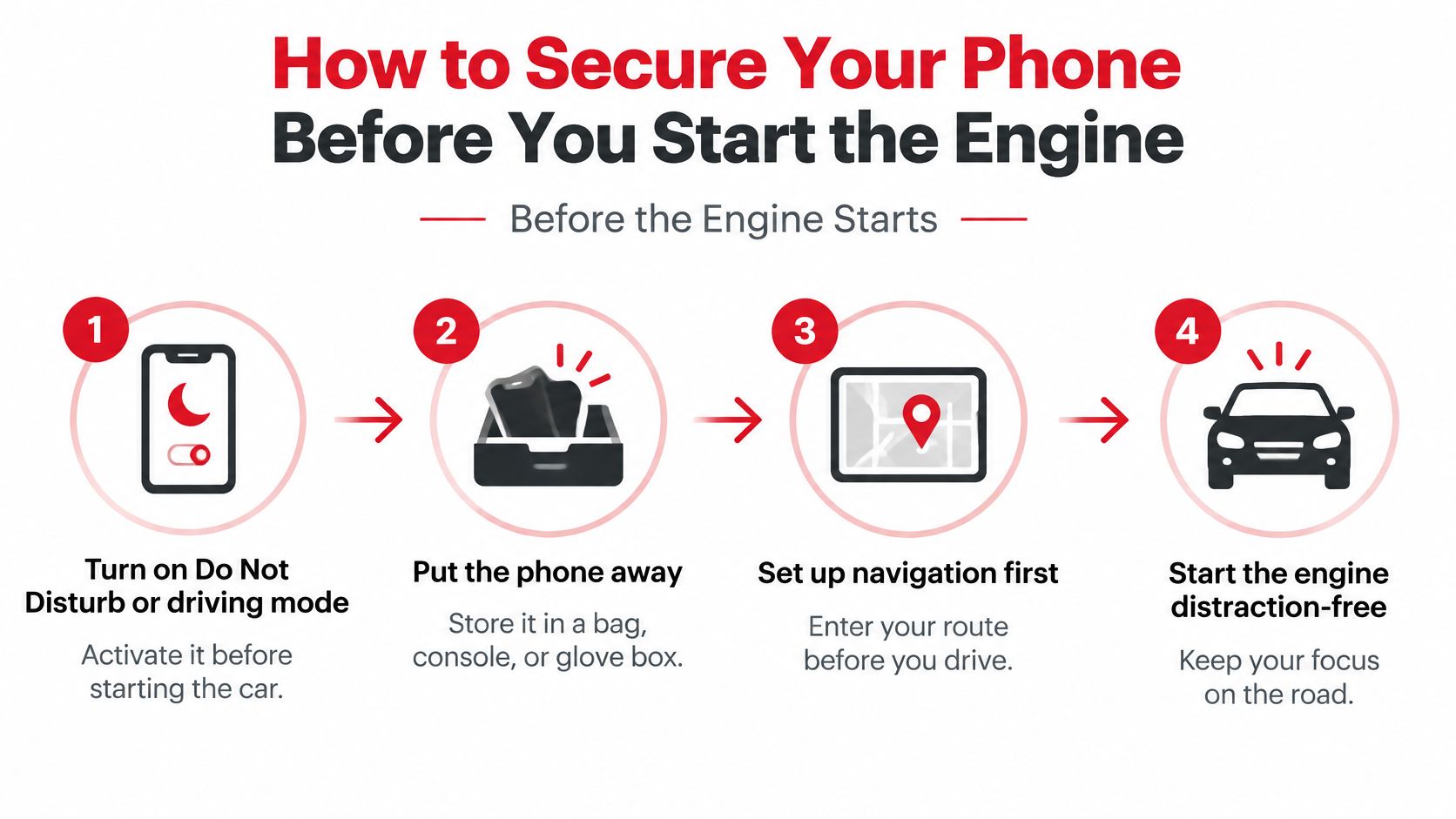
- Turn on Do Not Disturb or driving mode before you start the car. Silenced alerts remove the tug to look. The common slip is leaving the setting off because you expect one call.
- Set the destination while parked. Changing the route mid-drive is how a legal mount becomes a handheld search.
- Mount the phone in a fixed spot you can see without looking down into your lap. A phone on your thigh gets picked up.
- Assign a passenger to calls and messages. That's the simplest way to keep an urgent note moving without your hands on the screen.
- On a longer trip, bag the phone in the back seat or the glovebox so a red light doesn't become a reach.
- If something can't wait, stop. Pull into a legal, safe spot and put the vehicle out of traffic before you touch the screen.
The gap a texting ban leaves open
A ban on texts doesn't cover every screen habit. In the United States, visible manipulation of handheld devices rose from 3.0% of passenger-vehicle drivers in 2023 to 4.5% in 2024, while the share holding phones to their ears fell from 2.1% to 1.9%, in NHTSA's 2024 observational report. Drivers shifted toward texting, app navigation, notifications, and scrolling. Fewer calls at the ear is not proof the problem shrank.
That report also records 3,208 deaths and an estimated 315,167 injuries in distraction-affected crashes in 2024. Some drivers add apps with automatic crash detection as a backup if a crash still happens. An app is not a substitute for a phone that's already put away. Have an instructor watch the setup during a driving lesson before the first solo drive, and fix any reach you can still make from the seat.
How Parents Can Make a No-Phone Rule Stick
A 2019 CDC survey found that 39% of U.S. high-school students who had driven in the previous 30 days reported texting or emailing while driving on at least one of those days, and the CDC distracted-driving page notes the behavior showed up at similar levels among students earning mostly As or Bs and those earning mostly Cs, Ds, or Fs. Grades don't sort this habit. Routine does.
Teens who texted or emailed while driving were also more likely to report inconsistent seat-belt use, riding with a driver who had been drinking, and driving after drinking. The belief that "one quick check" is safe is what keeps the habit going. Willpower talks lose to a phone that's already in the hand.
A four-part family plan
- Write the rule down. Name the phone rule and the consequence for a repeat violation. Both of you sign it before the next practice drive.
- Model it. Parents put the phone away at red lights and in parking lots. A teen copies what you do, not what you say.
- Limit passengers in the first months of solo driving so the cabin stays quiet enough to build the habit.
- Pick a home storage spot the driver can't reach from the seat. The same spot, every trip.
Check compliance with a short weekly talk about one trip, and a review after any near miss. Distracted-driving prevention habits give families a simple checklist for that talk. This week, draft the agreement together before the next practice drive.
A signed no-phone agreement beats another lecture in the driveway.
Choose Your Georgia Driver Training Path
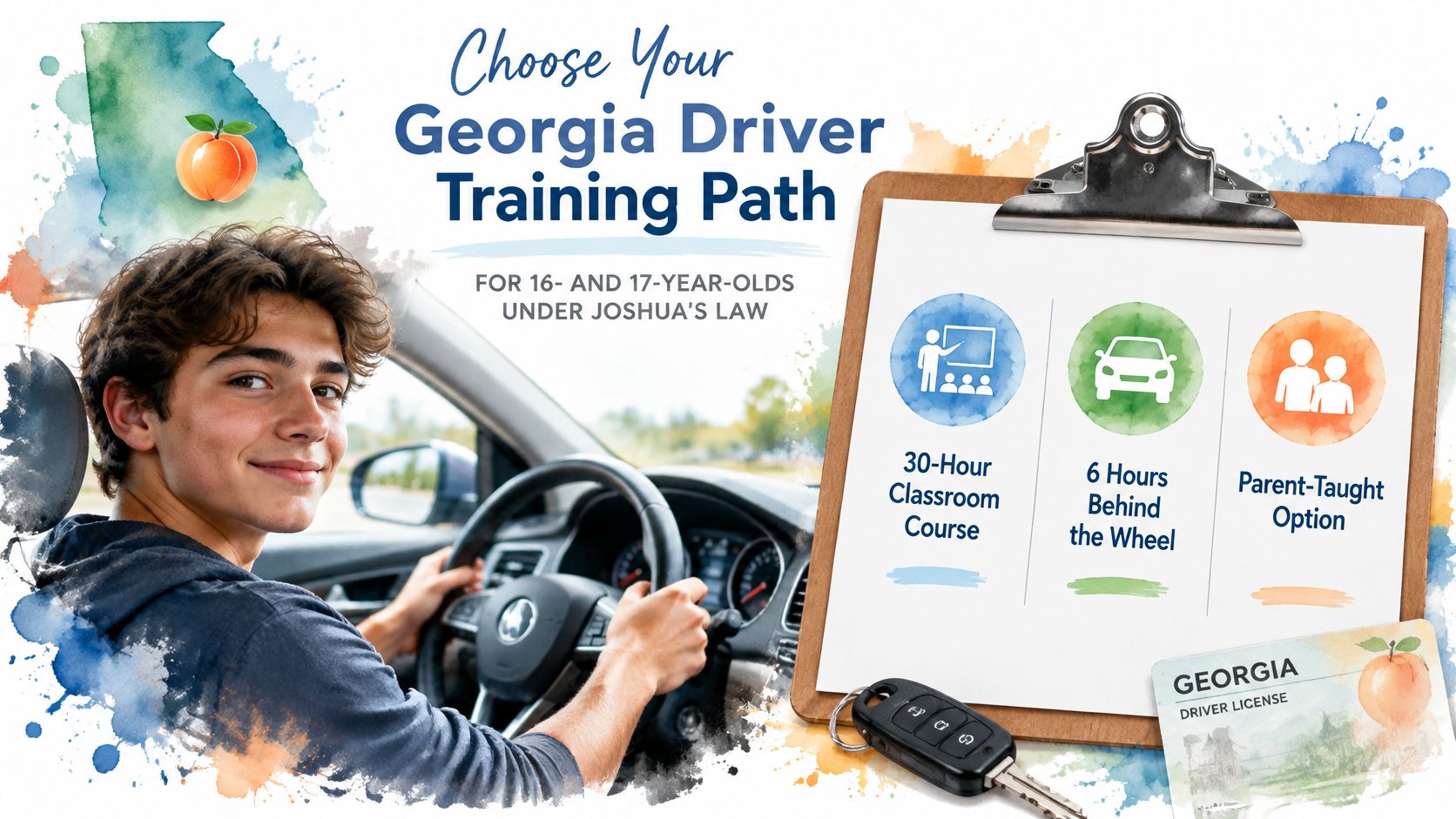
Sixteen- and 17-year-olds have three Joshua's Law routes to a Class D license. The phone rule belongs in every one of them, because the road test checks the same attention you use when a notification hits.
| Route | Classroom | Behind-the-wheel | Supervised driving |
|---|---|---|---|
| In-person Joshua's Law course | 30 hours in person | 6 hours with a certified driving school | 40 hours, at least 6 at night |
| Online Joshua's Law course | 30 hours via certified virtual program | 6 hours with a certified driving school | 40 hours, at least 6 at night |
| Parent-taught route | 30 hours, in person or online | Parent/Teen Driving Guide practice | Per Parent/Teen Driving Guide |
DDS Joshua's Law requirements set those hours. The online route covers the same 30 classroom hours through a certified virtual program, then the same school training and supervised hours unless you use the parent-taught guide. A completed course does not hand you the license.
Permit time and the road test
The learner's permit must be held for 1 year and 1 day. Eligible 16- and 17-year-olds also need the required education pathway, applicable school-enrollment and violation requirements, and a passed road test. Georgia DDS tells applicants to meet every Class D requirement, bring the listed documents, and make a road-test appointment. Confirm permit eligibility before you book anything. Finishing class and passing the skills exam are separate steps.
We offer an instructor-led Drivers Education Joshua's Law course and an online Drivers Education Joshua's Law course, plus road testing that includes the Georgia Road Test. Our Driver's Education and driving lessons include Georgia DMV-approved Joshua's Law courses, covering the education and the road testing.
This short video walks through why the phone stays down from the first lesson, not only on test day.
Book Lessons, Packages and the Road Test with A-1 Driving School
Once you pick a route, the next move is practice on a schedule. Our Joshua's Law courses, in person and online, cover the 30 classroom hours. The in-person and online routes then need the 6 hours of behind-the-wheel training with a certified school, which we provide.
Driving lessons are the piece that changes how a teen drives. Repeated practice builds the hazard spotting and lane control the road test checks, and booking on a set schedule keeps practice from slipping to "whenever we're free." A student needs a valid learner's permit or driver's license to take a lesson. We teach lessons in Atlanta and Athens, with day, evening, and weekend options at locations such as Roswell. Adults book lessons too, not only teens.
Road test help and the scholarship
Road-test preparation and testing assistance line up with what DDS asks for. You still bring the listed documents, and you still make the appointment. We help you get ready for that Georgia Road Test so the skills exam isn't the first time you drive the route under pressure.
Ask us about our Scholarship Grant Program to see whether the student qualifies before you pay out of pocket.
Three actions close the loop. Choose the in-person, online, or parent-taught route. Confirm the permit has been held for one year and one day. Then book the first lesson so the phone rule gets practiced, not just posted on the fridge.
A-1 Driving School has taught Georgia drivers since 1987, with instructor-led and online Joshua's Law courses, driving lessons, and Georgia road test preparation that build phone-free habits a new driver needs. Ready to pick a route? Visit A-1 Driving School and book the first lesson.