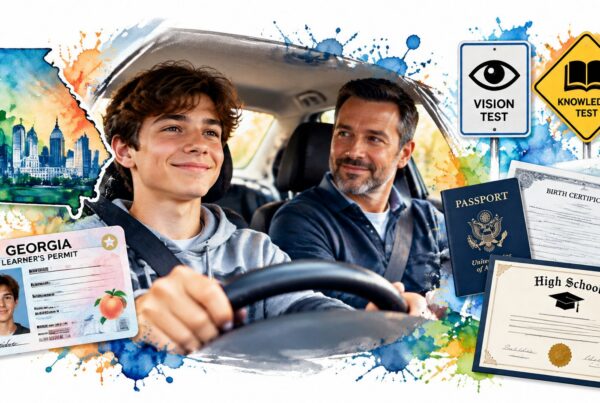

Yes, for Georgia teens aged 16 and 17 using the standard Joshua's Law route, 6 hours of certified behind-the-wheel training are part of the required Class D licensing path, not an optional extra. For adults and experienced drivers, lessons are worth paying for when they address a specific missing skill.
But are you buying better driving, a course certificate, or reassurance? Those aren't the same purchase. A useful driving lesson identifies what the student can't yet do independently, corrects it, and gives the family something concrete to practice afterward.
The best value usually comes from matching the lesson package to the driver's actual needs, rather than buying the largest package or assuming the cheapest online course covers everything.
Who Gains Most From Driving Lessons in Georgia
Paid lessons make the most sense when the instructor supplies something the driver's current practice cannot. For a teen on the standard Joshua's Law pathway, that includes certified instruction. For an experienced driver, it might mean help with a freeway merge that still causes hesitation.
Georgia's Joshua's Law requirements distinguish the certified-instructor pathway, which includes 6 hours of behind-the-wheel training, from the approved Parent/Teen Driving Guide alternative. That distinction matters: professional lessons are part of the standard route, but they aren't the only approved practical-training option.
Verdict by Driver Situation
| Driver situation | Verdict | Why it matters |
|---|---|---|
| Teen aged 16–17 on the Joshua's Law route | Yes, effectively required on the standard instructor route | Certified behind-the-wheel training is part of this license path |
| Teen on the parent-guided route | Worth it for extra structure | The Parent/Teen Driving Guide replaces the instructor component; lessons add expert correction |
| Adult new to driving | Often worth it | Structured feedback on observation, turns, and parking |
| Driver after a crash or near miss | Often worth it | Targeted sessions on the failed skill rather than a full package |
| Experienced driver wanting freeway or night confidence | Selective | Buy specific sessions; a full beginner course may add little |
| Parent who patiently supervises the required practice | Usually optional on the parent-guided pathway | Lessons can add road-test preparation and familiarity with an unfamiliar test vehicle |
A new adult driver may need help coordinating several tasks at once: checking mirrors, selecting a lane, controlling speed, and responding to directions. A structured package makes sense when those skills need to develop together.
After a near miss, start narrower. If the problem was judging a gap during a left turn, ask for an assessment of observation and gap selection before committing to a broad beginner package. Confidence without corrected judgment isn't a useful outcome.
Buying rule: Pay for a defined skill gap, then use supervised practice to reinforce the correction.
A patient parent can provide repetition and familiarity. An instructor adds value by identifying errors the family doesn't recognize, separating an observation problem from a steering problem, and setting clear readiness standards.
Older drivers can also benefit from a focused reassessment rather than starting over. Our guidance on driving lessons for seniors is relevant when changing comfort levels or unfamiliar traffic situations are the concern.
Find the situation that matches your driver. The right purchase should solve that driver's problem, not someone else's.
Georgia Licensing Rules That Require Lessons
Georgia Requirements by Applicant Case
The Georgia DDS Joshua's Law guidance establishes the teen education and practice framework: 30 hours of theoretical instruction, certified practical training or the approved parent-training alternative, and 40 hours of supervised driving, including 6 at night.
| Applicant case | Permit time | Behind-the-wheel requirement | Supervised driving |
|---|---|---|---|
| Teen 16–17, standard Joshua's Law route | 1 year and 1 day on Class CP | 6 hours with a certified provider | 40 hours, including 6 at night |
| Teen 16–17, parent-guided route | 1 year and 1 day on Class CP | Parent/Teen Driving Guide in place of 6 instructor hours | 40 hours, including 6 at night |
| Teen considering skipping driver education until 17 | Confirm current eligibility with DDS | Don't assume waiting removes driver education | Other licensing requirements still apply |
| Adult 18 or older | Not covered by Joshua's Law | Optional under Joshua's Law; verify the applicable DDS pathway | Confirm adult applicant requirements with DDS |
Don't treat an upcoming birthday as permission to skip training. The DDS license-classes page describes a wait-until-17 option, but that conflicts with the agency's Joshua's Law guidance covering both teen ages. Confirm your individual eligibility directly with DDS before relying on that exception.
The license-classes page also connects provisional licensing with permit duration, school enrollment, traffic-violation history, education, and the road test. Buying lessons doesn't replace those other conditions.
Put the Requirements in the Right Order
- Obtain a Class CP instructional permit. This is the starting point for a teen's driving practice. Our students must have a valid Learner's Permit or Driver's License to take a driving lesson.
- Complete the permit-holding period. DDS specifies at least 1 year and 1 day before the teen provisional-license stage. Finishing a course early doesn't move the permit date forward.
- Complete the approved education pathway. Choose classroom or approved online education, then the certified-instructor practical component or the Parent/Teen Driving Guide alternative. Decide which route you're following before enrolling.
- Keep the supervised-driving record. Record the practice conditions as well as the time, so nighttime experience doesn't become a last-minute scheduling problem.
- Pass the road test for the Class D provisional license. Course completion establishes that training was completed; the examination assesses driving performance.
Keep the permit issue date, education certificate, and practice log together. Families who organize these separately can finish the lessons yet still discover they aren't ready to apply.
Use our Joshua's Law requirements guide to organize the pathway, then confirm your age, permit date, and any eligibility questions with DDS before booking a test.
The Skills Lessons Build That Practice Often Misses
Say a teenager is comfortable driving around a parking lot but freezes when approaching an Atlanta interstate merge at dusk. More parking-lot practice won't address the problem. The student needs to coordinate acceleration, forward observation, mirror checks, gap selection, and lane position while visibility changes.
A useful instructor doesn't begin by repeatedly sending that student into an overwhelming merge. The instructor separates the tasks, practices them in manageable conditions, and increases the difficulty when the student can perform without constant prompting.
Professional feedback should connect what the student sees with what the student does.
Teach Observation Before the Emergency
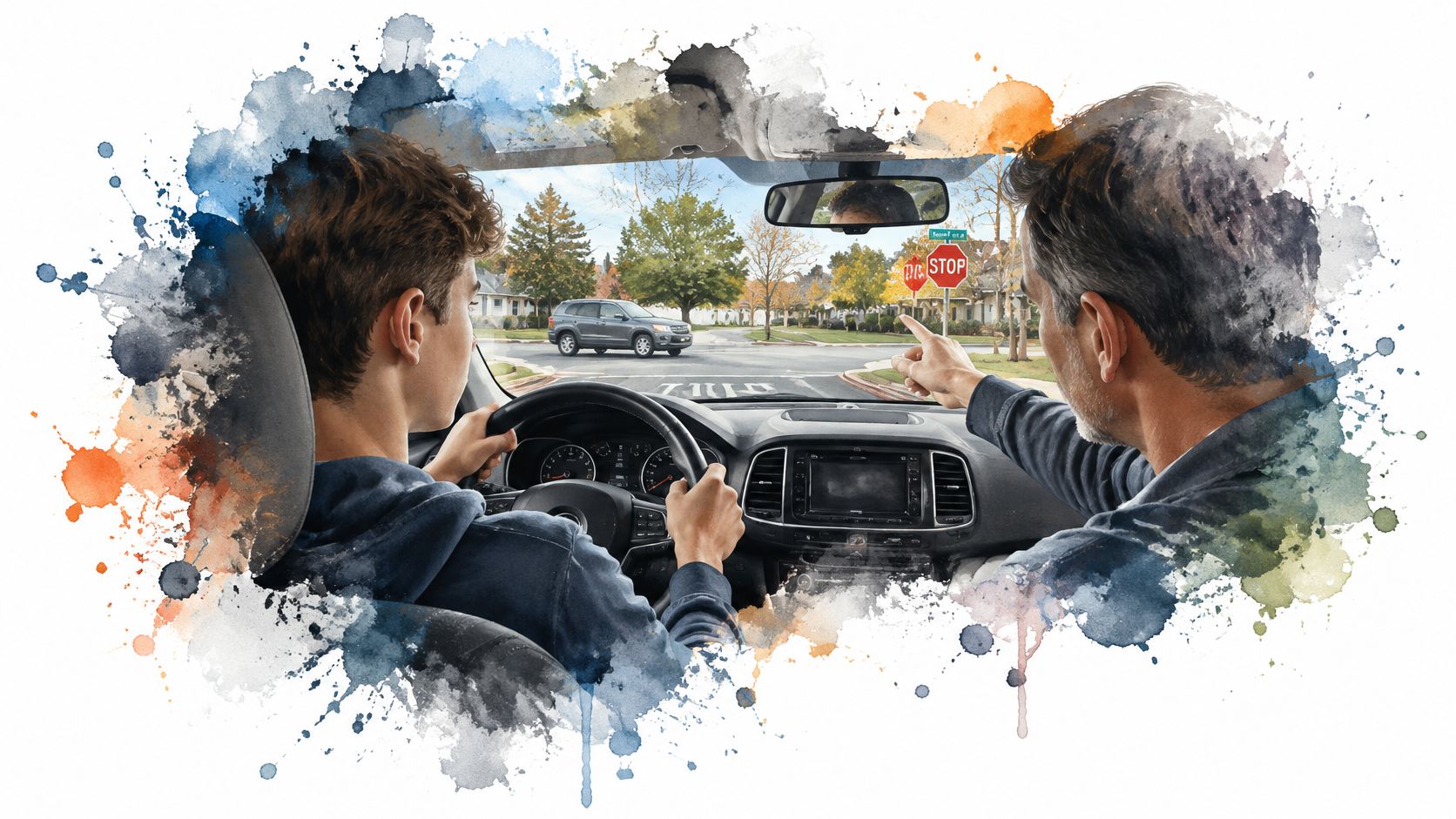
Good lessons go beyond keeping the car between lane markings. The instructor should ask the student to identify:
- Intersection conflicts: Check for turning vehicles and cross traffic before entering.
- Pedestrians and cyclists: Notice who could move into the vehicle's path, not just who is already there.
- Blocked sight lines: Recognize that a parked van or stopped vehicle may conceal someone.
- Attention demands: Keep looking ahead rather than becoming absorbed in the dashboard or a difficult maneuver.
- Reasons for action: Explain why easing off the accelerator or delaying a turn creates more room to respond.
In a California evaluation involving 5,251 drivers aged 16–18, the Risk Awareness and Perception Training program was associated with 23.7% lower crash risk among male participants than male controls, with no statistically significant reduction among female participants, according to NHTSA's pre-licensure training review.
That finding supports asking about the curriculum, not assuming every lesson produces the same result. NHTSA also cautions that transfer from hazard-perception exercises to everyday driving isn't consistently established.
Make the Feedback Usable at Home
After the merge lesson, a useful practice assignment might be maintaining forward attention while checking mirrors on a quieter road. The family should know what successful performance looks like before increasing traffic complexity.
Vehicle features deserve attention, too. Audio Jam Inc.’s safety tech guidance for Delaware drivers provides context for discussing blind-spot technology, but students still need to practice observation rather than treating an alert as permission to move.
Before paying, ask the instructor:
- Feedback: How will you explain errors and document what needs more work?
- Hazard anticipation: Will the student practice identifying concealed threats?
- Real-road application: Where will the student apply these skills with instructor observation?
What the Crash Research Shows About Lessons
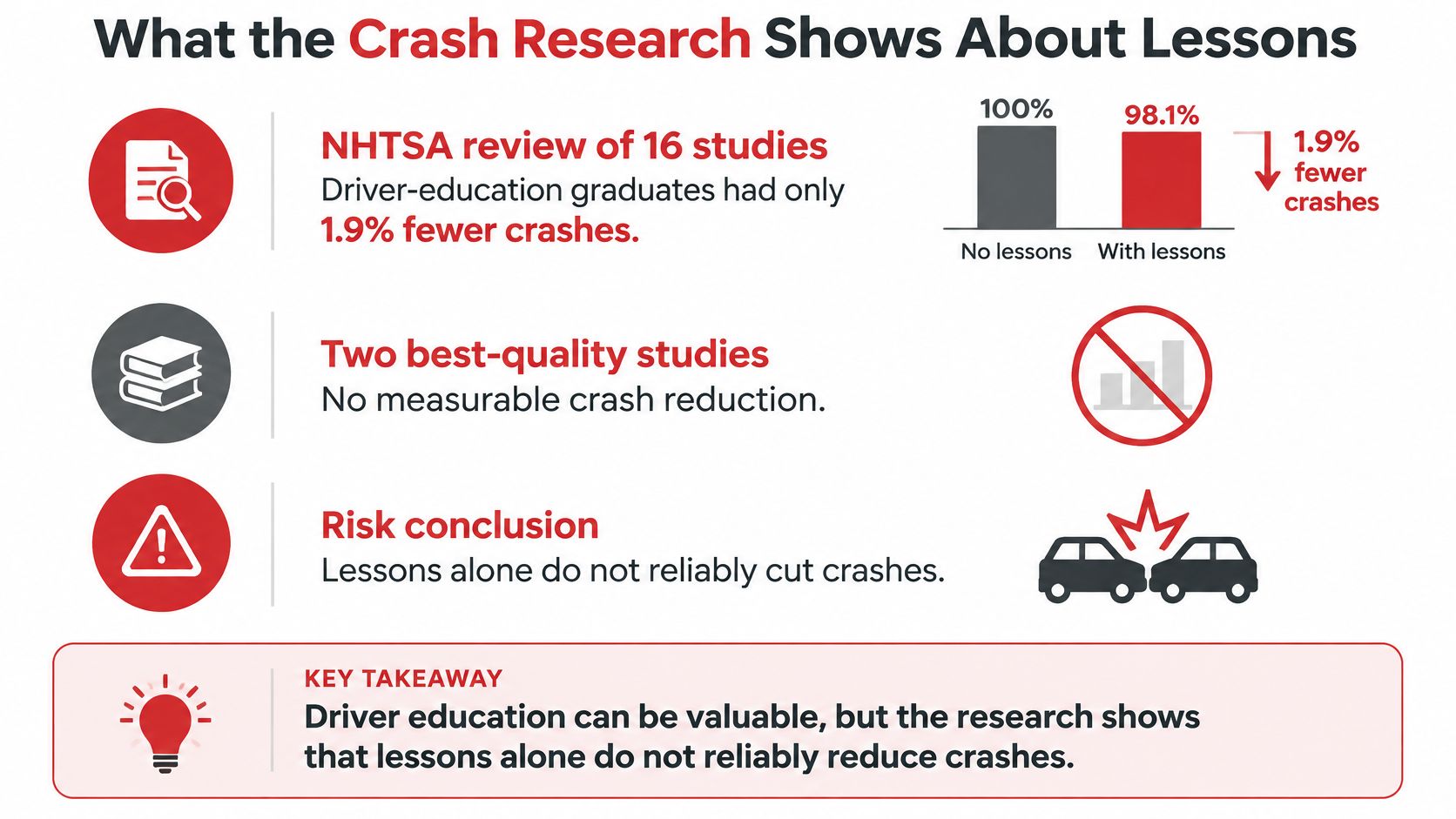
Lessons alone do not reliably cut crashes. That's the honest answer to the assumption that purchasing more instruction automatically purchases safer independent driving.
A driver can improve parking, understand signs, and pass a test without consistently making sound decisions when tired, distracted, or pressured by passengers. Those outcomes need to be separated when deciding what instruction is worth.
The NHTSA review of driver-education evaluations found 1.9% fewer crashes per driver across 16 studies, while experimental studies showed no meaningful per-driver difference and an 11% higher crash rate per kilometer in one combined analysis.
A separate 2025 analysis of licensing and crash records, covering more than 130,000 novice drivers first licensed before age 25, reported approximately 70% lower odds of severe-crash involvement during the first year after licensure among drivers completing training required under graduated licensing programs.
What the Main Crash Studies Show
| Source or study | Reported result | What it means for buyers |
|---|---|---|
| NHTSA review of 16 studies | 1.9% fewer crashes per driver for driver-education graduates | A small average difference |
| Experimental studies in the same review | No meaningful per-driver difference; 11% higher crash rate per kilometer in one combined analysis | More instruction alone doesn't guarantee safer driving |
| 2025 analysis of more than 130,000 novice drivers | Roughly 70% lower odds of severe-crash involvement in the first year after licensure | An association, not proof that lessons alone caused it |
These findings don't measure an identical intervention under identical conditions. Traditional driver education, targeted skills training, and education completed within a graduated-licensing program shouldn't be treated as interchangeable purchases.
The broad conclusion is more useful than a promise based on a single result.
Why the Larger Finding Isn't a Guarantee
The newer analysis is observational. Trained drivers may also have more parental supervision, different risk tolerance, different resources, or stronger compliance with licensing rules. Those differences prevent a clean conclusion that buying lessons alone caused the lower severe-crash odds.
NHTSA's overall assessment is cautious: evidence about lasting reductions in crashes, injuries, and citations is mixed, and education alone is unlikely to produce dramatic reductions in teen crash rates.
Buy instruction for skills you can assess. Don't buy it as a guarantee against a future crash.
For families, the practical response is to combine instruction with extensive supervised practice. Introduce night driving and wet-weather conditions gradually, maintain firm phone and passenger boundaries, and continue checking driving habits after licensing.
Expect an instructor to improve observation, explain mistakes, structure practice, and assess readiness. Don't expect a certificate to establish mature judgment, eliminate risk, or compensate for unsafe choices after the lesson ends.
Online Courses Versus In-Car Lessons
Which parts can happen online, and which require a moving car? Georgia permits an approved virtual education course, but virtual classroom completion isn't a substitute for practical driving preparation.
The DDS Class D application guidance accepts 30 hours of classroom instruction or an equivalent online virtual course, together with 6 hours of certified on-road experience or the Parent/Teen Driving Guide alternative. Both pathways retain 40 cumulative supervised hours, including 6 nighttime hours.
Online and In-Car Training Compared
| Training component | Online course | In-car lesson with an instructor |
|---|---|---|
| 30 hours of education | Accepted as an equivalent approved virtual course | Separate classroom or online component |
| 6 hours of on-road training | No | Yes, with a certified instructor |
| Hazard-anticipation practice | Simulated scenarios; transfer to real roads remains unclear | Real traffic with instructor observation |
| Feedback on lane changes and turns | Limited to digital feedback | Direct correction during driving |
| Test-style maneuvers and vehicle familiarity | Not covered practically | Can be practiced in the intended test vehicle when arranged |
Online education works well for learning rules and working through explanations at a manageable pace. It also avoids tying every classroom session to the family's travel schedule.
But a screen can't assess whether the student notices a cyclist beside the car, communicates clearly with another driver, or adjusts appropriately to traffic and weather at a busy Atlanta-area intersection.
Use Each Format for Its Strongest Job
A federal discussion of emerging driver-training evidence describes improvements in simulated driving skills while noting uncertainty about whether those gains transfer to real roads and persist. Simulators can rehearse situations without exposing a learner to immediate road risk; that doesn't make them equivalent to observed driving.
A practical blended approach is to finish approved education online, then reserve paid car time for difficult maneuvers and decision-making.
Before choosing an online-only purchase, check:
- Approval and competencies: Verify recognition under Georgia's approved system and look for meaningful knowledge checks, not merely completed modules.
- Practical-training arrangements: Confirm who delivers the road component and whether that provider is certified, unless you're using the approved parent-guided alternative.
Hidden Costs and How to Vet a Lesson Package
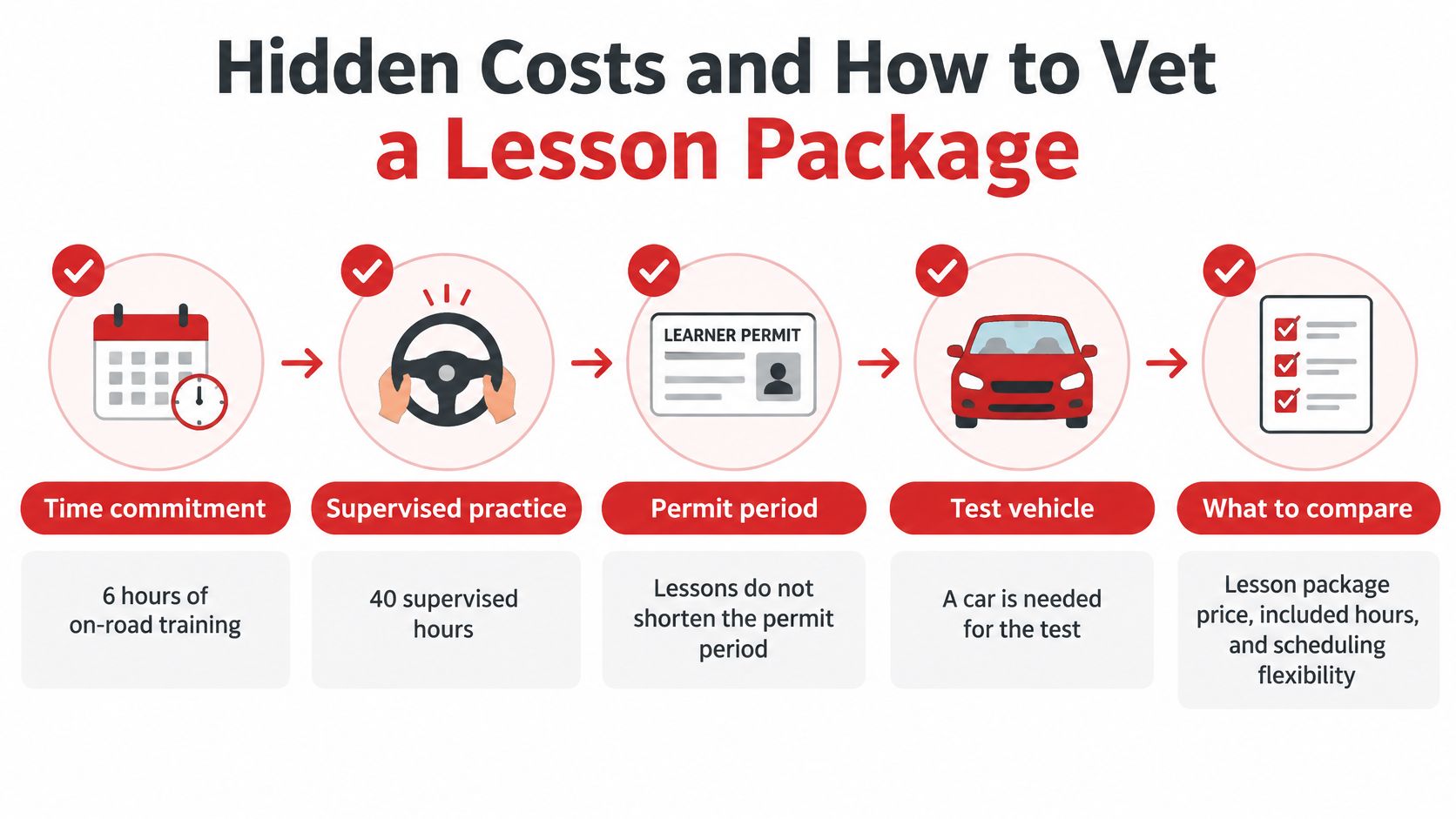
The lesson fee isn't the whole investment. Families must also budget time for supervised practice, transportation, scheduling, and test-day vehicle arrangements. A package that looks cheaper can be less useful if it doesn't address the student's weaknesses or fit the family's calendar.
Use the checklist to compare what you're buying.
Check the Test-Day Details
The DDS testing information requires an applicant-provided four-wheel vehicle with valid registration, a license plate, liability insurance, and a satisfactory safety inspection; it also sets a minimum passing score of 75%. For temporary tags, DDS describes additional purchase documentation, generally a bill of sale dated within 30 days, or 7 days for a third-party purchase.
An applicant whose vehicle lacks illuminated turn signals must be able to use hand signals. Check the car and paperwork before test day, not while the student is waiting to be examined.
Compare the Package Before Paying
- Confirm recognition. Make sure the education and practical-training components fit Georgia's approved pathway.
- Ask how progress is measured. Look for skill-specific feedback, such as whether the student changes lanes without reminders, rather than a statement that the lesson went well.
- Check the driving conditions covered. Ask whether hazard anticipation and night driving are included or need separate scheduling.
- Clarify test preparation. Establish which maneuvers are practiced, which vehicle will be used, and what road testing or testing assistance the package includes.
- Contact the insurer. Ask whether completed driver education qualifies for a discount, what proof is required, and what the actual saving would be.
- Read the refund terms. We refund the portion of Driver's Education or Driving Lessons fees not yet used for classroom or driving lessons when services have already been rendered.
Our guide to choosing a driving school can help organize those comparisons.
Cost-return check: Compare the total package price, included driving time, scheduling flexibility, test arrangements, and any confirmed financial assistance. Don't assign a cash value to promises nobody can document.
Insurance savings aren't automatic. Ticket reduction isn't a guaranteed return either, so don't justify the purchase using assumed citations avoided.
Likewise, the official passing threshold isn't a school's pass rate. Request written information before relying on a provider's pass-rate claim, including how that rate was calculated.
Check the Georgia Driver's Education Scholarship Grant Program before paying. Confirm eligibility, covered services, and approval timing directly with the school; a confirmed grant can lower your out-of-pocket cost, but an anticipated award shouldn't be treated as money already available.
Book Your Georgia Lessons and Confirm Your Path
Choose the pathway that matches the driver, then choose the package. A teen working toward provisional licensing needs an approved education plan and practical training; an experienced adult may need only focused work on merging, parking, or driving after dark.
You can review the school's enrollment options before discussing the right starting point.
Match Enrollment to the Goal
We offer instructor-led and online Drivers Education Joshua's Law courses, teen and adult driving lessons, and packages supporting the path through education and road testing. Our approved Driver's Education and Driving Lessons options include education and road testing, with road-test preparation and testing assistance available, so confirm exactly what your selected enrollment includes.
For a beginner, prioritize enough structured instruction to develop skills together. For an experienced driver, describe the difficult situation clearly before booking so the instruction can focus on that gap.
We also offer a Scholarship Grant Program. Before enrolling, confirm eligibility for the Georgia Driver's Education Scholarship Grant Program directly with us, since the program sets its own qualification rules.
The video provides another way to get acquainted with the school before making your booking decision.
Bring your permit or license details, weekly availability, and the driving situations that need attention. Confirm course approval, lesson scheduling, scholarship status, and test arrangements before committing to a package.
A-1 Driving School offers instructor-led and online Joshua's Law education, driving lessons and lesson packages, and road-test preparation and testing assistance. Visit A-1 Driving School to explore the courses and packages, confirm scholarship eligibility, and schedule a first lesson focused on the skills you need.