In 2023, distracted driving caused 3,275 fatalities in the United States, representing 8% of all motor vehicle deaths nationwide according to SafeTREC's distracted driving facts. For Georgia families, that number should change how we talk about driving. This isn't just about breaking a phone habit. It's about building a routine, a mindset, and a level of attention that protects everyone around the car, especially new drivers.
Teens often hear “don't text and drive” so many times that the warning starts to sound generic. Parents hear it too, and many assume the answer is simple: obey the law, use hands-free features, and move on. Real distracted driving prevention takes more than that. It starts at home, grows through training, and gets stronger when a student practices with structure, feedback, and repetition.
The Unseen Dangers of Driving Distracted in Georgia
A split second is enough. In Georgia, that moment can happen in a school pickup line, at a crosswalk near a shopping center, or on a multi-lane suburban road where a teen is still learning how quickly traffic patterns change. Distracted driving is dangerous partly because it hides in ordinary habits. A glance at a screen, a quick reply to a passenger, or a rushed decision at the wrong time can turn a routine trip into a crash.
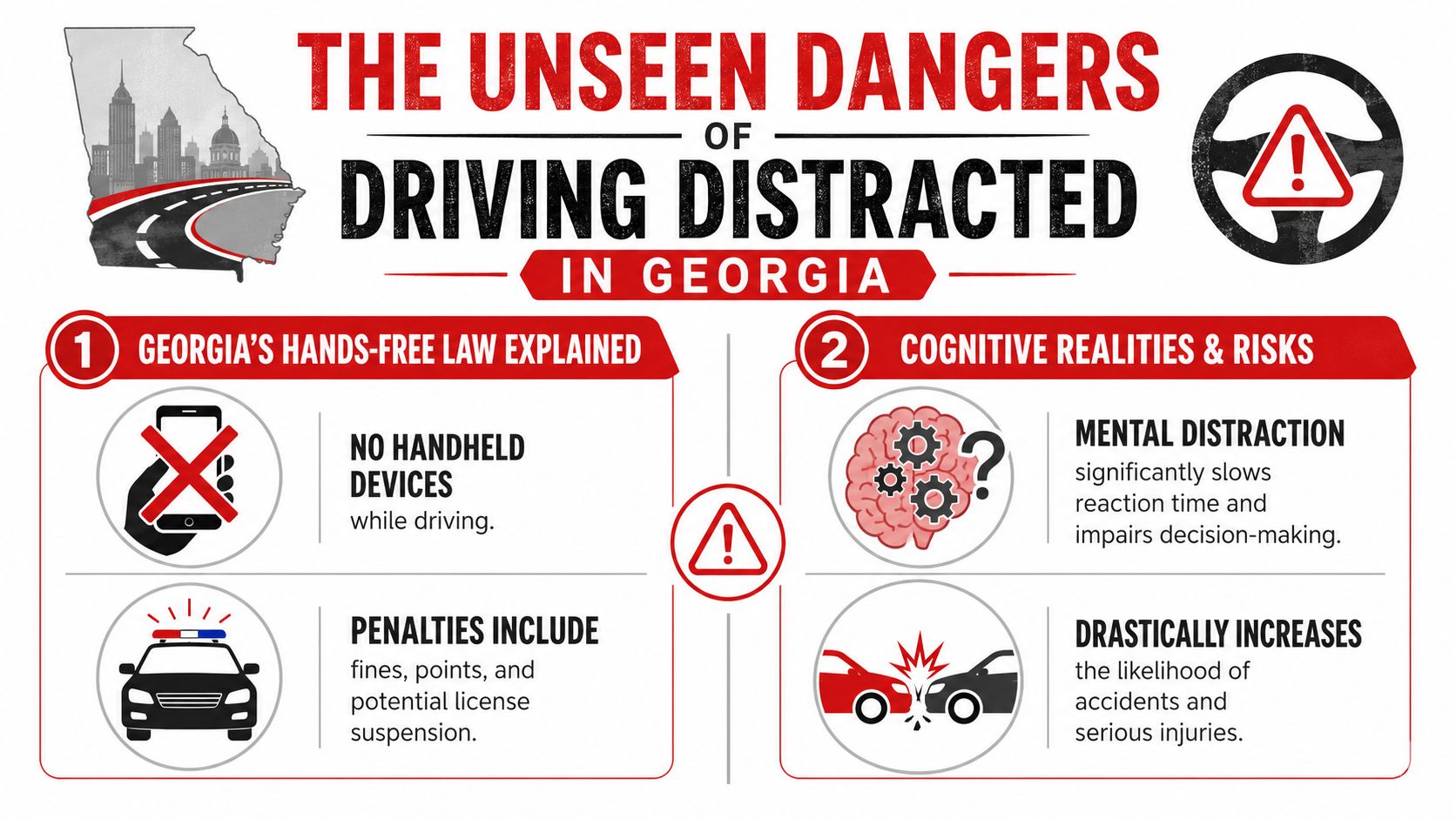
Georgia's Hands-Free Law gives families a clear starting point. Drivers cannot hold a phone, text, scroll, watch videos, or physically use a device in ways that pull attention away from driving. That legal standard sets the minimum behavior required on the road. Safe driving habits have to go further, especially for new drivers who are still building judgment, timing, and scanning skills.
Why hands-free still isn't safe enough
Many parents and teens get tripped up by the same question. If the phone is mounted and the driver's hands stay on the wheel, isn't the problem solved?
Usually, no.
Cognitive distraction is the missing piece. A review discussed in this article on cognitive distraction and hands-free risk explains that a demanding conversation can divert up to 30% of neural processing from driving. The car may stay centered in the lane for a few seconds, but the driver's mental bandwidth is already being used elsewhere.
A simple comparison helps here. Driving works like juggling several small tasks at once: speed control, mirror checks, lane position, brake lights ahead, pedestrians near the curb, and the timing of the next turn. Add an emotional phone call or a complicated conversation, and one of those balls gets dropped. That is often the moment a teen misses a stale green light, a cyclist at the edge of the lane, or a car slowing unexpectedly.
Practical rule: If a conversation requires problem-solving, strong emotions, detailed directions, or a long explanation, it is too demanding for a moving car.
That is why families benefit from deeper education on the dangers of distracted driving, not just a short list of traffic violations.
The mistake experienced adults make with teens
Parents sometimes focus only on the phone. For teen drivers, distraction also comes from passengers, dashboard alerts, music changes, drive-thru choices, missed turns, and the pressure of trying to make quick decisions in unfamiliar traffic. A student can follow the letter of the law and still have attention pulled in three directions at once.
This distinction is critical because inexperience makes distraction more costly. An adult with years behind the wheel may recover from a delayed reaction. A teen often has less margin for error. At A-1 Driving School, we teach students to reduce those competing demands before they build into trouble. That includes calm scanning habits, controlled speed, early decision-making, and routines that keep the mind from getting crowded.
Georgia families can strengthen that training at home. Set a rule that the driver does not answer calls, settle backseat arguments, fix navigation, or search for items while the vehicle is moving. Pull over first. That habit is especially useful for Joshua's Law students who are still turning basic skills into repeatable habits under real traffic conditions.
Vehicle technology can support attention too, as long as families treat it as backup rather than a substitute for focus. Parents reviewing safety features for a first car can learn about blind spot detection, then connect that conversation to a bigger lesson. Alerts can assist a driver. They cannot think, judge, or choose patience for them.
The goal is straightforward. When the car is moving, driving gets full attention. That standard gives Georgia teens a safer path from household expectations to certified instruction, guided practice, and the kind of disciplined habits A-1 works to build in every lesson.
Your Pre-Drive Safety Checklist
Most distracted driving doesn't begin after the car starts moving. It begins earlier, with one bad assumption: “I'll set that up once I'm on the road.” That's when small tasks become risky ones.
Research summarized in the Eastern Association for the Surgery of Trauma review found that tasks requiring more than two glances away from the road increase crash or near-crash risk by an odds ratio of 26.4. That's why the safest time to handle phone settings, GPS input, playlists, seat adjustments, and bag placement is before the vehicle moves.
A routine that should happen every trip
Use this like a pre-flight check. Short. Repeatable. Non-negotiable.
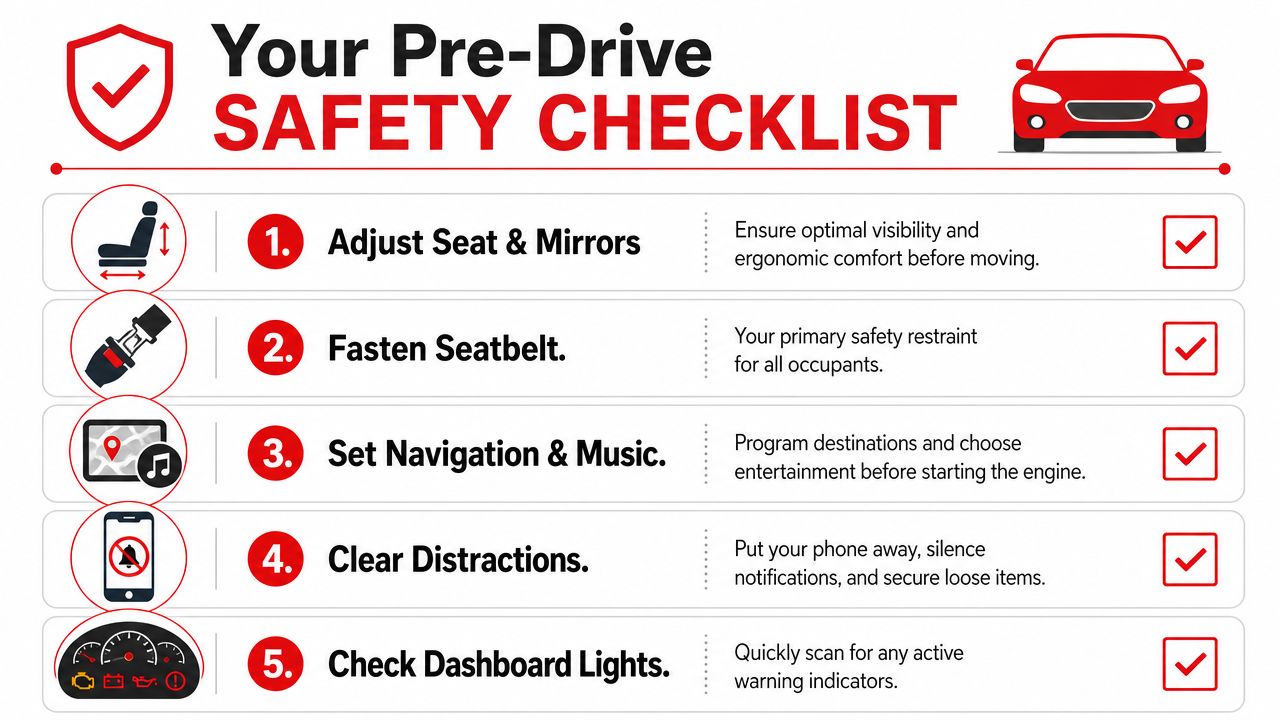
Set your body position first. Adjust the seat, steering wheel, and mirrors before the key turns or the start button is pressed. A cramped posture creates fidgeting later, and fidgeting becomes distraction.
Buckle up before touching screens. That sounds basic, but it creates a sequence. Seatbelt first, then final checks. Good drivers rely on order because order reduces forgotten steps.
Program navigation now. Enter the address, review the first turns, and place the phone where it will stay. If the route is new, glance at the overall path so the voice directions won't feel surprising.
Choose audio before backing out. Pick the playlist, podcast, or silence. Don't browse once the wheels are rolling.
Silence the phone and move it away. Turn on Do Not Disturb While Driving or Drive Focus, then put the phone in the back seat, a zipped bag, or another spot that requires effort to reach.
What teens forget most often
The phone isn't the only issue. Loose items create distraction too. A water bottle rolling under the seat, a hoodie slipping off a lap, fries in one hand, or a charging cable tangled near the console all pull attention in little bursts.
A quick visual sweep helps:
- Check the dashboard: If a warning light is on, handle it before leaving.
- Clear your lap: Nothing should sit where it can slide, spill, or fall.
- Secure passengers and pets: Everyone should be settled before the car moves.
- Decide on climate controls early: Temperature adjustments can wait, but if you know you'll need defrost or AC, set it now.
The safest trip is the one that doesn't ask the driver to “just do one quick thing” at the next red light.
Where technology helps and where it doesn't
Driver-assist features can support awareness, but they don't replace attention. If you're comparing vehicle upgrades or trying to understand extra visibility tools, it may help to learn about blind spot detection and how those systems fit into a broader safety routine. The key is using technology to reduce workload before driving, not adding more things to manage during the trip.
A good checklist feels boring after a while. That's a sign it's working. Safe habits usually don't feel dramatic. They feel automatic.
Creating a Family Safe Driving Pact
House rules matter more when they don't sound like random commands. Teens respond better when parents explain the reason, set the same standard for themselves, and keep the agreement clear enough to remember.
A family safe driving pact doesn't need legal language. It needs consistency. One page is enough if everyone understands it and follows it.
What belongs in the agreement
Start with the rule that matters most: the driver doesn't use the trip for phone activity. Then make the rest practical.
A strong family pact often covers:
- Phone placement: The phone goes in a designated spot before the car moves.
- Passenger behavior: Friends can help with directions, but they can't start arguments, show videos, or pressure the driver to respond to messages.
- Music limits: No searching for songs while driving.
- Pull-over policy: If something needs attention, the driver parks first.
- Parent modeling: Adults in the family follow the same phone rules.
That last point is where many families either build credibility or lose it. Teens notice quickly if a parent says “no phone while driving” and then grabs their own device at a stoplight.
Reward safe behavior, don't only punish mistakes
Many parents default to consequences only. Consequences matter, but they aren't the whole picture. The research behind teen behavior change suggests rewards can be powerful. According to EndDD research statistics, gain-framed financial incentives were rated by 75% of surveyed teens as likely to be a very effective strategy for reducing texting while driving.
That doesn't mean every family needs to pay for safe driving. It means teens often respond when safe choices are recognized. Rewards might include added driving privileges, more schedule flexibility, or help earning toward a goal.
Home coaching insight: “You followed the rule all month” is more motivating than “Don't mess up again.”
A simple way to handle pushback
Teens often say, “I only checked it for a second,” or “I can do both.” Arguing in the moment usually doesn't help. A better response is to bring it back to agreed standards.
Try this format:
| Situation | Family response |
|---|---|
| A text comes in while driving | Driver ignores it until parked |
| A friend asks to change music | Passenger handles it, or it waits |
| Driver gets lost | Pull over before touching the phone |
| Parent calls teen during a drive | Teen calls back after parking |
Parents may also benefit from broader guidance on communication and limits at home. Resources on setting healthy boundaries for teens can support the conversation, especially when driving rules connect to larger expectations around responsibility and trust.
A family pact works best when everyone signs it, everyone can explain it, and everyone knows that safety isn't a punishment. It's a shared standard.
Master Focus with Professional Driving Lessons
A checklist can start a habit. A family pact can reinforce it. Real traffic is where those habits get tested.
That test comes fast. A driver merges while a passenger asks a question. A delivery van blocks the view at an intersection. A navigation prompt comes at the same time as a yellow light. In those moments, the issue isn't whether the teen has heard the rule. The issue is whether the teen has practiced focused driving enough that the right response happens without panic.
What an instructor sees that families often miss
Parents usually notice obvious problems such as speeding, late braking, or poor lane position. An experienced instructor also watches for subtle signs of distraction:
- Long mirror checks that turn into staring instead of scanning
- Repeated glances at the dashboard
- Delayed response after a verbal instruction
- Overcorrection when traffic gets busy
- Tunnel vision near complex intersections
These are teachable issues. They often show up before a serious mistake, which makes them worth correcting early.
Research summarized by the World Health Organization on mobile phone distraction found that using a mobile phone while driving makes a driver approximately four times more likely to be involved in a crash, and that risk is similar for hand-held and hands-free use because cognitive distraction remains in play. That kind of risk doesn't disappear because a student “knows better.” It drops when the student has trained the habit of ignoring non-driving demands.
Practice under pressure matters
A teenager can do everything right in an empty parking lot and still struggle in real traffic. Professional lessons create controlled exposure to the situations that reveal distraction:
- Left turns with oncoming traffic
- Lane changes in steady flow
- School-zone scanning
- Parking lot decision-making
- Multi-step routes where signs, signals, and timing all matter
A focused driver doesn't try to do more things at once. A focused driver learns how to choose the one thing that matters most right now.
Families comparing options often benefit from reading about the benefits of taking driving lessons from an instructor. The value isn't just extra hours in the car. It's guided correction at the exact moment a bad habit begins.
How lessons support road test readiness
The Georgia Road Test assesses more than basic vehicle operation; it measures controlled attention. The examiner is watching whether the student follows directions, checks surroundings, manages turns smoothly, and stays composed.
That means distracted driving prevention is part of road test prep, even when nobody uses that phrase out loud. A student who has learned to set up the car before moving, avoid unnecessary glances, and stay mentally engaged tends to look steadier during the test.
This short video helps reinforce the idea that attention is a skill that can be trained.
Driving lessons are where safe habits stop being reminders and start becoming responses. That's the difference between knowing the rule and living it behind the wheel.
Fulfilling Joshua's Law and Funding Your Education
A clear training plan helps families avoid a common mistake. They treat licensing requirements, practice driving, and road test prep as separate jobs, then wonder why progress feels uneven. In Georgia, Joshua's Law gives teens and parents a set order to follow, and that structure helps safe habits grow faster.
Georgia requires specific training for many teens seeking a Class D license. Instead of leaving driver education to spare weekends and good intentions, Joshua's Law turns it into a schedule with real checkpoints.

What Joshua's Law requires
Joshua's Law in Georgia mandates that all 16- and 17-year-olds complete a DDS-approved 30-hour Driver's Education course before applying for a Class D license, with options for both in-person classroom instruction and approved online programs, as explained in this Georgia Joshua's Law guide.
That flexibility matters more than many parents expect. A structured classroom can help a teen who needs discussion, routine, and firm deadlines. An online course can fit a family balancing sports, work shifts, shared vehicles, and long commutes.
Families also have more than one approved path for meeting the requirement. That gives parents room to choose based on the student in front of them, not on a one-size-fits-all plan.
Choosing the format that fits the student
The best format is usually the one a teen will complete carefully and remember later. Driver education is not just paperwork for the DDS. It is the rulebook stage of training. If behind-the-wheel lessons are like practice on the field, the course is the film study that helps a student recognize what is happening before the moment gets busy.
A few questions can make the choice clearer:
- Does your teen stay on track without reminders? If not, a live class may provide the structure they need.
- Is family transportation hard to coordinate? Online coursework may remove that obstacle.
- Does your teen learn better by asking questions out loud? In-person instruction may be the better fit.
- Is your teen trying to finish fast, or trying to understand the material? Retention matters more than speed.
Good driver education should fit the student well enough that the lessons hold up later in traffic, not just long enough to finish the requirement.
Why driving lessons still matter after the course
Parents often assume the course means a teen is nearly road-ready. It usually means the teen has learned the rules and still needs guided practice applying them.
That distinction matters. A student may know that Georgia bans drivers under 18 from using a phone while driving, yet still struggle to keep attention steady in a left-turn lane, during a merge, or while following directions in unfamiliar traffic. Knowledge is the map. Coaching helps the teen drive the route.
A layered plan works well for many Georgia families:
| Training piece | What it builds |
|---|---|
| Driver's Education course | Knowledge of rules, laws, and decision-making |
| Driving lessons | Real-world skill, scanning, timing, and correction |
| Road test prep | Confidence with the maneuvers and focus expected on exam day |
Lesson packages often make that plan easier to follow. Instead of arranging practice one piece at a time, families can choose a sequence that builds skill in order. One lesson can cover vehicle setup and basic control. Another can work on intersections, lane changes, and speed management. A later session can focus on parking, route planning, and road test expectations. That kind of progression is part of what A-1 Driving School provides through its Joshua's Law courses, lesson packages, and road test preparation options.
Help with cost through the Georgia scholarship grant
Cost can slow families down, especially when they are already juggling insurance, school, and work schedules. Georgia offers a way to reduce that burden for qualifying students through the driver education grant scholarship program.
Parents can review the Georgia Driver's Education Grant Scholarship Program details early in the process and see whether funding may be available. That timing matters. It is easier to choose a course date and lesson plan when the budget question has been addressed before enrollment.
A practical path from house rules to a Georgia license
Many families start with the right idea but an incomplete plan. They set phone rules at home, sign up for the required course, and begin practice driving. Then the teen gets overloaded in traffic, glances down too long during basic checks, or loses track of signs while listening to directions. Those are not signs of failure. They are signs that the next step should include coached, certified instruction.
Other teens have the opposite problem. They feel ready too early. They can steer, brake smoothly, and drive familiar roads, so they assume they are prepared for anything. A trained instructor often spots the gaps quickly. Late scanning, rushed turns, casual mirror use, and weak attention control can hide behind early confidence.
For many Georgia teens, the strongest path looks like this:
- Set clear family rules about phones, passengers, and attention.
- Complete the Joshua's Law education requirement through a format that fits the student.
- Add professional driving lessons to build skill under real traffic conditions.
- Practice between lessons with parent feedback and clear goals.
- Prepare specifically for the Georgia road test.
That path does more than help a teen qualify for a license. It helps the teen build habits that last after the test is over, which is exactly the standard A-1 Driving School works toward with every student and parent partnership.