

If a course helps with a traffic ticket, does that mean it also satisfies a teenager's licensing requirements? No, and that confusion can lead Georgia families to enroll in the wrong class. Understanding what traffic school is starts with identifying what you need to accomplish: address a citation, reduce existing points, ask about insurance savings, or prepare for a license.
What Traffic School Is and What It Can Do
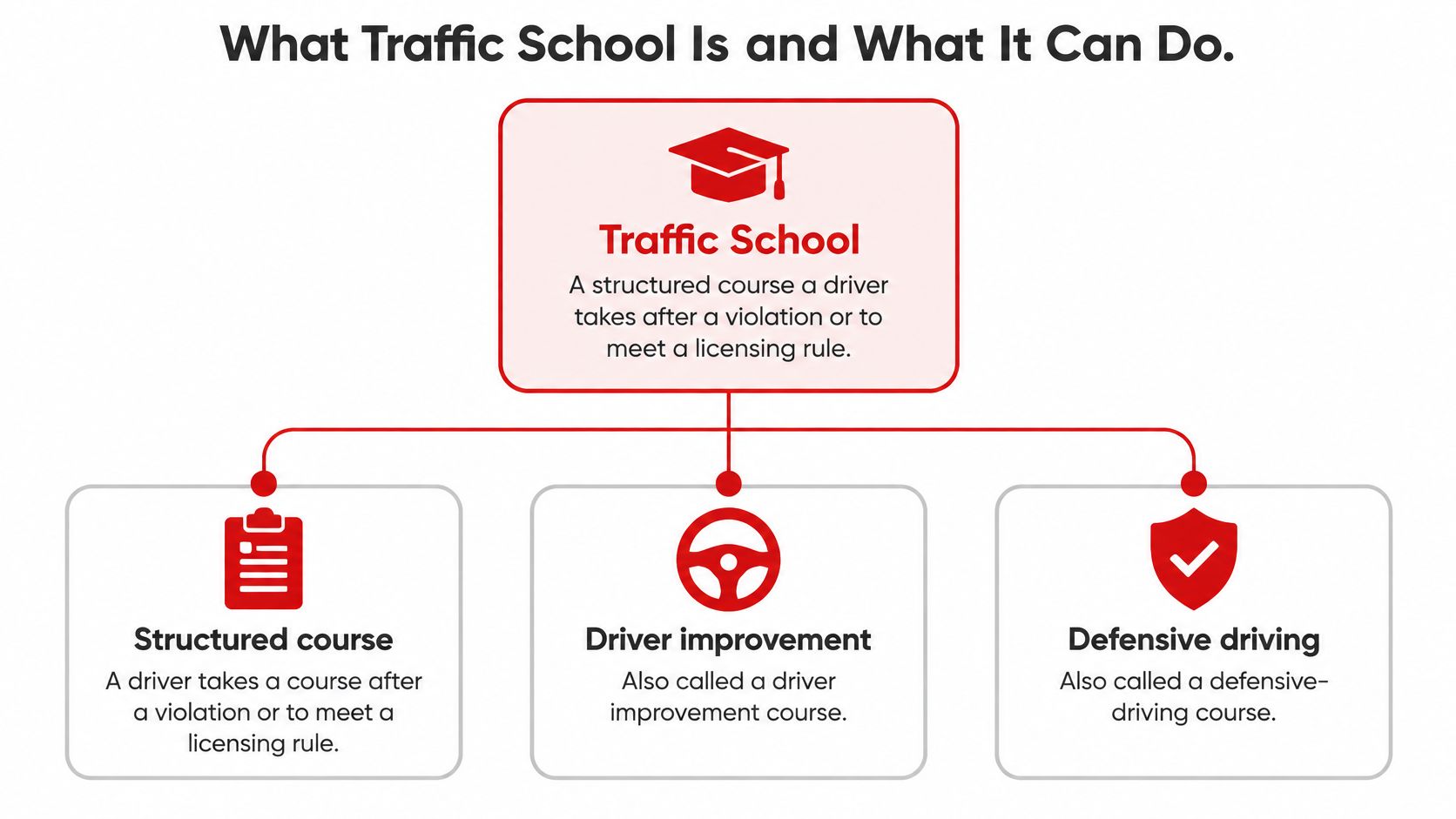
Traffic school is a structured course a driver takes after a violation or to meet a licensing rule, often called a driver improvement or defensive-driving course. People also use the term loosely for new-driver education, although Georgia treats those programs differently.
For remedial driver improvement, the Georgia Department of Driver Services defensive-driving FAQs specify a 6-hour course and allow eligible residents to request removal of up to 7 points once every 5 years after completing a certified course and submitting the original certificate. The purpose is to improve risky driving attitudes and habits, not just teach someone enough to obtain a first license.
Traffic school purposes, effects and requirements in Georgia
| Purpose | Who it fits | What it changes | Key requirement |
|---|---|---|---|
| Court disposition for a moving violation | Drivers cited for a moving violation | Possible 20% fine reduction and no points if the certificate reaches the court in time | Certified 6-hour course completed before the court appearance or as ordered |
| Point reduction | Georgia drivers with points on their record | Up to 7 points removed once every 5 years | Certified course plus original completion certificate submitted to DDS |
| License reinstatement | Drivers whose license action requires a course | Counts toward the course-related reinstatement requirement | Course from a DDS-certified provider |
| Insurance discount | Drivers asking an insurer about premiums | Possible premium reduction, not guaranteed | Confirm treatment with the insurer first |
| Teen licensing under Joshua's Law | 16- and 17-year-olds seeking a Class D license | Meets the driver education component, not the entire licensing process | 30-hour classroom or equivalent approved online course |
| Voluntary education | Any driver wanting safer habits | No automatic change to the record | Not tied to a citation |
Choose the purpose before the class
The important distinction is who will accept the completion certificate. A court considers it for a case, DDS processes licensing matters, and an insurer decides whether it affects premiums. A teen needs education approved for the licensing pathway, not just a certificate with “driving” in its name.
A course doesn't promise a clean record on its own. Before enrolling, answer these questions:
- Purpose: What specific requirement am I trying to satisfy?
- Deadline: When must I finish and deliver the paperwork?
- Certificate: Does the court, DDS, or insurer require an original completion certificate?
Who Needs Traffic School in Georgia
Consider an adult driver with a speeding citation who wants to keep points from being added. That driver needs to investigate court disposition, not enroll automatically in a new-driver education program. The court appearance or the court's written order controls the schedule, so the driver should confirm acceptance and certificate delivery before booking.
Now consider someone whose points are already on the driving record. That person is pursuing DDS point reduction. The task isn't to send a certificate back to an old court case, but to follow DDS's application and original-certificate requirements.
A teen has a different starting point
A teenager applying for a provisional license needs Joshua's Law driver education, practical training, and supervised driving. The permit-holding requirement controls when the teen can qualify for the next license, even if the classroom work is finished sooner.
For example, a parent might search for “traffic school” because their child needs an online course. The useful question is whether the course satisfies Georgia's new-driver education requirement, not whether it advertises ticket benefits.
Practical rule: Match the course to the document that created the requirement, not to the broad phrase “traffic school.”
Drivers ordered to attend by a court or DDS should follow the deadline and course description in that order. Someone enrolling voluntarily for an insurance benefit should get the insurer's acceptance criteria before spending money.
An out-of-state citation needs particular care. Don't assume a Georgia course will satisfy another state's court, and don't assume that court acceptance automatically resolves a separate Georgia licensing notice.
Gather the paperwork before comparing schedules:
- Citation: Identify the issuing court and the alleged violation.
- Court date: Record both the appearance date and any separate completion deadline.
- DDS notice: Check for a specific program or reinstatement requirement.
- Insurer letter: Keep any written explanation of eligible courses and documentation.
With those documents together, you can explain your goal clearly and avoid paying for education that doesn't meet it.
How Traffic School Affects Tickets, Points and Insurance
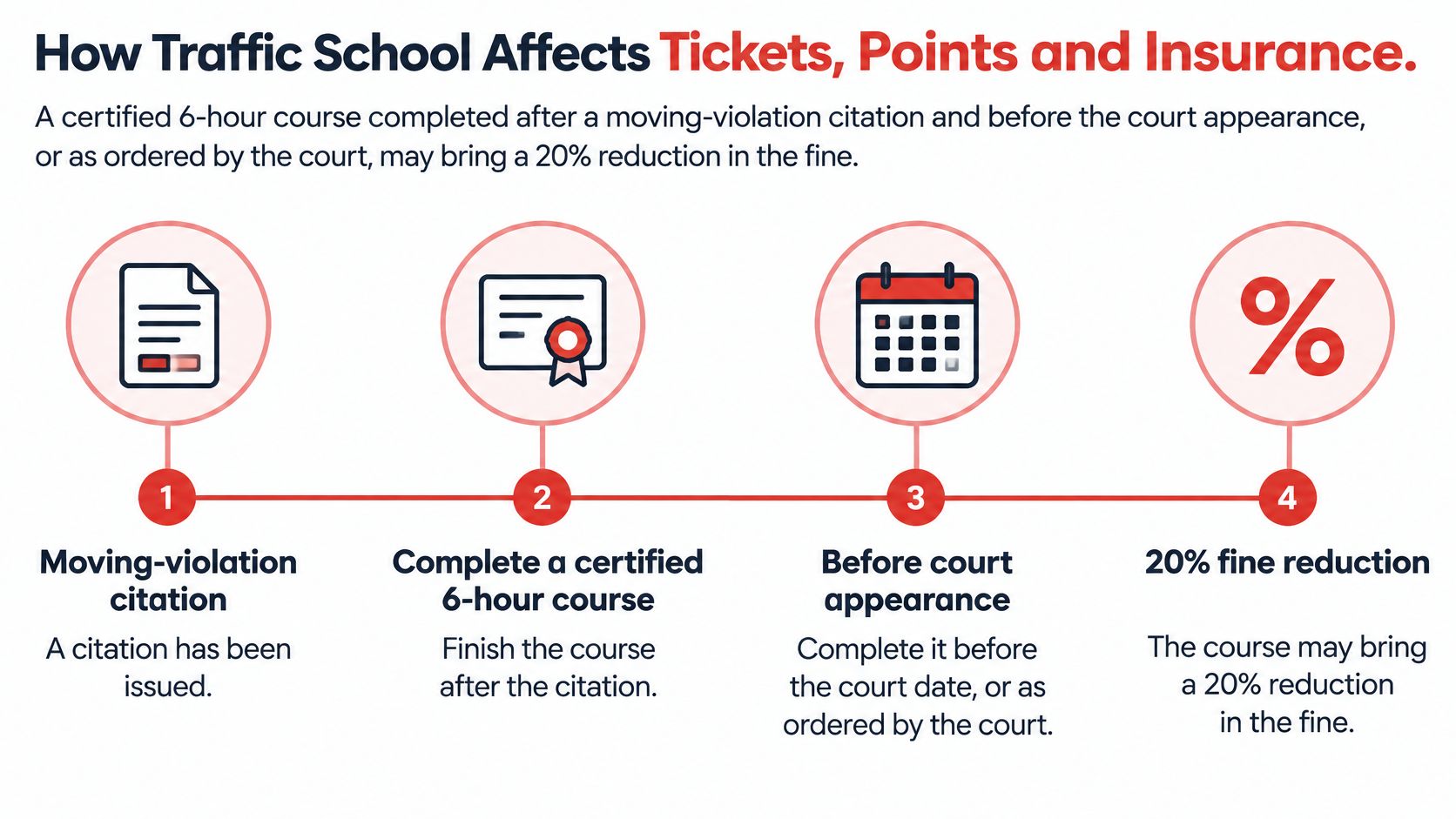
Under Georgia DDS driver-improvement guidance, completing a certified 6-hour course after a moving-violation citation and before the court appearance, or as ordered by the court, may bring a 20% reduction in the assessed fine, with no points assessed when the original certificate is presented to the court. Timing and documentation are part of the process, not administrative details to handle later.
Points avoidance and point reduction aren't interchangeable. Avoidance concerns the current citation before the applicable court disposition. Reduction concerns points already recorded and requires a separate DDS submission.
Follow the paperwork through to acceptance
- Confirm the court's instructions. Ask whether the course is ordered, whether you're eligible for the intended benefit, and when the certificate must arrive.
- Choose a DDS-certified course. Schedule completion early enough to handle certificate delivery before the applicable deadline.
- Protect the original certificate. Keep a scan for your files, but don't assume a scan replaces an original when one is required.
- Send it to the correct recipient. Present it to the court for the citation-related process or submit it to DDS for the relevant licensing action.
- Contact the insurer separately. Ask whether it recognizes the course, which policyholders qualify, and what documentation it wants.
For help understanding the distinction between a record entry and its point consequences, Brian Hansford Law's guide to Georgia driving history and points provides useful context. Our explanation of driver's license points can also help you prepare questions for DDS.
Don't treat course completion as proof that the court has processed the certificate. Keep delivery confirmation and check the case status through the court's established process.
A completion certificate isn't a promise of an insurance discount, ticket dismissal, or removal of every consequence.
Uncertified-school certificates aren't accepted for DDS licensing, reinstatement, or court requirements. A convenient schedule is useful only when the course meets the requirement you're trying to satisfy.
Joshua's Law Hours and How Online Courses and Driving Lessons Fit Together
For teens seeking a Class D provisional license, the DDS Joshua's Law FAQs specify 30 hours of driver education, either 6 hours of certified behind-the-wheel instruction or the approved Parent/Teen Driving Guide, and at least 40 hours of supervised driving, including at least 6 at night. These are complementary parts of preparation, not alternative names for the same class.
Joshua's Law requirements for a Class D provisional license
| Requirement | Hours or duration | Provided by | Key condition |
|---|---|---|---|
| Driver education, classroom | 30 hours | Certified driving school | DDS-approved course |
| Driver education, online | 30 hours | Certified virtual program | Equivalent DDS-approved virtual course |
| Behind-the-wheel instruction | 6 hours | Certified driving school | Or use the DDS-approved Parent/Teen Driving Guide |
| Supervised driving | At least 40 hours | Parent or guardian | Includes at least 6 hours at night |
| Instructional permit | At least 1 year and 1 day | Georgia Class CP permit | Held before the provisional license |
Online study handles education, not driving practice
Georgia's Joshua's Law requirements recognize an equivalent DDS-approved virtual program. An unrestricted internet course doesn't qualify because it discusses road signs or safe driving.
Online learning gives families flexibility around school, sports, and work. The student studies rules, decision-making, and safety concepts, then applies those concepts behind the wheel. Completing screens and quizzes doesn't demonstrate that a student can judge a gap in traffic or maintain lane position through a turn.
Choose a study schedule the student can maintain without rushing. After coursework on intersections, for example, a parent can discuss right-of-way decisions during a supervised drive, while an instructor can coach observation and approach speed during a lesson.
Driving lessons turn knowledge into repeatable skills
Professional lessons give a student focused feedback on steering, braking, lane position, scanning, and decision-making. Driving lesson packages suit families who want a planned sequence rather than unrelated appointments booked whenever a problem appears.
A useful progression begins with vehicle control in a suitable low-demand setting, then introduces intersections, lane changes, and more complex traffic as the student becomes ready. Parents can use supervised practice to reinforce the same habits between lessons rather than introduce several new challenges at once.
- Before a lesson: Tell the instructor which situations make the student hesitate.
- After a lesson: Identify the skills to reinforce during parent-supervised practice.
- Before adding complexity: Look for consistent observation and control, not confidence alone.
A teen who begins with a permit can spread supervised practice across ordinary family trips and planned practice sessions. Keep a driving log showing the date, conditions, skills practiced, and whether the drive occurred at night; don't leave the recordkeeping until the licensing appointment.
Our Driver's Education and Driving Lessons offerings include Georgia DMV-approved Joshua's Law education and road testing. Our locations offer day, evening, and online classes, allowing families to fit education around school or work; adults can also arrange lessons around their own learning needs.
Use our Joshua's Law requirements guide when organizing the education and practice components. When comparing packages, distinguish classroom or online instruction, in-car lessons, supervised family practice, and testing so you know what remains your responsibility.
Road Testing and the Class D License Path
Finishing a course doesn't finish the licensing process. The Georgia DDS Class D application guide says a teen generally must hold a valid Class CP permit for at least 1 year and 1 day, satisfy Joshua's Law and TADRA requirements, and pass the applicable Road Skills Test.
Treat testing as a separate appointment with its own readiness check. A student can understand the rules and still need coaching to apply them without reminders.
Prepare for independent decisions
During practice, work on smooth starts and stops, proper turns, intersection judgment, parking, and lane changes with mirror and blind-spot checks. Include observation for pedestrians and cyclists, and choosing a speed appropriate to conditions.
Common errors to address before testing include:
- Incomplete stops: Bring the vehicle to a complete stop rather than rolling through.
- Missing signals: Communicate before turning or changing lanes.
- Poor speed choice: Avoid both unnecessary hesitation and driving too fast for conditions.
- Skipped observations: Check the relevant mirrors and blind spots before moving.
- Loss of focus: After a small mistake, return attention to the next safe action.
Ask a certified instructor for a mock test using the applicable skills checklist and representative local roads. Don't rely on memorizing an exact route, which may not match the actual test.
Practice should show that the student can make safe decisions without a parent prompting every move.
For a driver whose mobility affects vehicle control, discuss assessment and equipment needs before arranging lessons or testing. Seat Belt Extenders' overview of driver assessment for limited mobility offers background for that conversation, but individual equipment decisions need qualified guidance.
Verifying a Certified Course and Scholarship Help
Before paying, verify the provider's approval for the particular program you need. Approval for one service doesn't establish that every course or delivery format will satisfy your court, DDS, or licensing requirement.
Our explanation of why certified driving instruction matters can help you identify questions to resolve before enrollment. For online education, confirm the program's approval rather than relying on a general statement that it teaches Georgia driving rules.
Compare the complete training cost
Compare driving lesson packages by what they include: education, in-car instruction, and testing. Ask about any remaining charges and scheduling conditions so a lower advertised enrollment price doesn't obscure the cost of finishing the pathway.
The Georgia Driver's Education Scholarship Grant Program may help eligible drivers pay for training. Confirm current eligibility, funding availability, application steps, and any approval needed before enrollment directly with the program and the school. Don't assume that paying first guarantees reimbursement.
Use this pre-enrollment checklist:
- Certification confirmed: The provider and course match the required program.
- Certificate details confirmed: You know the certificate type, delivery method, and recipient.
- Insurance treatment checked: The insurer has explained whether it recognizes completion.
- Scholarship eligibility checked: You've confirmed the current application process before committing.
- Deadline recorded: Your calendar includes completion and paperwork delivery.
- Package contents understood: You know which lessons and testing services are included.
Keep enrollment records, written acceptance information, receipts, and certificate copies together. Preserve the original certificate whenever the receiving authority requires it.
Enroll in the Right Course for Your Goal
Before choosing a schedule, complete this sentence: “I need this program accepted by ___ for ___ by ___.” If you can't fill in those blanks, resolve the missing information before enrolling.
For a citation, the accepting authority is the court. For a licensing action, it's DDS. For a teen learning to drive, the goal is a complete education-and-practice pathway, not merely obtaining the fastest available certificate.
Choose support for the driving you need to do
For new drivers, compare instructor-led and online Joshua's Law formats based on how the student learns and the family's schedule. Then give equal attention to driving lessons: which skills need instruction, how practice will continue between appointments, and how readiness for testing will be assessed.
Adults should identify their own goals just as clearly. Returning to driving, improving lane-change confidence, and preparing for a road test may call for different lesson priorities.
Before booking, check:
- Your goal: Identify the education, compliance, or practical skill you need.
- Your timing: Allow room for practice, paperwork, and the applicable appointment.
- Your documentation: Confirm what proves completion and who must receive it.
Ask about scholarship assistance while comparing the full training cost, not after making assumptions about coverage. Once the goal, deadline, and certificate requirement are confirmed, choose the course and lesson arrangement that matches them.
A-1 Driving School offers instructor-led and online Joshua's Law courses, driving lessons and lesson packages for students and adults, and Road Testing, including the Georgia Road Test. Visit A-1 Driving School to compare your options and ask about the Georgia Driver's Education Scholarship Grant Program. Confirm your goal, deadline, and certificate requirement, then book the course and driving lessons that fit your next step.