Your teen has a learner's permit, school is keeping everyone busy, and someone has started asking when to book the driving test. You're still sorting out which comes first: the Joshua's Law course, lessons, nighttime practice, or the appointment.
The way to pass a driving test is to turn that uncertainty into a skill plan. Keep the education paperwork alongside a driving log, record what still needs prompting, and use lessons to fix those gaps. Test-day preparation should start with the first supervised drive, not with a parking-lot cram session.
Class D Requirements Before Test Day
A teen with a permit hasn't finished the licensing process just because they can steer through the neighborhood. Joshua's Law education, supervised practice, permit time, and the road skills test are separate requirements. Passing the driving portion doesn't replace the others.
For the younger licensing route, the Georgia DDS Joshua's Law guidance describes 30 classroom hours or an equivalent certified online course, along with 6 hours of certified behind-the-wheel training or completion of the DDS Parent/Teen Driving Guide. It also requires at least 40 supervised driving hours, including 6 at night.
Georgia Class D steps by age path
Use this comparison to separate course completion from driving readiness.
| Requirement | Age 16 with driver's ed | Age 17 without driver's ed |
|---|---|---|
| Instructional permit | Held 1 year and 1 day | Held 1 year and 1 day |
| Driver education | 30 classroom hours or equivalent online | Not mandatory; still recommended |
| On-road instruction | 6 certified hours or Parent/Teen Guide | Supervised driving covers this path |
| Supervised driving | 40 hours, including 6 at night | 40 hours, including 6 at night |
| Road skills test | At least 75% | At least 75% |
| Road Rules written test | 15 correct out of 20 | 15 correct out of 20 |
The Georgia DDS Joshua's Law FAQs describe the age-16 route, including holding an instructional permit for 1 year and 1 day, and the alternative for applicants who wait until 17 without completing approved driver education. DDS still recommends education for that alternative, so waiting changes the eligibility route, not the need to learn safe driving.
Treat the age distinction as a scheduling decision, not a shortcut. A student seeking the earliest Class D path needs the course and practical preparation arranged early enough to finish without rushing.
Keep rules study beside road practice
The Road Rules written test is separate from the skills test. A student may handle the car smoothly yet misunderstand who yields at an intersection, so don't use comfortable vehicle control as proof that rules study is finished.
Review missed questions by topic. If right-of-way questions cause trouble, discuss those situations before driving through a similar intersection with a supervising adult. That connects the rule to something the student can recognize through the windshield.
Before booking: Identify what's unfinished: education, permit time, supervised practice, or independent execution of the maneuvers. A test appointment doesn't resolve an unfinished requirement.
Use the Class D licensing overview to organize the path, then check which age-path column applies before committing to a course or test date.
Online Driver Education Then Road Time
An online Joshua's Law course solves a scheduling problem. It doesn't solve a steering, observation, or judgment problem.
Under Georgia DDS Joshua's Law requirements, students may complete 30 hours of approved online instruction, followed by either 6 hours of certified-school driving instruction plus 40 supervised parent or guardian hours, or 40 hours of parent-taught driving using the DDS Parent/Teen Driving Guide. A learner's permit is required before behind-the-wheel training, and the permit must be held for 1 year and 1 day before receiving a Class D license.
Use the course to prepare for decisions
Work through traffic laws, signs, safe technique, distraction, impairment, and basic vehicle care as subjects to apply, not just pages to finish. After studying lane markings, for example, ask the student to explain where a lane change would be legal before the next supervised drive.
Choose a course format that fits how the student learns. Online study offers flexibility around school, while instructor-led classroom learning gives students a place to ask questions as they arise. Review the course's access and completion rules before planning study sessions.
Keep a notebook beside the computer for questions that need practice on the road.

Choose the practical pathway deliberately
The certified-instructor route and the parent-guided route require different planning.
- Certified instruction: Use the instructor's feedback to identify what the family should rehearse between lessons. Don't treat the lesson and home practice as unrelated activities.
- Parent-guided training: Follow the Parent/Teen Driving Guide rather than making every session a familiar trip to school or the store.
- Nighttime practice: Put these sessions on the family calendar. They're easy to postpone when daytime driving already feels convenient.
For metro Atlanta and Athens families, our locations offer day, evening, and online classes. Students who concentrate better in person can consider instructor-led classroom learning, including high-school programs, rather than choosing online study solely because it sounds easier.
The online certificate never replaces road hours. A completed course tells you the education block is finished, not that the student can make an unprompted left turn.
When choosing practical instruction, bring unfinished log items: prompted turns, parking too far from the curb, backing across boundaries, or difficulty seeing at night. Match a driving lesson package to those skills rather than adding aimless mileage or another round of theory.
Maneuvers Georgia Examiners Score
The Class D road test works like a checklist performed in motion. Each instruction gives the examiner a chance to observe what you check, where you stop, and how smoothly you control the vehicle. A driver can know every maneuver and still lose points when observation, lane position, or speed control arrives late.
A practice run should begin with a smooth start, controlled acceleration, and progressive braking. Keep the car centered, choose the correct approach lane, and finish each turn in the proper lane. At intersections, stop fully where required, yield correctly, and check for pedestrians before moving.
Georgia road-test skills and practice targets
The Georgia DDS road-test guidance sets the parallel-parking target at a 22-foot-by-10-foot space, finishing no more than 18 inches from the curb, and straight backing at approximately 50 feet at no more than 10 mph. The passing threshold is at least 75%.
| Skill | What a pass looks like | Practice target |
|---|---|---|
| Starts and stops | Smooth, with no lurch or late braking | Full stop before crosswalks |
| Turns | Signal, correct lane, controlled speed | Complete right and left turns in the proper lane |
| Lane changes | Early signal, mirrors, blind-spot check | A clean change without drifting |
| Following distance | Gap that grows with speed and conditions | No tailgating on arterials |
| Parallel or lined parking | Inside the space, controlled | Parallel parking: finish inside a 22-foot-by-10-foot space and no more than 18 inches from the curb |
| Straight backing | Head turned, slow, inside the lines | Back approximately 50 feet at no more than 10 mph |
| Three-point turn | Controlled, traffic checked | Check traffic before each movement and finish under control |
| Speed and observation | Legal speed, signs, people, cyclists | Adjust for weather and school traffic |
Practice parallel parking and parking between marked lines instead of assuming the test site will match your usual lot. During backing, turn your head to look behind the vehicle. A quick mirror glance does not provide the same view.
The 75% target reflects a logged skill plan built through Joshua's Law hours and supervised practice. A final-week cram may rehearse maneuvers, yet timing, distance judgment, and observation habits take repeated road sessions to become consistent.
Make the safety routine visible
Signal before the maneuver, stop before the crosswalk, and check both directions. Keep both hands on the wheel during ordinary driving. Complete observation checks naturally instead of making exaggerated movements for the examiner.
For lane changes, separate the tasks: assess traffic, signal early enough to communicate, check the mirrors and blind spot, then move when the gap is safe. A signal announces an intention; it does not create permission.
The Georgia DDS test information page states that the skills test is available only in English. Practice understanding stop, turn, and park directions in English before test day so language uncertainty does not compete with vehicle control.
A minor error does not necessarily end the test. Correct safely, listen, and focus on the next instruction rather than rushing to compensate.
Compare rehearsals with a driving-test rubric to identify errors that repeat across sessions. After licensing, keep building skill on unfamiliar roads, nighttime trips, and more complex traffic while keeping the phone put away and passengers within license restrictions. Controlled test maneuvers are only the beginning of independent driving.
How to Practice for the Road Test
A useful practice log records what the student did without help, not just how long the engine ran. If a parent still says “brake,” “signal,” or “look left,” record that prompt.
The Georgia DDS tips for teens call for at least 40 supervised hours, including 6 nighttime hours. The same guidance says the Road Rules test requires 15 correct answers out of 20 and reports a 68.02% pass rate for that portion, a reason to keep targeted rules review beside driving practice.
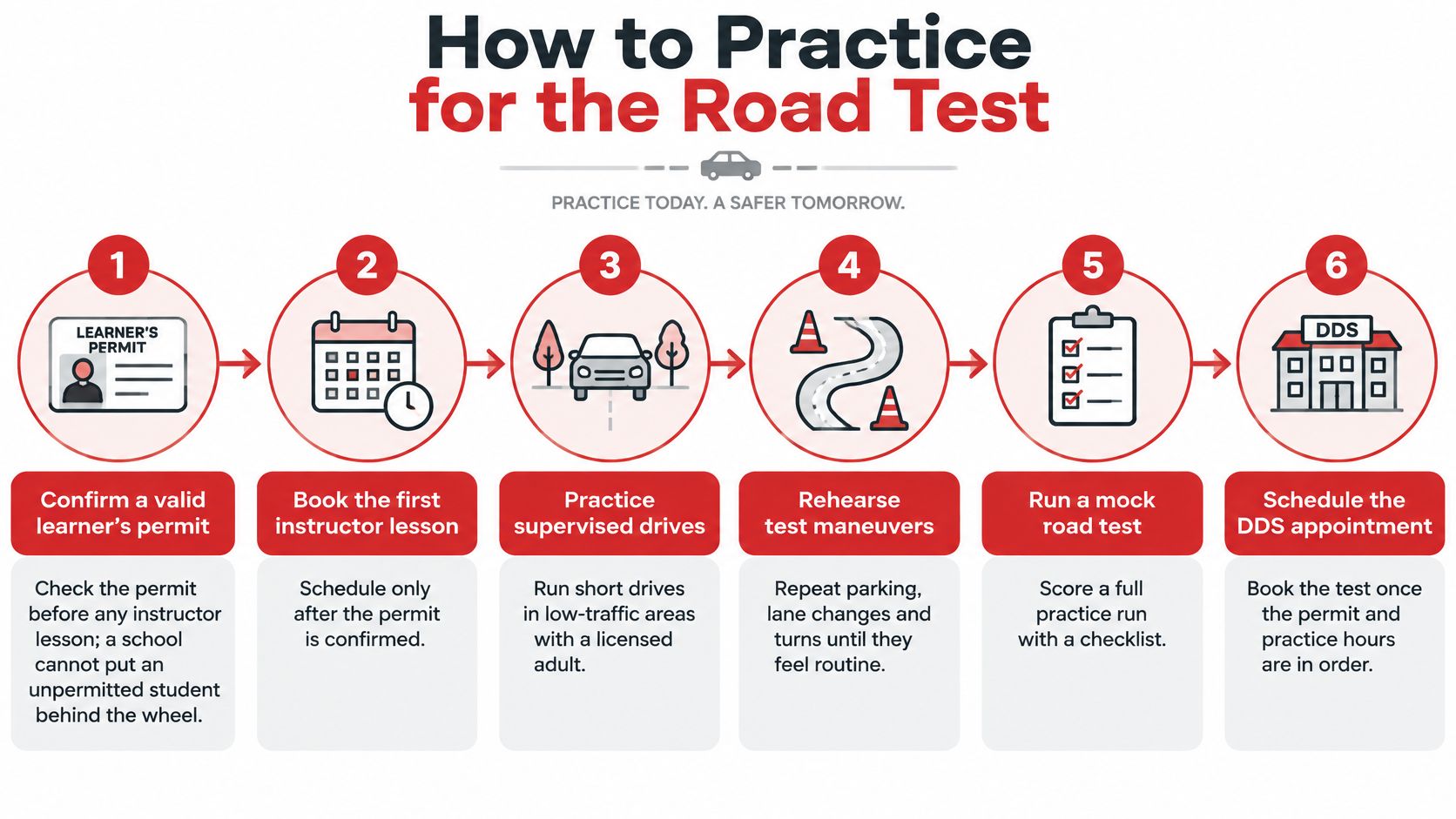
Use this visual to organize the preparation sequence.
Build skills in manageable blocks
Confirm the learner's permit. Check that it's valid before booking behind-the-wheel instruction. Our students must have a valid Learner's Permit or Driver's License to take a driving lesson; an unpermitted beginner can't start driving instruction.
Begin with control and scanning. Use a suitable quiet lot or low-traffic neighborhood to rehearse smooth starts, full stops, centered positioning, and steady hand placement. Ask the student to identify signs and possible hazards ahead so looking outward becomes part of controlling the car.
Add intersections and turns. Move on when basic control no longer needs constant reminders. Rehearse correct approach lanes, timely signals, stopping before crosswalks, and looking both ways; watching only for traffic from the expected direction leaves an observation gap.
Separate the difficult maneuvers. Give lane changes, following distance, parking, and backing their own practice blocks. If backing crosses a boundary, reset and identify whether the student started crooked, steered too much, or looked away from the travel path.
Schedule nighttime driving deliberately. Begin on roads already familiar from daylight practice once daytime control is reliable. Discuss what's harder to see, reduce distractions, and avoid combining the student's first night session with an unfamiliar complicated route.
Record performance and the correction. Log the date, route type, weather, day or night conditions, errors, corrective action, and whether the maneuver was unprompted. “Turned safely after a reminder” is more useful than “good drive” because it tells the next supervising adult what to rehearse.
Let the log decide when to advance
A log entry might read: “Neighborhood intersections, dry daylight conditions, late turn signal, repeated approach with earlier planning, still needed a reminder.” That gives the next session a starting point.
Short, repeated skill blocks are more useful than exhausting the learner with a weekend cram. End a difficult drill after a clean, understood correction, then revisit it during a later session to check whether the student retained the habit.
Practice standard: Required hours establish a minimum. Readiness means the student can repeat the skill safely without a parent supplying the missing decision.
Use this road-test preparation video as a discussion prompt before a supervised session.
Before scheduling, run a mock test without coaching except when safety requires intervention. Mark each prompt accurately, then match weak log entries to extra instructor time and a focused driving lesson package, not unsupervised miles.
Papers and People to Bring to the Test
Good driving won't fix missing vehicle documents. Before the appointment, confirm that the applicant, accompanying driver, and test vehicle meet the requirements.
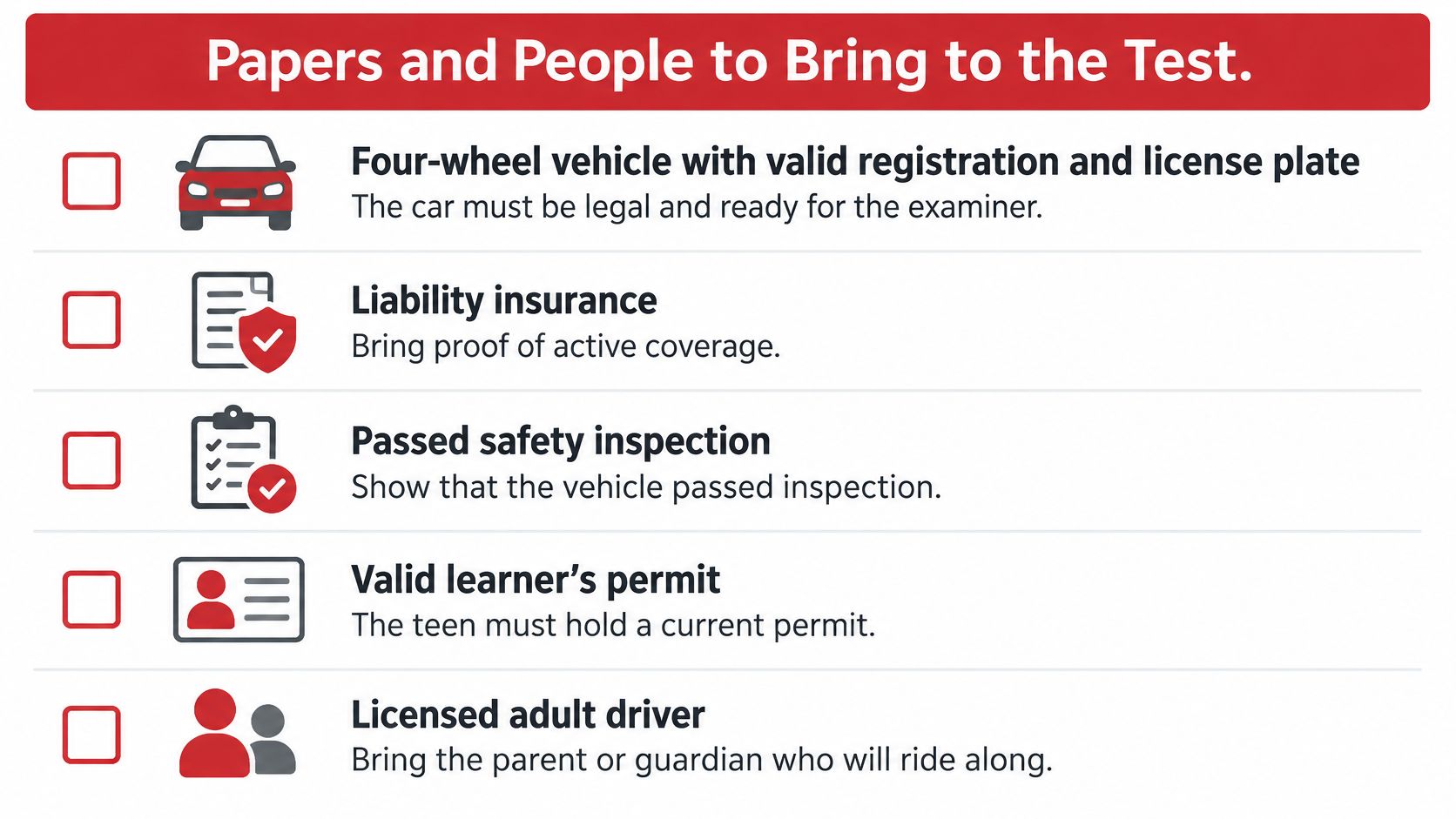
The Georgia DDS Class D application guidance requires a four-wheel vehicle with valid registration and a license plate. For a temporary dealer tag, bring proof of purchase, generally a bill of sale from within the previous 30 days, or within 7 days for a vehicle bought from a third party.
Check the vehicle and accompanying adult
Pack the documents together rather than assuming they're already in the glove compartment.
- Vehicle registration and plate: Match the paperwork to the vehicle being used, especially if the family recently changed cars.
- Liability insurance: Have proof of active coverage available and readable.
- Safety inspection: Make sure the vehicle passes the required safety check.
- Learner's permit: Bring the applicant's valid permit, not just course paperwork.
- Licensed accompanying driver: Bring a driver age 21 or older. Only the applicant and that driver are permitted in the vehicle under the DDS testing arrangement.
- Completed licensing records: Have the education and supervised-driving requirements finished before treating the skills test as the last booking.
Use this checklist while gathering the test-day materials.
Avoid the recently purchased car problem
Say a family plans to test in a car bought from a dealer, but the bill of sale is still in a folder at home. The temporary tag doesn't eliminate the proof-of-purchase requirement. Gather the purchase documents before leaving rather than expecting the tag alone to settle the question.
Walk around the car the night before. Check lights, turn signals, horn, wipers, tires, mirrors, and plates, and address warning lights instead of hoping they won't matter. Clear loose objects from the footwells and leave unnecessary personal items at home.
Know how to adjust the seat, operate the defroster, and find the hazard lights in that particular vehicle. Borrowing an unfamiliar car at the last moment adds tasks the student shouldn't be learning in the test lot.
A test-ready car is one the applicant can operate confidently and document properly.
Use the drive to the appointment for normal, careful driving, not a final burst of coaching. Once parked, pause and organize the paperwork. If a required document is missing, resolve it or reschedule rather than assuming driving ability will make up for it.
Book Lessons and a Georgia Road Test
Book the service that addresses the unfinished requirement. A student who understands the rules but needs reminders at every intersection has a different need from a student who drives consistently but hasn't completed the education course.
Match the booking to the gap
If education is unfinished, choose the learning format first. An instructor-led Joshua's Law course suits students who benefit from direct explanations and classroom questions. An online course suits students who can manage their study schedule and follow through independently.
If execution is inconsistent, prioritize driving lessons. A package gives the family a way to plan instruction around related problems instead of asking an instructor to fix everything in a hurried pretest session. Share the log so the lesson can begin with the weak maneuver rather than repeating skills already performed cleanly.
For example, prompted left turns call for work on approach planning, gap judgment, and lane placement. Parking errors may need a different session focused on low-speed control and reference points. The package should support that progression, with supervised family practice between lessons.
Finish with a readiness-based test booking
At A-1 Driving School, we offer instructor-led and online Joshua's Law driver's education, driving lessons for teens and adults, and Georgia Road Testing. Our driver's education path includes education and road testing, and families can plan driving lesson packages around the certified instruction requirement and additional skill practice.
We're family-owned and have served Georgia drivers since 1987, with locations across metro Atlanta, including Athens. Families who qualify can ask about the Georgia Driver's Education Scholarship Grant Program, which can cover training for eligible students; confirm eligibility and what the award covers before arranging training.
When the practice record and vehicle paperwork are ready, use our Georgia road-test scheduling page to arrange the testing step. Don't assume every licensing task requires the same appointment or that a booked test proves readiness.
Bring the driving log to the first lesson and keep updating it afterward. The decision to test should come from consistent, unprompted performance, not pressure to use an appointment that was booked too soon.
A-1 Driving School offers Joshua's Law courses, teen and adult driving lessons, driving lesson packages, and Georgia Road Testing. Visit A-1 Driving School to choose your course or arrange lessons, and bring your practice log so instruction starts with the skills you still need to master.