

You're staring at a piece of paper that decides what you do next. Maybe it's a citation with a court date circled, maybe it's a DDS notice about your license, maybe it's your teenager's learner's permit and a calendar that suddenly looks a lot shorter than it did last week. The phrase "defensive driving course" shows up in all three situations, and that's exactly where drivers get confused. One certificate can serve a judge, a licensing agency, an insurance agent or nobody but you, and each of those readers wants something different.
I teach Georgia drivers for a living, and the first thing I ask anyone who calls is simple: what's the reason, and what's the date? Answer those two questions and the rest of the plan falls into place. Skip them and you can end up paying for the right class at the wrong school, or finishing a course three days after the deadline that mattered.
Defensive Driving in Georgia at a Glance
A Georgia defensive driving course is a 6-hour program certified by the Department of Driver Services (DDS), built to change unsafe driving attitudes and behaviors and to help rehabilitate problem drivers. The DDS defensive driving program FAQs treat "defensive driving" and "driver improvement" as interchangeable names for the same approved course, and DDS keeps certified Driver Improvement Schools in their own category, separate from driver education, road testing, motorcycle and DUI programs.
That separation matters more than expected. A school approved to teach teens isn't automatically approved to issue a driver improvement certificate, and DDS states plainly that courses completed at uncertified schools won't be accepted for licensing, reinstatement or court requirements.
Five reasons drivers enroll, and what each one requires
The reason you're taking the course controls the paperwork, the recipient of your certificate and the clock you're working against.
Five reasons to take a Georgia defensive driving course
| Reason for Course | What It Does | Requirement to Count |
|---|---|---|
| Court-ordered | Satisfies a judge's order by the stated deadline | Certified 6-hour course; confirm the deadline with the court |
| License reinstatement | Supports reinstatement through DDS | Certified course completed and documented |
| Point reduction | Can reduce up to 7 license points, once every 5 years | Original completion certificate submitted to DDS |
| Insurance inquiry | May lead to a premium reduction | Eligibility and amount confirmed by the insurer; not guaranteed |
| Personal education | Builds safer attitudes and driving behaviors | Certified course from a DDS-certified provider |
The points chain, in the order it actually happens
Under O.C.G.A. § 40-5-86, successful completion of a certified course supports a reduction of up to 7 license points, limited to once every 5 years, according to the DDS driver improvement program guidance. The chain has three links: complete an approved course, obtain the original completion certificate, then submit it to DDS in person or by mail. Finishing the class does not, by itself, take anything off your record.
The course is the easy part. The submission is where drivers lose the benefit, because nobody at DDS knows you sat in a classroom until your certificate arrives.
Three outcomes get tangled together constantly, and they're separate. A court deadline is set by the judge and satisfied by delivering proof to the court. A DDS point reduction is an administrative action you initiate with the agency. An insurer discount is a private contract decision, and DDS doesn't guarantee insurance savings, so you have to confirm eligibility and the amount directly with your carrier. A driver can win one of those and get nothing from the other two.
Start with a record check, then name your objective out loud: adjudication, reinstatement, points or insurance. Before you pay anyone, confirm the provider appears on the DDS certified Driver Improvement list. Write your reason and your deadline on the same sticky note and keep it visible until the certificate is filed, because a course completed for the wrong purpose is a course you may end up taking twice.
Which Course Fits Your Situation
Four kinds of drivers call a Georgia driving school, and only one of them needs the six-hour compliance course. The heaviest requirement load belongs to teenagers, so start there.
The DDS Joshua's Law requirements build a specific pathway for 16- and 17-year-olds seeking a Class D license: 30 hours of classroom instruction or an equivalent 30-hour online course, plus 6 hours of behind-the-wheel instruction through a certified school (unless using an approved alternative DDS describes), plus at least 40 hours of supervised driving with a parent or guardian, including at least 6 hours at night. The student must also hold the learner's permit for 1 year and 1 day before the Class D license is issued.
Course and hour requirements by driver type
| Driver Type | Course Needed | Behind-the-Wheel and Supervision | Road Test |
|---|---|---|---|
| Teen aged 16-17 seeking Class D | 30-hour Joshua's Law course | 6 hours with a certified school; 40 supervised hours, 6 at night | Required |
| Driver with a ticket or points | 6-hour DDS-certified defensive driving course | Not applicable | Not applicable |
| Adult new to Georgia driving | Driver education optional; certified course recommended | Lessons optional | Required when applying for a first Georgia license |
| Parent supervising a teen | Teen completes Joshua's Law course | Log 40 supervised hours, 6 at night | Not applicable |
A worked permit example
Say a student receives an instructional permit on March 1. The earliest that student can be issued a Class D license is March 2 of the following year, and the education, supervised hours and testing all have to be finished inside that window. Families who plan backward from the birthday instead of the permit date usually discover the gap in the last month.
A teen permit holder also has to satisfy the ADAP obligations and stay clear of major violations that trigger permit suspension. A defensive driving course does not stand in for Joshua's Law, and it doesn't shorten the permit period.
Practical rule: the permit date, not the sixteenth birthday, sets the earliest license date.
If you're a ticket holder, your path is the compliance course and the certificate. If you're an adult who's new to Georgia roads or new to driving entirely, lessons are the useful investment, and it's worth reading up on what a defensive driving course costs before you assume it's the product you need. Parents, your job is the log and the passenger seat.
Online Versus Classroom Driver's Education
| Factor | Classroom Course | Online Course |
|---|---|---|
| Format | Instructor-led sessions at a set location | Self-paced modules at home |
| Schedule | Set class times | Study on your own timetable |
| Best for | Students who want structure and peer discussion | Students with shifts, distance or busy schedules |
| Verification | Confirm DDS certification of the school | Confirm DDS certification of the course |
| Practical training | Separate 6 hours behind the wheel still required | Separate 6 hours behind the wheel still required |
The content isn't the variable here. Both formats cover the same Joshua's Law material, and either one can satisfy the classroom-hours requirement. What changes is how the student is held to a schedule and who's in the room when a question comes up.
One decision rule
Choose classroom if the student needs fixed deadlines, a teacher watching for confusion and other students to argue with about right-of-way. Choose online if the family works shifts, the student studies at odd hours, or the drive to a class location would eat an evening every week. I'd rather see a motivated student finish an online course in three weeks than watch a classroom student miss two sessions and restart.
We run both instructor-led and online Joshua's Law courses, and our Driver's Education and Driving Lessons courses include Georgia DMV-approved Joshua's Law / Driver's Education courses, including all education and road testing. That bundling matters for parents who don't want to coordinate a classroom provider, a behind-the-wheel provider and a testing appointment across three different calendars.
One warning before you enter a card number. Confirm the provider's DDS certification first, and confirm the completion certificate will be accepted for your permit or license application. A slick website with a countdown timer isn't evidence of state approval, and a cheap unapproved course costs you the whole tuition plus the time you can't get back.
Driving Lessons and Packages That Build Road Skills
Passing a course and driving confidently are two different achievements. A student can score well on every module and still freeze at a four-way stop with a delivery truck behind them.

The required behind-the-wheel hours are a floor, not a finish line. Plenty of students add lessons for highway merging, for nerves after a near miss, or for the night hours a working parent can't supervise. Adult students often want the opposite of the teen curriculum: heavy traffic, parking garages, unfamiliar intersections near a new job.
What a lesson should actually cover
A productive hour behind the wheel works on smooth starts and stops, steering input and lane position, lane changes with mirror and blind-spot checks, turn setup and intersection judgment, parking, and speed control that matches traffic rather than the number on the sign. Repeating one weak maneuver five times in a quiet setting beats driving aimlessly for an hour. Our defensive driving practices guide covers the habits worth drilling between sessions.
Choosing a package without guessing
- Hours included: count them, and ask whether the required behind-the-wheel hours are part of that total or billed on top.
- Course bundling: check whether the Joshua's Law course is included, so you're not paying twice for overlapping material.
- Pickup and slots: our Decatur lessons include free pick-up from home or work, with day, evening and weekend appointments.
- Instructor continuity: ask whether the same instructor stays with the student, because a familiar voice corrects a habit faster than a new one each week.
Here's a short look at how a lesson runs in practice.
If a student misses two lessons before the road test, reschedule the test rather than cramming both sessions into one afternoon. Fatigued practice installs sloppy habits right when the examiner is about to look for clean ones.
What the Georgia Road Test Checks
| Skill Area | What the Examiner Checks | Practice Before Your Test |
|---|---|---|
| Basic control | Smooth starts, stops and steering | Practice in an empty lot |
| Turns and intersections | Full stops, yielding and correct lane | Practice right and left turns at busy intersections |
| Lane changes | Mirror and blind-spot checks, early signals | Practice on multi-lane roads |
| Parking | Parallel parking or parking between lines, varies by test site | Ask the test site which maneuver it uses |
| Observation and awareness | Pedestrians, cyclists, signs and following distance | Narrate hazards out loud while driving |
| Speed control | Appropriate speed for traffic and weather | Drive at posted limits without lagging behind traffic |
Education alone doesn't produce a Class D provisional license. DDS licensing materials require the applicant to schedule the road-test appointment, satisfy Joshua's Law and pass a road skills test that evaluates safe vehicle operation. The test is its own step, with its own preparation, and it rewards students who've practiced the specific maneuvers they rarely drive.
The mistakes that cost students a pass
Rolling through stop signs is the classic. So is forgetting a signal on a turn the student has made a hundred times from muscle memory. Speed cuts both ways: exceeding the limit fails, and creeping well below the flow of traffic reads as poor judgment. Skipped blind-spot checks and a full panic after one small error round out the list. A stall isn't fatal. Abandoning the wheel because of a stall is.
Book a practice drive with an instructor in the week before the test, on roads similar to the ones around your test site. Call the site and ask which parking maneuver it uses, since that requirement isn't uniform. We handle road testing and test preparation, so a student can rehearse and test with instructors who already know which habit needs one more correction.
Enroll in a DDS-Certified Course Before Your Deadline
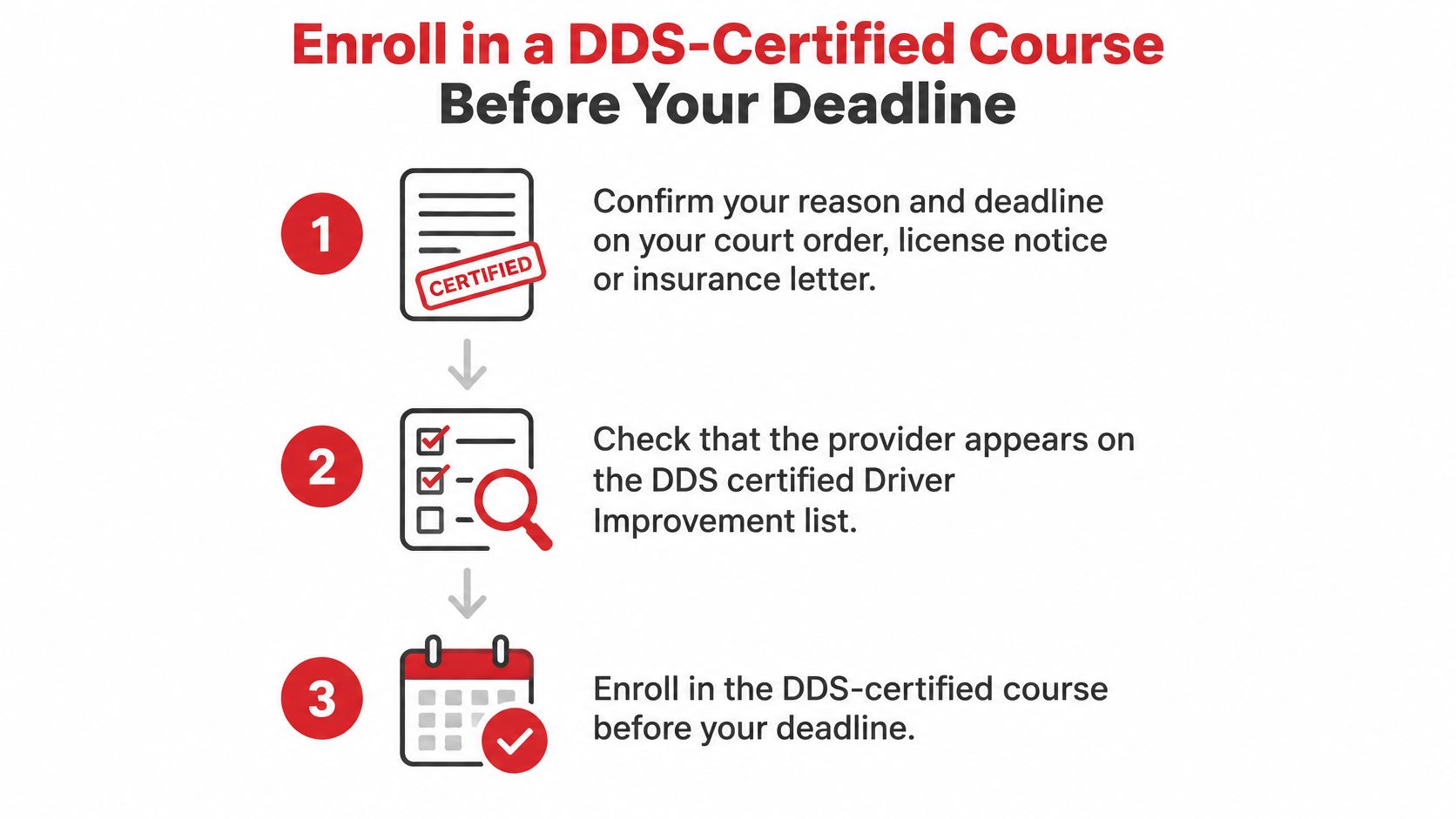
- Confirm your reason and your deadline. Read the court order, license notice or insurance letter and write down the exact date and the exact recipient of your certificate.
- Check the DDS certified Driver Improvement list before you pay. Approval is per school and per program category, not per advertisement.
- Match the provider's certification details against that list. Our Decatur location holds Georgia state certifications #1472 & 819 for A-1/I-285/Memorial Drive Driving & Defensive Driving School and #091 for A-1 Driving School Inc. – Memorial Drive/I-285, and our Atlanta location holds #1478 & 818 for A-1/I-85/Cheshire Driving & Defensive Driving School and #090 for A-1 Driving School Inc. at I-285 Cheshire Bridge. Numbers you can verify beat a badge on a homepage.
- Pick your format using the classroom and online comparison, then book the class session that finishes ahead of your deadline with room to spare.
- Book behind-the-wheel lessons and the road test, adding hours where the student needs improvement rather than where the package is cheapest.
- Keep the original certificate and file it with DDS or the court before the deadline. A photocopy may not be accepted, and if you're unsure what the assessment involves, review the defensive driving course exam expectations first.
If a court order drives your timeline, read the order's own wording rather than general advice. Court-imposed conditions get revised, and Miles Hansford Law Firm's discussion of changes to sex offender supervision terms shows how specific and changeable those conditions can be. Your paperwork controls your obligations.
Before enrolling, check your eligibility for the Georgia Driver's Education Scholarship Grant Program on its official state page. Criteria vary, so don't build your budget around qualifying until you've confirmed it.
We've taught Georgia drivers since 1987 across 18 locations, from Athens to Atlanta to Buford, with instructor-led and online Joshua's Law courses, teen and adult driving lessons, and Georgia road testing under one roof. Tell us your reason and your deadline and we'll build the schedule backward from it, whether that means a compliance certificate filed on time or a nervous student who finally merges without holding their breath. Visit A-1 Driving School to compare course formats and book your first lesson or class session.