

You're sitting in the parking lot after your Georgia road test, replaying the turn where you hesitated or the lane change where you forgot a mirror check. The examiner hands you a score sheet, and the word “failed” can make the whole drive feel like a judgment on your ability.
It isn't. Treat the sheet as a list of specific behaviors to fix, not a verdict. Across full-year practical-test results in Great Britain, about half of tests ended without a pass in each reported year from 2020 through 2023, according to official parliamentary driving-test data. Failing is a common test outcome, but repeating the same attempt without changing your practice is a poor plan.
The Moment the Examiner Hands Back the Score Sheet
The first thing many applicants do is focus on the result. The more useful move is to look at what the examiner marked. A missed observation, an inconsistent turn, or a parking error points to a different practice need. Once you name the behavior, you can work on it deliberately instead of wondering whether you're “just not ready.”
Georgia's Department of Driver Services allows the examiner to review the completed score sheet with you immediately after the test. Take advantage of that conversation. Ask what the deduction means in practical terms, and make sure you understand which action the examiner wanted to see. Don't leave with only a general impression such as “I need to be more careful.”
A failed test can shake your confidence, especially if nerves made ordinary driving feel unfamiliar. If anxiety is making it hard to process the feedback, this guide for anxious test-takers offers another way to think about pressure and preparation. Then return to the score sheet and turn each marked item into a task you can practice.
Start with evidence: Write down the examiner's feedback while you still remember the drive. Sort each deduction into a skill, then decide how you'll demonstrate that skill correctly next time.
The next step is not to immediately book another test. First, identify whether your main issue was vehicle control, observation, decision-making, or a specific maneuver. Georgia's scoring threshold, retake rules, and lesson options make more sense once you know what needs work.
How Georgia Scores Your Road Test
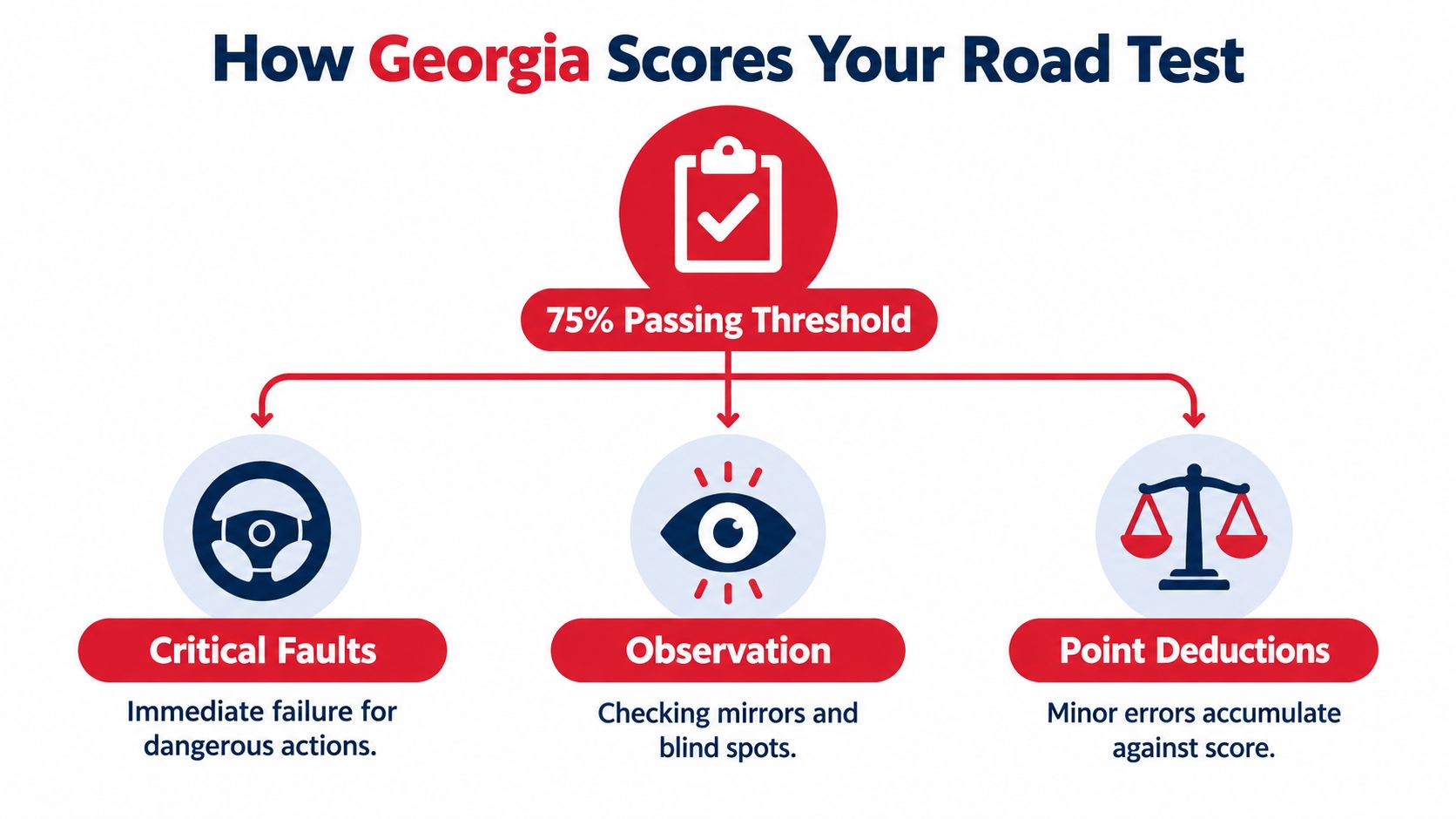
Georgia DDS requires at least 75% to pass the road test, per the Georgia DDS testing information. Treat the sheet like a diagnostic tool. Each mark should lead to one behavior you can rehearse before the next attempt.
The examiner is scoring control, awareness, position, and judgment while traffic is moving. A weak result usually clusters in one area: mirror checks before lane changes, speed control on turns, space management behind another vehicle, or clean execution on the required parking task. Some mistakes can end the test early, but DDS does not publish one universal formula that labels every error the same way, so do not guess at the weight of a mark.
Use the table to turn a broad label into a lesson plan. The wording is an example set for diagnosis, not a claim that DDS uses these exact phrases on every score sheet.
Common Georgia Road Test Scoring Categories
| Scoring Category | What the Examiner Scores | Practice Target to Book |
|---|---|---|
| Vehicle control | Smooth starts, stops, steering, and speed control | One lesson on braking points and low-speed control |
| Observation | Mirror, blind-spot, and intersection checks before action | Traffic-scan drills repeated until checks are automatic |
| Turns | Approach position, steering timing, and exit lane | Left and right turn repetitions on varied intersections |
| Lane position | Staying centered and choosing the correct lane | Lane-placement practice with verbal cues |
| Following distance | Safe space behind the vehicle ahead | City and highway spacing drills at changing speeds |
| Parking | Control, positioning, and awareness during the task | Slow maneuver practice with cones or marked space |
| Traffic-signal response | Correct reaction to signs, lights, and right-of-way | Signal-response routes with stop-and-go decision making |
My advice: match the package to the deduction. If the mark was observation, buy scanning repetitions, not a generic hour behind the wheel. If parking cost you, schedule a maneuver block. When a label is unclear, compare it with this Georgia road test rubric and choose the lesson that trains that exact behavior.
Retake Rules and Wait Times in Georgia
Georgia's retest clock is short enough to tempt you into booking before you're ready. A first failure on a Class C or D road test lets you retest as early as the next day. Fail a second time and the wait stretches to seven days, per Georgia DDS appointment information. Those windows answer when you can retest. They say nothing about whether you should.
Choose where to retest
Book the next attempt through DDS or ask a DDS-certified driving school whether it administers road tests. Fees are not uniform across providers, so confirm the current charge directly with whoever will test you before you commit to a date. An assumed amount is a bad reason to pick a testing location.
For a DDS appointment, follow the instructions attached to your test result and confirm what to bring. Keep your permit and identity documents together, and verify appointment requirements before leaving home. If you test through a certified school, ask that school what documents and vehicle arrangements it requires.
Then decide what has changed since the failed attempt. If the same observation or vehicle-control fault still shows up in practice, a new date buys you a second score sheet with the same deduction. Book a lesson or a mock test that trains the marked category, prove the correction under realistic conditions, and only then pick a retake date. The right date is the one that gives you time to fix the fault, not the earliest opening on the calendar.
Watch this Georgia road-test overview to see how test day runs, then check your own appointment instructions because procedures and availability vary by testing location.
The Faults That Cost the Most Points
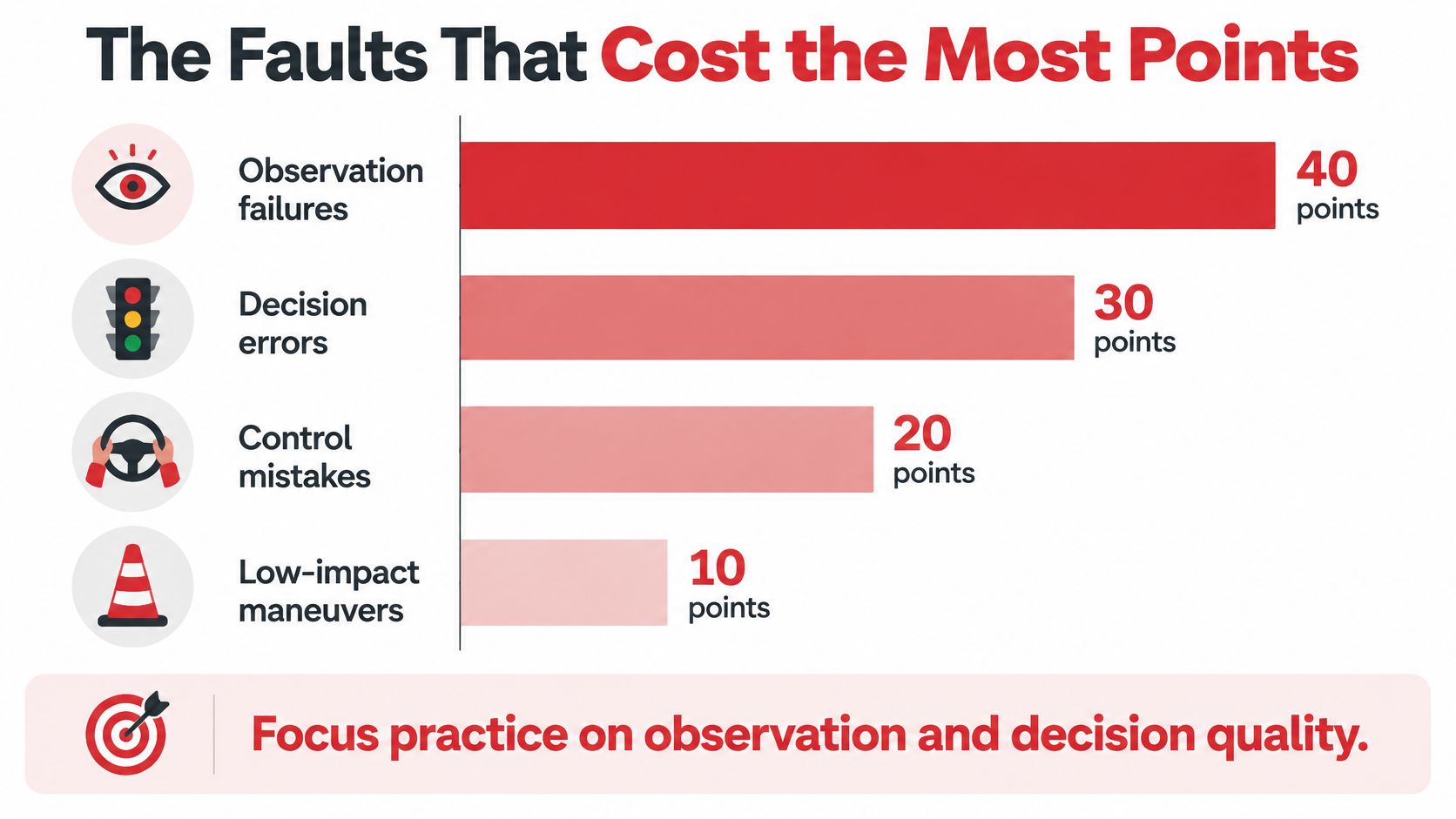
Treat the score sheet like a repair order, not a verdict. On a Georgia road test, the expensive faults are the ones that make the examiner question whether you saw the hazard, chose a safe response, and kept the car under control while doing it. A crooked park may cost points; a missed observation at a junction can end the test.
The pattern shows up beyond Georgia. The DVSA's review of driving-test faults ranked inadequate observation at junctions first and ineffective mirror use when changing direction second, and those two categories accounted for 368,047 failures in the cited one-year period, according to the DVSA review of common test faults. That is British data, but the fault logic travels: examiners penalize drivers who move before they look.
The safety case is just as blunt. NHTSA's national crash-cause survey assigns recognition errors such as inattention, distraction, and inadequate surveillance as the critical reason in about 41% of investigated crashes and decision errors in about 33%, according to the NHTSA critical-reason report. Those figures describe crashes, not DDS deductions. They tell you why observation faults sit near the top of the sheet.
Make your checks visible and repeatable
Convert each marked fault into a lesson module with a clear standard. Junction observation becomes a junction module. Lane changes become a mirror, signal, blind-spot, gap module. Parking stays in the plan only if the sheet says so.
My rule for retake prep is simple: buy practice for the categories the examiner marked. Two or three focused lessons that target observation, gap choice, lane position, speed control, or vehicle handling will do more than another week of casual driving. Ask for a package built around your deductions, then repeat each task until the correction holds at normal traffic speed. If the same glance, drift, or late brake still shows up, you are not ready to book.
Building a Retake Plan With Driving Lessons
More driving time helps only when it addresses the right problem. If the examiner noted missed mirrors, spend lesson time rehearsing mirror checks before each directional change. If following distance was the issue, practice using a roadside reference point and counting “one-thousand-one, one-thousand-two” after the vehicle ahead passes it. Your car shouldn't reach that reference point before the count ends.
A targeted driving lesson should connect the score-sheet deduction to a repeatable action. If turns caused trouble, practice approach, positioning, observation, and steering as one sequence. If parking was the issue, repeat the exact parking task while maintaining control and checking surroundings. For lane-position problems, practice selecting and holding the correct position through turns and changes in road conditions.
Families can compare individual lessons with a package that gives the student focused time across more than one weak area. Don't buy practice for its own sake. Ask whether the instructor can work from the score sheet, rehearse the failed tasks, and run a mock test that reveals whether the corrections hold when the student is under pressure. Road test lessons are one option for structured preparation.
My recommendation: For one isolated mistake, book a focused lesson on that skill and verify it in a mock test. If the sheet shows repeated observation or control problems across the drive, choose a package that gives the instructor room to correct the habit and check it again in varied situations.
For teens, separate test preparation from Joshua's Law requirements. Georgia requires 16- and 17-year-old Class D applicants to complete at least 30 hours of approved driver education plus either 6 hours of instructor-supervised behind-the-wheel training or 40 hours of parent-taught driving. Every pathway also requires 40 total supervised hours, including 6 at night, under the Georgia Joshua's Law requirements. Classroom completion alone doesn't replace the required practical training.
Course Options and the Driver's Education Grant Scholarship
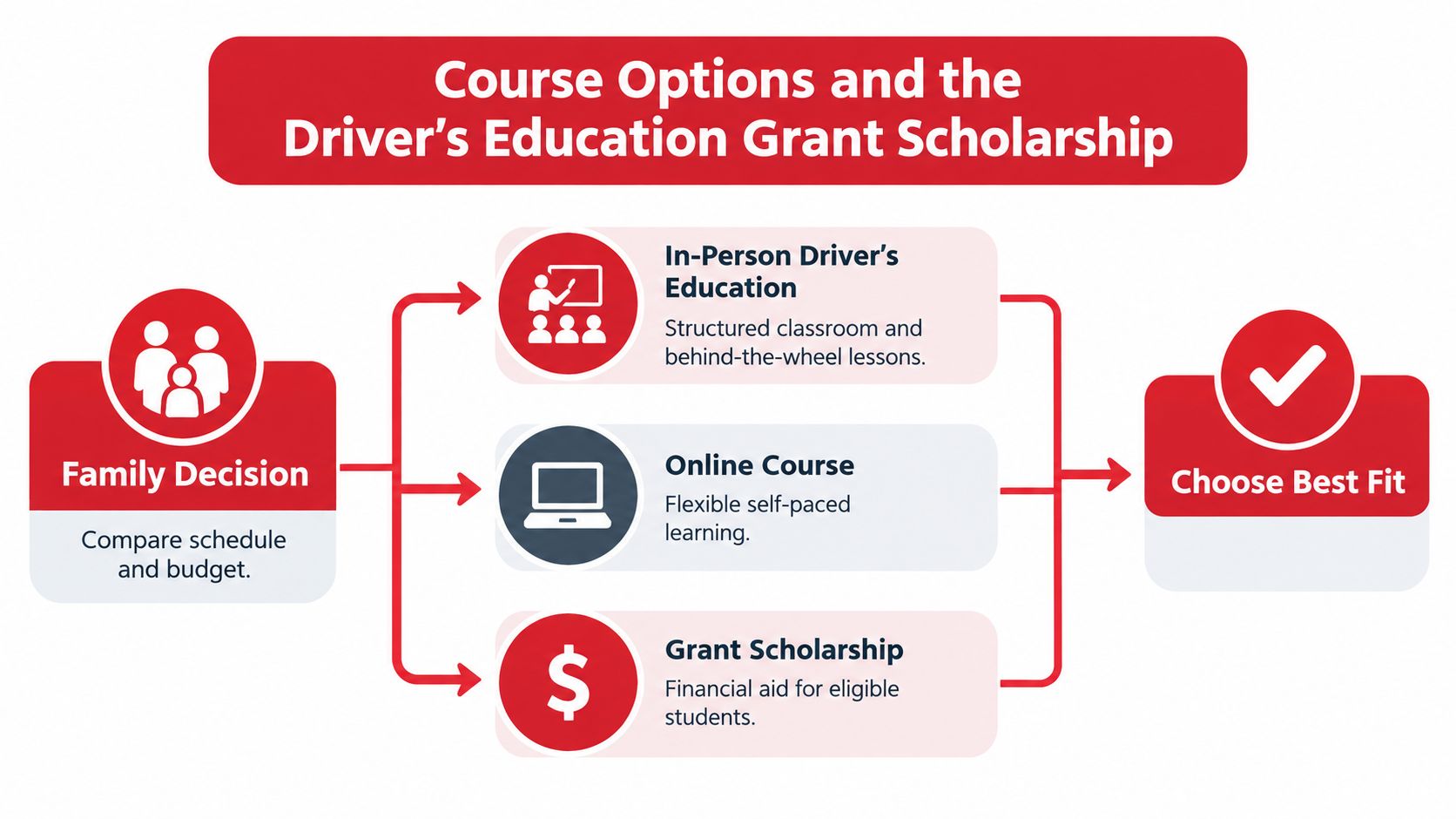
Choose the training route around the need your score sheet exposed, along with your family's schedule and budget. A classroom or online driver-education course can build foundational knowledge. Driving lessons focus on what happens behind the wheel. Road-test preparation connects those skills to the assessment itself.
Georgia DDS permits approved online instruction for the classroom component of Joshua's Law, but the provider must be approved. Families should check that a course meets Georgia's requirements before enrolling. An unapproved online course may not count toward the teen's licensing pathway.
Match the option to the family's situation
- Choose in-person Driver's Education if the student benefits from a scheduled classroom and in-person instruction.
- Consider an approved online course if flexibility matters, but confirm it meets Georgia DDS and Joshua's Law standards.
- Ask about the Georgia Driver's Education Scholarship Grant Program if cost is a concern. Check eligibility and application steps with the program provider before planning around funding.
- Look at road-test services if the student wants a structured test-preparation setting. Ask the provider how its testing works and what requirements apply.
The Georgia Driver's Education Grant Scholarship Program is worth checking for eligible teens who need help accessing approved driver education and behind-the-wheel training. Confirm the current application requirements and timing before assuming support will be available for a particular course or lesson.
If a failed test revealed weak foundational habits, don't treat the classroom and practical training as substitutes for each other. Reinforce the rules through driver education, then use lessons to practice the exact behaviors the examiner marked. That combination gives families a practical way to address both understanding and execution without repeating unrelated training.
A Seven Day Countdown to a Confident Retake
Use the time before your retake to make each practice session answer a question: can you perform the marked skill correctly and repeat it under test-like conditions? If your appointment comes sooner, compress the plan, but don't skip the diagnosis.
- Day one: Review the score sheet and write down each deduction in plain language. Ask for clarification if you don't understand an examiner's note.
- Day two: Sit in the car and talk through the relevant maneuvers. Identify when you'll check mirrors, scan for hazards, signal, and act.
- Day three: Book a focused lesson or mock test around the main deductions.
- Day four: Practice with a parent or qualified supervisor. Ask them to watch for the specific behaviors on your list.
- Day five: Repeat the weak tasks in realistic traffic conditions. Stop and reset if the same error returns.
- Day six: Run a mock test without coaching during the drive. Review what still needs attention afterward.
- Day seven: Confirm your appointment and documents, and prepare the vehicle as instructed by your testing provider.
On test day, take a slow breath before starting, settle into the seat, and focus on one observation and one decision at a time. A failed test is a score sheet, a wait period, and a plan, not a verdict on your ability to become a capable driver.
A-1 Driving School offers driver-education courses, focused driving lessons, lesson packages, and road-test preparation for Georgia drivers. If you're ready to turn your score sheet into a specific practice plan, visit A-1 Driving School to explore your options.