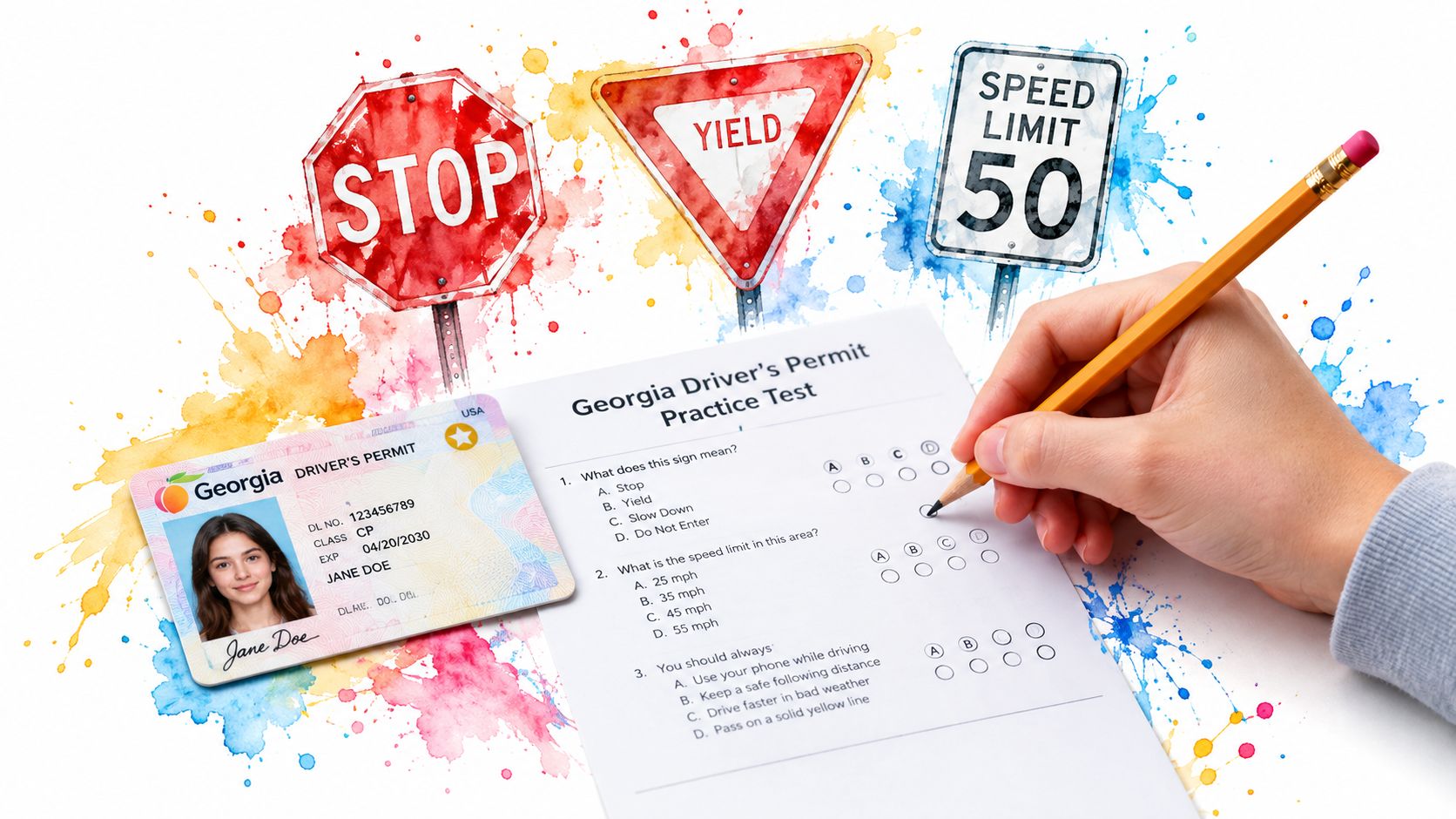
You're sitting in a Georgia DDS customer service center, trying to remember whether a yellow diamond sign means a law or a warning. Then you notice that the permit exam isn't one large quiz. It has two separate parts, and a strong performance on one won't rescue a weak performance on the other. That detail changes how you should study.
A useful GA driver's permit practice test should do more than give you random questions. It should help you understand the exam format, recognize the difference between road rules and road signs, explain why an answer is correct, and show you exactly what to review next. You can use this guide as a calm practice session before visiting DDS, then carry that same method into driver education, supervised driving, and your eventual road test.
Introduction to Your GA Permit Test Journey
Most first-time applicants don't feel nervous because they're incapable of learning traffic rules. They feel nervous because they don't know what the testing experience will feel like. A student may study signs for several evenings, complete a practice quiz, and still arrive at DDS unaware that the knowledge exam is scored in two separate parts.
Think of the test like two locks on one door. You need the key for road rules, and you need the key for road signs. Studying only the rules is like preparing for one lock and hoping the other opens by itself.
Before test day, review the Georgia instructional permit requirements and make sure you understand the difference between learning information and applying it. A question about yielding isn't only asking whether you've memorized a sentence. It's testing whether you can identify who needs to slow down, who has priority, and what action prevents a collision.
Build confidence through understanding
Start with the structure. Then study rules in driving situations, learn signs by visual families, complete a two-part simulation, and score each section separately. That sequence gives you feedback instead of leaving you with a vague feeling that you “need to study more.”
For example, missing several sign questions doesn't automatically mean you're bad at driving. It may mean you're confusing warning signs with guide signs, or that you recognize a sign when you see it but can't recall the required action quickly. Those are specific problems with specific fixes.
Instructor's perspective: Don't judge your readiness by how familiar the questions look. Judge it by whether you can explain the safe action without guessing.
The permit is an important first milestone, but it isn't the finish line. After passing, Georgia teens pursuing a Class D license still need education, supervised practice, and behind-the-wheel preparation. Treat this test as the foundation for those skills, not as a memory contest you'll forget afterward.
How the Georgia Permit Test Works and How It Is Scored
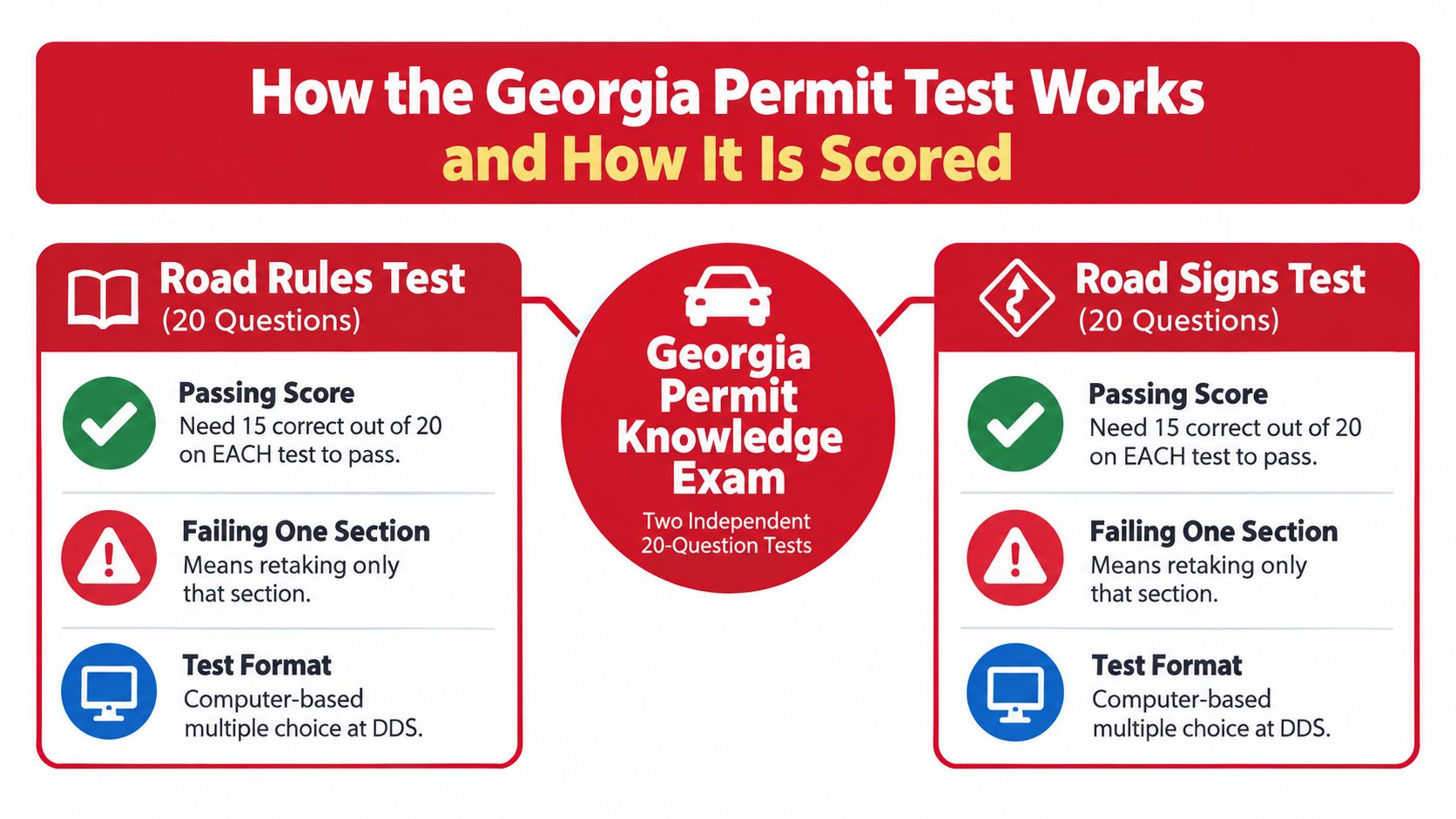
Georgia's instructional permit knowledge exam has two independently scored sections. The first is the Road Rules Test, and the second is the Road Signs Test. Each section contains 20 questions, and you need at least 15 correct answers out of 20 on each section to pass, as explained by the Georgia Department of Driver Services practice-test guidance.
That means the passing standard is 75% on each part, not 15 correct answers across both sections combined. If you answer 20 road-rules questions correctly but struggle with road signs, the strong rules score can't compensate for the signs result.
Use a balanced study plan
Separate your notes into two folders:
- Road Rules: Right-of-way, turning, lane use, speed management, safe following, and interactions with other road users.
- Road Signs: Sign shapes, colors, symbols, warnings, regulations, directions, and required actions.
This split mirrors the testing design and makes your practice results more useful. If you score well on rules but not signs, you won't waste time rereading every traffic topic. You'll focus on the sign family or symbol that caused the error.
The DDS online practice test is useful because it lets applicants preview the question style and rehearse recall before taking the official exam. Use it as a learning tool, not as proof that you'll receive the same questions at the customer service center.
Plan the visit carefully
The official guidance also says applicants must begin the written test at least 30 minutes before closing at customer service centers, according to the DDS testing information summarized for Georgia applicants. Since testing is handled on a walk-in basis statewide, arriving near closing can create unnecessary pressure or leave you unable to start.
Give yourself enough time to check in, settle down, and read each question carefully. A rushed answer often comes from recognizing one familiar word and ignoring the rest of the situation.
Road Rules You Must Know for the Georgia Permit Test
Road Rules questions become easier when you connect them to ordinary driving decisions. You're not just memorizing definitions. You're deciding who should move first, when to wait, how to create space, and how to communicate with other people on the road.

Treat right-of-way as responsibility
Many learners ask, “Who has the right-of-way?” A safer question is, “Who should yield to prevent danger?” At an intersection, look for signs, signals, lane position, pedestrians, and vehicles already moving through the conflict area.
If you're turning across a pedestrian's path, slow down and yield rather than assuming your turn gives you priority. If two vehicles approach a situation where one must wait, don't force the other driver to guess your intention. Reduce speed, observe, and make your movement predictable.
Manage space before you need it
Following distance gives you time to respond when traffic changes. If the vehicle ahead brakes suddenly, a small gap leaves you reacting with panic. A larger space lets you brake smoothly and maintain control.
Speed management works the same way. The posted limit is not a command to drive at that speed in every condition. Curves, rain, congestion, visibility, and nearby pedestrians can all require a slower, more controlled pace.
When a practice question includes several reasonable-sounding answers, choose the one that creates the most safety margin without creating a new hazard. That usually means slowing down early, checking carefully, and avoiding abrupt movements.
Make lane changes and turns deliberate
A good lane change follows a repeatable sequence. Check mirrors, identify the blind area, signal, confirm that the space is open, and move smoothly. A signal communicates intention, but it doesn't give you permission to enter an occupied lane.
For turns, enter the correct lane early, control your speed before the turn, and watch for pedestrians, cyclists, and vehicles approaching from other directions. Don't let a green signal replace observation. The signal controls movement, but you still have to check the path.
Use this short mental cue:
- See: Identify vehicles, people, signs, and lane markings.
- Decide: Determine who must yield and where the safest space is.
- Signal: Communicate before changing direction.
- Move: Complete the action smoothly and keep checking.
A visual lesson can reinforce how these decisions work in real traffic:
Questions about pedestrians and cyclists often test patience rather than speed. Give vulnerable road users extra attention, especially near crossings, driveways, intersections, and areas where sightlines are limited. The strongest answer is usually the one that protects the person with less physical protection.
Georgia Road Signs Made Simple and Memorable
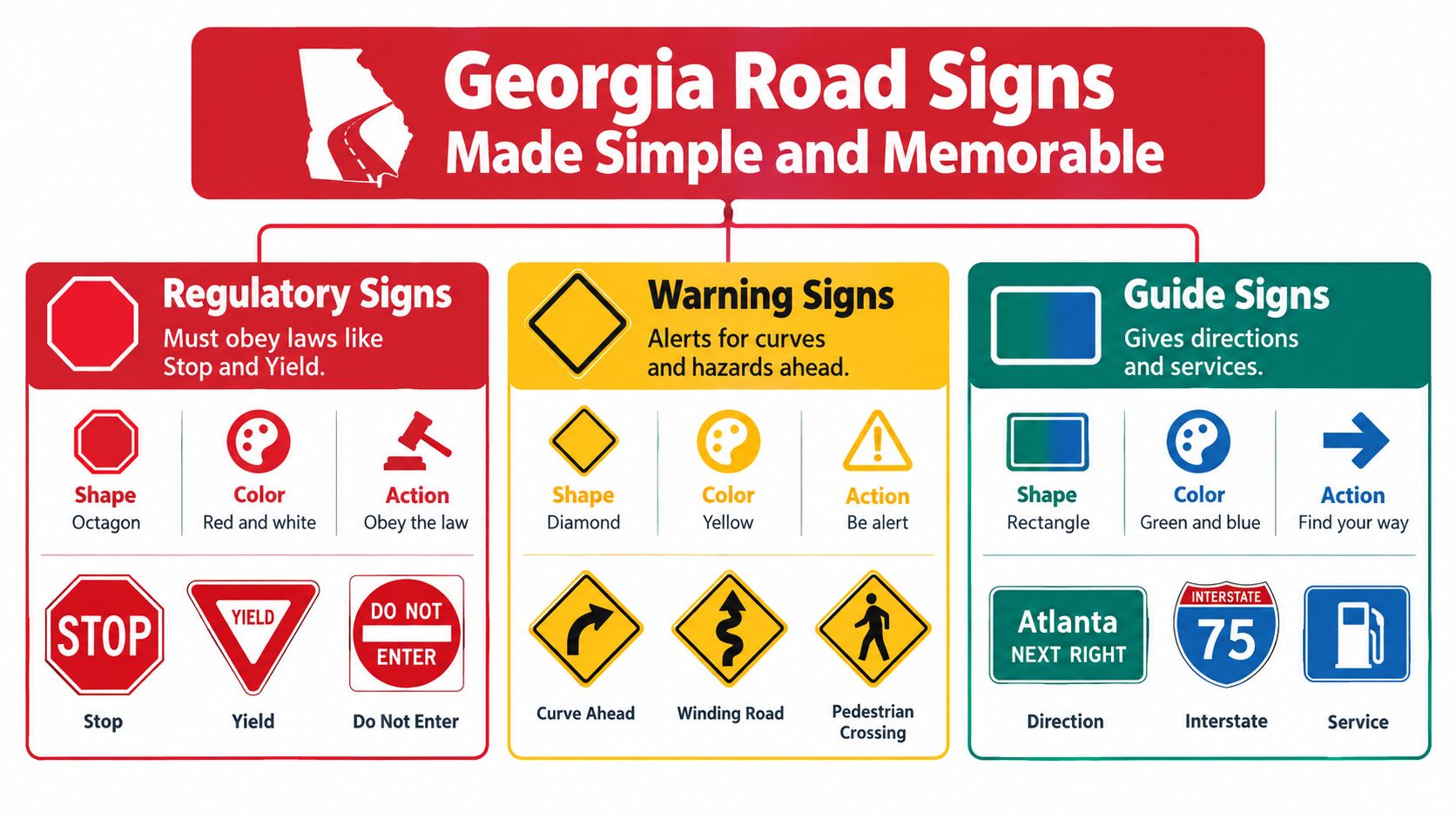
Road signs stop feeling like a pile of unrelated pictures when you organize them by shape, color, and action. Instead of asking only, “What does this symbol mean?” ask three questions: What family does the sign belong to? What does its appearance tell me? What does it require me to do?
Learn the three major families
Regulatory signs tell you about laws or required actions. A stop sign uses a distinctive octagonal shape, while yield signs use a triangular shape. Their message isn't descriptive. It tells you what you must do before continuing.
Warning signs alert you to conditions ahead. Yellow diamond signs belong to this family and may warn about curves, changing road conditions, crossings, or other hazards. When you see one, begin preparing before you reach the problem area.
Guide signs help you. Rectangular green and blue signs commonly provide directions, route information, or service information. They're less about immediate control and more about helping you understand where the road leads.
The Georgia driving test signs guide can help you review these visual categories and connect recognition with action.
Use a shape-first memory system
When a sign appears briefly, read its outline before trying to interpret every word. An octagon should trigger “stop,” a triangle should trigger “yield,” and a diamond should trigger “warning.” That first reaction gives your brain a useful shortcut.
Color adds a second layer. Red and white often signal control or prohibition, yellow warns about a condition, and green or blue generally supports navigation and services. Don't rely on color alone, because lighting and screen presentation can vary. Combine the shape, color, symbol, and wording.
Practice recognition under pressure
Flashcards help, but don't study only by staring at the front of a card until the answer feels familiar. Turn the card over quickly, name the sign family, state the action, and describe the driving response.
For example, if you see a warning sign for a curve, your answer should go beyond “curve ahead.” Say, “I should reduce speed before entering the curve and remain prepared for changing visibility or road position.” That turns visual recognition into a safe driving decision.
A sign is useful only when you respond to it early enough.
During the exam, eliminate answers that confuse a warning with a command. A warning sign tells you a condition may be ahead. A regulatory sign tells you what the law requires. That distinction prevents many avoidable mistakes.
Full GA Drivers Permit Practice Test With Sample Questions and Answers
Use the following simulation in two sittings or one focused session. Complete the Road Rules questions first, record your answers without checking the explanations, and then do the same for Road Signs. The goal isn't to copy a score. It's to practice making a decision and explaining why.
Road Rules practice
Question 1: You're approaching a crosswalk and a pedestrian is preparing to cross your path. What's the safest response?
Answer: Slow down and yield as required. The trap is treating the crosswalk as decoration instead of a place where someone may enter your path.
Question 2: You want to change lanes. What should you do before moving?
Answer: Check mirrors and blind areas, signal, confirm the lane is clear, and move smoothly. A signal communicates your plan, but it doesn't make the lane available.
Question 3: Traffic ahead is slowing on a wet road. What should you change first?
Answer: Reduce speed and create more space. Braking late gives you fewer choices, while early speed control keeps the vehicle easier to manage.
Question 4: You approach a curve at a speed that feels comfortable on the straight road behind you. What's the better choice?
Answer: Adjust speed before entering the curve. Waiting until you're already turning can make braking and steering less stable.
Question 5: Another driver appears ready to enter the same space as you at an intersection. What should you do?
Answer: Slow down, assess the signs and traffic, and yield when required. Don't compete for priority.
Road Signs practice
Question 6: What does an octagonal red-and-white sign tell you?
Answer: Stop. The shape is a fast recognition cue, and the required action is a complete stop before proceeding when safe.
Question 7: What does a yellow diamond-shaped sign generally communicate?
Answer: A warning about a condition or hazard ahead. It calls for attention and preparation, not automatic stopping in every situation.
Question 8: What is the main purpose of a rectangular green or blue guide sign?
Answer: To provide directions, route information, or service information. It helps you rather than directly controlling your movement.
Question 9: A triangular sign is displayed ahead. Which action should come to mind?
Answer: Yield. Slow down, check conflicting traffic, and proceed only when the path is safe.
Question 10: You recognize a sign's symbol but aren't sure whether it gives a warning or a command. What should you inspect?
Answer: Check the sign's shape, color, wording, and placement. The visual family often reveals whether you're being warned about a condition or instructed to obey a rule.
| Question Type | Correct Answer Focus | Why It Matters |
|---|---|---|
| Road Rules | Yielding and right-of-way | Safe decisions depend on identifying conflicts early |
| Road Rules | Space and speed management | More time and distance improve control |
| Road Rules | Lane changes and turns | Signals support communication but don't replace checking |
| Road Signs | Shape and color families | Visual cues speed recognition |
| Road Signs | Required action | Knowing a sign's name isn't enough, you must respond correctly |
After each answer, explain why the other choices fail. If an option tells you to accelerate into uncertainty, ignore a blind area, or assume another driver will stop, it's probably testing whether you understand defensive decision-making.
How to Score Your Practice Test and Fix Weak Areas
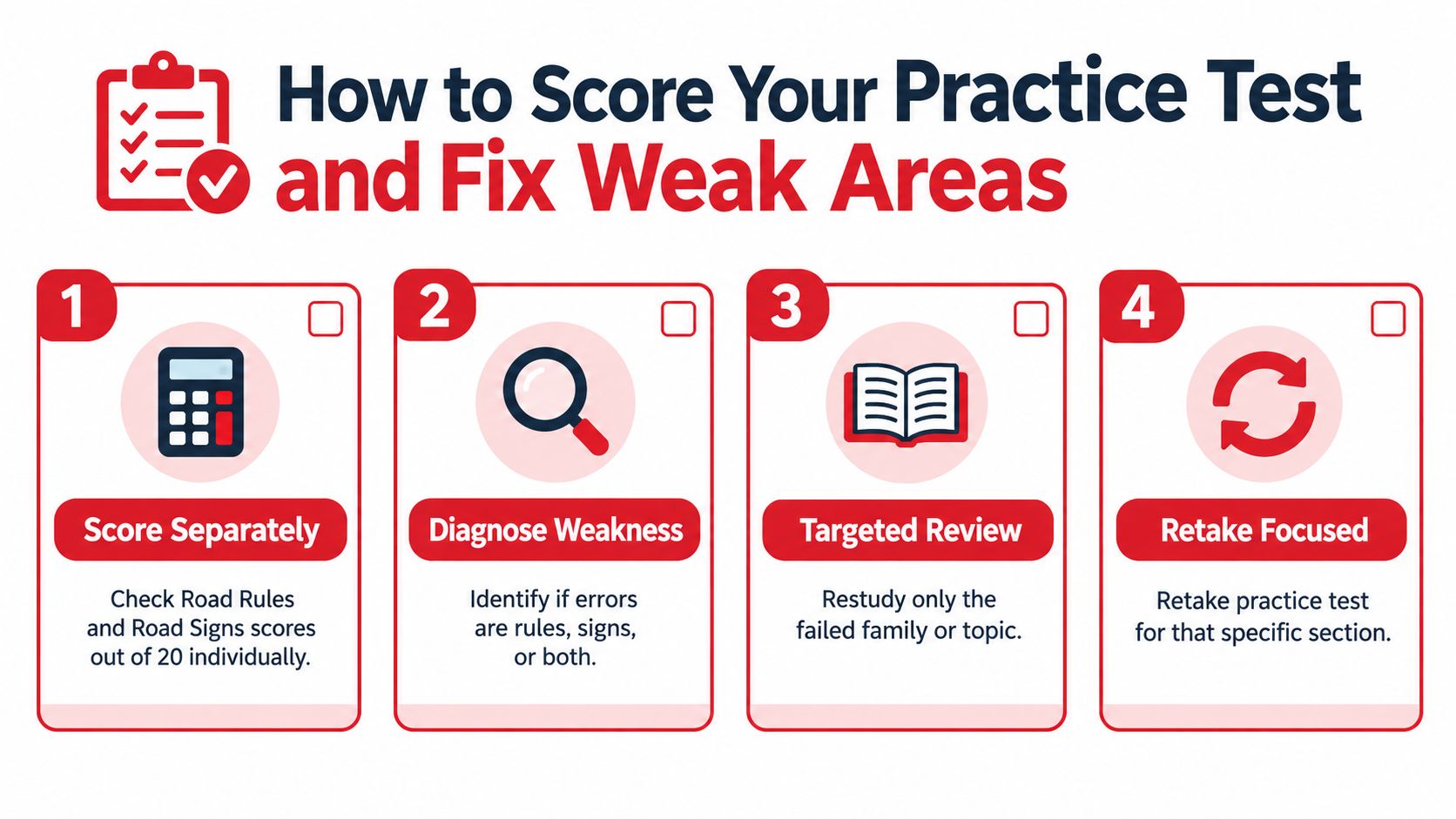
Score the two parts separately. Give yourself one point for each correct answer, then write Road Rules: __ out of 20 and Road Signs: __ out of 20. Don't combine the totals, because the official exam requires you to meet the passing standard on each section independently.
Read the score as a diagnosis
Use this practical rubric:
- 15 to 20 correct: You're at or above the required practice threshold for that section. Review missed questions and confirm you can explain the reasoning.
- Below 15 correct: Treat the section as not ready yet. Sort every missed question by topic instead of repeating the same full quiz immediately.
- Close misses: If you missed by one or two questions, focus on the exact errors. A small gap can still reveal a recurring confusion, such as mixing up a warning sign and a regulatory sign.
Create an error log with three columns: the question topic, your chosen answer, and the rule or visual clue you missed. This turns “I keep getting these wrong” into a concrete review assignment.
Handle a failed attempt constructively
One neutral Georgia testing resource notes that knowledge-test waiting periods can begin at 1 day after the first failure and rise to 7 days after later failures, as described in its Georgia retest information. Confirm current DDS procedures before relying on a waiting-period detail, because retest logistics matter when you're planning school, work, and transportation.
Use the delay as a short study loop. Review only the weak section, explain each missed answer aloud, complete focused practice, and then retake that section. Repeating questions without understanding the error can make familiar wording feel easy while leaving the underlying gap untouched.
Your Next Steps After Passing From Permit to License With A-1 Driving Schools
Passing the knowledge exam gives you permission to begin learning behind the wheel. For Georgia teens ages 16 and 17 seeking a Class D license, Joshua's Law requires an approved driver education course and 40 hours of supervised driving, including 6 hours at night, according to the Georgia DDS Joshua's Law requirements.
The education component includes at least 30 hours of theoretical instruction, available through classroom instruction or DDS-approved online courses. Georgia DDS also describes the traditional “30 and 6” option, which combines 30 hours of classroom instruction with 6 hours of behind-the-wheel training from a DDS-certified instructor, as outlined in the DDS driver education FAQs.
Choose training that matches your next milestone
Families can use an approved course, parent-supervised practice, certified driving lessons, or a combination that fits the student's needs. Certified lessons are especially useful for correcting habits, practicing road-test maneuvers, and building calm routines in traffic. Lesson packages let a new driver choose focused preparation or more sustained coaching rather than treating every student as if they starts at the same skill level.
The Georgia Driver's Education Grant Scholarship Program helps eligible Georgia residents ages 15 through 17 who hold a valid Georgia instructional permit or driver's license complete Joshua's Law requirements. The program is tied to a 30-hour classroom component and 6 hours of behind-the-wheel instruction with an approved instructor.
Before the road test, DDS teen guidance requires an affidavit confirming 40 hours of supervised road driving, including 6 hours at night. When the on-road component is completed with a certified instructor, separate documentation confirming that requirement must be completed at the time of the road test, according to the DDS road-test guidance.
For a complete licensing pathway, review this Georgia driver's license guide and organize your course, practice hours, driving lessons, and road-test preparation early.
A-1 Driving School offers DDS-aligned driver education through online and in-person options, customized driving lessons and lesson packages, Georgia road-test preparation, and road-test services. Visit A-1 Driving School to compare course options, explore scholarship eligibility, and book the hands-on lessons that turn a passing permit test into confident driving.