
Could you drive well enough to pass the Georgia road test and still lose your test date because your permit, paperwork, or vehicle isn't ready? Yes. Preparing for a Class D license means coordinating instruction, supervised practice, eligibility dates, and a compliant test vehicle, not just practicing turns and parking.
For parents and teens searching for driving Class D requirements, the most useful starting point is a shared plan. Keep the permit date, course records, practice record, and test-day checklist together, then use driving lessons to correct the skills that still need work.
Class D Requirements at a Glance
A Georgia Class D license is the provisional license for drivers under 18, the middle stage of the state's graduated driver-licensing system, according to the Georgia Department of Driver Services license-class guide. It follows the Class CP instructional permit and comes before unrestricted licensing.
The licensing gates include holding the Class CP permit for 1 year and 1 day, avoiding a major violation that suspends it, completing the applicable education requirements and ADAP, and passing the vision examination and road-skills test. The DDS guide also identifies 40 hours of supervised driving, including 6 at night, as part of preparation.
Class D eligibility by age and driver education status
| Applicant | Driver education status | Earliest Class D eligibility | Notes |
|---|---|---|---|
| Age 16 | Approved Joshua's Law course completed | After 1 year and 1 day holding the Class CP permit | Permit must not be suspended by a major violation |
| Age 16 | No approved course | Generally not before age 17 | Other requirements still apply |
| Age 17 | Approved Joshua's Law course completed | After 1 year and 1 day holding the Class CP permit | ADAP, vision exam and road test still required |
| Age 17 | No approved course | Generally eligible if other requirements are met | Confirm course status with DDS before booking |
Read each row as an eligibility screen, not a promise that a license will be issued. The applicant must satisfy the conditions together, and course status needs particular attention. Georgia's more specific Joshua's Law guidance addresses applicants at both teen licensing ages, so don't treat waiting for a birthday as a substitute for confirming the applicable education requirement.
Age isn't the whole decision
A birthday doesn't erase an unfinished permit-holding period, incomplete training, or missing documentation. Likewise, passing a course doesn't automatically make someone eligible for a road test.
The Alcohol and Drug Awareness Program (ADAP) is the required alcohol and drug course. Use DDS enrollment information to arrange it, and keep its completion record separate from the Joshua's Law certificate so the documents don't get confused.
Practical rule: Build the licensing calendar around the permit's issue date, not the date you hope to start driving independently.
Before paying for or reserving testing, answer these questions:
- Age: What will the applicant's age be on the proposed test date?
- Education: Has the applicant completed an approved course, and is the completion record available?
- Permit date: On what date does the required holding period end?
If an answer is uncertain, resolve it before booking. A confirmed date is more useful than a family's best estimate.
Joshua's Law Hours and What Counts Toward Them
Think of Joshua's Law as theory, practical training, and supervised experience, plus a calendar requirement. These aren't interchangeable categories: finishing an online course doesn't complete the driving portion, and accumulating practice doesn't shorten the permit-holding period.
The DDS driver-education FAQs allow at least 30 hours of theory through classroom instruction or a DDS-approved online program, with a practical route using 6 hours with a certified instructor or the approved Parent/Teen Driving Guide. The DDS Joshua's Law requirements distinguish those components from 40 total supervised hours, including 6 nighttime hours, and the 1-year-and-1-day permit requirement.
Joshua's Law hour and timing requirements by component
| Requirement | What it covers | Route options | Amount |
|---|---|---|---|
| Theory | Rules of the road and safe driving | Classroom or DDS-approved online course | 30 hours minimum |
| Practical training | Behind-the-wheel skills | Certified instructor or Parent/Teen Driving Guide | 6 hours with instructor, or 40 hours parent-taught |
| Supervised driving | Practice with a parent, guardian or qualifying instructor | Any route | 40 hours, including 6 at night |
| Learner's permit | Waiting period before licensing | Class CP permit | 1 year and 1 day |
| Affirmation | Confirms supervised driving was completed | Parent, guardian or certified instructor | Signed under penalty of law; no driving log required |
Keep separate records without double-counting
The parent-taught route follows the approved guide. It isn't a collection of errands with a teen behind the wheel. Treat practical-route completion and supervised experience as separate checklist fields, even when activities contribute to both under the approved pathway.
DDS says a parent, guardian, or qualifying certified instructor must affirm supervised-driving completion under penalty of law, although a driving log isn't required. A voluntary record is still useful: use the driving practice log to track conditions, skills practiced, and nighttime experience rather than reconstructing everything from memory.
For a hypothetical schedule, spreading the required supervised total across 20 weeks works out to about 2 hours weekly, with the required nighttime portion deliberately scheduled. That's planning arithmetic, not an additional state rule. Leave room for canceled drives, school commitments, and sessions that need to be repeated.
Keep a simple tally of theory completion, practical route, supervised experience, nighttime experience, and permit issue date. Completing the hours early still doesn't move the calendar eligibility date.
Families comparing licensing systems may find G1ready.ca's explanation of G1 and G2 testing requirements useful for understanding staged licensing. Those are Ontario requirements, however, and they must not replace Georgia's DDS rules.
Driving Lessons That Build the Skills You Need
Driving lessons are where an instructor can identify why a maneuver keeps going wrong. A teen may know the rule for a left turn but still approach too quickly, look in the wrong direction, or steer before choosing the correct destination lane.
Coached control matters more than merely spending time in the car. The instructor should explain the error, demonstrate or describe the correction, and give the student another opportunity under manageable conditions. Parents can then reinforce the same technique during supervised practice.
What a useful lesson should cover
A lesson plan should connect vehicle handling with observation and decisions:
- Basic control: Smooth starts and stops, measured braking, and steering that keeps the vehicle centered.
- Turns and intersections: Proper right and left turns, complete stops, yielding, and choosing the correct lane.
- Communication: Early signaling, mirror checks, blind-spot checks, and deliberate lane changes.
- Traffic judgment: Following distance and speed appropriate to traffic, visibility, and weather.
- Parking: The maneuvers identified by the testing location, practiced with a repeatable setup.
Don't measure progress only by whether the instructor intervened. Ask whether the student noticed hazards independently, selected an appropriate gap, and explained the decision afterward.
The benefits of taking driving lessons from an instructor include having structured opportunities to address habits that family practice can overlook. Familiar routes can hide weaknesses because a teen remembers what usually happens rather than reading the road.
Choose a package around the student's weak points
Driving lesson packages make the most sense when sessions have different purposes. An early session can establish basic control, a later session can address intersections, and another can assess whether the corrections hold without frequent prompts.
Say a teen struggles with left turns. Instead of repeating an entire practice route, arrange a follow-up session focused on approach speed, scanning, gap selection, and lane placement at intersections. Then practice the instructor's corrections with a supervising adult.
A completed lesson is useful. A corrected habit that survives the next drive is better.
Students must have a valid Learner's Permit or Driver's License before taking a driving lesson. Check that credential before making transportation arrangements.
Bring a short list of the least reliable skills to the first lesson. Agree on the lesson priorities with the instructor before driving away, and ask what the parent should reinforce between sessions.
Step-by-Step Path and Readiness Audit
Prepare the appointment with the same care you give the driving. The DDS appointment guidance provides online road-test booking and identifies the need for a licensed accompanying driver age 21 or older, a vehicle that passes the DDS safety inspection, and only the applicant and accompanying driver in the vehicle during testing.
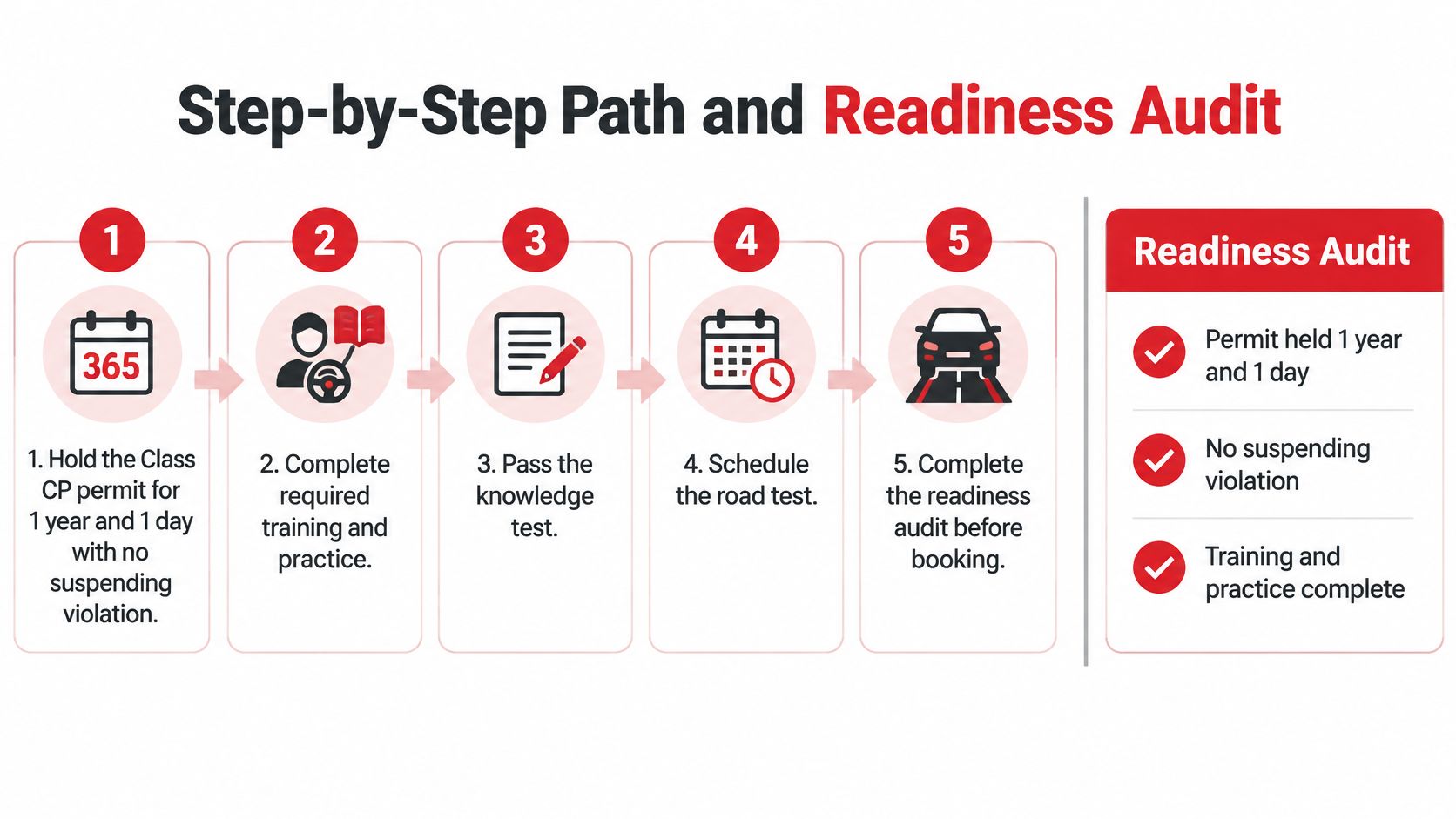
Use the process visual as an overview, then follow the detailed order below. Complete the readiness audit before committing to a test appointment.
Put the milestones in order
Confirm the permit-holding period. Check the issue date printed on the Class CP permit and verify that no suspending violation affects eligibility. The usual mistake is counting from a course date, a practice drive, or a hoped-for test date instead of the actual permit date.
Complete ADAP. Save the completion record where the family keeps licensing documents. Don't assume a Joshua's Law certificate also proves ADAP completion.
Finish approved theory instruction. Before beginning an online course, confirm that it's a DDS-approved Georgia program. A course advertised as driver education isn't automatically the right course for this application.
Complete the selected practical route. Use certified instruction or the approved Parent/Teen Driving Guide pathway. Don't combine incomplete pieces of different routes and assume the result satisfies a complete approved method.
Finish supervised practice and arrange the affirmation. Review nighttime experience separately so it doesn't disappear inside the overall total. The person affirming completion should be able to stand behind the statement, not guess from a busy family calendar.
Confirm the vision requirement. Follow the testing provider's instructions for completing or verifying the examination. Bring corrective lenses if you use them for driving, and resolve any uncertainty before test day.
Audit before you book
Check the applicant, adult, documents, and vehicle together. Review the permit date, ADAP record, course completion, supervised-driving affirmation, and vision status. Confirm valid registration or a qualifying temporary tag, liability insurance, and a vehicle suitable for the DDS safety inspection. Walk around the vehicle while someone operates the lights, turn signals, and brakes; check tires, visibility, mirrors, and seat belts, too. Review hand signals, but don't treat them as permission to ignore defective equipment.
Reserve the road test only after the audit. Use the DDS online appointment system when testing through DDS, and identify an alternative date that works for the accompanying adult and vehicle. When arranging school-based testing, confirm the school's booking instructions rather than assuming a DDS appointment reserves that service.
Keep digital records accessible, but also follow the provider's instructions about original documents and printed copies. A screenshot isn't automatically an acceptable replacement for every required item.
For an additional preparation resource, watch the following video alongside your own checklist.
Say a teen reserves a Saturday test, then discovers a failed brake light the evening before. An earlier walk-around would have left time to repair it or arrange another compliant vehicle.
Before spending on extra practice: Confirm that the applicant can legally test, the adult can attend, and the vehicle can pass inspection.
More lessons can improve driving. They can't repair a missing registration, supply an unavailable accompanying driver, or change an eligibility date.
What the Georgia Road Test Actually Measures
The road test evaluates safe vehicle operation, not whether a student can recite the rules. That focus is consistent with the National Highway Traffic Safety Administration's teen-driving guidance, which supports graduated licensing as a way to reduce teen crash risk.
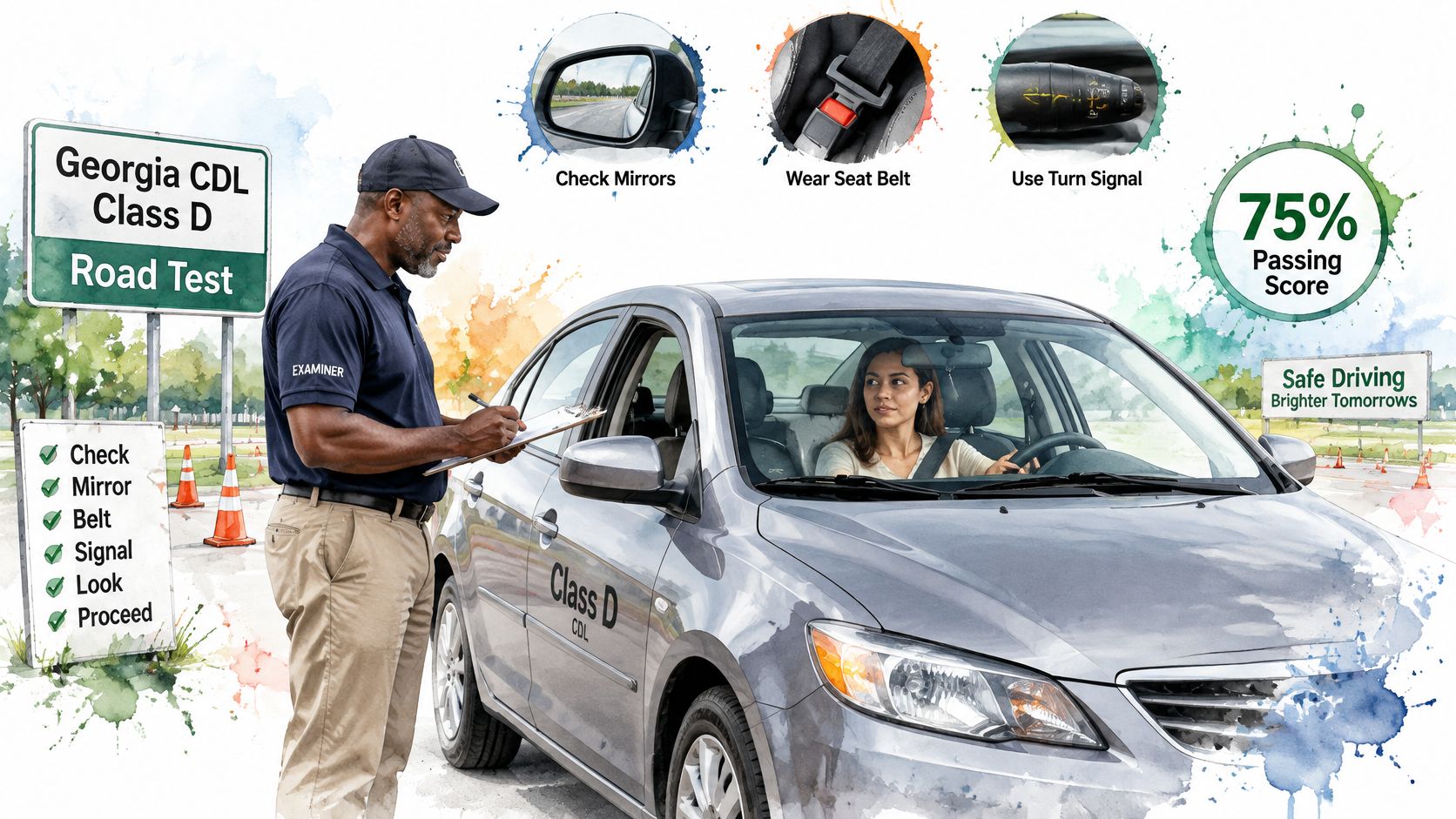
Use the test image as a reminder: an examiner observes actions and decisions, not how many practice routes a student has memorized.
Georgia road test skill areas and common mistakes
| Skill area | What the examiner checks | Common mistake |
|---|---|---|
| Basic control | Smooth starts and stops, safe acceleration and braking, steering that stays centered | Jerky braking or drifting in the lane |
| Turns and intersections | Proper turns, full stops, correct yielding, turning into the correct lane | Rolling through stop signs |
| Lane changes | Mirror and blind-spot checks, early signals, smooth merges | Forgetting to signal |
| Observation | Pedestrians, cyclists, signs and following distance | Tailgating or missing signs |
| Speed control | Speed matched to traffic and weather | Speeding or driving too slowly |
| Parking | Maneuvers set by the test site | Poor setup or inadequate observation during the assigned maneuver |
| Composure | Calm recovery while maintaining safe control | Panicking after a small mistake |
Prepare for consistent decisions
A full stop should be unmistakable. Before changing lanes, observe first and signal in time. Appropriate speed means responding to conditions, rather than driving unnecessarily slowly to appear cautious.
For parking, follow the testing location's instructions. Practice the setup and observation sequence instead of relying on a steering trick that works only beside a familiar cone.
The Georgia driving test rubric can turn a vague concern about passing into specific behaviors to rehearse. Use it to find skills that need work, not to calculate which mistakes you can afford.
Georgia's testing requirements recognize hand-signal operation when a vehicle lacks illuminated turn signals. The practical lesson is clear: communicate with other road users, whether signaling a turn, yielding or keeping a predictable lane position.
A score threshold does not make every mistake harmless, and good parking cannot offset dangerous driving. If you make a small error, keep observing, regain steady control and follow the next instruction. One mistake need not lead to another.
Graduated licensing gives beginners time to build safe habits before unrestricted driving. The road test is a checkpoint in that learning process, not the end of it.
Choose Your Joshua's Law Course and Book Lessons
Which course format can your student complete consistently, and what needs to be ready before a test appointment is booked? Set the learning schedule first, then coordinate lessons, the vehicle, and required paperwork. An online course offers flexibility around school and family commitments. Instructor-led classes let students ask questions as topics come up.
Coursework and driving practice serve different purposes. A student may understand right-of-way rules on screen and still need coached practice judging a safe gap at a busy intersection.
Make the training decisions together
Start by choosing the theory format. Decide whether independent study fits the student's routine, where coursework will happen, and how the family will track completion. Leaving that check until the intended test month can put the appointment at risk.
Next, discuss driving lessons in light of the student's current ability. Identify skills to work on and how supervised practice can reinforce each lesson. Don't schedule lessons only for the days immediately before a road test.
Then confirm where testing will happen, how to book it, which vehicle will be used, and what documents the testing provider expects. Preparing and testing through the same school may simplify communication, but the applicant still needs to meet licensing requirements.
Ask about scholarship support before enrolling
A-1 Driving School offers a Scholarship Grant Program. Ask about eligibility, the application process, and which training the program covers before enrolling. An application does not guarantee funding, and not every lesson may qualify.
A-1 offers instructor-led and online Joshua's Law courses, Georgia DMV-approved driving lessons for teens and adults, and Georgia Road Test assistance. The school also offers Road Testing. When discussing lessons, explain whether the student is a beginner, has completed parent-supervised practice, or needs help with particular maneuvers. That gives the school a useful starting point for planning instruction, without promising a fixed amount of practice will make every student test-ready.
Your decision checklist: Choose the course format, arrange driving lessons and supervised practice, confirm vehicle and document requirements, and complete the readiness audit before booking the road test.
A-1 Driving School offers Joshua's Law courses, driving lessons, scholarship support, and Georgia road testing. Visit A-1 Driving School to compare courses and enroll online, or call the school to discuss lessons and scholarship eligibility before scheduling your road test.