
Your teen has the permit. The questions are piling up. How long do they have to wait? Do they need Joshua's Law? Can a parent do the practice driving? What exactly is a provisional licence, and what can go wrong at the DDS counter?
That confusion is normal. Georgia's provisional licence laws aren't hard once you lay them out in order, but they do trip families up when pieces get mixed together. One family is focused on the permit wait period. Another finishes the course but forgets a required certificate. A teen gets excited about driving alone, then learns there are passenger and late-night limits that still apply.
The good news is that Georgia gives you a clear path. If you follow the steps in the right order, keep your documents organized, and treat the Class D licence as a training stage instead of full freedom, the process gets much simpler.
What Is a Georgia Provisional Licence
A Georgia provisional licence is the Class D licence most 16- and 17-year-old drivers receive before they move on to a full Class C licence. It sits in the middle of Georgia's Graduated Driver Licensing system. First comes the learner's permit. Then comes the provisional licence. After that comes full, unrestricted driving.
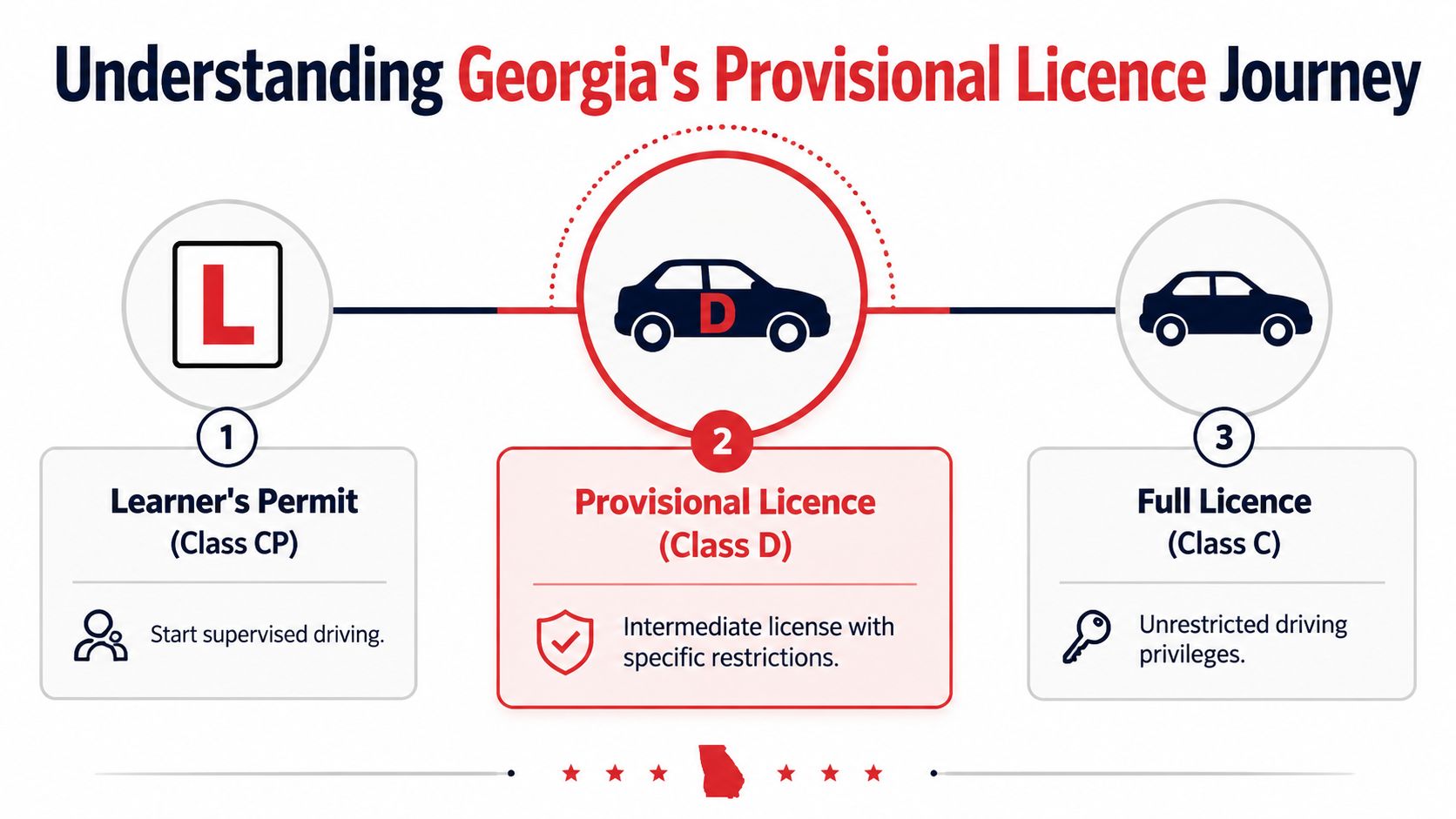
That middle stage matters because it gives teens time to drive with some independence while still following added safety rules. Georgia doesn't treat a brand-new teen driver the same as an experienced adult driver, and that's the whole point. The law builds in a gradual transition.
Where the Class D licence fits
Think of the process like this:
Class CP Instructional Permit
A teen starts learning with supervision.Class D Provisional Licence
A teen can drive without constant supervision, but only within specific rules.Class C Full Licence
Driving privileges become unrestricted once the provisional stage ends and the driver qualifies.
For most families, the Class D licence is the first time the teen feels like a “real driver.” That excitement is understandable. But legally, this licence is still a controlled step. Georgia uses it to lower risk while the teen builds judgment in everyday traffic, parking lots, neighborhood roads, and busier routes.
Why teens can't skip this stage
Many parents ask whether the provisional step is optional. For Georgia teens in this age group, it isn't. Joshua's Law in Georgia mandates that all 16- and 17-year-olds must complete a DDS-approved 30-hour Driver's Education course before applying for a Class D provisional license, which makes it the core entry point for teen licensing in the state, as outlined in this Georgia Joshua's Law overview.
Practical rule: If your teen is 16 or 17, don't plan for “getting a regular licence.” Plan for earning a Class D first.
That simple mindset helps families avoid a lot of confusion. The provisional licence isn't a side note. It's the normal Georgia path for teen drivers.
What families often misunderstand
A provisional licence is not the same as a learner's permit, and it's not the same as a full licence either. That middle status changes what a teen can do on the road and what restrictions still apply.
Common mix-ups include:
Calling it a full licence too early
Teens can drive alone with a Class D, but they still have legal limits.Thinking the road test is the only hurdle
The road test matters, but paperwork, course completion, and timing matter too.Missing the purpose of the law
Georgia's provisional licence laws are designed to build experience in stages, not to slow teens down for no reason.
When families understand that structure early, the rest of the licensing journey starts to make sense.
Meeting Joshua's Law The First Major Milestone
For most Georgia families, Joshua's Law is where the main licensing plan begins. If your teen is 16 or 17, this isn't optional. It's the first major checkpoint on the road to a Class D licence.
Near the start of the process, many students benefit from seeing what the course system looks like before they begin.
The two parts families need to track
Joshua's Law combines classroom learning with actual driving practice. Under Joshua's Law, teen drivers aged 16 to 17 must complete a state-certified driver education program and hold an Instructional Permit (Class CP) for at least 1 year and 1 day, a requirement that has reduced teen crash rates by 12% among 16-year-olds in Georgia since 2010, according to the Georgia DDS teen driver guidance.
Here's the easiest way to break that down:
The academic piece
Georgia requires a 30-hour driver education course.The practice piece
The teen must complete either 6 hours of behind-the-wheel training with a licensed instructor or 40 hours of supervised driving, including 6 hours at night, depending on the qualifying path described in the verified guidance.The timing piece
The learner's permit has to be held for 1 year and 1 day before moving up.
Families get confused because they often treat these as separate tasks when they really work as one package. A teen can't rush the permit wait period just because the class is done. A teen also can't rely on time alone if the course and practice pieces are incomplete.
Online or classroom
The format is less important than completing a DDS-approved course properly. Some students do better in a traditional classroom because they like a set schedule and direct instruction. Others do better online because they can move at their own pace and fit the course around school, sports, and family schedules.
That flexibility matters. A self-paced online course can help a busy teen stay consistent instead of falling behind. If you already have access to a course portal, the Joshua's Law student login is one way students keep their progress moving.
The best course format is the one your teen will actually finish on time and take seriously.
What supervised driving should really look like
Parents often ask whether the 40 hours are just a logbook exercise. They shouldn't be. During these hours, teens build habits that show up later on the road test and in real traffic.
A strong practice plan includes different conditions, not the same short route over and over:
- Neighborhood drives for turns, stop signs, and scanning
- Main road practice for lane changes and traffic flow
- Parking work for control, reverse movement, and patience
- Night driving because Georgia specifically requires nighttime practice hours
Later in the process, many teens also benefit from structured coaching before test day.
Where teens stumble
The most common issue isn't usually ability. It's incomplete requirements, missing certificates, or waiting too long to finish one part of the process. Treat Joshua's Law like a checklist with deadlines. Keep every record. Save certificates right away. Make sure the permit date lines up with your expected road test timeline.
That approach takes a lot of stress out of Georgia's provisional licence laws because you're not guessing. You're finishing each required step in order.
The Rules of the Road Your Class D Restrictions
Getting the Class D licence feels like a big win, and it is. But this licence comes with limits that families need to understand clearly before the teen starts driving regularly.
Georgia's Class D Provisional License imposes a strict driving curfew from 12:00 a.m. to 5:00 a.m. and limits non-family passengers, restrictions credited with a 19% decline in nighttime teen crashes involving passengers in Georgia between 2015 and 2024, according to this Georgia provisional license restriction summary.
The two rules teens need to remember every time
The fastest way to explain Class D restrictions is this: Georgia is trying to reduce the highest-risk situations for new drivers. Those situations often involve late-night driving and extra teen passengers.
Here's the quick reference.
| Restriction | Rule for First 6 Months | Rule After 6 Months (Until Age 18) |
|---|---|---|
| Night driving | No driving between 12:00 a.m. and 5:00 a.m. | No driving between 12:00 a.m. and 5:00 a.m. |
| Non-family passengers under 21 | None | One during the next 6 months, then up to three after the first year |
That passenger rule is where many accidental violations happen. A teen may think, “It's just one short trip with friends.” The law doesn't care whether the drive is quick, familiar, or close to home.
Why these restrictions exist
New drivers are still learning how to divide attention. Adding conversation, music choices, route pressure, and late-night fatigue makes that much harder. Parents usually see this right away in practice driving. A teen who's calm with one adult in the car can get distracted fast when the car feels social.
Remember this: A Class D licence gives independence, not unrestricted freedom.
That's why passenger limits change over time instead of disappearing immediately. Georgia's provisional licence laws assume experience should build gradually.
A plain-language way to avoid violations
If your teen wants a simple decision rule, use this:
- Late at night means no driving.
- Friends in the car means check the timeline first.
- If you're unsure, don't go until a parent confirms it's legal.
For a fuller overview of the state rules families often ask about, this guide to Georgia teen driving laws is a useful reference point.
One more habit worth building
Treat every drive like it could be reviewed later. That mindset changes behavior. Teens are more likely to check the time before leaving, think about who's riding with them, and avoid casual mistakes that turn into citations.
A Class D driver doesn't need fear. They need clarity. Once the restrictions become routine, most families find the provisional stage is very manageable.
Your Roadmap From Learner to Licensed Driver
A lot of teen drivers don't need more motivation. They need a cleaner sequence. When the steps are in order, the path from permit to licence feels much less overwhelming.
Step one starts earlier than most teens think
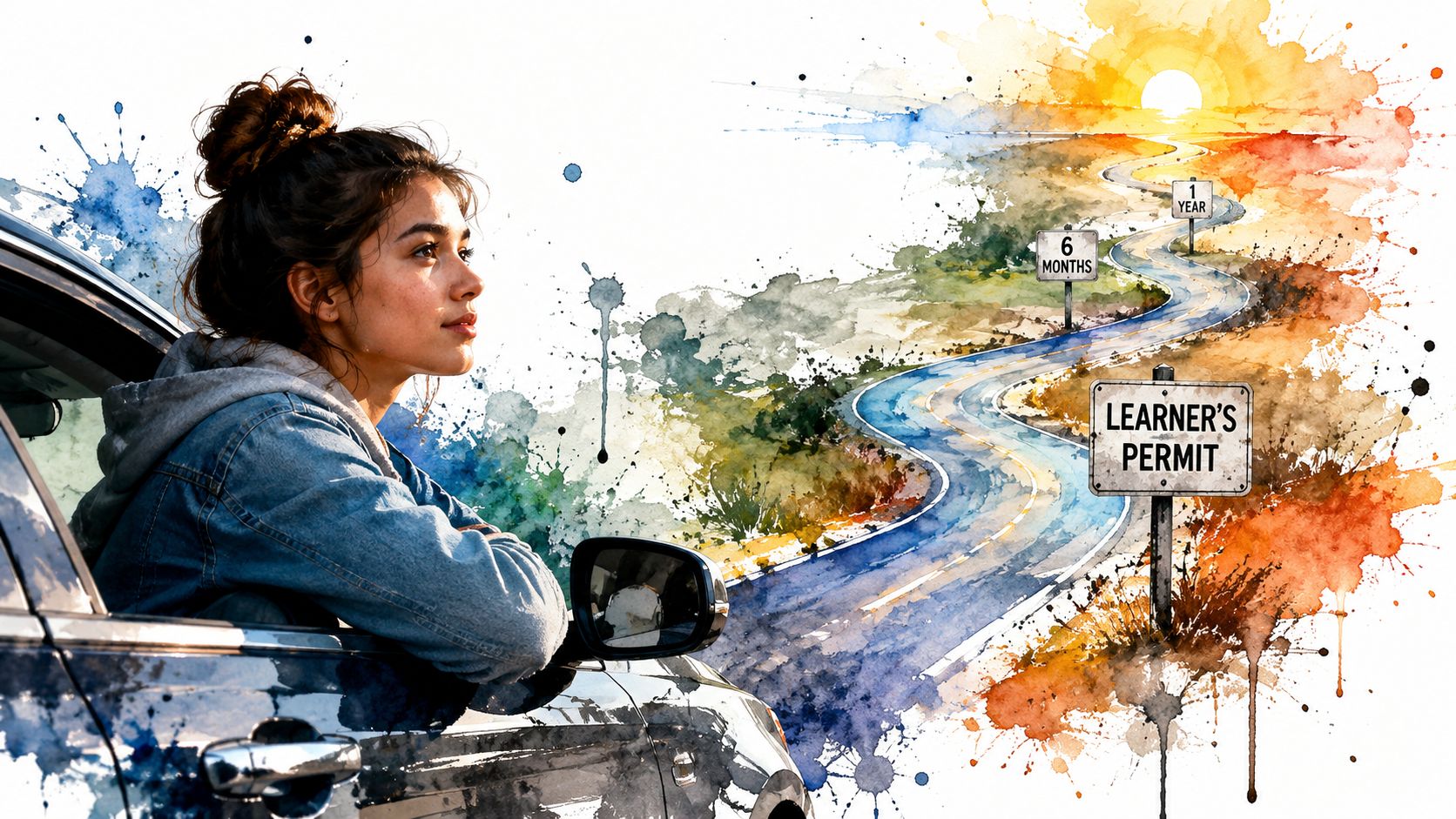
The road to a provisional licence doesn't begin when your teen feels “ready for the test.” It begins on the day the learner's permit is issued.
In Georgia, drivers aged 16 to 17 must hold a learner's permit for at least 1 year and 1 day and complete all Joshua's Law requirements; failure to do so, including omitting ADAP certification or the 30-hour course, results in automatic application rejection at the DDS office, as explained in this Joshua's Law certificate requirement page.
That means timing matters just as much as skill. If the permit window isn't complete, the application stops there. If a required document is missing, the application stops there too.
A simple order that works
Most families do best when they follow a steady progression instead of trying to cram everything near the end.
Get the permit and save the issue date
That date controls your earliest move-up timeline.Complete the Joshua's Law course
Don't leave this until the last minute.Finish supervised driving carefully
Spread practice across different roads, traffic levels, and times of day.Keep ADAP and course records together
Missing paperwork creates avoidable DDS stress.Prepare specifically for the road test
General driving experience helps, but test-focused prep matters too.
Why driving lessons help at the end
Parents can supervise a lot of productive practice, but some teens hit a plateau. That usually shows up in the same places: lane positioning, parking accuracy, rolling stops, turns that are too fast, and nerves under observation.
That's where focused driving lessons make a difference. A professional instructor can spot habits a parent may not notice and correct them before they become road test mistakes. Lesson packages are especially helpful for teens who need repeated work in a few weak areas rather than one long cram session.
A smart lesson plan usually includes:
- Test route readiness with starts, stops, turns, parking, and observation habits
- Skill-building sessions for traffic judgment and confidence
- Practice under structure so the teen gets feedback right away
Parents teach familiarity. Instructors often sharpen precision.
Road testing without extra chaos
The final step should feel organized, not frantic. Many families benefit from arranging testing through a school that also provides road test preparation, because the teen practices in the same general environment and arrives with a clearer idea of expectations.
If your teen is still at the beginning of the process, this overview of how to get a permit in Georgia helps connect the first step to the rest of the licensing journey.
One last piece of advice matters here. Don't measure readiness by confidence alone. Some nervous teens are fully ready. Some confident teens still need work. Readiness means the teen can drive safely, legally, and consistently without reminders.
How A-1 Driving School Guarantees Your Success
Families usually want one thing from a driving school. They want a place that can help them move from “What do we do first?” to “My teen is ready.”
That's where A-1 Driving School stands out. It isn't just one class or one test-day service. It's a full path through Georgia's provisional licence laws, with support at the points where families most often get stuck.
What makes the process easier
A-1 offers the pieces families usually need in one place:
Joshua's Law courses
Students can choose from online options or in-person formats, depending on how they learn best.Driving lessons and lesson packages
This is the part many teens need most. Repetition with feedback builds confidence faster than guesswork.Road test support
Test preparation and road testing services help families avoid the scramble that often happens near the finish line.
The biggest differentiator is the driving lesson side. A teen doesn't just need to “get hours.” They need to become smooth, observant, and predictable behind the wheel. Packages help families build that progression in a more practical way than isolated practice alone.
Help for families watching costs
The Georgia Driver's Education Scholarship Grant Program is also worth exploring. For families who qualify, it can make driver training more accessible. That matters because some students need both the course requirement and extra behind-the-wheel coaching to feel ready.
A good training plan doesn't just help a teen pass a test. It helps the family trust the teen after the test.
Why this matters in real life
The licensing process is easier when one provider can help with classroom education, online learning, road skill development, and testing logistics. Parents spend less time coordinating. Teens spend less time wondering what comes next. The whole experience feels less fragmented.
That's why many families look for a school that can support the full journey instead of only one piece of it.
Your Provisional Licence Questions Answered
Can my parent provide all of my driving training?
A parent can supervise practice driving that counts toward the required supervised hours when that practice is done correctly and documented properly. But Georgia's rules can also involve professional behind-the-wheel instruction depending on the path used to satisfy Joshua's Law requirements. Families should make sure they understand which requirement set applies to their teen before assuming parent supervision covers everything.
What if I finish the course but forget another required document?
That can stop the application. Missing items such as the required course completion record or ADAP documentation can lead to rejection at the DDS. Keep every certificate together in one folder, digital and printed if possible.
Do the Class D restrictions disappear once I pass the road test?
No. Passing the road test gives the teen the provisional licence. The restrictions attached to the Class D still apply until the teen moves beyond that stage.
Are online Joshua's Law courses acceptable?
Yes, if the course is DDS-approved. For many students, online learning works well because they can complete lessons on a flexible schedule. The key is making sure the course is approved and fully completed.
What happens if I get a ticket on my provisional licence?
A ticket can create bigger problems for a new driver than many teens expect. The safest approach is to treat the Class D stage seriously from day one and avoid preventable violations tied to passengers, curfew, speed, or distraction.
Should I take driving lessons if I already practice with my family?
For many teens, yes. Family practice is valuable, but lessons often help most with precision, consistency, and test readiness. If a teen still struggles with parking, lane control, turns, or nerves, a structured lesson package can make practice much more productive.
If your family wants a clear, low-stress path through Georgia's provisional licence laws, A-1 Driving School offers Joshua's Law courses, online driver's education options, driving lessons, lesson packages, road testing support, and guidance on the Georgia Driver's Education Scholarship Grant Program. It's a practical place to start if you want one team to help from permit to provisional licence.