
A parent in Peachtree City adds a teen to the family auto policy and winces at the new premium. In Savannah, a college student wonders why her roommate pays less to insure a similar car. Both drivers are asking the same practical question: can safer driving lower the bill?
The answer is often yes, but the path isn't limited to having a clean record. Georgia drivers may qualify through formal education, documented behind-the-wheel training, or a usage-based insurance program that evaluates driving behavior through an app or device. The final discount depends on the insurer, the driver's history, the course or program rules, and the habits recorded over time.
What a Safe Driving Insurance Discount Really Means
A safe driving insurance discount is a premium reduction an insurer applies when it has credible evidence that a driver presents less risk. The insurer isn't giving away money as a reward for being pleasant. It's adjusting the expected cost of coverage because fewer crashes, violations, and claims generally mean fewer expected payouts.
For the Peachtree City parent, that evidence might come from the teen completing Georgia-approved Driver's Education, maintaining a clean record, or participating in a telematics program. For the Savannah student, it might come from a good-driver status, a completed course, or an app that records smooth braking and limited phone handling.
The evidence insurers use
Most programs rely on one or more of three broad signals:
- Driving history: A record without serious violations, at-fault accidents, or major claims can support a good-driver or accident-free discount.
- Formal training: A certificate from an approved defensive driving course or a qualifying Joshua's Law program gives the insurer documentation that the driver completed structured education.
- Observed behavior: Telematics apps and devices can evaluate mileage, time of day, location patterns, hard braking, rapid acceleration, and other driving events. Consumer Reports describes how telematics changed safe-driving pricing from a simple violation-free reward into an ongoing, data-based process.
Georgia insurers may use labels such as good driver, accident-free, or safe driver discount. The name matters less than the qualification rules. A driver should ask what evidence the company accepts, when the discount begins, and whether the savings applies at the next renewal or earlier.
A useful starting point is to review your insurer's good-driver discount requirements alongside your current record and training documents. That simple check can show whether the fastest opportunity is a course, additional practice, telematics enrollment, or a combination.
The Three Main Types of Safe Driving Discounts
Insurers generally reward safer drivers through three different routes. Each route answers a different question: How have you driven? What have you learned? How do you drive now?
Clean-record discounts
A clean-record discount looks backward. The insurer reviews violations, accidents, and claims to determine whether your history suggests lower risk. Some companies call this a good-driver or accident-free discount.
The important distinction is that a clean record usually isn't created by taking a class after a ticket. It develops through consistent driving without the events that cause an insurer to reassess risk. A Georgia driver should ask the carrier how far back it reviews records and which incidents affect eligibility.
Course-completion discounts
A course discount looks at formal education. Depending on the insurer, an approved defensive driving course, mature-driver refresher, or Driver's Education program may provide documentation that the driver has studied traffic laws, decision-making, and risk management.
Joshua's Law Driver's Education serves a separate licensing purpose for eligible Georgia teens, but the completion record may also function as evidence of structured training when an insurer evaluates available discounts. Insurance recognition isn't automatic, so the parent or driver should confirm eligibility before enrolling.
Telematics and usage-based insurance
Telematics looks at actual trips. A smartphone app or vehicle device may collect signals such as miles driven, time of day, location patterns, hard braking, rapid acceleration, and cornering. The carrier then converts those signals into a risk assessment and may adjust the premium.
Usage-based insurance research explains how these programs connect driving signals with premium discounts. Some programs begin with introductory savings and later determine a larger renewal adjustment after monitoring behavior.
| Discount Type | What It Rewards | Typical Qualification | Can It Stack? |
|---|---|---|---|
| Clean record | Consistent driving history | Fewer qualifying violations, accidents, and claims | Sometimes |
| Course completion | Structured driver education | Approved course and valid completion certificate | Sometimes |
| Telematics | Recorded driving behavior | Enrollment, monitoring, and program-specific score | Sometimes |
These discounts may stack, but never assume they will. A driver with a clean record who completes a course and enrolls in telematics could be considered for multiple savings lines, yet the insurer may limit combinations or apply only the most favorable option.
Commercial operators need the same careful comparison. For a broader look at reducing insurance expenses across transportation operations, trucking insurance cost reduction strategies can help separate driver-training decisions from fleet-level policy choices.
How Telematics Programs Score Your Driving
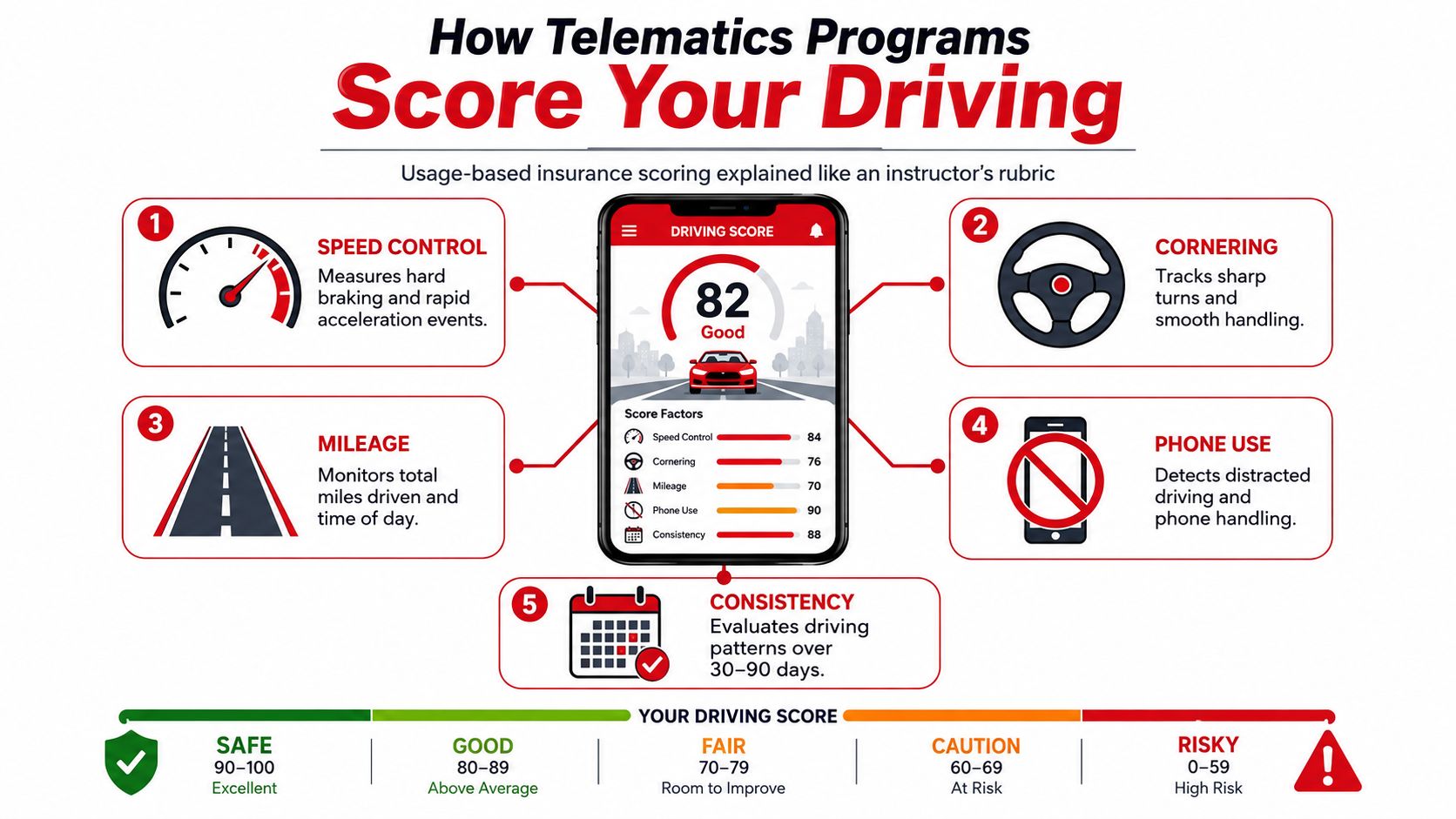
Think of telematics as a driving lesson with a digital scorecard. Instead of an instructor sitting beside you, an app or in-vehicle device observes selected patterns and reports them to the insurer.
Programs commonly examine several signals:
- Braking and acceleration: Repeated hard braking or rapid acceleration can indicate abrupt decision-making, although traffic conditions can affect the result.
- Cornering: Sharp turns and sudden steering changes may be recorded as higher-risk events.
- Mileage and timing: Total miles and the time of day can influence the program's assessment.
- Phone interaction: Phone movement or handling may suggest distracted driving.
- Driving patterns: The program may compare behavior across trips rather than judging one isolated moment.
Why the advertised maximum isn't your personal result
Major insurers commonly advertise telematics savings in the 10% to 40% range, depending on behavior and program design, while the Consumer Federation of America found a more typical discount of about 10%. In the Consumer Reports summary, the median annual savings among telematics users was $120, which shows why a maximum advertised discount shouldn't be treated as a personal forecast. Consumer Reports details the difference between headline savings and typical outcomes.
State Farm's Drive Safe & Save illustrates the structure. The program advertises a 10% initial participation decrease and up to 30% off overall, combining an enrollment incentive with later performance-based pricing. The program overview explains how sign-up savings and later driving results can work together.
Atlanta traffic can produce frequent braking events on roads such as I-285, even when the driver is attentive. A household with several drivers may also see different results because each person's behavior contributes according to the insurer's rules. Age, vehicle, commute patterns, and the underlying policy price still matter.
Practical rule: Before enrolling, ask whether the program can raise your premium, what data it collects, how long it monitors you, and whether the data remains useful if you change insurers.
You can also use family safety tools to discuss habits before they become insurance problems. Life360 for teen driving safety can support conversations about location awareness and responsible driving, while professional instruction builds the physical skills an app can only observe.
Course Completion Versus Extra Practice Hours
A course certificate and additional driving practice solve different problems. The certificate proves that the driver completed formal instruction. Practice helps the driver perform smoothly when traffic, weather, merging, parking, and unexpected hazards demand quick decisions.
A defensive driving course may help an eligible adult obtain an insurer's course-related reduction, subject to the company's rules. Joshua's Law Driver's Education establishes foundational training for qualifying Georgia teens pursuing a Class D license. Extra lessons generally don't create a separate discount line by themselves, but they can help the driver avoid the violations and collisions that damage a clean-record pathway.
Consider two Georgia drivers. A 17-year-old may complete Joshua's Law education and take additional lessons to improve lane changes, parking, and highway confidence. A 35-year-old with years of driving experience may choose an approved defensive driving refresher instead. The teen's training supports licensing readiness and documented education, while the adult's course may address a specific insurer discount. Their policies won't respond identically because the insurer also considers driver history, vehicle, household, and coverage details.
| Option | Typical Discount Impact | Duration | Best For |
|---|---|---|---|
| Approved defensive driving course | May qualify for an insurer-specific course discount | Depends on insurer rules | Adults seeking a documented refresher |
| Joshua's Law Driver's Education | Supports Georgia licensing requirements and may provide training documentation | Based on course and licensing requirements | Eligible teens pursuing a Class D license |
| Additional driving lessons | Usually supports safer habits rather than a direct discount line | Based on selected lesson package | New drivers, nervous drivers, or skill refreshers |
The practical choice depends on the gap you need to close. If paperwork is missing, start with the approved course. If the driver understands the rules but struggles behind the wheel, structured lessons may produce more useful improvement than another certificate.
Claiming Your Discount in Georgia Step by Step
Finishing a course doesn't always activate an insurance discount automatically. The driver or policyholder usually needs to verify the course, collect documentation, and ask the carrier to apply the correct savings.
Follow the documentation trail
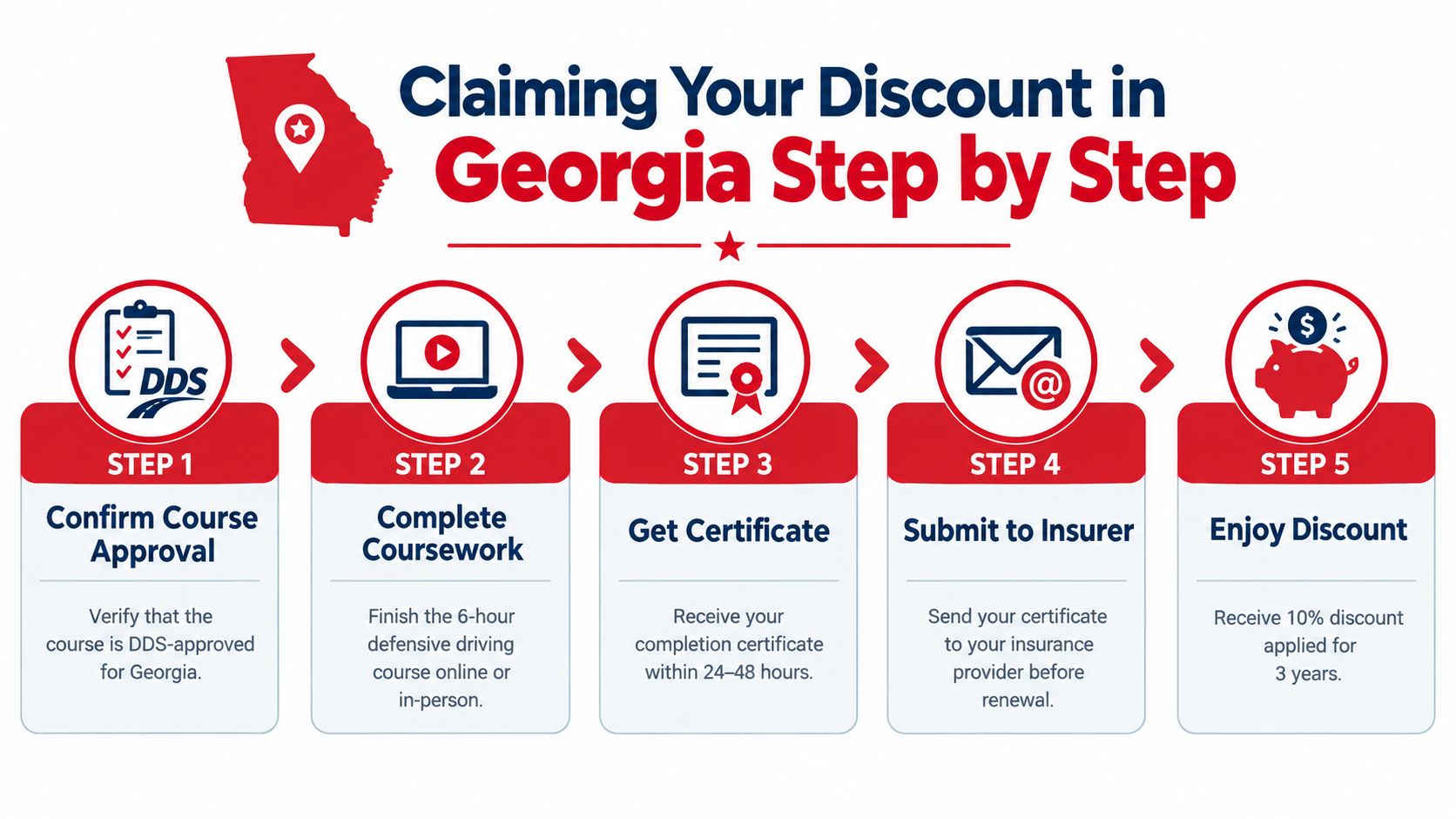
- Confirm approval first. Ask whether the defensive driving course is approved for the intended Georgia purpose. For Joshua's Law, confirm that the provider is authorized to deliver the required Driver's Education.
- Complete the coursework. Keep the enrollment confirmation and final completion record. Online and in-person formats may be available, but the insurer cares about recognized completion.
- Collect the certificate. Save the digital and printed versions if both are offered. Check the name, completion date, and certificate information for errors.
- Contact the insurer before renewal. Use the company portal, agent, or customer-service line. Request the specific safe-driver, good-driver, or course-completion discount rather than saying that you took a class.
- Ask for written confirmation. Request confirmation of eligibility, the effective date, and how the discount appears on the policy.
Not every insurer offers every discount. Some carriers also set a time limit for course completion, so a driver should ask whether the course must be recent. A teen may need a parent or policyholder to make the request because the parent controls the policy.
Keep a policy file: Store the certificate, insurer response, renewal declaration page, and any expiration information together. That file makes follow-up much easier.
Insurance professionals also manage their own education and documentation duties. If you're organizing compliance records or agent training, an insurance CE compliance checklist by LearnStream offers a useful model for tracking completion evidence and deadlines.
Joshua's Law and Online Driver's Ed Options
Georgia's Joshua's Law requirements give eligible teens a defined education path. A 16-year-old applying for a Class D license must complete an approved Driver's Education course plus 40 hours of supervised driving, including 6 hours at night. The education component can be completed through 30 hours of classroom instruction and 6 hours behind the wheel, or a 30-hour online virtual course plus 6 hours behind the wheel, according to the Georgia Department of Driver Services Joshua's Law requirements.
That distinction confuses many families. The course is formal instruction. The supervised driving affidavit documents practice with a qualified supervising driver. The behind-the-wheel component gives the student direct experience with vehicle control and traffic decisions.
Choosing online or in-person instruction
Online Driver's Ed can fit around school, sports, work, and family schedules. A student can complete the classroom portion virtually, then schedule hands-on training separately. In-person instruction may suit students who learn better with a teacher, classmates, and a fixed classroom routine.
A-1 Driving School offers instructor-led and online Driver's Education options designed around Georgia's Joshua's Law pathway. Its program information is available through the Georgia Joshua's Law Driver's Education course page.
Families who qualify may also explore the Georgia Driver's Education Scholarship Grant Program, which can reduce tuition and make approved training more accessible. Eligibility and availability should be confirmed before enrollment because grant support depends on the program's requirements.
Course completion gives the family a formal record to present to an insurer, but the insurer decides whether that record qualifies for a discount. The larger benefit is practical: education, supervised driving, and professional lessons work together to prepare the student for safer independent driving.
For licensing, Georgia DDS says road skills tests are appointment only, and applicants must bring the vehicle. Class C and D tests require a four-wheel vehicle with valid registration or acceptable temporary-tag documentation. Georgia DDS explains vehicle and appointment requirements in its driver manual.
Driving Lessons and Packages That Build a Safer Record
A road test checks whether a student can perform required maneuvers at one point in time. Insurance savings depend on what happens after licensing, when the driver faces daily traffic without an instructor beside them.
Professional lessons can reinforce smoother braking, steady lane changes, controlled merging, parking judgment, and responses to changing weather. Those habits matter because they can support both a cleaner driving record and stronger results in a telematics program.
A structured lesson package may include one-on-one instruction, a dual-control vehicle, pickup from home or school, and a checklist covering mirrors, signaling, lane changes, parking, and interstate driving. The instructor can identify a weak skill early, then repeat it until the student performs it reliably.
Match the package to the learner
A new permit holder often needs broad instruction. That student may benefit from repeated sessions that build fundamentals before road-test preparation. A licensed driver returning after a long lapse may need fewer hours focused on confidence, traffic judgment, and specific problem areas.
| Package | Hours | Best For | Insurance Impact |
|---|---|---|---|
| Foundation package | 6 | A permit holder beginning structured practice | Supports safer habits, with no automatic discount guarantee |
| Development package | 10 | A learner who needs repeated work across several skills | May help reduce risky behaviors that affect future record and telematics results |
| Confidence package | 20 | A new driver needing extensive practice or a licensed driver needing a thorough refresher | Builds broader experience that may support long-term safe driving |
The hours don't replace supervised practice or licensing requirements. They give the learner professional feedback that family practice may not provide, especially during interstate merging, busy intersections, night driving, and parking in tight spaces.
Driving lesson insight: The best insurance strategy isn't chasing a score after a mistake. It's practicing the behaviors that make a clean record more likely in the first place.
A-1 Driving School provides driving lessons and lesson packages for Georgia teens and adults, along with road-test preparation. Families should compare the package scope, pickup area, vehicle features, instructor availability, and the learner's specific goals before booking.
Putting It All Together and Taking the Next Step
A safe driving insurance discount becomes easier to pursue when you treat it as a sequence instead of a single coupon. The clean record reflects consistent decisions. Course completion documents formal education. Telematics, if you choose it, records selected habits over time.
Georgia drivers can organize the next year around four practical actions:
- Review the current record. Ask the insurer which discount categories are already active and which incidents or missing documents affect eligibility.
- Choose approved education. A teen may need Joshua's Law Driver's Education. An adult may prefer an approved defensive driving refresher. Confirm the insurer's rules before paying for a course.
- Schedule hands-on lessons. Use professional practice to work on braking, lane position, parking, merging, night driving, or any skill that feels uncertain.
- Submit every document. Send the certificate and completion information to the insurer, then verify the effective date and renewal treatment in writing.
Georgia DDS also requires a valid Georgia Non-Commercial Learner's Permit, a passed knowledge exam, and an affidavit confirming 40 hours of supervised driving including 6 hours at night before a non-commercial road test. DDS testing information outlines those requirements.
Privacy deserves a place in the decision. Telematics programs can collect location patterns, mileage, timing, and driving events. Recent surveys cited in the available research found that 62% of UK motorists were concerned about sharing location information, while 27.6% of UK respondents in another survey identified data privacy as a significant usage-based insurance issue. The privacy discussion on black-box insurance explains why savings and surveillance should be weighed together.
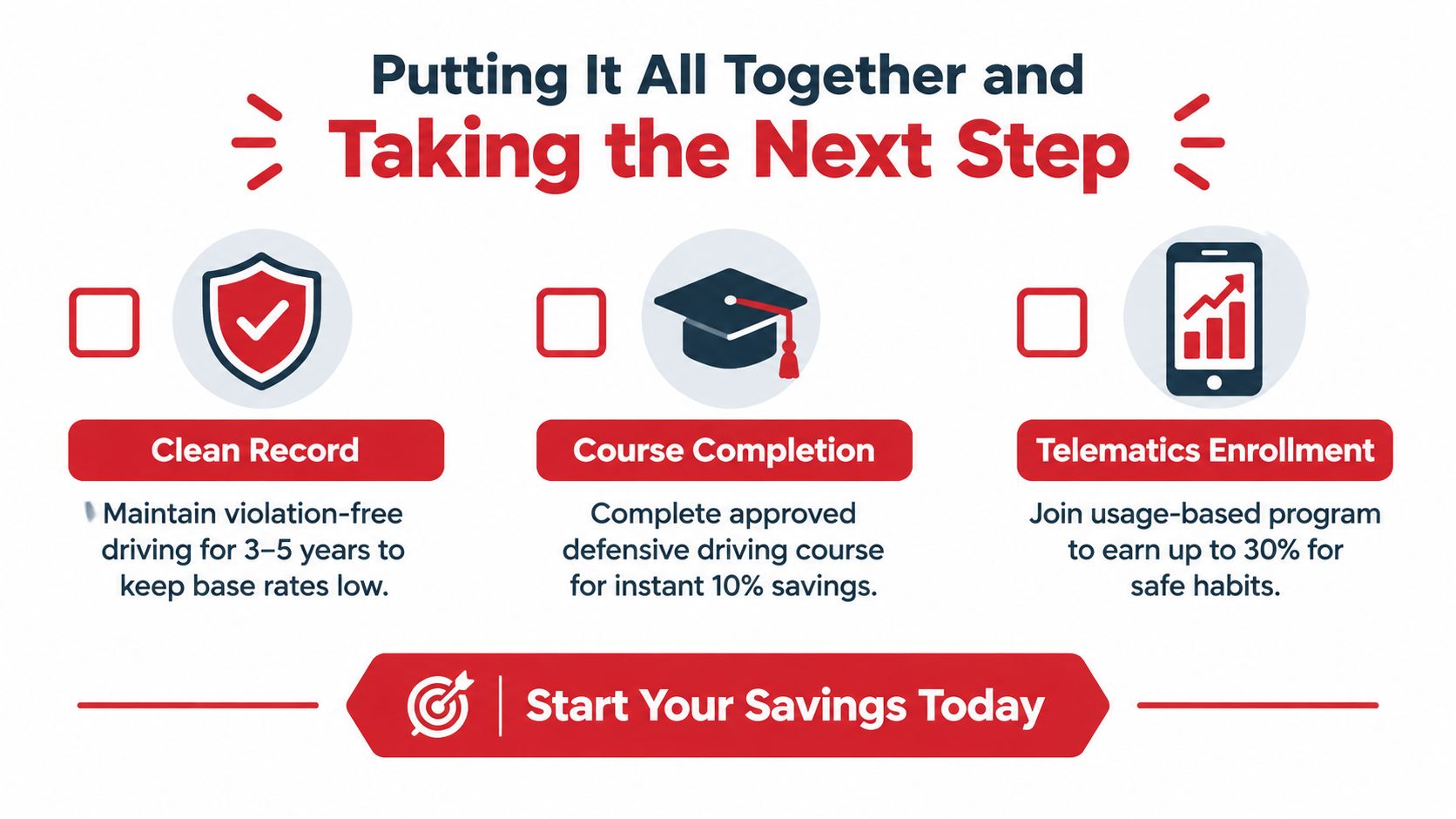
Start with the option that solves your biggest need today. If licensing is the priority, begin with Joshua's Law education and supervised driving. If skill is the concern, schedule lessons. If you're considering telematics, read the insurer's privacy and scoring rules before enrolling.
A-1 Driving School offers Georgia Joshua's Law Driver's Education, online and in-person course options, hands-on driving lessons and packages, road-test preparation, and licensing support. Visit A-1 Driving School to choose a course, schedule lessons, review road-test services, and explore the Georgia Driver's Education Scholarship Grant Program if you qualify.