
Which Georgia driving rule trips up more families than any other? Not the curfew, and not the passenger count. It's the quiet assumption that any licensed adult in the car counts as supervision, or that the rules a teen learns at 15 stay identical the day they turn 16.
Georgia writes those rules in two separate places. A Class CP instructional permit comes first, and a Class D provisional license comes second, and the two stages forbid different things. The permit stage governs who must be sitting beside your teen. The provisional stage governs who else can ride along and what hours the car is allowed to move. Find the row below that matches the license your teen holds today, then work through the section that covers it. That one habit prevents most of the expensive mistakes.
Georgia Learner's Permit Rules at a Glance
Georgia's learner-permit system is the first stage of the state's Teenage and Adult Driver Responsibility Act (TADRA), a graduated licensing program designed for drivers ages 15 to 18, as the Georgia DDS teen driving laws FAQ lays out. A teen applies for a Class CP instructional permit at 15 after passing a vision examination and a knowledge test covering road rules and road signs. Applicants under 18 also need a parent, guardian, responsible adult or authorized driver-training instructor to sign the application.
One line in that source deserves more weight than the rest. The permit does not authorize unsupervised driving. Every trip needs a qualifying adult in the front passenger seat, and Georgia counts that time toward the 1 year and 1 day holding period, including qualifying time a teen held on an out-of-state learner permit after transfer.
| Restriction | Rule | Applies To |
|---|---|---|
| Minimum age for Class CP permit | Age 15, after passing the vision exam and the knowledge test | Teens seeking a learner's permit |
| Supervising driver | At least 21, valid Class C license, able to take control, front passenger seat | Every hour of permit driving |
| Parent or guardian signature | Required on the application | Applicants under 18 |
| Holding period before Class D | 1 year and 1 day (366 days) on the permit | Teens applying for a provisional license |
| Supervised practice | 40 hours total, including 6 at night | Teens under 18 before the road-skills test |
| Passenger limit, first 6 months of Class D | Immediate family members only | Class D license holders |
| Passenger limit, months 7 to 12 | One passenger under 21 who is not immediate family | Class D license holders |
| Passenger limit, after 1 year | Up to three passengers under 21 who are not immediate family | Class D license holders |
| Curfew | No driving from 12:00 a.m. through 5:00 a.m. | Class D license holders |
Read the split carefully. The middle rows belong to the permit stage and apply from the day DDS issues the permit. The last four rows belong to the provisional stage. They don't start when your teen passes the knowledge test, and they don't start when practice hours reach 40. They start when the Class D license is issued.
The distinction that matters: during the permit stage, the only thing limiting when and with whom your teen drives is the supervisor requirement itself. Passenger caps and the overnight curfew are provisional-license rules, not learner rules.
Families who plan around the wrong row lose time. A parent who assumes the midnight restriction already applies may cut valuable evening practice. A teen who assumes the passenger rules never applied may be surprised at month one of the provisional license.
Who Can Supervise a Learner Driver
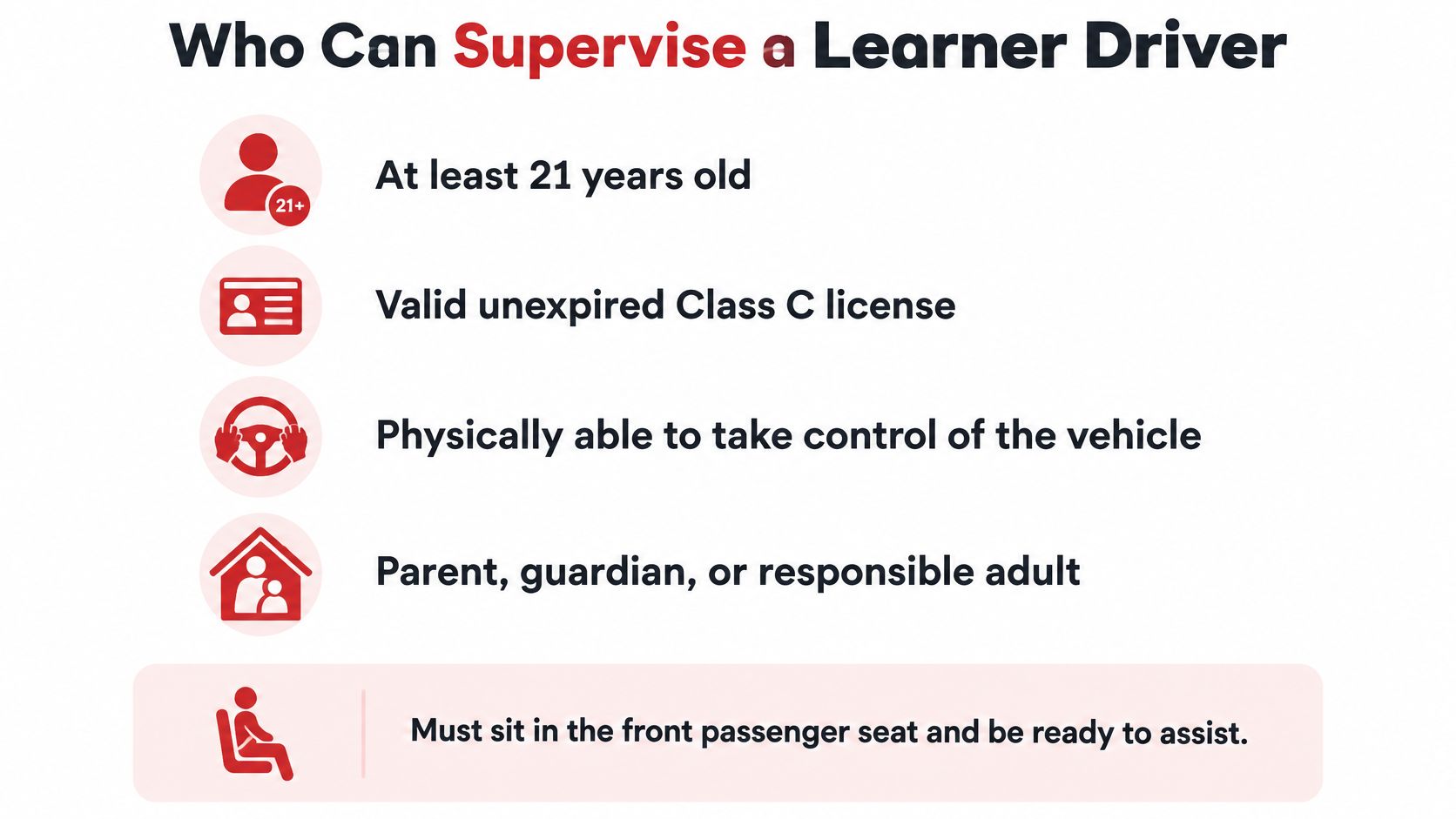
Georgia's Class CP permit is available at 15 to a teen who passes the road-signs and road-rules knowledge examination, and applicants under 18 need parent, legal-guardian or responsible-adult consent along with the identity, lawful-presence, residency, vision and school-enrollment checks described in the DDS Class CP permit requirements. Once the permit is in hand, the operating rule takes over, and it's categorical. The permit holder may drive a Class C vehicle only with a supervising driver who meets four conditions at the same time:
- Age. The supervisor must be at least 21 years old.
- License. The supervisor must hold a valid Class C license, unexpired.
- Capability. The supervisor must be fit and physically able to take control of the vehicle.
- Position. The supervisor must sit in the front seat beside the learner, ready to intervene.
The permit itself stays valid for up to two years, and none of that time converts it into independent driving authority.
Test each condition against a real family
Take a grandmother who drives your teen to practice twice a week. She qualifies, because she meets all four conditions. Now take a father whose license lapsed two months ago and hasn't been renewed. He doesn't qualify until it's valid again, no matter how many years he's been driving.
A 19-year-old sibling with a clean record doesn't qualify, because the age floor is 21. An uncle riding in the back seat while the teen drives doesn't qualify either, since the rule fixes the supervisor in the seat beside the learner. And when two adults split supervision across a long trip, each one has to meet all four conditions for the segment they supervise. Swapping mid-drive is fine. Riding along as an unqualified passenger is not.
The five-step pre-drive check
- Confirm the supervisor is 21 or older.
- Check that the license is Class C and hasn't expired.
- Confirm the supervisor can reach the pedals, wheel and brake from the passenger seat.
- Keep that person in the front passenger seat for the whole drive, not just the first mile.
- Record the date, start time, end time and road conditions of the session.
The fifth step isn't paperwork for its own sake. It's the only durable evidence of what your teen did behind the wheel, and it becomes the basis for a parent's sworn verification later.
The most common gap is the quiet one. Families assume any adult in the car satisfies the law. An adult merely riding elsewhere in the vehicle does not, and a stop that begins as a routine traffic check can end with a teen driving outside the terms of the permit.
Permit Validity, Eligibility Documents and Suspensions
Paperwork derails more timelines than driving skill does. A Class CP permit is issued with an expiration date, and DDS controls renewal and reissue, so confirm the current rules before you build a schedule around one. Count the holding period from the permit issue date, never from the first practice drive. A teen who passes the knowledge test on March 1 is 366 days from eligibility on that date, not on the Saturday the family finally found time for a parking lot session.
What to have in hand before the DDS visit
Bring proof of identity and lawful presence, proof of residency, the vision screening and school-enrollment documentation, plus a parent, guardian or responsible adult present to sign. Missing paperwork turns a 30-minute visit into a second appointment and pushes the whole calendar back, because the holding period can't start until the permit exists.
A citation that puts the permit at risk does more than cost money. It can suspend the permit, which moves the date your teen becomes eligible for the provisional license, and that date is the one the family has been planning around for a year.
The trap: Georgia doesn't require a formal state practice log, yet a parent, guardian or DDS-certified instructor must later affirm under penalty of law that the applicant completed the required supervised hours, as the DDS learner's permit requirements page explains. The missing form doesn't remove the obligation. It hands the record-keeping to you.
Joshua's Law Routes and the 40 Supervised Hours
Joshua's Law gives families three legitimate paths to the education requirement, and they differ in who does the teaching, not in how much driving the teen ultimately needs.
| Education Route | Course Hours | Behind-the-Wheel Training | Supervised Driving |
|---|---|---|---|
| Instructor-led route | 30 hours classroom | 6 hours with a certified school instructor | 40 hours including 6 at night |
| Online route | 30 hours online through a certified virtual program | 6 hours with a certified school instructor | 40 hours including 6 at night |
| Parent-taught route | 30 hours classroom or online | Not required; parent-taught practice follows the DDS Parent/Teen Driving Guide | 40 hours with parent or guardian including 6 at night |
The Georgia DDS Joshua's Law FAQ sets the target for a 16-year-old applicant: a DDS-approved driver-education course, at least 40 hours of supervised driving with a parent or guardian, at least 6 nighttime hours inside that total, and sworn verification of the supervised driving from the parent or guardian. Applicants who haven't completed an approved driver-education course generally have to be at least 17 to qualify for a Class D license, which is why the course doubles as a calendar decision, not just an education one.
The DDS section on obtaining a license or permit confirms the routes: 30 hours of classroom instruction or 30 hours of online instruction through a certified virtual program, then either 6 hours of behind-the-wheel training with a certified school instructor or parent-taught practice using the DDS Parent/Teen Driving Guide.
Five steps from route choice to verification
- Pick the route with the calendar in front of you, not after enrollment.
- Enroll in the 30-hour course, classroom or online.
- If you chose an instructor route, book the 6 hours of behind-the-wheel training with a certified school instructor early, because those slots fill.
- Log the 40 supervised hours, with at least 6 at night, in a driving practice log you update after each session rather than reconstructing later.
- Get the parent or guardian's sworn verification before the DDS appointment, not at the counter.
Which route suits which family
A household with a parent home most evenings and weekends fits the parent-taught route well. That parent can supervise the 40 hours across different conditions and follow the DDS guide, and the family saves the instructor hours. A household with two working parents, or a teen carrying a job and a sport, usually fits the online route better. The 30 hours happen on the teen's schedule, and 6 concentrated instructor hours cover the behind-the-wheel component with a trained eye on habits a parent might miss.
Nighttime Driving Hours and the 12 to 5 a.m. Curfew
Two rules involve the clock, and they belong to different licenses. Keeping them apart answers most of the questions parents bring to a first lesson.
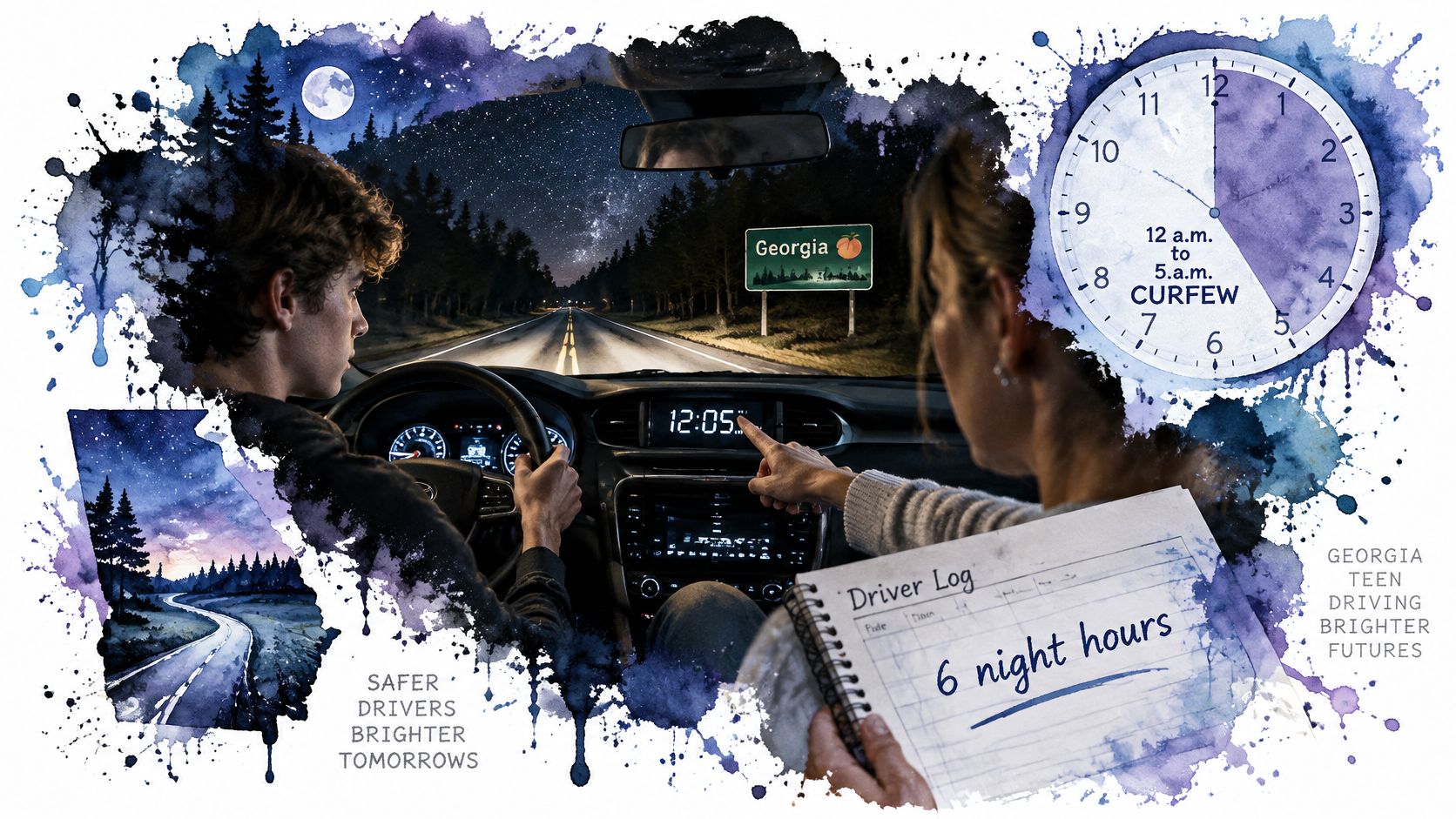
Rule one is practice. Six of the supervised hours must happen after dark, and a parent or guardian verifies them. These hours exist because night driving is a different skill set: headlight glare, shorter sight distance, pedestrians in dark clothing, and road markings that read poorly in rain.
Rule two is the curfew. A Class D provisional license holder may not drive from 12:00 a.m. through 5:00 a.m., with no exceptions. That restriction rides on the provisional license, not on the permit.
A workable plan for the night hours
- Set the target early. Six night hours spread across the permit period beat six hours crammed into one weekend.
- Start in familiar territory. Run the first night sessions on roads your teen already knows in daylight, at low-traffic hours.
- Finish before the window closes. Begin evening sessions well before 10 p.m. so the drive ends long before the hours your teen will one day be barred from driving.
- Write down the start and end times. "Night" needs to be provable, and a log with timestamps settles any question later.
A learner driving at 11 p.m. with a qualified supervisor is following the supervision rule, and those hours count toward the total. Once the provisional license arrives, the same clock reading becomes a violation. Confirm with DDS what counts as nighttime before your teen logs the hours, and put the answer in the log so the record is consistent.
Holding Period and Road Test Requirements
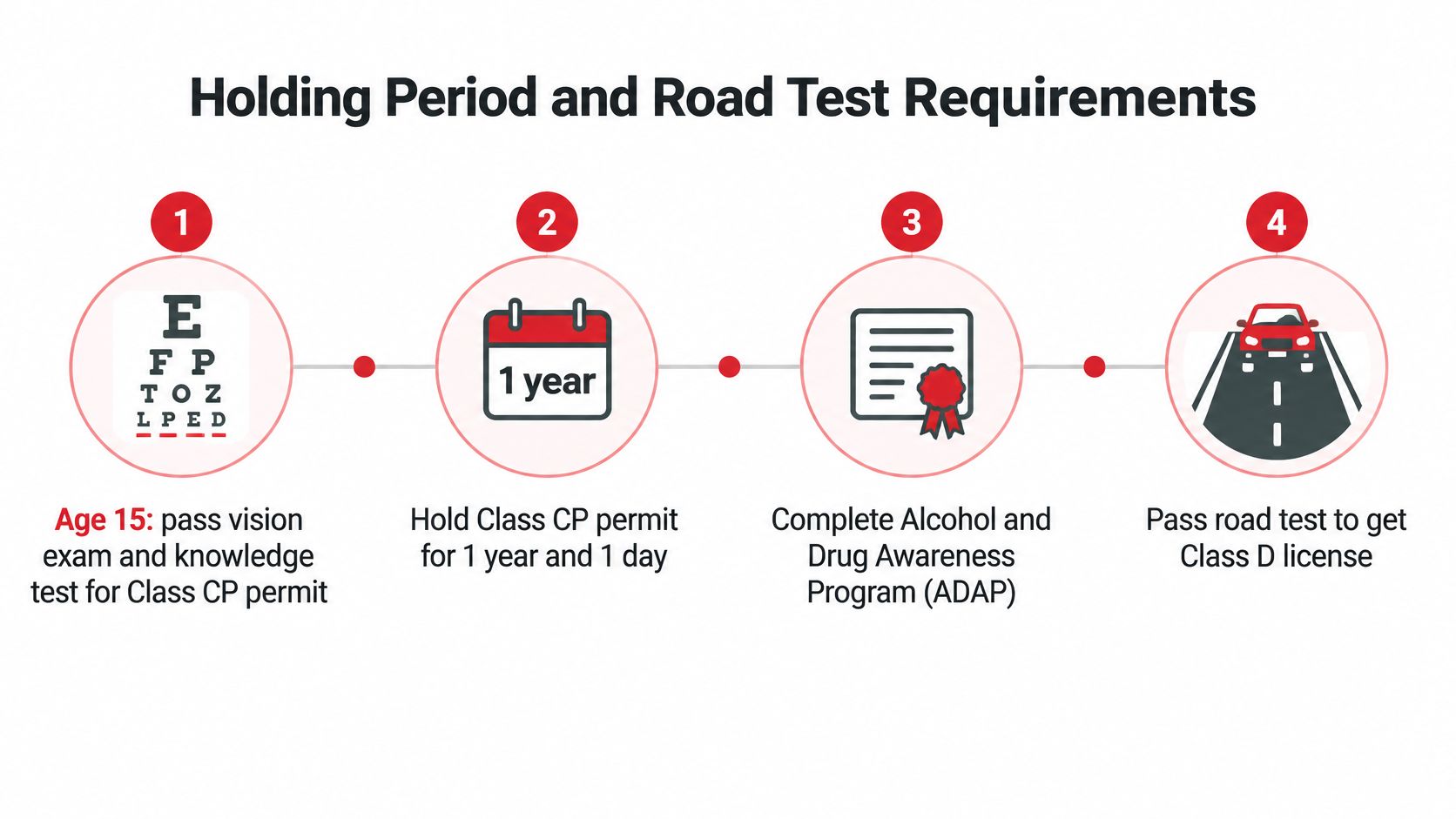
The holding period is fixed, and it's the requirement families most often miscalculate. A Georgia teen seeking a Class D provisional license must hold a valid Class CP learner's permit for at least 1 year and 1 day before applying, according to the DDS testing and exam information. The same applicant must complete the applicable Joshua's Law requirements, finish the Alcohol and Drug Awareness Program, and pass the road test.
The timeline in the order it happens
- Age 15. Pass the vision exam and knowledge test for the Class CP permit.
- From the first week. Start logging supervised drives, including the six night hours.
- During the permit year. Complete the Joshua's Law course, classroom, online or parent-taught.
- Hold the permit 366 days. Count from the issue date on the permit card, and include qualifying out-of-state permit time if your family transferred in.
- Finish ADAP. Complete the Alcohol and Drug Awareness Program before the road test.
- Book the road test. Schedule it at DDS or through a certified school once the holding period is satisfied.
DDS describes the road test as an evaluation of the applicant's ability to safely operate a motor vehicle. It's a driving assessment, not a memory quiz, so the practice hours are the preparation. Book through a Georgia road test scheduling guide so you know which documents the appointment requires before you arrive.
What the test vehicle needs, and what you carry in
The vehicle itself has to pass muster. For the road-skills examination, the test car needs valid liability insurance, current registration and a passing required safety inspection. A borrowed car with an expired registration card in the glovebox ends the appointment before the teen turns the key.
Bring your teen's identity documents, the learner's permit, the record of supervised hours, the insurance and registration for the test vehicle, and proof of the safety inspection. It also helps to drive the test route area beforehand, so the teen isn't reading new intersections while being evaluated.
Passenger Limits After You Get a Provisional License
The Class D license opens independent driving, then narrows it. Georgia makes the provisional license available at 16 to a teen who has held a permit long enough, avoided major violations that suspended it, and completed Joshua's Law, and the DDS guide to Georgia teen driving restrictions then phases in three passenger stages:
- First 6 months. Immediate family members only.
- Second 6 months. No more than 1 passenger under age 21 who isn't immediate family.
- After 1 year. Up to 3 passengers under 21 who aren't immediate family.
Two worked examples
Say a 16-year-old is in month 8 of a Class D license and wants to drive two friends to a Friday game, one aged 17 and one aged 19. Both count toward the single-passenger cap, so only one of them can ride. The other drives separately or stays home. Nothing about the car's seating changes the answer, because the rule counts passengers, not empty seats.
Now move the same driver past the one-year mark. Three friends under 21 can ride. Add a fourth and the limit is broken, even if the car seats seven. Immediate family members don't count toward that cap, so a younger sibling in the back seat doesn't consume one of the three slots. Confirm the immediate-family definition with DDS before relying on it for a specific person.
A three-part check before every trip
- Count the passengers, and separate immediate family from everyone else.
- Check the months since the provisional license was issued, because the stage changes at six months and again at one year.
- Confirm each passenger's age, since a 20-year-old friend counts and a 21-year-old doesn't.
Run this check out loud with your teen for the first month of independent driving. It turns a rule your teen has to remember into a habit the whole family reinforces, and it prevents the most common provisional-license violation, which is losing track of which stage applies.
Book Driving Lessons That Meet Georgia Requirements
The permit year is a build, not a wait. Enrollment in a DDS-approved Joshua's Law course and a structured set of driving lessons turn those 366 days into a plan with checkpoints, which is exactly what the state's staged system rewards.
A-1 Driving School runs DDS-approved Joshua's Law and driver's education courses in instructor-led classroom and online formats, and both cover the education component a 16-year-old needs before applying for a Class D license. Our teen and adult driving lessons and driving lessons packages are the part families lean on most, because they cover the 6 instructor hours in the instructor-led route with a trained instructor watching for habits a parent may not catch. We also provide Georgia road testing, and the Georgia Driver's Education Scholarship Grant Program is available for families who qualify. Students need a valid learner's permit or driver's license before taking a driving lesson.
The booking checklist
- Confirm the permit issue date and count 366 days from it before you pick a road test date.
- Choose the classroom, online or parent-taught route based on your family's weekly schedule.
- Book a driving lessons package including the 6 instructor hours if you chose an instructor route.
- Prepare for the first lesson with this guide to getting ready for driving lessons, so the hour is spent driving rather than adjusting the seat.
- Schedule the road test once the holding period is met, with insurance, registration and inspection documents in hand.
Map the whole path before the first lesson, and the permit year stops being a countdown. It becomes a sequence of skills your teen can demonstrate, which is what the road test measures and what the first solo drive demands.
A-1 Driving School teaches DDS-approved Joshua's Law courses in instructor-led classroom and online formats, and our driving lessons packages cover the behind-the-wheel hours that turn a permit into real skill. With 18 locations across metro Atlanta and a Georgia road test service, we can carry your family from the first practice drive through the day your teen earns the Class D license. Visit A-1 Driving School to enroll in a course, book a driving lessons package or schedule your road test.