

Georgia Class C and D road tests require a minimum score of 75% to pass, and the examiner records points against each scored maneuver. But if you can parallel park perfectly, does that mean you're ready for the rest of the drive?
Not necessarily. Your preparation needs to cover the decisions between maneuvers, including when you look, where you stop, how you signal, and whether you maintain control without reminders. Understanding your road test passing score helps you turn nervous practice into a clear plan.
The 75% Threshold and What Georgia Scores
Georgia's Class C and D road test requires at least 75% to pass, according to the Georgia Department of Driver Services testing guide. DDS evaluates practical driving skills and reviews the score sheet afterward, so the result reflects observed performance rather than a general impression of your confidence.
Think of your score as a points budget, with an important qualification: the percentage tells you the passing boundary, but it doesn't tell you the official deduction for every possible mistake. Don't assume every fault costs the same amount.
The rules that frame your preparation are straightforward:
- Protect the passing margin. On a normalized hundred-point illustration, losing more than a quarter of the available credit puts you below the passing threshold.
- Keep safety ahead of arithmetic. An unsafe act or inability to control the vehicle can stop the examination before every maneuver is completed.
- Treat the entire drive as scored work. The examiner gives directions while recording performance. The drive between parking exercises matters.
- Prepare the vehicle and documents. Bring valid liability insurance, registration, and a vehicle that meets the safety-inspection requirement.
Georgia road test scoring rules at a glance
| Element | Georgia rule | What it means for you |
|---|---|---|
| Passing threshold | At least 75% | Losing more than 25% of the available points fails the test |
| Early end of test | DDS may end the test for an unsafe act, failure to show basic control, failure to follow directions, or too many penalty points | One serious error can stop the test before you reach 75% |
| Score sheet | Examiner reviews the score sheet with the applicant after the test | You receive a record of where points were lost |
| Vehicle documents | Valid liability insurance, registration, and a safety inspection | Missing paperwork can prevent the test from starting |
| Examiner focus | Examiner records scores while giving instructions | Avoid conversation and leaning on the window during the drive |
Make the budget useful during practice
A budget isn't permission to spend every available point. It's a way to recognize that several avoidable errors can leave you with little room for another mistake.
Write the passing target at the top of your practice log. Underneath, record the maneuver, the observed fault, and whether you needed a reminder. Independent, repeatable performance is a better booking signal than completing an exercise correctly only after someone coaches you through it.
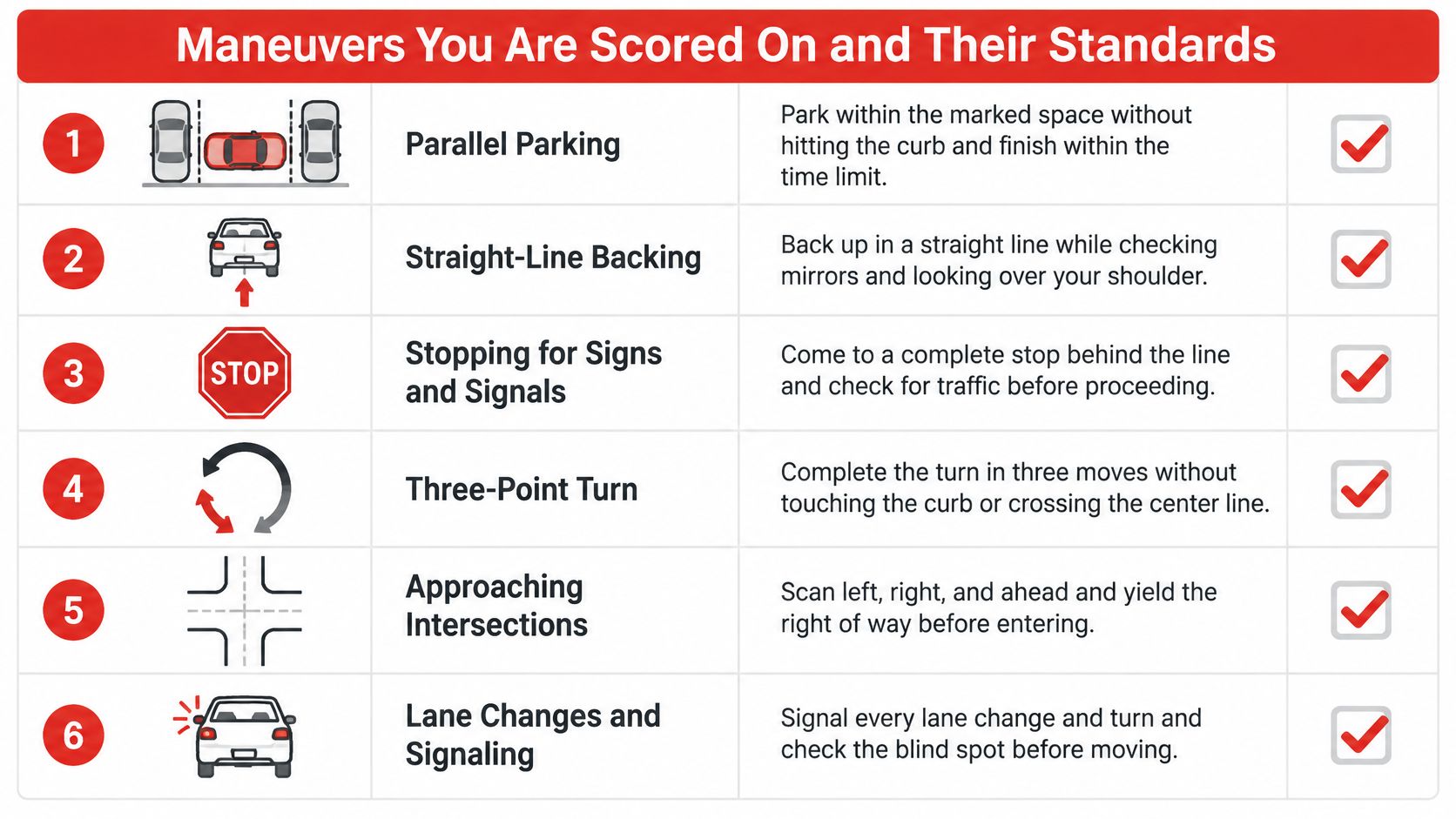
Maneuvers You Are Scored On and Their Standards
Parking deserves practice, but it shouldn't consume every practice drive. DDS also evaluates stopping, intersections, yielding, turns, passing, following distance, posture, and steering control.
Use this visual as a rehearsal checklist, with the published Georgia measurements in the table below as your numeric reference.
Published standards for two scored maneuvers
| Maneuver | Georgia standard | What the examiner watches |
|---|---|---|
| Parallel parking | Space 22 feet long by 10 feet deep; finish no more than 18 inches from the curb | Position, distance from curb, and vehicle control |
| Straight-line backing | About 50 feet at no more than 10 mph | Looking behind the vehicle and staying inside the boundary lines |
These are the published measurements from the DDS testing guide. Don't add an assumed parking time limit or treat the illustrated checklist as a substitute for official directions.
Rehearse control before adding complexity
Parallel parking: Set up consistently, observe around the vehicle, and move slowly enough to make controlled steering adjustments. After parking, get out safely with your supervising driver and check the final position rather than guessing from the driver's seat.
Straight-line backing: Look behind the vehicle and use small corrections. A large steering input followed by an equally large correction can turn a manageable drift into repeated weaving.
Stopping for signs and signals: Identify the stopping position early, brake progressively, and come to a complete stop before proceeding when permitted. Don't confuse slowing almost to a stop with stopping.
Three-point turn: Check the area before each change of direction, control the vehicle's movement, and leave room to avoid the curb. A two-point turnabout explanation can help distinguish turnabout patterns, but follow the maneuver your examiner requests.
Show judgment on the road
At intersections, approach in the appropriate lane and scan for traffic, pedestrians, and signals before entering. When yielding, make your decision from what other road users are doing, not from a passenger's prompt.
For turning and passing, prepare before moving: observe, signal, select a safe opening, and maintain the appropriate lane position. Don't force a passing opportunity just to demonstrate the skill.
Maintain following distance that leaves room to respond smoothly. Keep an upright driving posture and steady steering control throughout, not just during a named exercise.
Use this practice checklist:
- Choose a pair of maneuvers: Give each enough attention to identify a specific weakness.
- Record the result: Note where the car finished and whether observation or control broke down.
- Track time without racing: Use elapsed time to notice hesitation, not to invent a speed target.
- Repeat independently: Ask your supervising driver to withhold routine prompts when it's safe.
How Point Deductions Decide Pass or Fail
In a hypothetical hundred-point model, losing twenty-five points leaves the passing threshold; losing twenty-six puts you below it. That boundary explains why remembering only “a few mistakes” doesn't tell you whether you passed.
The important distinction is between points and percentage points. On this illustration, each point lost reduces the percentage by the same amount. That relationship is arithmetic for this teaching model, not confirmation that DDS assigns every maneuver an equal weight.
Points lost and the resulting outcome, hundred-point illustration
| Points lost | Score out of 100 | Result |
|---|---|---|
| 0 | 100% | Pass |
| 20 | 80% | Pass |
| 25 | 75% | Pass at the threshold |
| 26 | 74% | Fail |
| 30 | 70% | Fail |
These values illustrate the passing boundary, not an official DDS deduction schedule. Confirm the actual values attached to faults with DDS rather than borrowing a scoring chart from another state.
Why counting mistakes doesn't work
Say a student remembers a late signal, poor parking position, and backing drift. Calling that “only a few errors” ignores whether the faults were repeated, how they were scored, and whether any created an immediate safety problem.
The opposite mistake is assuming a small imperfection automatically means failure. Stay focused after an error, listen to the next direction, and continue driving safely unless the examiner tells you otherwise.
Practice rule: Track the fault you can correct, not the score you hope the examiner will give it.
A serious safety failure can override the arithmetic. You can't rely on unused points as protection against unsafe driving.
Build an honest practice budget
Make a worksheet with columns for fault, frequency, confirmed deduction, and practice habit. If the official deduction isn't known, leave that cell blank rather than inventing a number.
You can use clearly labeled hypothetical estimates to understand how repeated faults accumulate, but don't use those estimates to declare yourself test-ready. Prioritize unsafe behavior first, then recurring mistakes, then isolated execution problems.
For example, repeated late signals deserve more attention than a single awkward parking adjustment. One is a habit that may reappear throughout the drive; the other may need a narrower technical correction.
Common Point Losses and How to Stop Them
A rolling stop deserves attention before cosmetic parking improvements. But there's no verified ranking here showing which mistake Georgia applicants make most often, and there's no published deduction schedule in these sources assigning a fixed penalty to each fault.
The more important distinction is between a correctable execution error and unsafe performance. The Georgia DDS road-test guidance says the examiner may end the test for an unsafe act, failure to demonstrate basic control, failure to understand or follow directions, or exceeding the allowed penalty points.
Use the visual to identify a practice target, then rehearse the specific habit that addresses it.
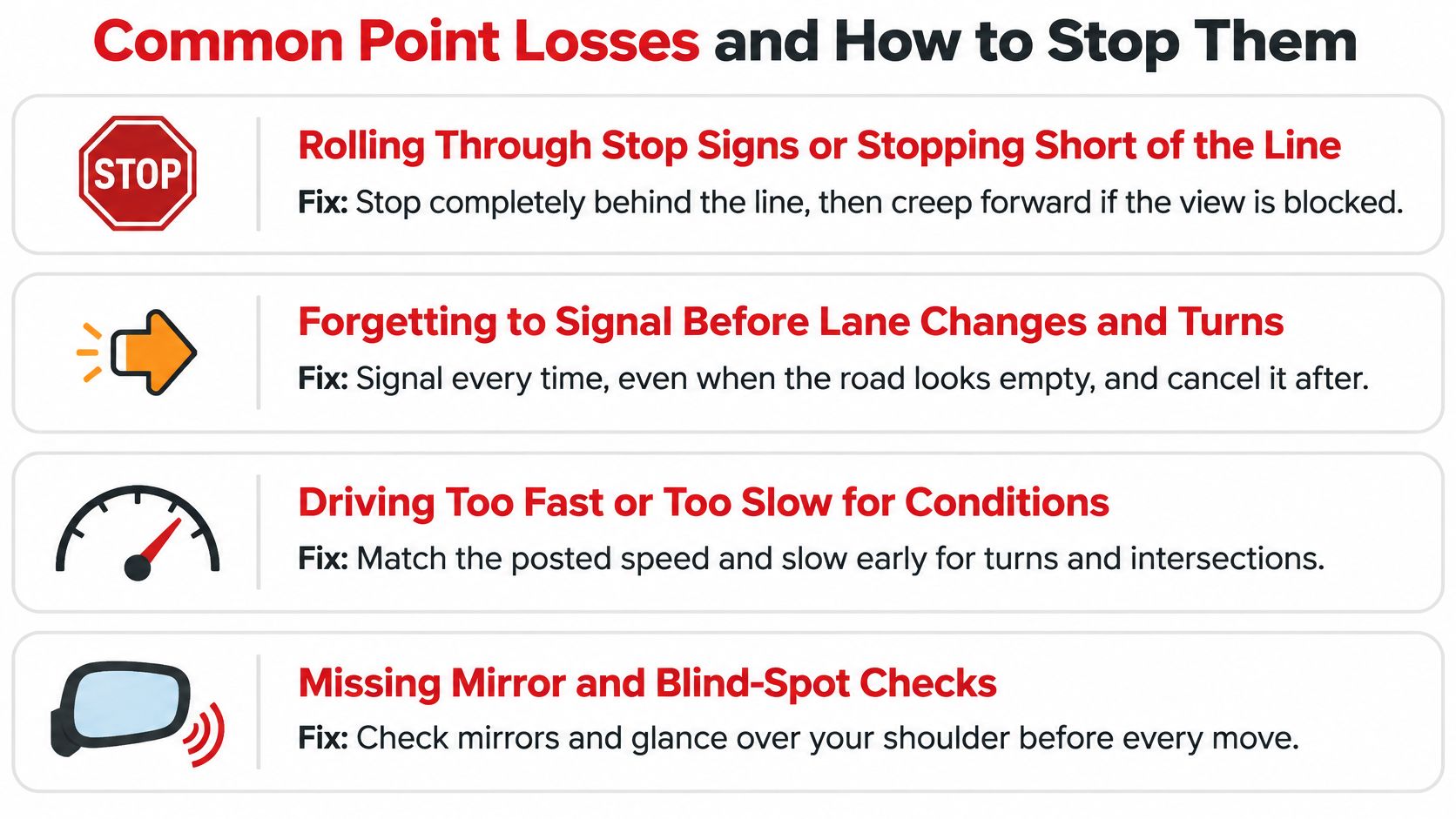
Pair each fault with a repeatable action
- Rolling stops or poor stopping position: Identify the line early and stop completely before it. If visibility is blocked, establish the stop first, then move forward cautiously when lawful and safe.
- Missing or late signals: Build signaling into your preparation before a turn or lane change. Check that the signal cancels afterward.
- Unsuitable speed: Read signs and conditions early. Don't exceed the limit, and don't assume unnecessarily slow driving demonstrates better judgment.
- Skipped mirror or blind-spot checks: Rehearse an observation sequence before changing position. Use a brief shoulder check where needed without losing awareness ahead.
- Lane drift: Look farther along your intended path and make small corrections. Ask your supervisor to identify whether drift appears during mirror checks or conversation.
- Wide or tight turns: Reduce speed before turning, look toward the intended lane, and steer progressively instead of correcting sharply halfway through.
- Abrupt starts and stops: Practice smooth pedal pressure in a suitable area before combining acceleration and braking with busier traffic decisions.
Practice listening without distraction
Keep conversation to necessary communication. DDS explains that the examiner is giving instructions and recording the score, so don't try to fill the silence with small talk.
If a direction is unclear, ask for clarification instead of making a sudden maneuver. Rehearse receiving directions from your supervising driver without needing reminders about basic control.
Use this video alongside supervised practice, not as a replacement for in-car instruction.
Choose a single recurring fault for your next drive. Log whether it happened, what triggered it, and whether you corrected it independently.
Reading Your Score Sheet and What to Do Next
Your result is most useful when you understand the behaviors behind it. The Georgia Driver's Manual explains that the examiner may show the score sheet and discuss the result afterward, giving you an opportunity to connect recorded performance with specific driving actions.
Ask focused questions: Was the problem the final parking position or vehicle control during the maneuver? Was a signal absent or late? Those distinctions lead to different practice tasks.
Read the result in three passes
- Check the total. Identify whether the result meets the passing requirement and whether an early termination affected the outcome.
- Group deductions by maneuver. Separate parking and backing problems from stopping, observation, lane position, and following-distance problems.
- Find repeated habits. Several observation faults suggest a routine that needs rebuilding, not unrelated bad luck.
Sample score sheet, illustrative hundred-point base
| Maneuver | Points lost | Observed fault | Running score |
|---|---|---|---|
| Parallel parking | 5 | Finished 20 inches from curb | 95 (95%) |
| Straight-line backing | 10 | Drifted over boundary line | 85 (85%) |
| Stop at sign | 5 | Stopped past the line | 80 (80%) |
| Following distance | 5 | Gap too short behind lead car | 75 (75%) at threshold |
| Lane change | 5 | Signal given late | 70 (70%) fail |
Every deduction in this sample is hypothetical. The table is a practice worksheet, not a reproduction of the DDS score sheet or official fault values.
The running total shows why the final fault matters, but it doesn't mean signaling should be your only practice priority. The backing error carries the largest imagined deduction, while poor stopping position and following distance also deserve correction.
Turn each deduction into a lesson objective
For the parking fault, rehearse setup and verify the finished position. For backing, practice slow movement with smaller corrections; for stopping, identify the line earlier; for following distance, restore space smoothly; for signaling, communicate before changing position.
If you passed, confirm any remaining licensing requirements, including applicable Joshua's Law completion. Passing the driving assessment doesn't replace those obligations.
If you failed, choose the largest or most frequent weaknesses and devote targeted practice to them before another mock drive. Confirm current retest waiting periods, fees, and booking rules with DDS before scheduling.
Don't rebook on the same weak habits. Rebook when you can demonstrate the correction without prompting.
Joshua's Law Pathways Before the Road Test
The supervised-driving requirement applies whichever education format you choose. The DDS Joshua's Law FAQs require a sixteen-year-old applicant to complete approved driver education and at least 40 hours of supervised driving, including 6 hours at night, and hold a learner's permit for 1 year and 1 day before receiving a Class D license.
Those requirements also apply to seventeen-year-olds applying on or after July 1, 2021, according to the same FAQs. The classroom format is a choice; completing the practical preparation isn't.
Joshua's Law completion pathways for Class D applicants
| Pathway | Classroom or online hours | Behind-the-wheel training | Supervised driving |
|---|---|---|---|
| Classroom with school-based driving | 30 hours classroom | 6 hours at a certified school | 40 hours, including 6 at night |
| Classroom with parent-taught driving | 30 hours classroom | Parent-taught practice | 40 hours, including 6 at night |
| Online with school-based driving | 30 hours approved online | 6 hours at a certified school | 40 hours, including 6 at night |
| Online with parent-taught driving | 30 hours approved online | Parent-taught practice | 40 hours, including 6 at night |
Choose the format and driving pathway separately
Classroom instruction suits students who benefit from a scheduled learning environment. Approved online instruction offers flexibility, but finishing lessons on a screen doesn't establish that you can control a car.
The DDS Joshua's Law requirements distinguish the certified virtual classroom component from behind-the-wheel training and supervised driving. Choose the in-car pathway deliberately rather than assuming online completion handles everything.
With school-based training, use professional feedback to identify the mechanics you should reinforce during family practice. With parent-taught driving, plan practice around specific skills and keep an accurate record rather than relying on remembered outings.
Put lessons on the permit timeline
Students must have a valid learner's permit or driver's license to take a driving lesson with us. A-1 Driving School's Driver's Education and Driving Lessons courses include Georgia DMV-approved Joshua's Law and Driver's Education courses, including all education and road testing.
Review the Georgia Joshua's Law driver's education options to choose the appropriate education format. Then organize the in-car work around the weaknesses your practice log identifies.
Start with the permit issue date and work forward to the earliest licensing eligibility date. Count backward from your intended test appointment to leave room for instruction, supervised practice, and corrections. Eligibility and readiness are separate checkpoints, and both need to be satisfied.
Book Driving Lessons Packages Before Your Road Test
A driving lessons package gives your practice a structure: identify a fault, rehearse the correction, apply it in traffic, and check whether it holds on another drive. That's more useful than taking occasional drives without a defined objective.
Choose lesson priorities from your performance rather than your anxiety alone. Parking may feel intimidating, but if you consistently miss observation checks, those checks need deliberate attention too.
Make repeated lessons purposeful
Bring your practice log to instruction. Describe the situation precisely: “I drift when checking the mirror” gives an instructor a clearer starting point than “I'm bad at lanes.”
Ask for feedback you can rehearse with your supervising driver. A useful takeaway identifies the trigger, the correct action, and what successful execution looks like.
A package should support a progression from coached execution to independent driving. Don't judge progress only by how comfortable the drive feels; check whether you still need reminders to signal, scan, select a lane, or adjust speed.
The Georgia Driver's Education Scholarship Grant Program may help qualifying applicants access training. Check eligibility directly before enrolling, and don't assume assistance has been approved until your participation is confirmed.
Follow a clear booking sequence
- Review the relevant options. Browse the course information and road-test lessons page with your practice priorities in mind.
- Match the plan to your timeline. Call our Driver's Education Hotline at (770) 603-3320 to discuss your permit date and the preparation you need.
- Schedule purposeful practice. Book the lessons package and arrange supervised drives that reinforce the instructor's feedback.
- Separate testing from preparation. Choose the road-test appointment after your driving becomes consistent, rather than using the appointment to force a rushed schedule.
Before booking the examination, confirm your permit, select your Joshua's Law pathway if applicable, and arrange the lesson package. As a practical readiness check, complete a pair of consistent practice drives without routine coaching; that's a preparation recommendation, not an additional DDS requirement.
Leave room to correct anything those drives uncover. Your target is a controlled, observant drive, not a last-minute calculation about how many errors you might survive.
A-1 Driving School offers driving lessons for students and adults, driver's education, and Georgia Road Testing to help you connect preparation with the skills the examiner evaluates. Visit A-1 Driving School and call our Driver's Education Hotline at (770) 603-3320 to discuss a driving lessons package that fits your permit timeline and practice needs.