
The night before a road test, most students do the same thing. They replay every stop sign, every turn, every parking attempt, and every mistake they made in practice. By the morning, the problem usually isn't lack of knowledge. It's overload.
A good georgia road test video helps because it removes surprise. Once you can see the order of events, the pace of the drive, and the kinds of maneuvers that show up, your brain stops guessing and starts preparing. That shift matters.
What makes the biggest difference, though, is knowing what the examiner is watching. The test isn't about flashy driving. It's about safe habits that are easy to observe: full stops, clear signaling, steady speed, good lane position, real mirror checks, and calm control when something feels awkward.
Your Georgia Road Test Video Walkthrough
A solid georgia road test video should give you a driver's-eye view of the test, not just a commentary from the passenger seat. You want to watch the setup, the first move away from the curb or parking area, the examiner's pacing, and the transitions between maneuvers. Those are the moments that make nervous drivers rush.
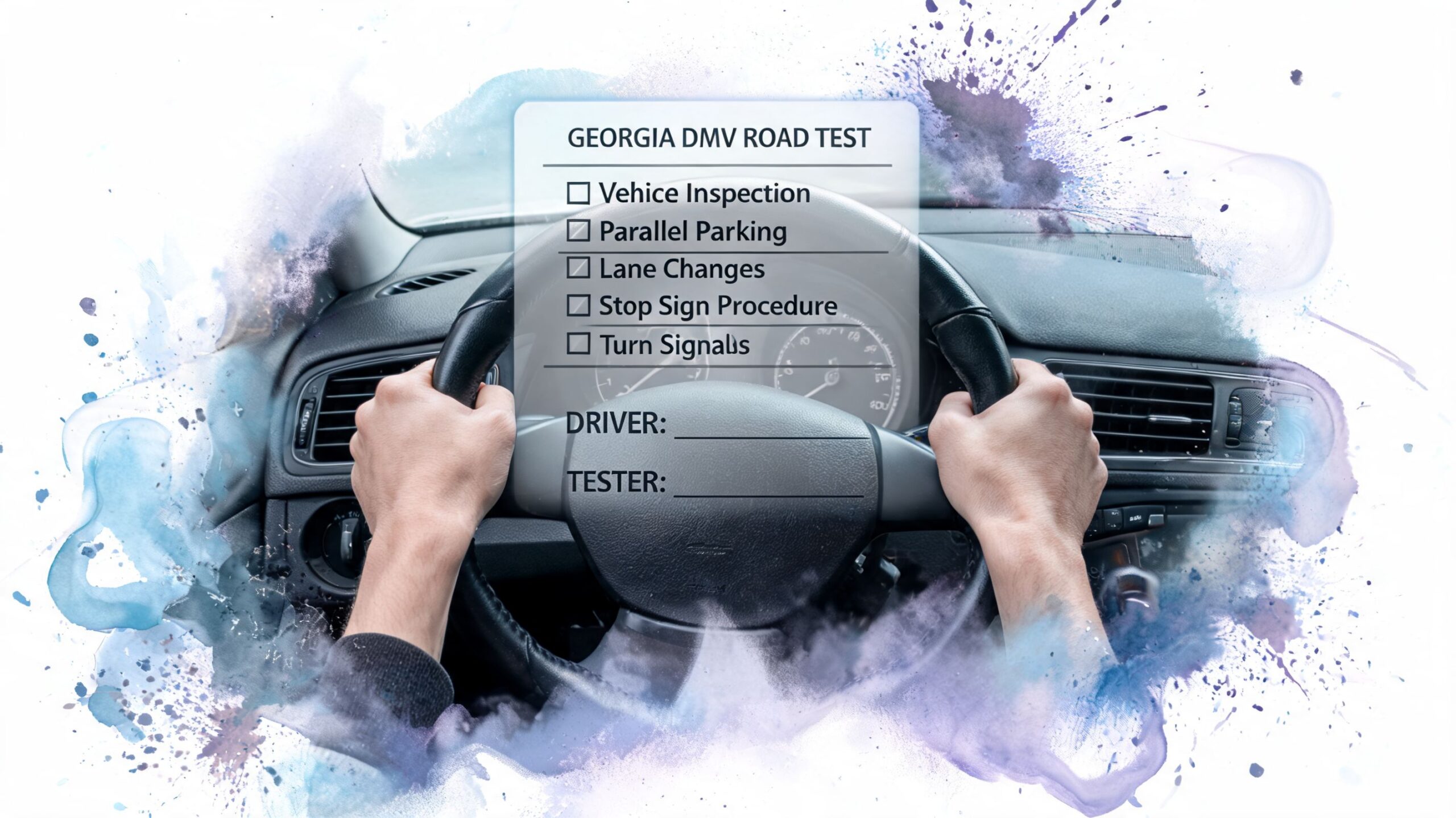
If you're studying from video, don't just watch passively. Pause before each maneuver and say out loud what you would do next. That's one of the easiest ways to turn a video into practice. If you're reviewing spoken instructions and want cleaner notes from any training clip, HypeScribe's video transcription guide is a practical way to turn video lessons into something you can highlight and review later.
What to notice while you watch
Focus on the small habits that examiners can score quickly:
- Start-up routine: seat position, mirrors, seat belt, and a calm move into traffic
- Observation pattern: mirror, signal, blind spot, then move
- Stopping behavior: complete stop before the crosswalk, then creep only if visibility requires it
- Speed control: steady pace, not hesitant and not rushed
- Parking setup: how early the driver positions the vehicle before the maneuver starts
Practical rule: If a video shows the route but not the driver's visual checks, it's only half useful.
What videos often miss
Many students watch route videos and still fail simple maneuvers because the video never explains the why. An examiner isn't just checking whether you turned left. They're checking whether you chose the correct lane, yielded properly, controlled speed through the turn, and looked where a safe driver should look.
That's why the best georgia road test video is one you can study like game film. Watch once for flow. Watch again for details. Then practice until each movement looks ordinary.
Pre-Test Prep That Sets You Up for Success
A student pulls into our lot knowing every turn signal rule in the book, then starts the test flustered because the insurance card is missing and the seat still sits where Dad left it. I see that kind of mistake all the time. The road test does not begin at the first intersection. It begins the moment you present yourself and the car.
At A-1, we coach this part the same way we coach lane changes and parking. We use a repeatable pre-drive routine, then run it the same way in our road test packages so students show up settled, organized, and ready. That matters even more for families using our testing option to avoid long DDS lines. A calm start saves mental energy for the driving itself.
For teen drivers, paperwork and eligibility need to be handled before test day, not guessed at in the parking lot. If you want a practical checklist, this guide on how to prepare for a driving test gives you a solid review.
What to bring and confirm
Students often overpractice the route and underprepare the car. The examiner notices both.
Use this checklist before you leave home:
- Valid permit or license credential: make sure it has not expired
- Registration and insurance: keep both current and easy to reach
- Joshua's Law completion records: teen applicants should confirm these are squared away
- Test vehicle condition: brake lights, turn signals, horn, mirrors, tires, and seat belts should all work properly
- Interior readiness: remove clutter and anything that distracts you or blocks visibility
The pre-drive check examiners expect
The examiner is looking for a driver who gets set before moving. That means no fumbling, no guessing, and no rushing through the basics.
Use a simple routine:
- Adjust the seat so you can press the pedals fully without stretching.
- Set the mirrors for a clear view down both sides and behind the vehicle.
- Fasten your seat belt before the examiner needs to mention it.
- Make sure registration and insurance are ready to hand over.
- Clear your phone and other distractions out of sight.
- Take one steady breath, then put the car in gear.
We drill that sequence at A-1 until it becomes automatic. Students who practice it in every lesson usually look composed on test day because nothing feels new.
Why this part matters
Examiners score visible habits. A strong start tells them you take responsibility for the vehicle before the wheels move.
I tell students this all the time. If you rush the setup, you usually rush the first turn, the first stop, and the first lane decision. If you settle in, check your position, and get the car ready the same way every time, the rest of the test gets simpler. That is one reason our training puts so much attention on the first two minutes, not just the route itself.
Mastering Core On-the-Road Maneuvers
You leave the parking area feeling steady, then the examiner asks for a lane change, a right turn, and the next stop sign comes up faster than expected. That is the point in the test where habits show. A student does not pass this part by knowing the rule in theory. The examiner needs to see the rule happen in the correct order, at the correct time, without coaching.

At A-1, we train these maneuvers the same way they are judged. Students do not just drive the route and hope it feels right. We rehearse a visible routine for scanning, signaling, braking, lane position, and speed control so the examiner can recognize safe decisions immediately. That matters even more in our road test packages, where bypassing long DDS lines helps students stay fresh and focused instead of burned out before the drive starts.
Lane changes that look organized
A good lane change is simple to describe and harder to fake. Check traffic behind you, signal with enough notice, confirm the next lane is open, make a real shoulder check, then move over once. No drift. No half-commitment. No last-second correction.
Students lose points here for one reason more than any other. They rush the sequence and turn their head so slightly that the examiner cannot tell whether they checked the blind spot at all. We coach a quick, clear head turn that keeps the car stable. Students who need extra work on that habit should practice how to check blind spots while driving until it feels natural and visible.
The trade-off is timing. Signal too late and it looks reactive. Signal too early and some students start drifting while they are still checking. The fix is repetition. In lessons, we cue the whole pattern out loud until the hands, eyes, and feet stop fighting each other.
Intersections, turns, and spacing
Intersections tell the examiner whether you are planning ahead or merely catching up to the car. Clean stops, calm turns, and proper spacing matter more than trying to look polished.
Keep these habits steady:
- At stop signs: stop fully before rolling ahead for a better view, and only creep forward if visibility requires it
- On right turns: slow before the turn, stay near the curb without hugging it, and finish in the correct lane
- On left turns: enter under control, avoid cutting across the corner, and do not swing wide on the exit
- In traffic: keep enough following distance that you have time to brake smoothly instead of late and hard
I give students one rule that usually fixes half their spacing errors. If the car ahead stops and you cannot see where its rear tires meet the pavement, you are too close. That reference is easier to judge under stress than counting in your head, and examiners notice the difference right away.
If the stop feels rushed, the setup was rushed.
A visual walkthrough helps students connect these habits to a real route and see how one mistake can spill into the next.
What examiners notice first
They notice braking quality within minutes. A hard stop usually means the driver looked up too late. A delayed signal usually means the decision came late. Speed that rises and falls for no reason tells them nerves are driving the car.
The goal is predictable control. Students usually score better when they make calm, ordinary decisions than when they try to perform for the examiner. That is exactly how we coach it at A-1. Build repeatable habits, show them clearly, and let the test confirm the work.
Solving the Parking and Turning Puzzles
You can spot the tension before the car even moves. The student handled traffic well, then freezes the moment the examiner asks for backing or a turnabout. Tight spaces do that. They make good drivers rush.
At A-1, we train these maneuvers as routines, not guesses. That matters because the examiner is not looking for fancy car control. The examiner wants a clear setup, steady speed, full observation, and a finish position that shows you stayed in command. Our road test packages help students skip long DDS lines, but the bigger advantage is what happens before test day. We rehearse the exact visual cues that keep these low-speed maneuvers calm and clean.
That is also where many practice videos miss the mark. They show the flow of the test, but they do not give students reference points they can repeat under pressure. The better approach is simple. Name the start point, name the cue, and name where the car should finish.
Reference points beat guessing
Students improve faster when each maneuver has a fixed process. “Turn when it feels right” falls apart on a test. A mirror cue or shoulder reference holds up much better.
A practical approach:
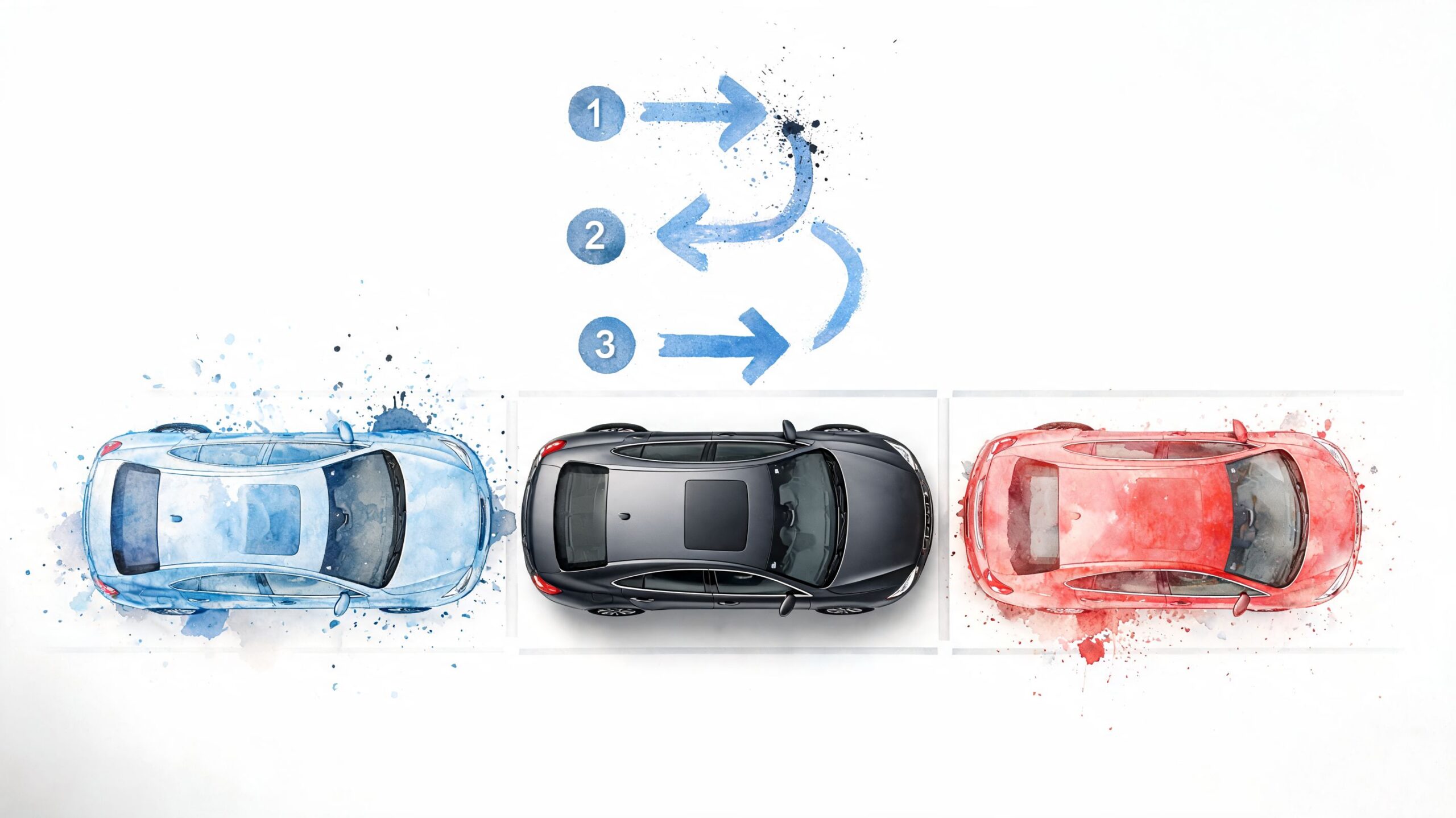
- Perpendicular parking: straighten the car before entry, creep in slowly, and use the same mirror reference each time so the wheel turn starts from a known point
- Parallel parking: build the setup first, keep the car close and even, then use rear-corner and mirror references instead of turning early and chasing the space
- Backing straight: turn your head and look through the rear window, keep your hands quiet, and make small corrections before the car drifts
Students who need a tighter method usually do best with a focused breakdown like this guide on how to parallel park for a road test.
The turnabout and straight backing
As noted earlier in the article, Georgia's test standards for these maneuvers are specific. Straight backing is graded on slow, controlled movement with proper observation and lane control. The turnabout is graded on whether you choose your space well, yield, reverse carefully, and complete the turn without hitting a curb or losing position.
Slow hands solve a lot here.
I tell students to stop staring at the hazard. Look where the car needs to end up. Your hands usually follow your eyes, and that one adjustment cleans up both backing and turnabouts.
For the three-point turn, the mistake I see most often is poor setup on the first move. Drivers either crowd the edge or turn too late, which forces extra correction in reverse. We coach the first steering input hard because it makes the rest of the maneuver easier. For straight backing, the common problem is oversteering after a small drift. Early correction works better than a big snap of the wheel.
Parking and turning stop feeling like puzzles once each maneuver has a routine you can repeat on command. That is how we teach them at A-1, and it is why students usually feel more settled by the time the examiner gives the instruction.
Understanding the Score and Avoiding Critical Errors
A student can drive well for most of the route and still fail in one moment if that moment shows poor judgment. That is the part many drivers miss. The examiner is not looking for perfection. The examiner is looking for safe, repeatable habits under light pressure.
As noted earlier in the article, Georgia uses a scored road test with multiple graded maneuvers, and a serious safety mistake can end the test early. At A-1, we train for that reality directly. We do not coach students to "drive pretty." We coach them to give the examiner clear evidence of control, observation, and decision-making on every instruction.
What loses points and what ends the test
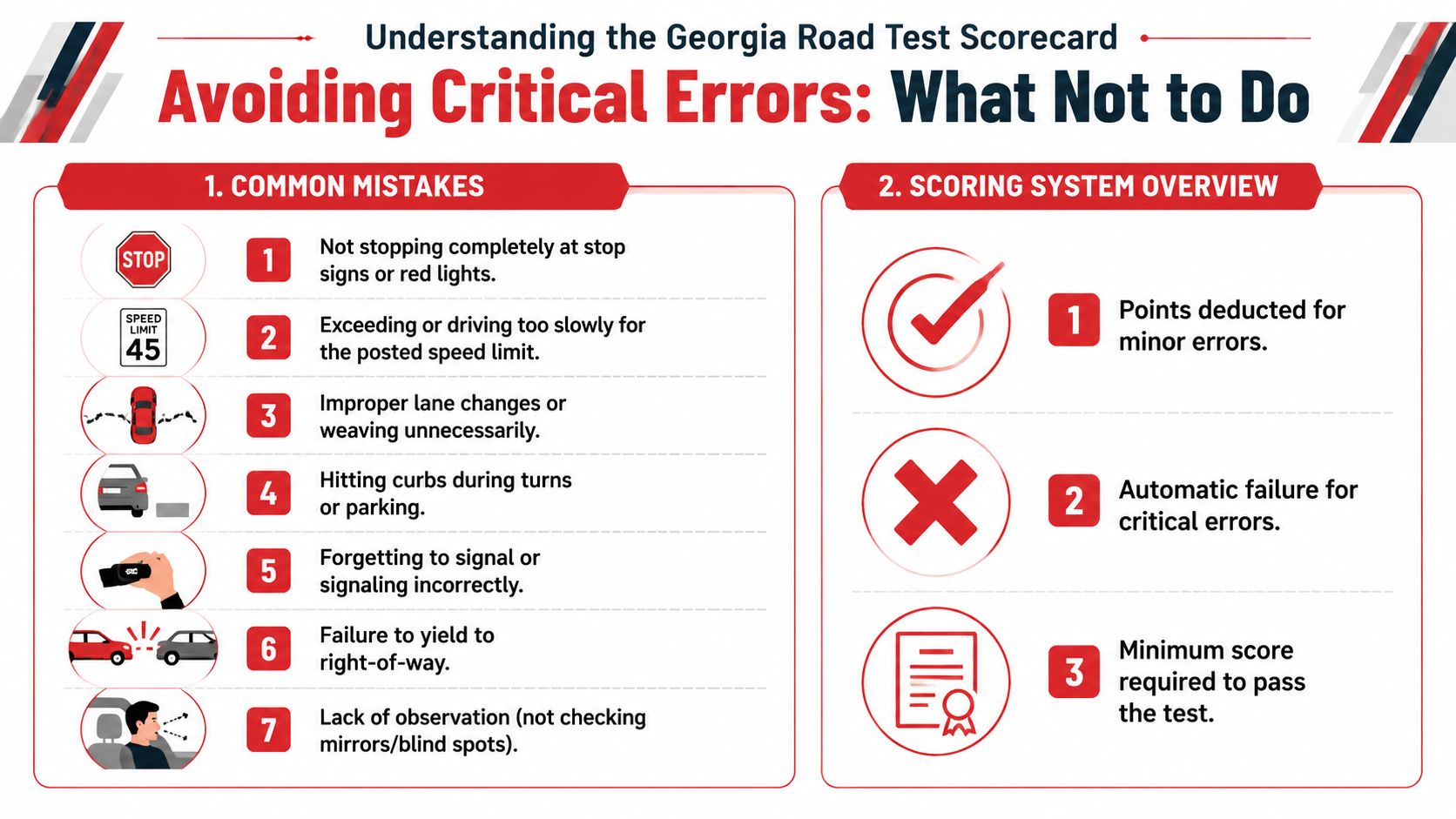
Point deductions usually come from technique problems. Automatic failures come from safety problems.
That distinction matters in the car. A slightly rough stop may cost points. Rolling through a stop, missing a pedestrian zone, backing carelessly, or failing to yield can tell the examiner you are not ready to drive alone.
| Type | What it looks like |
|---|---|
| Point deductions | rough braking, drifting within the lane, late signal, weak mirror checks |
| Critical errors | unsafe backing, crosswalk violations, failure to yield, dangerous lane use, other unsafe acts |
Students do better once they understand what the examiner is judging. The score sheet is not rewarding style. It is measuring whether your choices stay safe, legal, and predictable.
The mistakes examiners notice fastest
These errors show up often on test day, especially when nerves make drivers rush:
- Rolling stops: the wheels never fully stop before the line or crosswalk
- Late observation: the driver turns or changes lanes before showing a clear check pattern
- Hard braking: the driver sees the stop too late and reacts instead of planning ahead
- Bad turn path: the car swings wide or cuts across the proper lane
- Following too closely: the driver watches one car instead of reading traffic ahead
Following distance deserves extra attention. In lessons, I see students lose spacing any time they get fixated on the next instruction. That is why A-1 road test prep includes coached route work where the student keeps a steady gap, calls out hazards early, and learns to slow the situation down before it gets tight. Examiners notice that kind of planning right away.
How to practice for the score you need
Practice should match the way the examiner scores. Random driving does not help much.
A better method is to divide the drive into categories and grade each one fairly:
- Run a short route focused only on full stops, smooth starts, and controlled turns.
- Run a second route focused on lane position, mirror checks, blind spot checks, and spacing.
- Finish with backing, parking, and any maneuver that tends to break down under pressure.
- Have the person with you mark what you did, not what you intended to do.
This is the same trade-off we talk through with A-1 students. If a driver is close to test-ready but keeps making one repeat mistake, a targeted lesson usually works better than more casual family practice. If the habits are inconsistent across the board, a full road test prep package gives better value because it builds the routine from start to finish, and many students prefer testing through A-1 so they can avoid long DDS lines and stay in a familiar process.
A passing drive usually looks quiet and controlled. No surprises. No rushed corrections. Just one safe decision after another.
Your Best Path to Passing with A-1 Driving School
A student can drive well all week, then tighten up on test day because the process feels rushed and unfamiliar. I see that pattern often. The fix is not more random practice. The fix is a test path that feels organized, predictable, and close to the way the student trained.
That is why many families choose A-1 for both preparation and testing. Students practice the exact habits the examiner wants to see, then test in a setting that cuts out long DDS lines and a lot of the confusion that comes with them. Georgia's Department of Driver Services handled 182,989 road tests in FY 2020 and 194,298 in FY 2021, with 60 crashes during FY 2020 road tests and 30 in FY 2021, according to the Georgia DDS testing and exams information. At that volume, a calmer and more familiar testing process has real value.
Why lessons and road test prep work better as one plan
The best results usually come when training and testing are built together, not treated as separate steps. A student who learns with one method and then tests in a completely different rhythm often gets tense at the wrong moment.
At A-1, the road test packages are meant to close that gap. We coach the same observation routine, speed control, stopping habits, and turning setup that show up on the test. That matters for teens finishing Joshua's Law requirements, and it matters just as much for adults who drive well overall but still have one weak spot that can cost points.
A focused package is usually the right fit when the problem is clear:
- Parking mistakes: learn fixed reference points and a repeatable wheel movement pattern
- Lane change hesitation: practice mirror check, signal, blind spot check, then one steady move
- Test anxiety: run coached drives that make the sequence feel familiar instead of rushed
- Adult beginners or returning drivers: rebuild decision-making step by step, without trying to fix everything in one lesson
What to look for in a school
The strongest option is usually a school that can handle the full process. That includes driver education, Joshua's Law courses, online class options, behind-the-wheel instruction, and road testing.
But the difference is not the list of services.
It is whether the instructor can spot the one habit that keeps showing up under pressure, correct it quickly, and give the student a clean routine to follow on test day. That is the part families remember. A-1's advantage is practical. Students get training that matches the score sheet, road test packages that reduce DDS line headaches, and a clearer path from nervous practice driver to licensed driver.
Georgia Road Test Frequently Asked Questions
Can I use my own car for the road test
Yes, if it meets the testing requirements and is legal to drive. The vehicle should be properly registered, insured, and in safe operating condition. Check lights, mirrors, tires, brakes, and seat belts before the appointment.
What if I fail the test
Most students who don't pass the first time don't have a knowledge problem. They have one or two habits that break down under pressure. The best next move is to identify the exact issue, then practice that skill deliberately before rescheduling.
Do teens and adults need the same documents
No. Teen drivers usually need additional proof tied to permit time, school or training requirements, and Joshua's Law completion. Adult applicants generally have a simpler document path, but they still need to arrive with valid identification and a road-test-ready vehicle.
Are online courses a good option in Georgia
They can be, especially for busy schedules. Online driver education works best when it's paired with real in-car instruction. The course teaches rules and structure. The lessons turn that information into usable driving habits.
What is the Georgia Driver's Education Scholarship Grant Program
It's a program designed to help qualifying families access driver training at reduced or covered cost through approved providers. If budget is the reason training keeps getting delayed, it's worth asking whether grant-supported options are available.
Should I book driving lessons if I've already watched a georgia road test video
Yes, if you still have one weak area. Videos are useful for understanding the flow of the test. Lessons are what fix timing, positioning, steering control, and observation habits in real time.
If you're ready for more than just watching a georgia road test video, A-1 Driving School offers the pieces that matter most for getting licensed: driver's education, Joshua's Law course options, online classes in Georgia, road testing, scholarship guidance, and, above all, driving lessons and lesson packages that target the exact skills you need to build before test day.