
A lot of 17-year-olds in Georgia are in the same spot right now. You want the freedom that comes with a license. Your parent wants to make sure you do it the right way. Then the questions start. Can you take drivers ed online? Is that enough by itself? Do you still need driving lessons? When does the road test happen?
That confusion is normal. Georgia's licensing path for teens has several moving parts, but it's not random. It's a step-by-step system built to help new drivers learn in the right order, with time to practice before they're fully on their own.
Your Journey to the Driver's Seat Starts Here
A typical 17-year-old driver doesn't struggle with motivation. They struggle with sorting out the process.
One student might be ready to knock out the classroom part quickly from home. Another may already have some practice with a parent but still freeze up at left turns, lane changes, or parking. A lot of families think the hardest part is passing a test. In reality, the hardest part is knowing which step comes first, which step can be done online, and which step still has to happen in the car.
That structure matters for a reason. The crash rate for 16- to 17-year-olds is about 3 times the rate for drivers age 20 and older, according to the Insurance Institute for Highway Safety teen driver research. That's why Georgia and other states don't treat teen licensing like a simple paperwork exercise. They require training, supervised practice, and gradual skill-building.
New drivers need more than information. They need repetition, judgment, and time behind the wheel in real traffic situations.
If you're searching for online drivers ed for 17 year olds, the good news is that online learning can absolutely be part of the path. The key is understanding what it covers and what it doesn't.
Think of the process in two parts. First, you learn the rules, signs, responsibilities, and decision-making habits. Then you turn that knowledge into actual driving skill. Those are different jobs, and both matter.
For families in Georgia, the smoothest path is usually the one that keeps everything connected. The online course, the driving lessons, the paperwork, and the road test preparation all make more sense when they're treated as one journey instead of separate tasks.
Decoding Joshua's Law for Georgia 17-Year-Olds
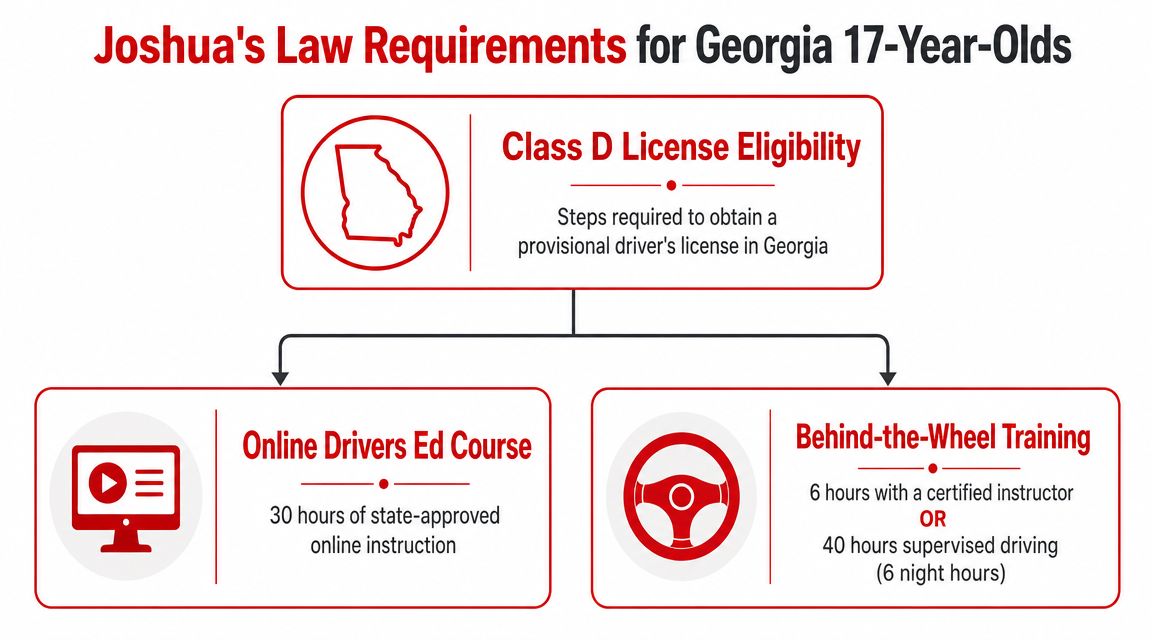
Georgia doesn't leave this process vague. For 17-year-old drivers, Joshua's Law requires the completion of a 30-hour driver education course and 40 hours of supervised driving, including 6 hours at night, to qualify for a Class D license, according to the Georgia Department of Driver Services teen driver requirements.
What the state expects
Here's the practical checklist:
- Complete the classroom portion: You need 30 hours of driver education.
- Build real driving experience: You also need 40 hours of supervised driving.
- Include night driving: Out of those supervised hours, 6 hours must be at night.
Some families get tripped up here because they assume one item replaces the others. It doesn't. Georgia is asking for both instruction and practice.
Why each part matters
The online or classroom course teaches the mental side of driving. That includes road signs, traffic laws, right-of-way decisions, and risk awareness. This gives a teen driver a framework before they start making split-second decisions in traffic.
The supervised hours do something different. They teach timing, observation, pedal control, lane position, and calm decision-making under pressure. You can read about checking mirrors and scanning intersections, but that isn't the same as doing it smoothly while other cars are moving around you.
A lot of parents also wonder why night hours are specifically required. Night driving changes visibility, timing, glare, and depth perception. Even a familiar road feels different after dark.
Practical rule: Don't treat the hour requirements like boxes to check at the end. Start logging practice early so your teen gets experience in different situations, not just the same short route.
The simple way to think about Joshua's Law
A 17-year-old's path to a Georgia license works best when you break it into three layers:
| Step | What you do | What it builds |
|---|---|---|
| Learn | Complete the 30-hour course | Knowledge and decision-making |
| Practice | Log supervised driving, including night driving | Comfort and consistency |
| Apply skills | Refine habits in the car before the test | Readiness for independent driving |
That's the heart of Joshua's Law. It's not there to slow you down. It's there to help a new driver build skill in the right order.
Choosing and Completing Your Online Drivers Ed Course
For many families, the first practical step is the easiest one to schedule. The 30-hour online course can be completed from home, which makes it a good fit for busy school schedules, sports, jobs, and family routines.
What the online course actually does
A good online course covers the classroom side of driver education. It teaches the rules of the road, signs, basic Georgia driving laws, and the habits that reduce mistakes before they happen.
That flexibility is why online drivers ed for 17 year olds has become such a practical option. A student can work through lessons at a steady pace instead of trying to fit everything into a fixed in-person schedule.
If you want to learn how the classroom portion works, A-1's overview of online driver education gives a clear picture of what students complete during this stage.
What the online course does not replace
Families frequently misunderstand this aspect. In Georgia, Joshua's Law requires the 30-hour course to be paired with supervised driving and behind-the-wheel training, meaning the online portion is a prerequisite, not the final step, as explained in this guidance on whether an online course is enough.
That means the online course is necessary, but it isn't the entire licensing process.
Here's the simplest way to see it:
- Online drivers ed teaches concepts: Signs, laws, risk awareness, and safe choices.
- Driving practice builds execution: Steering, braking, lane control, parking, and judgment in motion.
- Road test prep ties it together: The student shows they can apply what they've learned in a real driving setting.
If your teen finishes the online course and says, “I'm done,” they're only done with the classroom piece.
How to choose wisely
When you compare course options, focus on clarity. You want a state-approved program, straightforward enrollment, and a clear next step for in-car training. The families who have the easiest experience usually choose a path that doesn't stop at coursework. They choose one that leads naturally into lessons and test preparation.
From Screen to Street With Professional Driving Lessons
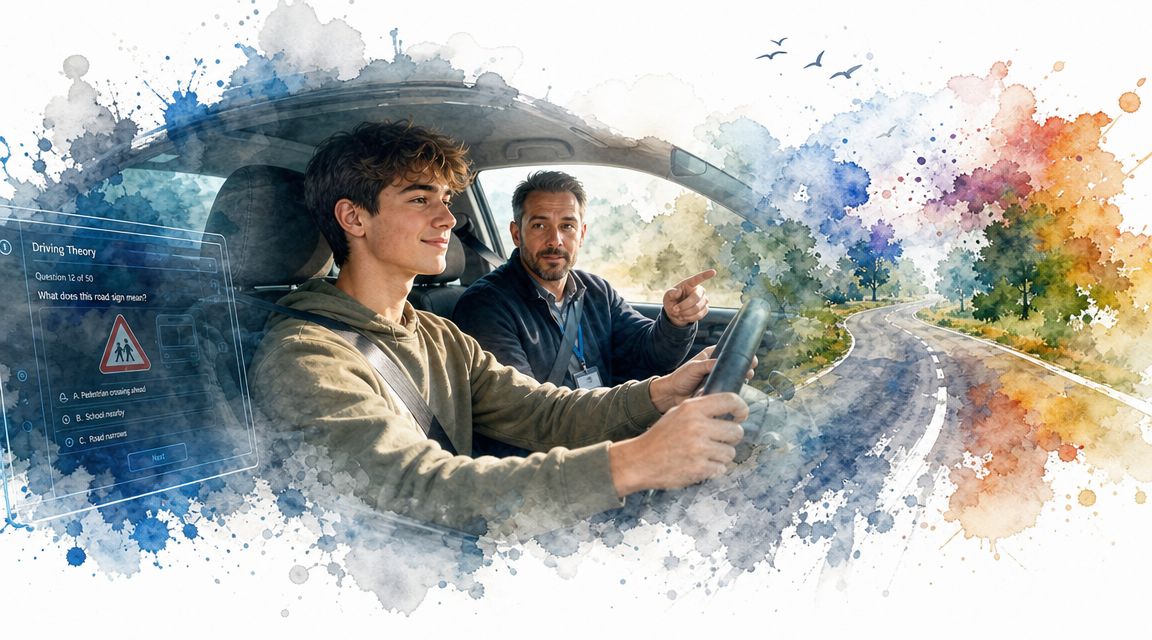
Most teens don't become confident drivers from information alone. They become confident when someone in the passenger seat helps them correct mistakes before those mistakes become habits.
Why lessons matter more than most families expect
Parent practice is important. It gives a teen repetition and exposure to everyday driving. But a parent is usually balancing a lot at once. They're supervising, explaining, managing nerves, and trying not to overreact when the car drifts too close to the curb.
A professional instructor brings structure to that learning process. Instead of saying “be more careful,” the instructor can pinpoint the exact issue. Maybe the student is braking late. Maybe they're looking too close to the front of the car. Maybe they're turning the wheel too much in residential areas and not scanning far enough ahead.
That kind of feedback matters because weak habits get stronger every time they're repeated.
How skill should progress
State Farm's guidance recommends gradual progression from low-traffic roads to busier environments, because teens need repeated practice with turns, braking, and hazard recognition before more complex traffic demands are added, as described in its step-by-step teen driving guidance.
That progression is exactly where professional instruction helps most.
A smart lesson sequence usually looks like this:
Start simple
Empty parking lots and low-speed roads help a student focus on steering, braking, smooth stops, and basic turns.Add decision points
Residential streets and light traffic introduce parked cars, intersections, pedestrians, and right-of-way choices.Increase traffic complexity
Busier roads teach lane changes, gap judgment, traffic flow, and composure.Practice test-related skills
Parking, backing, turns, stopping control, and general consistency all get sharper with targeted repetition.
For a closer look at why many families add formal instruction, this explanation of the benefits of taking driving lessons from an instructor highlights where professional coaching fits into the process.
What to look for in lesson packages
Driving lessons are most useful when they match the student's real needs.
Some teens need a small number of sessions to clean up technique. Others need a fuller package because they're nervous in traffic, haven't had much practice, or need help with parking, lane changes, and road test readiness. The right package should let a family build from foundational skills to more advanced road situations without rushing.
A student who can drive around the neighborhood isn't automatically ready for heavier traffic, night driving, or a road test.
This short video gives a feel for how training turns classroom knowledge into on-road awareness.
One practical option for Georgia families is A-1 Driving School, which offers online Joshua's Law coursework, driving lessons, lesson packages, and road testing support through the same training pathway. That kind of setup can make scheduling and handoffs simpler for families who don't want to piece the process together from multiple providers.
From Certification to Your Georgia Road Test
Once the coursework and driving practice are complete, families usually have a new set of questions. What paperwork do we need? When do we get the certificate? Can the road test feel less stressful than going in cold?
That final stretch is where organization matters.
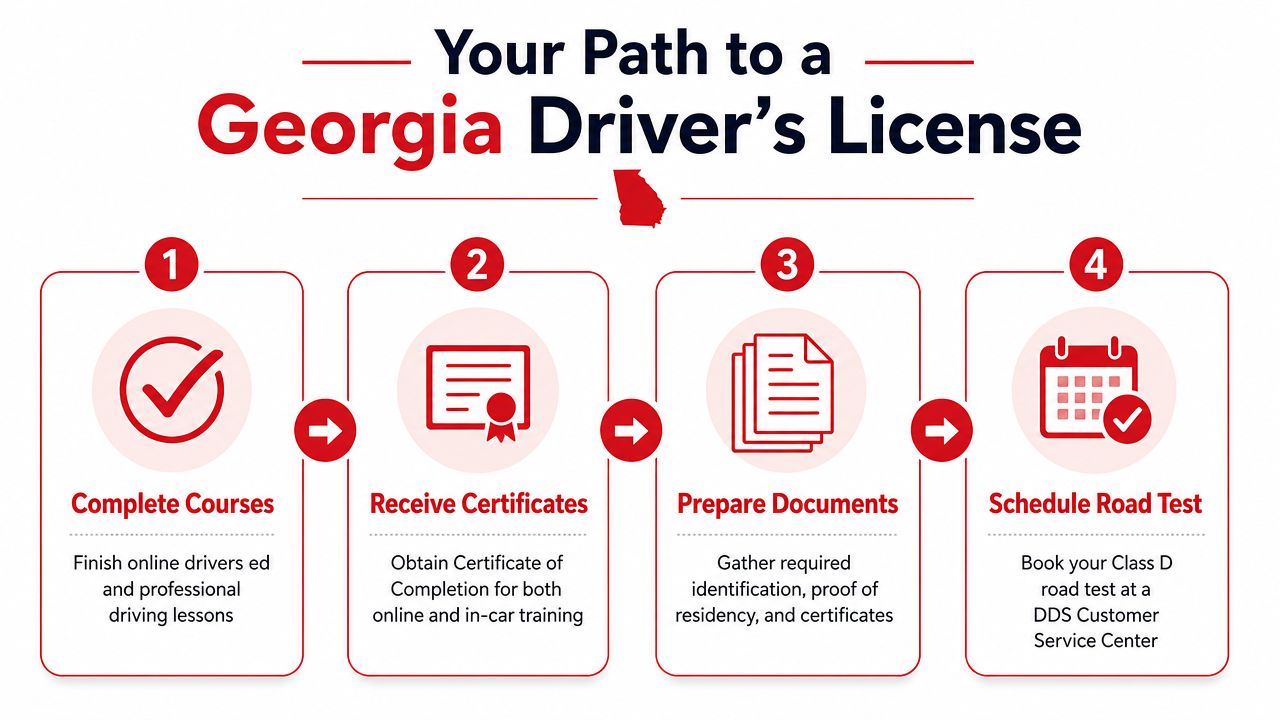
What happens after training is complete
When a student finishes the required course and completes the needed in-car work, the next task is making sure the completion records are in order. Families should keep certificates and related documents together well before test day.
A practical road test plan usually includes:
- Confirming completion records: Make sure the student has the needed proof from the course and any in-car training.
- Reviewing test skills: Practice turns, stops, backing, parking, observation, and general control.
- Checking documents early: Don't wait until the night before to gather what the state or testing location may require.
- Driving the week before the test: Short, calm practice sessions often help more than one long stressful drive.
For students who want a more focused final review, this road test preparation guide is a useful checklist before scheduling the exam.
Why the road test feels harder than it should
The road test usually isn't hard because the student knows nothing. It feels hard because nerves make basic skills less consistent. A teen who normally drives fine may suddenly brake too sharply, forget mirror checks, or rush a turn because they know they're being evaluated.
That's why road test preparation should feel specific, not generic. Students do better when they know what the examiner is watching and have practiced those actions enough times that they don't have to think through every move.
Calm, repeatable habits matter more on test day than trying to drive perfectly.
Help with affordability
Training only works if families can access it. That's why scholarship and grant options matter more than many people realize.
Grant-funded programs are designed to remove cost barriers for students, and the Georgia Driver's Education Scholarship Grant Program is one pathway that can make thorough training more accessible for families, as described in this overview of grant-supported access to driver education.
If cost is part of the decision, it's worth asking about scholarship pathways before assuming lessons or a full training package are out of reach. Many families focus only on course format, but affordability can be just as important as convenience.
Frequently Asked Questions
Do I need my learner's permit before starting the online course
Many families start with the classroom requirement because it's the easiest part to schedule. The exact timing of your permit and driving practice can affect when you move into the in-car portion, so it's smart to confirm the current enrollment and permit details with your provider before you begin.
Can I take my driving lessons and road test at A-1 if I took an online course from another school
In many cases, students use different providers for different parts of the process. What matters is whether the training you completed meets Georgia requirements and whether your records are in order. Before booking lessons or a road test, confirm what documentation the school needs to see.
How long is my Joshua's Law Certificate of Completion valid for
Certificate questions are common, especially when a student finishes the course but waits before scheduling the next step. Because timing and documentation rules can change, the safest move is to check directly with the school that issued the certificate or with Georgia DDS guidance before test scheduling.
Your Keys to a Lifetime of Confident Driving
A license at 17 feels like freedom, and it is. But the better goal is bigger than getting plastic in your wallet. The primary goal is becoming the kind of driver who can handle traffic calmly, make safe decisions quickly, and keep improving after the test is over.
Online drivers ed for 17 year olds works best when it's treated as the starting point, not the finish line. The online course builds knowledge. Supervised driving builds comfort. Professional lessons sharpen judgment and fix mistakes early. Road test prep pulls everything together.
That's why the smoothest path is usually the one that connects all the pieces instead of treating them like separate chores. When families understand the order, the process stops feeling overwhelming and starts feeling manageable.
If you're 17 and ready to move forward, take it one step at a time. Learn the rules. Practice with purpose. Get coached where you need it. Then show up for your road test knowing you've prepared for more than a score sheet.
If you're ready to start your Georgia licensing path, explore A-1 Driving School for Joshua's Law courses, online options, driving lessons, lesson packages, road test preparation, and information about scholarship pathways that may help make training more accessible.