
A lot of Georgia families hit the same moment at about the same time. A teen turns 16, starts talking about freedom, school pickups, practice, work, and weekend plans. Then the questions start. Can the class be online? What counts for Joshua's Law? When do the driving lessons happen? Who signs what? Where does the road test fit in?
That confusion is normal.
Online drivers ed for 16 year olds sounds simple, but the full licensing path in Georgia includes more than a laptop and a login. A teen has to complete the classroom requirement, train in the car, practice with a parent or guardian, gather the right paperwork, and pass the road test. Families also need to keep the focus where it belongs, on safety and readiness, not just speed.
Parents sometimes ask broader safety questions too, especially once a teen starts spending more time around other new drivers. If that's part of your conversation at home, this overview of Georgia DUI penalties for teens is a useful legal resource.
The Keys to the Car Getting Your License at 16 in Georgia
A 16-year-old in Georgia usually starts with one clear goal. Get the license as soon as possible. What catches many families off guard is that Georgia doesn't treat that goal as one step. It treats it as a process.
That's a good thing.
The Insurance Institute for Highway Safety reports that all U.S. states now have at least some Graduated Driver Licensing elements, and since the first three-stage GDL program was implemented in 1996, teenage crash deaths declined by 48%, from 5,819 to 3,048 by 2023. IIHS also notes that the fatal crash rate per mile driven for ages 16 to 17 is about three times that of drivers 20 and older. That's why states use staged licensing and structured practice for new teen drivers, not just a written test and a quick drive around the block (IIHS teen driver research).
The shortest path to a Georgia license usually isn't the least work. It's the path with the least confusion.
For most teens, the process feels easier once they stop thinking of it as separate tasks and start seeing it as one connected journey. The online class teaches rules and decision-making. The in-car lessons turn that knowledge into skill. The supervised hours build consistency. The road test confirms that the driver can put it all together.
What families usually get mixed up
Some parents assume “online drivers ed” means everything can happen online. It can't. The class portion may be online, but driving is still a physical skill, and Georgia still requires time in the car.
Teens often focus on the road test because it feels like the finish line. In practice, the actual work happens before the test. If the course, lessons, and supervised practice are organized well from the start, the final steps become much less stressful.
Decoding Joshua's Law Your First Checkpoint
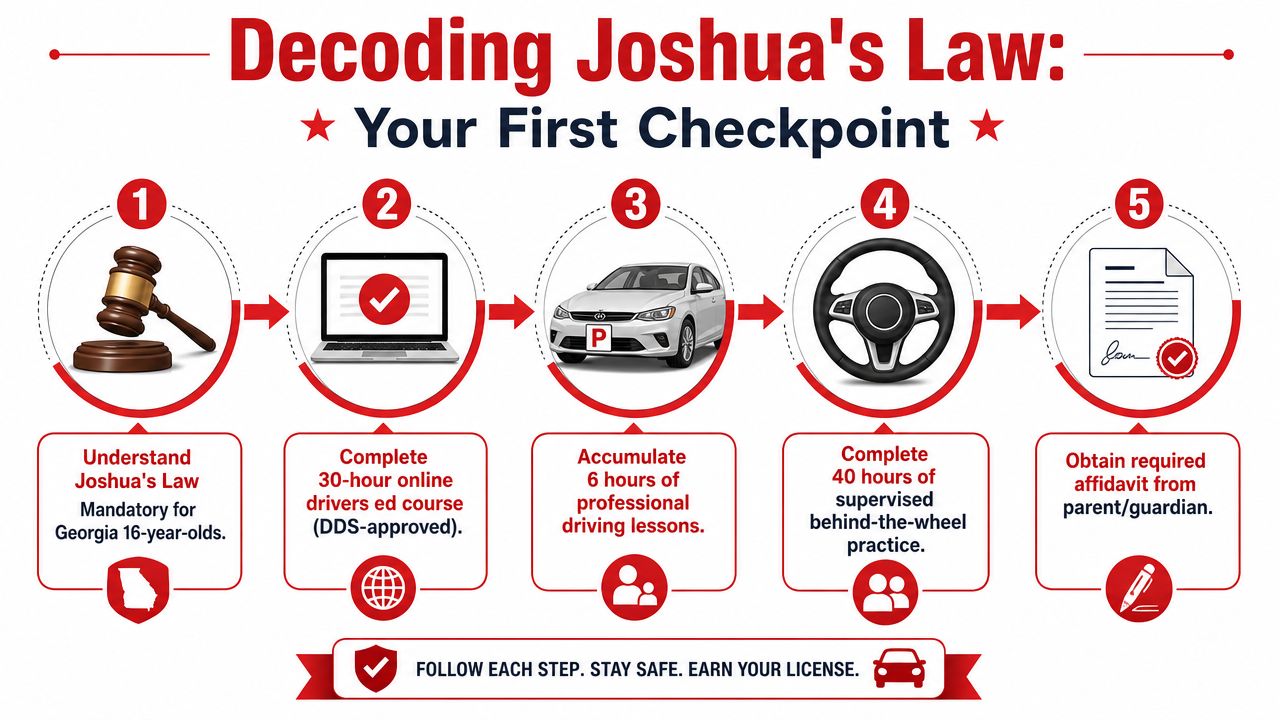
If your teen wants a Class D license at 16, Joshua's Law is the first checkpoint. In Georgia, DDS requires 16-year-olds seeking a Class D license to satisfy Joshua's Law, and the state makes clear that this is a Georgia-specific compliance issue, so families should use a course that is approved for Georgia teens through the DDS driver education programs page.
The three parts families need to know
Joshua's Law works best when you break it into three separate responsibilities.
The 30-hour driver education course
This is the classroom or theory portion. For many families, this is where online drivers ed for 16 year olds becomes appealing because it gives teens flexibility to work from home and move through the material in manageable sessions.The 6 hours of professional driving instruction
This is not the same as practicing with a parent. These are lessons with a qualified instructor in a training vehicle. That professional instruction matters because teens get immediate correction on scanning, turning, speed control, lane position, and judgment.The 40 hours of supervised driving practice
Georgia also requires at least 40 hours of supervised driving experience, including 6 hours at night, for a Class D license. This parent-guided practice is where skill becomes habit.
Why the law is built this way
Each part does a different job.
The online course teaches the rules, signs, and mental side of driving. Professional lessons teach technique under pressure. Family practice adds repetition across normal life situations like school traffic, left turns, parking lots, rainy afternoons, and dark roads.
Practical rule: If a program only solves the classroom requirement, you're only partway through the real licensing process.
That's where many families get tripped up. They finish the online course and think they're nearly done. In reality, the in-car training and supervised log often take more planning than the course itself.
What to verify before enrolling
Before you sign up for anything, make sure the program answers these questions clearly:
- Georgia approval: Does the course specifically meet Georgia teen requirements?
- Certificate process: How will the teen receive proof of completion?
- Driving lessons: Does the school also offer the required in-car training?
- Scheduling: How soon can lessons be booked after the class starts?
- Login access: Can the student easily return to the course and track progress through the Joshua's Law student login portal?
A good fit is more than a legal checkbox. It should make the next step obvious.
Choosing Your Georgia Online Drivers Ed Course
Families usually start shopping by typing a search into Google and comparing websites. That's where things often go sideways. Search results mix state rules, national course providers, and generic “drivers ed” pages that don't clearly separate Georgia requirements from other states.
The first filter should be simple. Is the course clearly set up for Georgia teens seeking a Class D license?
What a quality online course should actually do
A course shouldn't just help a teen finish. It should help them remember.
An evidence review tied to NHTSA guidance notes that driver education is most effective when it is structured for retention, not just completion. Useful methods include spaced learning, interleaving worked examples with practice, combining graphics with verbal explanations, and frequent quizzing. The same review also notes that driver education has not consistently reduced crashes or injuries at the population level, which is why the quality of instruction and what happens after the course matter so much (evidence review on driver education methods).
That means parents should look for more than “self-paced” and “mobile-friendly.” Those features are convenient, but they aren't enough by themselves.
A stronger course usually has:
- Short learning blocks: Teens absorb more when material is broken into manageable pieces.
- Knowledge checks: Frequent quizzes help memory stick.
- Clear visuals: Diagrams and illustrations support the written explanation.
- Simple progress tracking: Students should always know what's complete and what's left.
Questions worth asking before you enroll
Use these questions when comparing providers:
| What to ask | Why it matters |
|---|---|
| Is it approved for Georgia teen licensing? | That keeps you from taking a course that won't count |
| Is the course self-paced? | Families often need flexibility around school and activities |
| How does the course teach, not just test? | Better retention helps once the teen gets behind the wheel |
| Does the school also handle in-car lessons? | That reduces handoff confusion later |
| Can I check real student feedback? | Reviews often reveal how smooth the full process feels |
If you want to compare course experience before enrolling, the online drivers ed reviews page is one place to see how students describe the class format and pacing.
A short video can also help families understand what they're signing up for before they commit.
For a Georgia teen, the right online course isn't the one that looks fastest. It's the one that fits cleanly into the full licensing process without creating new questions.
Mastering the Road with Professional Driving Lessons
The online course teaches a teen what driving is supposed to look like. Professional lessons show them what driving feels like.
That difference matters more than most families expect. A teen can score well on quizzes and still struggle with braking pressure, gap judgment, steering control, lane position, or checking mirrors consistently in real traffic. Those aren't knowledge problems. They're performance problems, and performance gets built in the car.

Why structured in-car training matters
A 2024 study from CHOP's Center for Injury Research and Prevention found that teens licensed at 16 had 27% lower crash rates in their first two months of licensure than drivers licensed at 18, and 14% lower crash rates over the first 12 months. For teens licensed at 17, crash rates were also lower than for those licensed at 18, and every additional month spent in the learner-permit stage was associated with a 2% reduction in crash rates (CHOP study summary).
The takeaway for parents isn't “rush to get licensed.” It's that structured education plus supervised practice appears to prepare younger novice drivers better during the highest-risk early period of driving.
A calm instructor can catch a habit in ten seconds that a family might not notice for ten practice drives.
Professional lessons also help separate instruction from emotion. Parents often do a great job supporting practice, but many teens respond differently to a third-party instructor. The car feels calmer. Feedback feels more specific. Corrections happen in the moment.
What teens learn in lessons that videos can't teach
The most useful lesson time usually focuses on situations that make new drivers tense:
- Intersections: judging turns, signals, lane placement, and timing
- Lane changes: mirror checks, blind spot checks, and speed matching
- Parking: angle, perpendicular, backing, and space control
- Neighborhood hazards: parked cars, children, school zones, and narrow streets
- Higher-speed roads: entering, merging, and maintaining position without overcorrecting
Some teens need a lot of work on confidence. Others need work on pace and patience. A skilled instructor can tell the difference quickly.
Why extra lessons often help
Joshua's Law sets the minimum professional lesson requirement. Minimum doesn't always mean ready.
A teen who is nervous in traffic, hesitant on turns, inconsistent with scanning, or inexperienced at parking may benefit from additional sessions before the road test. That's especially true when family schedules make supervised practice harder to arrange. In many homes, the challenge isn't willingness. It's time, vehicle availability, weather, and finding quiet moments to practice without rushing.
That's why many families look at driving lesson packages instead of only the minimum required hours. More lesson time gives the teen a chance to repeat key skills under supervision, in different road conditions, and with less pressure to “get it right fast.”
How to choose the right lesson package
Not every teen needs the same amount of training. A simple way to think about packages is by driver profile.
| Teen driver situation | What usually helps |
|---|---|
| Brand-new and very nervous | Start with a foundation package focused on basic control and confidence |
| Comfortable in neighborhoods only | Add lessons for traffic, lane changes, and larger roads |
| Close to test-ready but inconsistent | Use targeted road test prep and maneuver review |
| Has the permit but little recent practice | Schedule refresher lessons before the test |
The strongest package is the one that matches the student's current skill, not the one that sounds shortest.
This is also where one school can simplify the path. A-1 Driving School offers Joshua's Law coursework, in-car lessons, lesson packages, and road testing support in Georgia, which can reduce the usual handoff problems between separate providers.
What parents should watch for after lessons
After a few professional sessions, ask practical questions instead of general ones.
- Can your teen explain what they were corrected on?
- Are they smoother with braking and steering?
- Do they scan earlier, not just when reminded?
- Are they calmer in traffic than they were before?
Those signs matter more than whether they “feel ready.” Real readiness shows up in repeatable behavior.
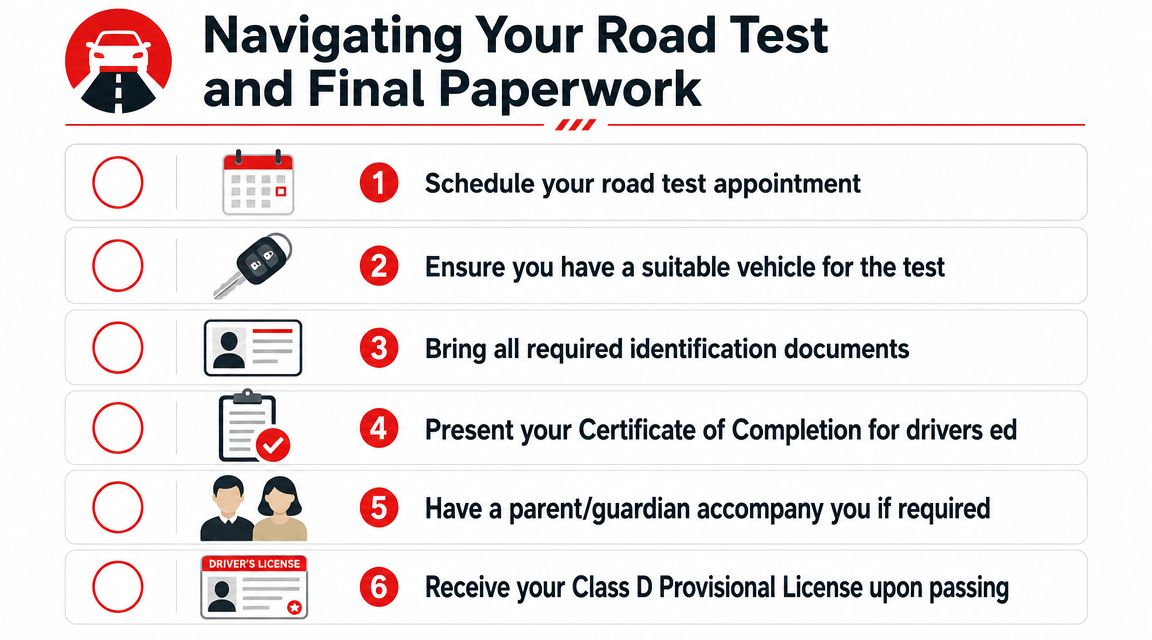
Navigating Your Road Test and Final Paperwork
By the time a teen reaches the road test stage, most of the main work should already be done. The challenge now is logistics. Families often lose time here because of missing paperwork, incomplete practice records, or uncertainty about where to test.
Two ways Georgia teens usually approach the road test
Many families think only about testing at a DDS Customer Service Center. That's one option.
Another path is testing with a certified third-party road tester. Some families prefer that because the scheduling can feel more manageable, and the teen may already know the school, the check-in process, and the training rhythm from prior lessons.
Bring every document as if no one will let you “look it up later.” That one habit prevents a lot of same-day frustration.
The better option depends on your schedule, your teen's confidence, and whether you want the road test connected to the same training environment where the teen practiced.
The paperwork families most often forget
The online course is only one piece of the file. Georgia families should expect to organize several documents before test day.
Use a checklist and verify details early. Common items can include:
- Driver education proof: Certificate of completion for the required course
- Practice requirement proof: Parent or guardian documentation for supervised driving experience
- Night driving record: Georgia requires 40 hours of supervised driving, including 6 at night, and this often becomes the main bottleneck for families because logging and scheduling practice takes longer than finishing the online class (Georgia practice-hour overview)
- School-related documentation: Teens may need proof tied to school enrollment requirements
- ADAP or eADAP documentation: Have the certificate ready if required for your licensing step
- Identification materials: Bring the forms of ID and supporting documents required for issuance
A practical test-day plan
Road test days go better when families treat them like appointments, not errands squeezed between other plans.
- Confirm the appointment location the day before.
- Check the vehicle early if the teen is testing in a school or family car.
- Organize documents in one folder rather than loose papers.
- Arrive with time to spare so the teen isn't starting the test already flustered.
- Avoid last-minute cramming. A short warm-up drive is fine. A tense lecture in the parking lot usually isn't helpful.
When a third-party test can be easier
A school-based testing option can be useful when a teen does better in a familiar setting. That can reduce one layer of stress. It also helps when parents want a smoother handoff from lessons to test prep to the final exam.
If your teen has completed training but still feels uneven on parking, lane control, or stop-sign habits, schedule a final prep lesson before the road test instead of hoping the nerves disappear on their own.
Funding Your Training The Georgia Scholarship Grant
Cost matters for many families. Driver education is important, but that doesn't mean every household can pay for the full process comfortably at the exact moment a teen is ready to begin.
Georgia offers help through the Georgia Driver's Education Scholarship Grant Program. For eligible students, this program can make it easier to complete the required training rather than delaying the process because of budget pressure.
What the grant is meant to support
The grant is designed to help qualifying Georgia teens access driver training tied to the licensing process. For families, the practical value is simple. It can reduce the barrier to getting both the classwork and the behind-the-wheel instruction done in a timely way.
That matters because waiting too long between steps often creates a different problem. Teens forget course material, lose momentum with practice, or end up trying to prepare for the road test in a rush.
How families should approach the application
The smartest approach is to treat the grant like a time-sensitive school form.
- Read the eligibility details carefully: Make sure your teen fits the program requirements.
- Apply early when possible: Don't wait until every lesson slot around your schedule is already taken.
- Gather supporting information before starting: That makes the process smoother.
- Ask questions if anything is unclear: A licensing delay often starts with one missed form or assumption.
Why this helps beyond cost
Families sometimes think of grant funding as financial relief only. It's also a planning tool. When training is easier to access, teens are more likely to complete the class, the professional driving requirement, and the next scheduling steps without long gaps between them.
That usually leads to a more organized path and a calmer experience for both parent and teen.
If your family wants one place to start the process, schedule lessons, and prepare for the road test, take a look at A-1 Driving School. It's a practical starting point for Georgia teens working through online drivers ed, Joshua's Law, driving lessons, and the final licensing steps.