
The day of your Georgia road test is finally here. You've practiced your turns, your stops, and your parking. Then the examiner walks up to the car and notices a problem before the test even starts. That can happen with something as simple as a brake light, bald tire, or wiper that smears instead of clears.
That's why a vehicle inspection checklist matters. It isn't just a mechanic's tool. It's a calm, practical routine that helps teens and parents make sure the car is safe, legal, and ready for test day. Modern checklists are much more structured than a quick walkaround. In major markets, a common format is the 100-point car inspection guide, and some shop-level systems go even deeper. The same source explains that core checks often include tires, lights, brakes, seat belts, windshield wipers, fluid levels, warning lights, and leaks.
If you're feeling nervous, that's normal. A good checklist lowers stress because it gives you something clear to do. Parents can use it the week before the test, and teens can use it again the night before and the morning of. For extra practical tips, you can also read this guide on preparing for your vehicle check. At A-1 Driving School, this kind of step-by-step preparation is part of how we help students show up confident, not rushed.
1. Brake System Inspection
Brakes are one of the first things I want a student to respect. If the car doesn't stop smoothly and predictably, nothing else matters much. A teen might know every road sign in the handbook and still have a bad test day if the brake pedal feels soft or the car shudders during a stop.
Start with what you can notice without tools. Press the brake pedal with the engine on. It should feel firm and steady, not sink slowly toward the floor. Listen when you brake in a quiet parking lot. Squealing, grinding, or a pulse in the pedal means the car needs attention before test day.
What to check before the test
- Brake pedal feel: Press and hold it. If it feels spongy or keeps dropping, don't ignore it.
- Stopping response: At low speed in a safe area, the car should stop straight without pulling.
- Brake warning lights: If a brake-related light stays on, have the car checked.
- Fluid level: Low brake fluid can point to wear or a leak. A-1 also explains the basics in this article on brake fluid and why it matters.
Practical rule: If a parent or teen says, “The brakes feel a little off,” that's already enough reason to inspect the car before the road test.
A common real-world situation is a parent driving with their teen and noticing that the car takes more effort to stop than usual. That's not the time to hope it passes. It's the time to schedule a check and avoid a test-day surprise. If you want to understand one warning sign better, this article on causes of a sinking brake pedal gives a useful overview.
At A-1, we reinforce smooth, controlled braking during lessons because road test success depends on it. A student who learns to feel what normal braking is like is much more likely to catch a problem early.
2. Tire Condition and Tread Depth Assessment
Tires affect steering, stopping, and wet-road grip. They also affect confidence. Teens get less anxious when the car feels planted and predictable, especially during turns and lane changes.
Put tire checks near the top of your vehicle inspection checklist. Inspection failure data from 10,000 vehicle inspections in the Netherlands identified lights, brakes, tyres, and emissions as the leading defect categories. That makes tires one of the highest-value things to inspect before a test.

A simple family routine works well here. Check tread and air pressure once a month, and check again before the road test. Look for uneven wear, sidewall damage, or a tire that looks noticeably lower than the others.
A quick teen-friendly tire routine
- Use the penny check: Insert a penny into the tread with Lincoln's head down. If too much of the head is visible, the tire may be too worn.
- Check pressure cold: Morning is best, before driving heats the tires.
- Look across the tread: If one edge is wearing faster, the car may need alignment.
- Know basic roadside skills: A-1 has a useful guide on how to fix a flat tire.
Parents often tell teens, “The car drives fine,” even when the front tires are worn. Then the student practices in rain and feels the wheel slip slightly on a turn. That small moment can shake confidence fast. Better tires often mean calmer practice sessions and a smoother road test day.
If you want a quick visual refresher, this short video helps show what to look for before you drive.
At A-1 Driving School, we connect these checks back to real driving. Good tires don't just help the car. They help the student trust the car.
3. Light and Visibility Systems Check
A burned-out light is one of the most frustrating test-day problems because it's often easy to catch ahead of time. Yet families miss it all the time. One person sits in the car, another walks around, and you can verify almost everything in a few minutes.
Headlights, taillights, brake lights, turn signals, and hazard lights all need to work. They help you see, and just as important, they help other drivers understand what you're doing. That matters every day, but it matters even more when a nervous teen is trying to make clean, obvious decisions during a road test.
A two-person check works best
- Front lights: Test low beams, high beams, and turn signals.
- Rear lights: Have someone press the brake while you stand behind the vehicle.
- Hazards: Make sure all four corners flash properly.
- Lens condition: Dirty or cloudy lenses reduce visibility. Clean them before the test.
If your teen says, “I think the left rear signal blinks faster than normal,” check it right away. Fast blinking often points to a bulb problem.
A common scenario is a student practicing beautifully in daylight, only to discover the brake lights aren't working when a parent checks the car later that night. That's exactly why this belongs on every vehicle inspection checklist.
Night driving isn't the only concern. Rain, fog, and early morning conditions make working lights even more important. If you care about keeping lenses clearer and better protected over time, this article on headlight paint protection film is worth a look.
A-1 instructors regularly remind students to know every light control in the car they'll test in. On test day, fumbling for the headlight switch or hazards adds stress you don't need.
4. Windshield and Wiper Systems Evaluation
A clear windshield changes how calm a student feels behind the wheel. If the glass is dirty, chipped, fogged, or streaked by worn wipers, the driver starts working harder before the test even begins.
Modern vehicle inspection checklists often include not just mechanical items but also documentation and recorded findings. The AA's checklist separates basic and detailed inspection items, and SafetyCulture notes that a checklist should capture details like the date, VIN, plate number, inspector identity, and findings in order to function as a formal compliance record. You can see that broader shift in the AA vehicle inspection checklist. For families, the takeaway is simple. Write down what you checked instead of relying on memory.

What to test in your driveway
- Wiper blade performance: Run them with washer fluid. They should clear, not smear.
- Washer fluid: Fill it before the test. Don't assume there's enough.
- Defroster: Make sure front defrost works properly.
- Windshield condition: Small chips can spread, and cracks can interfere with visibility.
A practical example: a teen heads to an early morning road test, the windshield fogs lightly, and the defroster barely works. That student starts the test already distracted. A five-minute driveway check the night before could have prevented that.
Georgia families should also pay attention to anything that blocks the driver's view, including stickers, clutter on the dash, and non-compliant tint. At A-1, we encourage students to drive in the same vehicle they've practiced in most often, because they already know how the wipers, washer, and defroster behave.
5. Engine and Fluid Levels Inspection
You don't need to be a mechanic to do a basic under-hood check. You just need a calm routine and the owner's manual. For a road test, the goal isn't to diagnose every possible issue. It's to avoid obvious problems like low fluid, warning lights, overheating risk, or a battery that seems weak.
Open the hood when the engine is cool. Check the oil dipstick, look at coolant level if the reservoir is visible, and confirm washer fluid is topped off. If you notice leaking fluid under the car, don't shrug it off. Leaks are specifically named in common inspection frameworks because they can point to larger problems.
The fluids worth checking
- Engine oil: Look for a normal level on the dipstick.
- Coolant: Check the reservoir markings when the engine is cool.
- Washer fluid: Fill it completely.
- Power steering fluid: If your vehicle uses it, make sure it's at the proper level.
The AA also shows how much broader modern checklists have become. Its inspection list includes items like coolant level and condition, power steering oil level, turbo or supercharger checks, and hybrid or electric battery testing. That's one sign that a vehicle inspection checklist has evolved from a quick once-over into a more complete review of vehicle condition.
A parent might hand down a family car to a new teen driver and assume it's ready because it starts every time. Then the student notices a temperature gauge climbing during practice. That's exactly the kind of issue a simple fluid check can catch before it becomes a roadside problem.
A-1 lessons focus on driving skill first, but we also want students to understand the warning signs their cars give them. That knowledge reduces panic and helps them make better choices.
6. Steering and Suspension System Assessment
This is the part students usually describe instead of identify. They say, “The car feels weird,” or “It drifts,” or “The wheel doesn't come back smoothly.” Those comments matter. Steering and suspension problems often show up as feel.
In a safe parking lot or quiet neighborhood, notice how the wheel responds. The car should turn smoothly and track straight on level pavement. If it pulls to one side, bounces too much after a bump, or clunks during turns, have it checked before the test.
Signs the car may not be test-ready
- Loose steering feel: Too much play before the car responds.
- Pulling left or right: Could be alignment, tire, or suspension related.
- Excess bouncing: Worn shocks or struts can make the car feel unsettled.
- Clunking noises: These often point to worn steering or suspension parts.
A real-world example is a teen in a lesson who keeps drifting slightly in the lane. The instructor watches closely and realizes the student is correcting against a pull in the vehicle, not a lack of focus. That changes the solution completely. The student may need a vehicle check, not just more criticism.
Road-test mindset: If the car doesn't go where you point it without extra effort, don't use it for the exam.
At A-1, we work hard to separate driver habits from vehicle problems. That matters because a student can't build confidence in a car that feels unpredictable.
7. Seatbelts and Restraint Systems Verification
A teen can drive well all week, then lose focus on test day because the buckle clicks late, a belt is twisted, or a warning light stays on. That kind of distraction is easy to prevent.
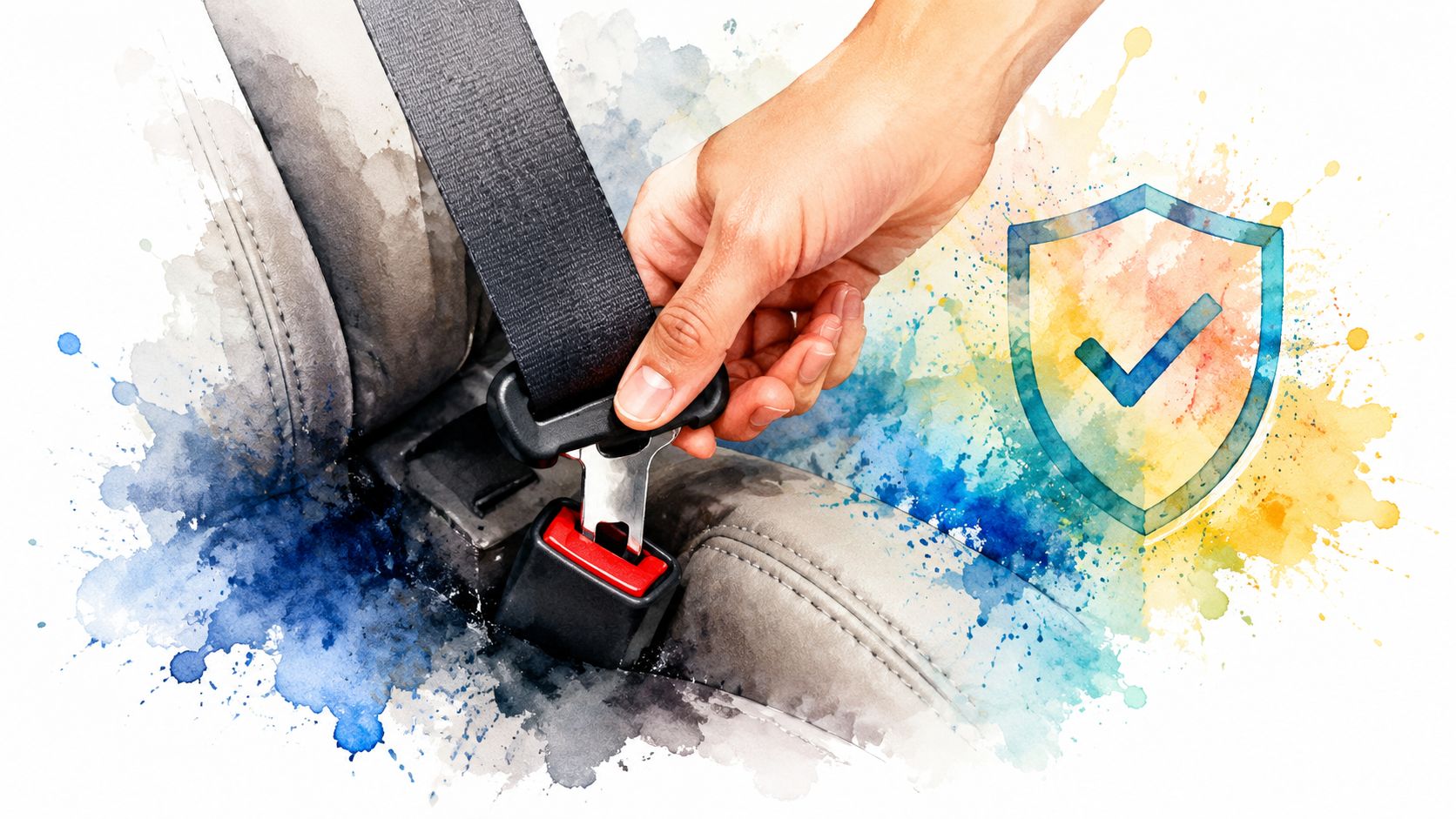
Seatbelts are one of the first habits examiners notice because they reflect safe driving before the car even moves. For Georgia teens and parents, this check is simple. Make sure every belt you may use during the road test works the way it should, every time.
What to check before test day
- Latch and release: Buckle and unbuckle each seatbelt to confirm it clicks securely and releases without sticking.
- Retractor action: Pull the belt out and let it return. It should move smoothly and not hang loose.
- Webbing condition: Look for frays, cuts, burns, or twists that could affect proper use.
- Warning lights: Airbag or restraint-system lights should not stay on after the car starts.
Parents sometimes focus on whether the teen remembers to buckle up, but the vehicle matters too. A belt that locks awkwardly or retracts poorly can rattle a nervous driver before the test even begins. Seatbelts work like a handshake. They should be quick, reliable, and the same every time.
Families with younger children should also check any booster or child seat in the vehicle. If your teen may drive younger siblings, proper restraint use is part of being road-ready, not just test-ready. A-1 shares practical help on child safety seat installation so families can set up the vehicle correctly.
One rule makes this easy to remember. If everyone is not buckled, the car stays parked.
That habit supports road test success because it removes hesitation, prevents last-second scrambling, and reinforces the calm, prepared mindset we coach at A-1 through lessons, courses, and road testing support.
8. Electrical System and Battery Health Check
Some vehicles give plenty of warning before a battery fails. Others don't. If the car hesitates to start, clicks, or sounds weak when cranking, take it seriously before test day.
Battery reliability matters because so many other systems depend on it. Lights, signals, dashboard functions, and starting all connect back to the electrical system. A student who arrives for a road test with a car that won't start has a problem no amount of studying can solve.
What parents and teens should notice
- Start-up sound: Slow cranking often means the battery is weakening.
- Terminal condition: Corrosion around battery posts needs cleaning and attention.
- Warning lights: A charging-system warning light shouldn't be ignored.
- Basic supplies: Keep jumper cables in the vehicle and know how to get help safely.
A practical example is the family car that has been fine for short local trips, but after sitting overnight it starts sluggishly. The teen assumes that's normal because the car still starts. It isn't something to gamble with on road test morning.
The same idea applies to power accessories. If headlights dim unusually at idle or dashboard electronics flicker, that's worth checking. At A-1, we encourage families to test the actual road test vehicle a few days early, not just the night before, so there's time to fix a battery or connection issue.
9. Exhaust System and Emissions Inspection
This is one area families often ignore because much of it sits out of sight. But if the car is unusually loud, smells strongly of exhaust, or has a check engine light on, don't treat that as background noise.
Inspection data from the Netherlands identified emissions among the leading defect categories in a large set of vehicle inspections, alongside lights, brakes, and tyres. That tells you emissions issues aren't rare side problems. They're one of the practical failure points a serious vehicle inspection checklist should include.
Red flags you shouldn't ignore
- Check engine light: Have it diagnosed before the test.
- Exhaust noise: A suddenly louder car may have a leak or muffler problem.
- Odor: Exhaust smells near the cabin need prompt attention.
- Registration readiness: In Georgia, emissions compliance can affect legal operation depending on the vehicle and county requirements.
For Georgia families, this is also about planning. Don't wait until registration deadlines or test week to think about emissions-related maintenance. If a parent already knows the car has had an unresolved check engine light for a while, that's not the best vehicle to send with a nervous teen for an exam.
A-1 keeps the focus on driver education, but we also know that a smooth road test experience depends on a roadworthy vehicle. A student shouldn't have to worry about odd smells, warning lights, or a loud exhaust while trying to remember proper lane position.
10. Horn and Emergency Equipment Functionality
The horn doesn't get much respect until you need it. Then it matters immediately. Your horn should sound clearly and consistently, and your hazard lights should work just as reliably.
This part of the vehicle inspection checklist also covers what's in the trunk or cargo area. A spare tire, jack, and basic emergency gear won't usually be the star of your road test, but they're part of being ready to drive without depending on luck.
What to keep in the car
- Working horn: Test it briefly in an appropriate place.
- Spare tire and jack: Make sure they're present and accessible.
- Jumper cables: Keep them stored neatly.
- Flashlight and basic first aid supplies: Helpful for everyday readiness.
- Owner's manual: It's easier to solve small problems when you know where to look.
A real example is a teen who gets a flat after school and has no idea whether the car even has a spare. That turns a manageable problem into a stressful one fast. Parents can prevent that by showing new drivers where emergency equipment is stored and how to use it.
One broader trend is worth noting here. Digital inspections are becoming more common across fleets, dealerships, and service operations. DataIntelo projects the digital vehicle inspection market at $2.8 billion in 2025 and $6.4 billion by 2033, with North America holding 42.1% share. For families, the practical lesson is simple. Whether you use paper or an app, a repeatable checklist is better than “I think the car's fine.”
10-Point Vehicle Inspection Comparison
A long table can make a simple safety check feel harder than it is. For a Georgia teen getting ready for a road test, the better approach is to group the inspection into a few clear priorities so nothing important gets missed and test-day nerves stay lower.
Use this quick comparison as a parent-teen review the night before the test or in the parking lot before you leave.
- Start with pass-or-fail items first. Check the parts that can stop a road test before it starts, such as brakes, tires, lights, wipers, mirrors, seatbelts, and the horn.
- Then check “drive without stress” items. Look at fluid levels, battery condition, and basic steering response. These may not be the first things an examiner mentions, but they matter if you want a calm, predictable drive.
- Leave shop-level checks to a pro. If the car pulls, shakes, leaks, makes loud exhaust noise, or shows warning lights, a parent should schedule service instead of guessing. A road test is not the time to hope a problem stays quiet.
- Match the check to the driver's skill level. Teens can handle walk-around checks, light tests, tire inspection, and seatbelt checks. Parents should help with anything under the hood unless the student has been shown how to do it safely.
- Focus on road test readiness, not perfection. The goal is a safe, legal, dependable vehicle that lets the student focus on turns, stops, lane position, and examiner directions.
A good way to remember the ten points is to picture them in layers, like getting ready for a sport. First, the car has to be safe to move. Next, the driver has to be able to see and control it. Last, the vehicle has to be reliable enough that a small issue does not turn into a failed appointment.
Here is the short version parents and teens can use:
- Safety to move: brakes, tires, steering, suspension
- See and be seen: lights, windshield, wipers
- Protect the driver and passengers: seatbelts and restraints
- Keep the car running properly: engine basics, fluids, battery, electrical system
- Handle problems on the road: horn and emergency equipment
- Stay legal and test-ready: exhaust condition, emissions status, no warning signs of neglect
If your family wants more than a checklist, A-1 helps connect these vehicle checks to the actual road test. Our courses, driving lessons, and road testing services help teens practice in a way that reduces surprises, builds confidence, and gets both the student and the vehicle ready for test day.
From Checklist to Certified Driver Your Next Steps with A-1
A good vehicle inspection checklist helps you avoid preventable problems. It can catch the obvious things that create stress on test day, like bad lights, worn tires, weak wipers, warning lights, or braking issues. For Georgia teens and parents, that kind of preparation matters because the road test starts before the car even moves.
But a safe vehicle is only part of becoming a licensed driver. Students also need calm instruction, smart practice, and feedback from someone who knows what Georgia examiners expect. That's where A-1 Driving School stands out. We help teens and parents connect the basics of vehicle readiness with the bigger goal, which is becoming a safe, confident, certified driver.
If your teen still needs to meet Joshua's Law requirements, A-1 offers driver's education options that fit different schedules. That includes classroom and online options for Georgia families who need flexibility. If you want more practice behind the wheel, A-1's driving lessons and lesson packages are the biggest advantage for many students. One-on-one coaching helps teens fix small habits before those habits show up on the road test.
That matters a lot for nervous drivers. A student may know the rules but still need guided repetition with parking, lane control, turns, speed management, and test-day confidence. Parents often find that a professional lesson package lowers tension at home, too. Instead of every practice drive turning into a debate, the student gets structured coaching from an instructor who does this every day.
A-1 also supports families who are trying to make training more affordable. The Georgia Driver's Education Scholarship Grant Program can open the door for eligible students to receive quality driver training. That's worth exploring if cost has delayed your plans.
If the next step is the road test itself, A-1 can help there too. You can prepare with lessons, choose an online course if that suits your schedule, and even look into road testing services through the school. That creates a smoother path from permit to license.
The strongest plan is simple. Make sure the car is ready. Make sure the driver is ready. Then practice in the same calm, repeatable way you want the student to drive. When you're ready to move from checklist to real preparation, enroll in a course or book a driving lesson today.
A-1 Driving School has helped Georgia drivers build skill and confidence for decades. If you need Joshua's Law driver's education, online course options, road test preparation, or personalized driving lesson packages, A-1 Driving School gives teens and parents a clear path from the classroom to the driver's seat.