
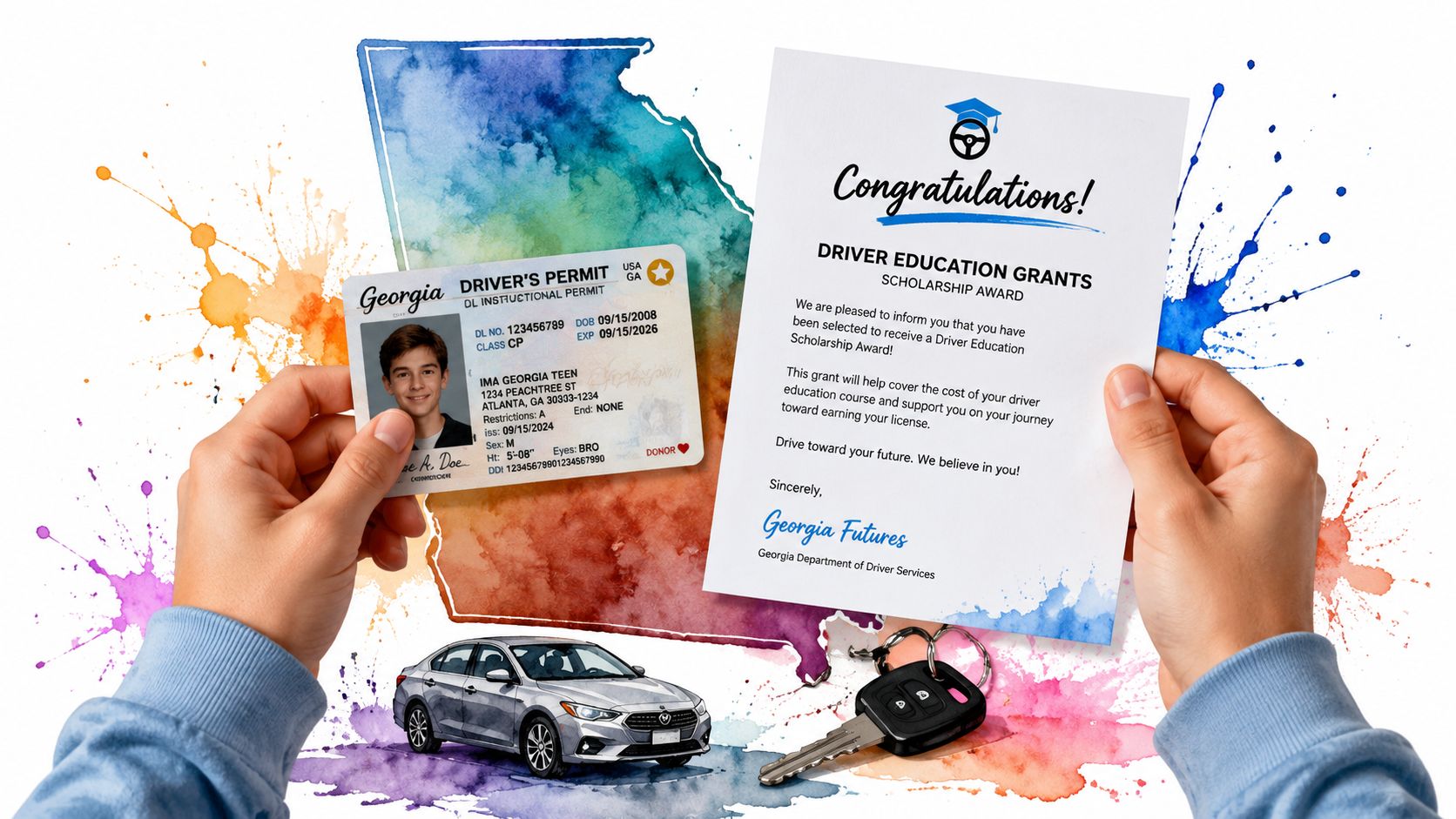
You're trying to line up driver's education, a permit, and a budget that already feels tight. That's a common place for Georgia families to be, especially when a teen is ready for Joshua's Law coursework and the road test feels close enough to plan for, but not close enough to pay for casually.
Scholarship eligibility requirements can look simple at first, then get messy fast. A family may hear “grant” and assume it's automatic, only to learn that age, residency, income, and paperwork all matter. In Georgia, that process can be a real help when it's understood clearly, because the state grant is meant to make approved driver training more reachable for teens who meet the rules and can use the funding with an approved provider like free driving lessons in Atlanta.
Making Teen Driver's Education Affordable in Georgia
A lot of parents start the same way. They know their teen needs driver's education, they know the classes matter, and they open the calendar expecting one more expense to manage.
Georgia does have a grant pathway that can reduce that burden for qualifying families. The Georgia Driver's Education Grant Scholarship Program helps teens complete the required classroom and behind-the-wheel training through an approved provider, so families can connect eligibility with real course options instead of guessing what comes next. A-1 Driving School's scholarship process also helps keep the next steps tied to specific lesson packages and courses, so the family is not sorting out the paperwork and the training plan separately. For a closer look at the school's free introductory option, families can review free driving lessons in Atlanta and see how approved training can fit into the scholarship path.

Why this kind of aid matters
Scholarship funding for education is usually limited, and that is true here too. CollegeMonk's scholarship statistics overview shows that aid is often spread across many applicants, which is why families should not assume a grant will appear on its own. how AI helps education administrators is one example of the kind of support schools and programs can use to keep application work organized, and that same need for order applies here, where documents and deadlines have to be handled carefully.
For driver education, timing and fit matter just as much as interest. A family can have a motivated teen and still miss the benefit if the teen's age, permit status, or documentation does not line up with the program rules.
Practical rule: Treat the grant like a reserved training spot, not a promise. If your teen matches the rules, keep documents ready, follow the approved steps, and choose a course path that the provider can actually redeem.
Families who understand that pattern usually feel less stressed. They are not chasing a vague “scholarship,” they are matching a specific training need to a specific state-funded program.
Decoding the Georgia Driver's Education Grant Program
A family usually understands Georgia's grant faster once it is tied to a real training plan. The program covers a defined driver education package, not every driving cost a teen might have. Under the state materials, that package includes 30 classroom hours and 6 behind-the-wheel hours through an authorized provider, with coverage of up to $500 for the Method 1 driver education package, according to open.ga.gov.
That structure is the point. Georgia is attaching public money to a specific learning path, the same way a school district assigns a set curriculum instead of leaving each family to piece together classes on its own. The scholarship follows the approved course, so the provider has to be able to redeem the award.
How the program is organized
Georgia uses a tiered eligibility model. The first group considered includes children of first responders killed or disabled in the line of duty, military members killed in action, and children in state custody. After those priority groups, the program moves to applicants who meet a financial-need threshold.
Parents often expect a scholarship process to focus mainly on grades. Here, the state is looking first at need, protection, and access. That is why the paperwork has to show who qualifies before anyone talks about which class to buy.
The logic is simple once you line it up. The state needs to confirm the applicant, confirm the type of training, and confirm that the money will be used with an approved provider. A general discount code would not do that job.
Families who work with schools, youth programs, or after-school staff usually understand systems like this once the steps are explained clearly. The grant answers three questions at once, who gets first consideration, what the money pays for, and where it can be used.
A-1 Driving School's grant page helps connect those answers to actual enrollment choices through its scholarship program resource. That matters for a parent who is moving from “my teen may qualify” to “which course can we reserve.”
The program reduces the gap between eligibility and enrollment. It does not only lower the price, it channels the award into a specific training option so the state's funding reaches the intended lesson package.
A scholarship can be generous and still be tightly controlled. That is normal. The more specific the rules, the more important it is to gather the documents and choose the provider before you apply.
For families comparing this with other school support systems, the process works much like the administrative load described in how AI helps education administrators. The paperwork is there to make sure limited resources go to the right applicants and the right services.
Who Qualifies for the Scholarship
A family can save time by checking the basic gate first. Georgia's driver education grant is built for teens who already fit the program's age and documentation rules, then move on to redemption with an approved provider. For scholarship applicants, the teen must be in the 15 to 17 age range and have a valid instructional permit or driver's license before the scholarship can be redeemed. Applicants also complete an online account and application process and upload proof of Georgia residency and age. Georgia's the state's scholarship walkthrough lays out those steps.
Georgia Driver's Ed Scholarship Eligibility Checklist
| Requirement | Details |
|---|---|
| Age | Teen must be 15 to 17 |
| License status | Must have a valid instructional permit or driver's license before redemption |
| Residency | Must provide proof of Georgia residency |
| Age verification | Must provide proof of age |
| Application method | Complete the online account/application process |
| Redemption | Scholarship must be redeemed through an approved provider |
What families usually misunderstand
Many parents hear the word “scholarship” and assume grades are the main filter. This program works differently. Age, residency, and licensing readiness come first, because the grant is meant for a teen who can use structured driver training soon after approval.
The financial side still matters, but it sits inside a broader screening process. Georgia's model follows the same general pattern seen in public aid programs, where identity, residency, and timing rules are checked along with the award itself. Families should expect a file review, not a simple yes or no based only on interest.
That same layered approach shows up in other state programs too, which helps explain why families should read every requirement carefully. One useful comparison is Ticket Shield's guide to hardship licenses, since it shows how eligibility rules can depend on both paperwork and the applicant's current driving status.
The rule families should remember
If a teen cannot document age, residency, and permit status, the application will stall early. Gather those items before starting the form, so the process does not stop halfway through.
A-1's enrollment guidance gives families a practical example of how the process is handled in real life, and the school's enrollment information can be found at how to enroll in driver's ed. That is useful when you want scholarship eligibility to line up with a course schedule that fits a teen's permit timeline.
Common point of confusion: eligibility for the scholarship and eligibility to redeem it are not the same thing. A teen may qualify to apply, but still need the right permit status before the grant can be used.
The state's system is set up that way on purpose. It keeps the award tied to a real training path and helps prevent misuse, so the money goes toward the intended instruction rather than an abstract approval.
Your Step-by-Step Application Guide
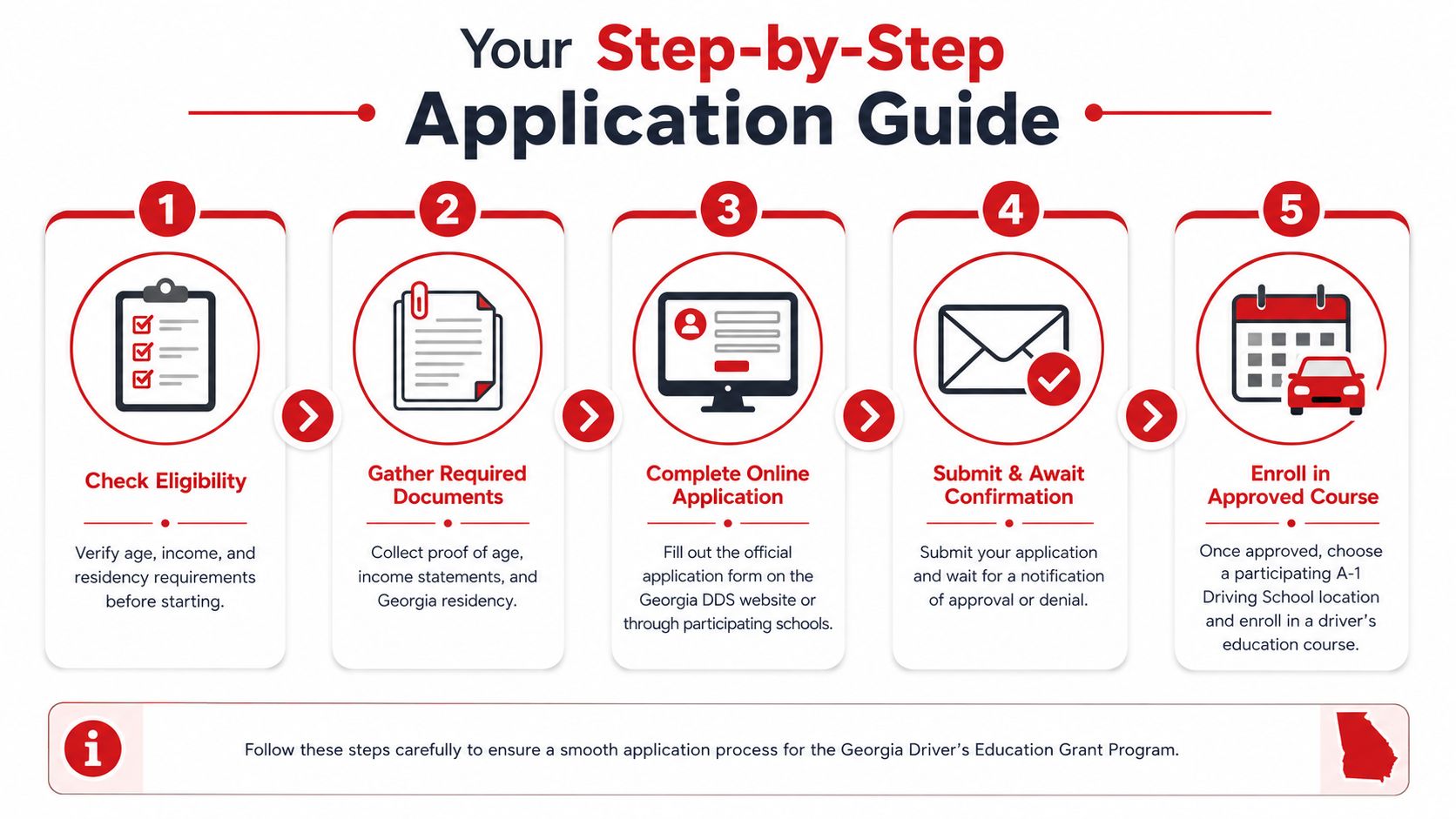
A scholarship application goes more smoothly when families prepare the file before they open the portal. Gather the basic identity documents first, confirm the teen's permit status, then move into the online form only after those pieces are in hand.
Start with the documents
The application is built around proof, not guesswork. Families should expect to upload documents that confirm the teen's age and Georgia residency, and they may also need income verification if they are applying through the need-based portion of the program. The exact checklist can vary by applicant category, so it helps to get organized before the deadline turns into a problem.
Families often miss scholarship opportunities because they underestimate how many checkpoints the process can include. Public aid programs frequently ask for more than one layer of review, such as verification, time windows, and enrollment rules. That pattern is clear in Michigan's aid eligibility guidance, and it shows why a complete file matters more than a rushed submission.
Move through the process in order
- Check eligibility first. Confirm the teen's age, residency, and permit status before opening the application.
- Gather supporting documents. Keep age and residency proof together so nothing gets lost during submission.
- Complete the online account and application. Use the state's application process carefully and enter matching details in every field.
- Wait for confirmation. Do not schedule training until the scholarship status is clear.
- Redeem with an approved provider. Once approved, the family can apply the grant to a participating course path.
A family that follows that sequence avoids the most common fixable mistakes. It also keeps the grant tied to the right provider, which matters because the award is designed for a defined education package, not just a general pool of lessons.
Ticketing and permit issues can confuse parents too, so a practical comparison point is Ticket Shield's guide to hardship licenses. The situations are not the same, but the lesson is useful. Driver-related paperwork usually depends on exact eligibility steps, not broad assumptions.
A-1's redemption path is straightforward once the scholarship is awarded, and families can review the process through the school's enrollment guidance. That is the point where the grant becomes a real seat in a course, not just an approved application.
Good habit: Save screenshots or copies of every uploaded document. If a detail gets questioned later, you will be able to answer quickly.
The best applications feel boring, and that is a good sign. They are complete, readable, and ready for review.
Common Disqualifiers and Tips to Improve Your Chances
Some scholarship systems look generous on the front end but subtly filter applicants through small details. Residency cutoffs, income bands, and service-area rules can create eligibility cliffs, and the same basic reality applies here, scholarship eligibility is often less about being the strongest student and more about matching the program's target. That point is reflected in Illinois scholarship-granting rules, where the award structure depends on specific income and residency categories.
The biggest mistake families make is assuming the headline requirement is the only one that matters. It isn't. A teen can be enthusiastic, motivated, and ready to learn, but still lose out if the paperwork is incomplete or the permit isn't valid when the scholarship has to be redeemed.
The mistakes that cause trouble
- Missing a document: If proof of age or residency is missing, the file may stall.
- Confusing eligibility with redemption: Approval to apply doesn't always mean the grant can be used immediately.
- Overlooking the income screen: Families sometimes guess instead of checking the actual threshold.
- Waiting too long: Grant programs often run on limited funding, so delay can matter even when a teen qualifies.
How to improve your odds
Prepare the file early. Keep the teen's permit information, residency proof, and any income records in one place before you begin. That simple habit saves time and lowers the chance of an avoidable rejection.
It also helps to read the rules as they're written, not as you hope they work. Programs with layered criteria are designed that way, and families who take the time to line up each requirement usually move through the process with less stress.
If your household is also thinking about driving safety and teen risk, it's wise to keep the legal side in mind. Resources such as underage DUI charges and penalties can be a reminder that good planning and supervised training matter long before a teen ever drives alone.
Practical rule: Apply as soon as you're ready, not after you've finished comparing every possible option. Limited funding rewards prepared families.
That's a key advantage of staying organized. You're not just filling out a form, you're reducing the chance that one missing detail closes the door.
Beyond the Grant How A-1 Driving School Invests in You
A scholarship decision does not always settle the whole plan, and many Georgia families still need a clear path to driver education after they check eligibility. A-1 Driving School helps with that part of the process through classroom instruction, online Joshua's Law options, behind-the-wheel lessons, and road test services, so parents can choose a training route that fits their schedule and budget.
Scholarships are limited in the bigger picture too, as noted earlier. Families cannot assume aid will cover every cost, which is why flexible course planning matters whether the grant is approved or not.
A-1 Driving School connects that planning to specific lesson paths. A family can pair classroom learning with behind-the-wheel practice, then move into a road test path when the teen is ready. For Georgia parents trying to keep everything organized, that combination is often easier than trying to coordinate separate providers.
A-1 also offers online course options and road test services, which helps when a teen already has a crowded schedule. If a scholarship is approved, the family can redeem it through the right course path. If it is not approved, there is still a clear way to continue without losing progress.
The best choice is the training format that fits the teen. Some families want the structure of in-person classes. Others need the flexibility of online instruction. Either way, the goal is the same, get the right practice, the right instruction, and a direct path to the road test.
A CTA for A-1 Driving School.