You're stopped at a busy Atlanta intersection, one hand on the wheel, a line of cars behind you, and a pedestrian stepping off the curb just as the light changes. That split second feels small until you realize it can decide whether you clear the turn, earn a point deduction, or freeze long enough to fluster your whole drive. Traffic signal meanings are really a language, and Georgia examiners expect you to read the whole sentence, not just the color in the middle.
Most new drivers learn red, yellow, and green, then get surprised by the rest of the signal face. A flashing arrow, a lane-control display, or a dark signal can change the rule in a heartbeat. That's why driver education matters, because confidence at an intersection comes from knowing what each face means before you roll forward.
Why Every Driver Misreads at Least One Signal
The mistake usually happens when a driver is already moving, not when they're sitting in class. A teen eases up to a familiar Atlanta corridor, sees the light ahead, notices a pedestrian at the curb, and then starts guessing which cue matters most. That's the moment where traffic signal meanings stop being a memorized list and become a real-time decision.
A lot of learners get the base colors right and still miss the details. They know red means stop and green means go, but they hesitate when a flashing yellow arrow appears, or they roll through a lane-control signal without reading the face above the lane. Those are the kinds of mistakes that turn a routine drive into a tense one.
The part that feels simple is usually the part people rush
The basic colors are easy to repeat out loud. The hard part is slowing down enough to notice whether the signal is telling you to stop, yield, wait for a turn arrow, or treat the intersection like a stop-controlled crossing. That's where good instruction helps, because it trains your eyes to look at the full setup, not just the brightest light.
Practical rule: if you're guessing, you're probably moving too soon.
By the end of this guide, you'll be able to read the common signal faces you'll meet in Georgia, understand what the law expects at each one, and see how structured driving lessons turn that knowledge into habits that hold up on a road test. If you've ever paused at a light and thought, “Can I go now, or am I about to do something wrong?”, this is the version of the rule set you need.
Red, Yellow, and Green as a Hierarchy of Movement
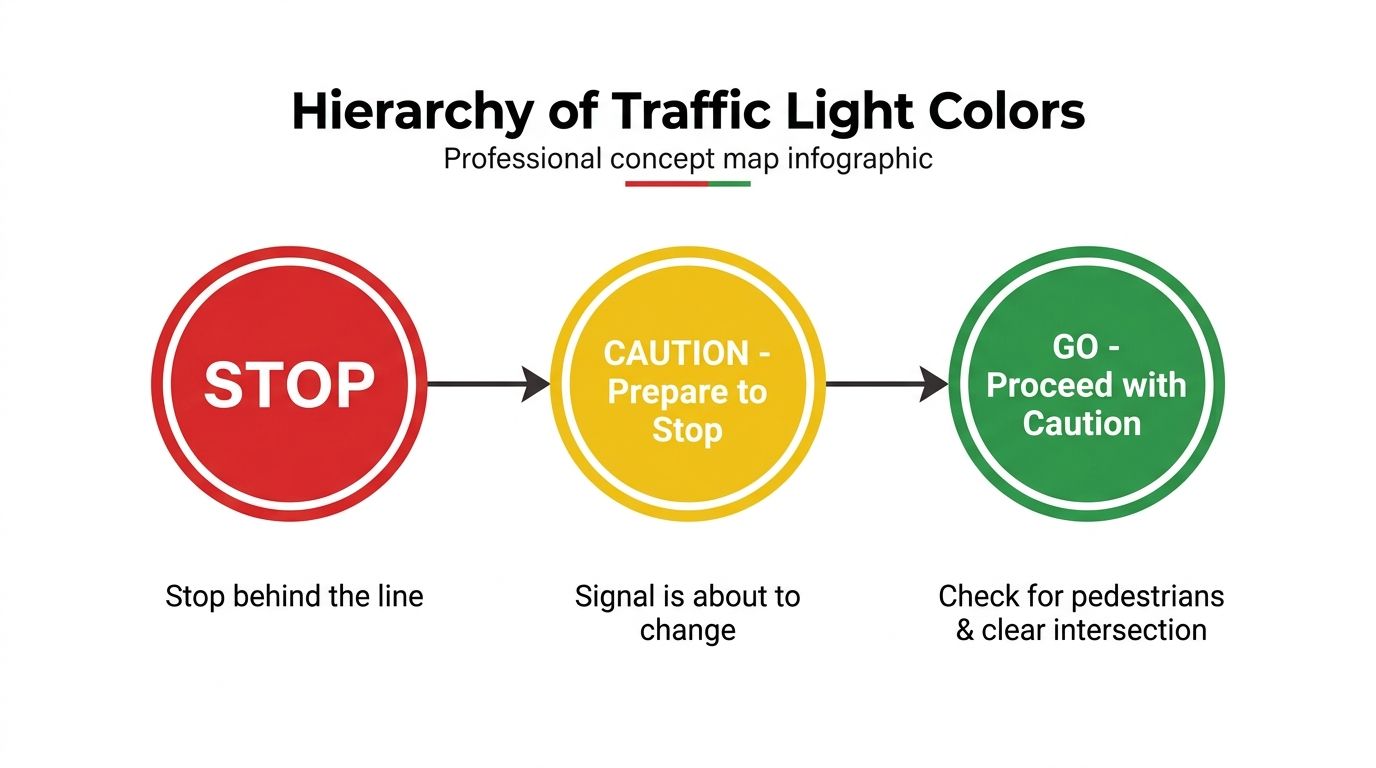
Start with red, because that's the easiest place to build good habits. A steady red light means stop before the stop line, the crosswalk, or the nearest point where you can see the traffic safely. If you creep past that line, you're not “being ready,” you're already in the space the signal is protecting.
Yellow is not a race cue
A yellow light is the signal's change interval, not an invitation to speed up. The MUTCD defines a signal phase as the green, yellow change, and red clearance intervals assigned to a movement, which means yellow belongs to the transition, not the sprint (FHWA MUTCD guidance). That's why the yellow interval exists, to end the green movement and clear the intersection before conflicting traffic gets the right-of-way.
A lot of nervous teens hear “yellow” and think “go if you can beat it.” That mindset causes hesitation, hard braking, and bad calls at the exact moment the signal is asking for calm. On a Georgia road test, the safe move is to decide early, not to accelerate into a changing light.
Green still asks you to read the whole face
A circular green means you may proceed, but only if your lane and any turn restrictions allow it. A green light doesn't override lane-use signs, turn-control signs, or a protected turn arrow that's holding another movement back. That's why a driver can't just see green and assume every turn is legal.
Memorize it this way: red means stop, yellow means prepare to stop, green means proceed only after you read the whole intersection.
Arrows That Override the Circular Lights
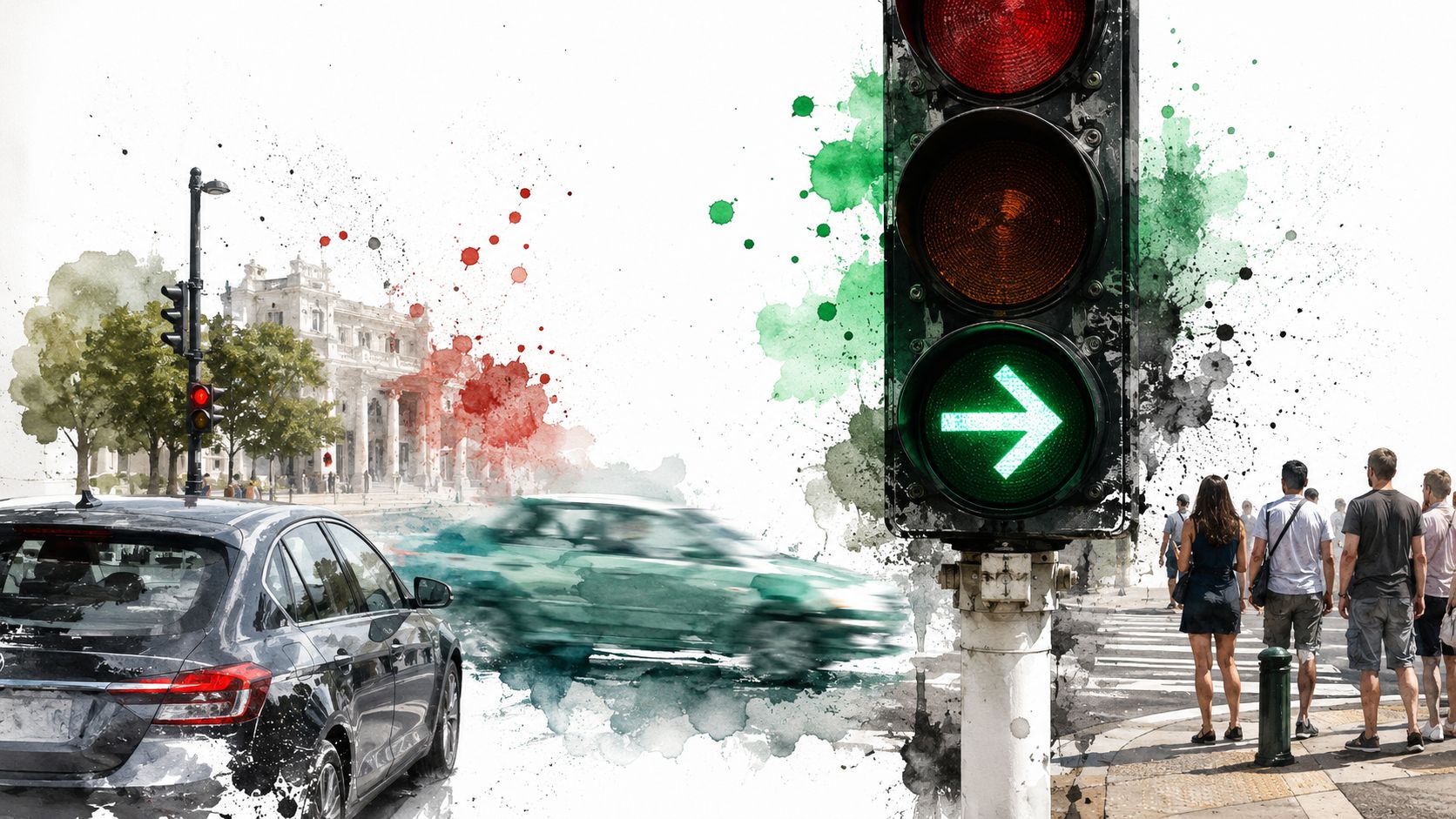
A green arrow is the cleanest movement you'll see at a busy intersection. It means that movement is protected, oncoming and cross traffic are held by red, and you can make the turn or go straight in the direction shown without negotiating with traffic across from you. That's the signal face many Georgia examiners like, because it shows whether you can move decisively without drifting into the wrong lane or hesitating too long.
The circular green is still permissive, not automatic
A circular green works differently. You may turn only if the turn is allowed by lane-use signs or other control devices, and you still have to yield to pedestrians and any traffic that has the right-of-way. That's the exact spot where a student can pass a lot of classroom quizzes and still feel uneasy in a real left-turn lane.
A red arrow is even stricter. It prohibits the movement shown by the arrow, even if the rest of the signal is green. That's a common road-test trap, because a driver sees the circle, trusts the circle, and forgets the arrow is controlling the lane they're in.
Yellow arrow means the protected phase is ending
A yellow arrow tells you the protected movement is ending. You don't speed up for it, and you don't treat it like a new opportunity to start. You clear the turn if you're already in it and you can do so safely, because the phase is ending and cross traffic is about to get a turn.
The most confusing arrow in metro Atlanta is the flashing yellow arrow. It's used heavily for protected-permissive left turns, and it means you may turn only after yielding to oncoming traffic and pedestrians. That's the version students need to practice repeatedly, because it looks friendly but still demands judgment.
A-1 Driving School's in-class and online Joshua's Law instruction uses the same signal diagrams students meet in driver education, which helps the arrow rules stick before they ever reach a busy intersection.
Flashing Signals and What a Dark Signal Really Means
A flashing signal has a different rhythm from a steady light, and the rhythm matters. Under the MUTCD, a flashing traffic signal must cycle at 50 to 60 flashes per minute, with each flash lit for one-half to two-thirds of the full cycle (MUTCD flashing signal requirements). That standard keeps the signal recognizable, so drivers can tell a real indication from a bad bulb or an electrical problem.
Flashing red and flashing yellow are not the same instruction
A flashing red requires a full stop, then movement under stop-sign rules. A flashing yellow lets you proceed cautiously, without requiring a stop first. That distinction sounds minor until you're the one deciding whether to roll through or wait, and the answer changes based on the color that's blinking.
If you're unsure how Georgia drivers are taught to handle the yellow flash, this plain-language guide to a flashing yellow light helps connect the signal face to the driving action. The point is the same every time, the flash is telling you to respond with a specific level of caution, not to improvise.
A dark signal changes the rule again
A dark or unlit signal is not the same as a normal red, yellow, or green indication. At a non-functioning intersection, Georgia drivers treat it like an all-way stop, which means everyone comes to a complete stop and takes turns carefully. That's the kind of edge case that shows up during storms or outages, and it can feel more stressful than a regular red light because nobody wants to be the first person to move.
Traffic lights are easiest when they're working normally. Real skill shows up when they don't.
A flashing yellow arrow deserves one more reminder here. It's still a left-turn control, not a free pass, and it asks you to yield before turning. That's why behind-the-wheel practice matters, because edge cases like flashing and dark signals are much easier to handle after you've seen them coached in a lesson car.
Pedestrian, Bicycle, and Lane-Control Signals
Drivers often focus on the light facing the car and miss the signals facing everyone else. That's a problem, because the car doesn't own the intersection, people walking and biking are part of the same timing plan. In Georgia, that means watching for pedestrian indications, bike-specific faces where they exist, and the lane-control signals hanging above travel lanes.
Pedestrian signals protect the crosswalk, not just the curb
A WALK indication tells a pedestrian to start crossing, and a flashing DON'T WALK or upraised hand means a pedestrian already in the crosswalk may finish crossing, but new pedestrians should not step off the curb. Drivers need to treat the whole pedestrian sequence as active, not just the moment someone is visible in front of the hood. If the pedestrian is still clearing the lane, you wait.
That's why a driver can't rush a turn just because the car light has changed. The crosswalk has its own timing, and Georgia examiners watch whether you respect it consistently. If you're turning across a crosswalk, you're responsible for clearing it only when pedestrians are no longer in your path.
Lane-control faces tell you whether the lane is open
Some Atlanta corridors use lane-use signals to manage traffic more precisely. A steady green arrow over a lane means the lane is open, a steady red X means the lane is closed, and a flashing yellow X warns that the lane is about to close and drivers should merge. Those faces matter because a lane can look usable from the windshield while the signal above it says otherwise.
Cyclist-specific signal faces and bicycle detection indicators also appear on some routes and multi-use paths, especially where the road design gives bikes their own timing. A driver doesn't need to become an engineer to use these correctly, but you do need to notice that a signal might be controlling a bike movement instead of a car movement.
The best lesson cars teach this with repetition. When a teen practices near corridors that feature crosswalks, protected lanes, and lane-control signals, the driver starts reading the whole intersection instead of focusing on the nearest red light.
How a Real Georgia Intersection Cycle Plays Out
A rush-hour cycle at a big Atlanta intersection can feel like a dance with too many steps. The through lane starts on circular green, the left-turn bay may get a flashing yellow arrow, pedestrians receive their WALK phase, and everyone else waits for the signal to hand over the right-of-way in order. Georgia examiners watch whether you read that order correctly from the driver's seat, not whether you can recite it from memory. A real intersection teaches the rule faster than a chart does.
The first mistake happens early. A nervous driver sees yellow and treats it like a last chance to beat the intersection, then brakes too late or enters the crosswalk when there is not room to clear it. That is where understanding what a red light requires starts to matter, because the light change is part of a controlled stop, not a cue to hurry into the space ahead.
The second mistake shows up at the left turn. If the arrow is flashing yellow, the driver has to yield before turning. If the pedestrian phase is still active, the turn waits. If the crosswalk is clear and oncoming traffic is gone, the turn can happen smoothly, without the wobble that comes from second-guessing every movement. That same habit, reading the face first and moving second, is what examiners look for on a road test.
For the right-turn side of the same decision-making, the school's guide to right on red shows how the rule changes when you are turning across a different movement. The common thread is simple. The signal face tells you whether you are moving now or yielding first.
Turning Signal Knowledge Into a Georgia License
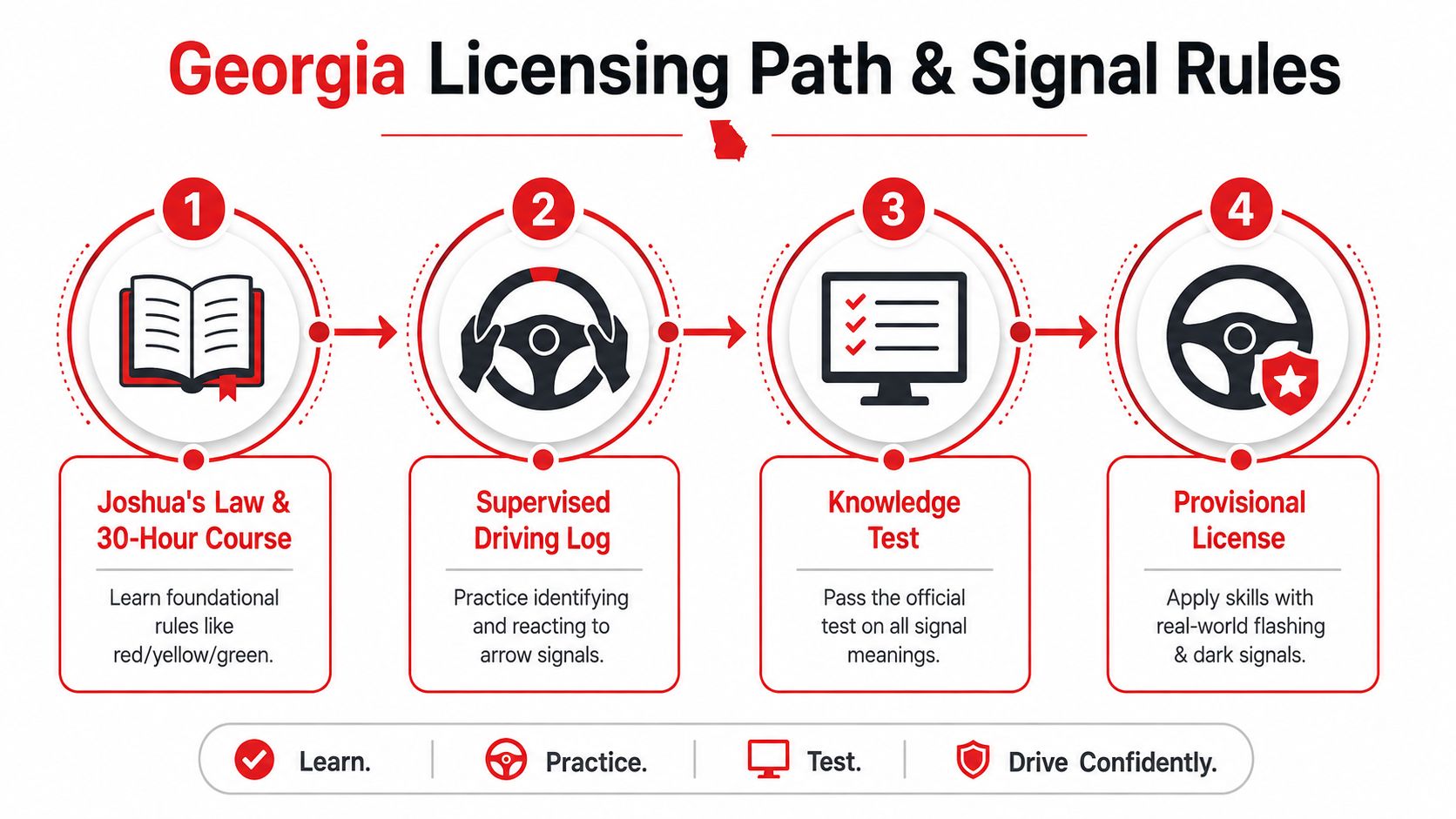
Georgia's licensing path rewards drivers who can recognize signals and act on them without freezing. Joshua's Law, the 30-hour Driver's Education course, and the required 6 hours of behind-the-wheel training work together because classroom knowledge and actual lane position are two different skills. One teaches the rule, the other teaches timing.
Why structured lessons matter more than memorizing a chart
A student can read about a flashing yellow arrow and still hesitate when one appears over a busy left-turn lane. In a lesson car, the instructor can repeat the same intersection until the student stops guessing and starts responding naturally. That is the bridge from permit-level awareness to road-test confidence.
A-1 Driving School delivers Joshua's Law instruction both online and in classrooms across metro Atlanta, Athens, and Fulton County Schools, and it also offers driving lessons packages that let teens and adults practice real intersections with a certified instructor. The school also administers the Georgia road test at multiple locations, which helps students test where they've trained instead of facing an unfamiliar setup on exam day.
The scholarship option can remove the cost barrier
For eligible teens, the Georgia Driver's Education Scholarship Grant Program can cover Joshua's Law requirements at no cost. That matters for families who want the training but need a practical way to make it happen. If you're comparing programs, look for the one that ties the classroom lesson to the exact signal faces you'll meet on the road, then gives you supervised driving time to lock it in.
If you're ready to turn signal recognition into clean, confident driving, enroll in A-1 Driving School's Joshua's Law course or book a lesson package that puts you at real intersections with an instructor who can coach every arrow, flash, and lane-control face. Visit A-1 Driving School to choose an online course, a class time, or a driving lesson schedule that fits your path to a Class D license.