You're probably here because a simple question turned out not to be so simple: what does a red light mean when you're the one behind the wheel?
For a new Georgia driver, that question comes up fast. You approach an intersection, the light changes, cars are moving beside you, a pedestrian is near the crosswalk, and you have only a moment to decide whether to stop, wait, or turn. Parents feel the same pressure from the passenger seat because they know one small mistake at a red light can become a dangerous one.
The red light meaning is straightforward, but the situations around it can be confusing. Solid red. Flashing red. Red arrow. Right on red. Stop line. Crosswalk. Road test rules. Joshua's Law. It all connects. When teen drivers understand those pieces clearly, they drive with more control and make calmer decisions.
Why Understanding Red Lights Is Critical for New Drivers
A red light is one of the first real tests of judgment for a new driver. It asks you to notice the signal, read the intersection, control your speed, stop in the right place, and wait without rushing. That's a lot for someone still building confidence.
The rule matters because intersections leave very little room for error. In 2023, red light running violations in the United States led to 1,086 fatalities, which shows how serious this one mistake can be on real roads, not just on a written test (Insurance Institute for Highway Safety red light running data).
What a red light is really telling you
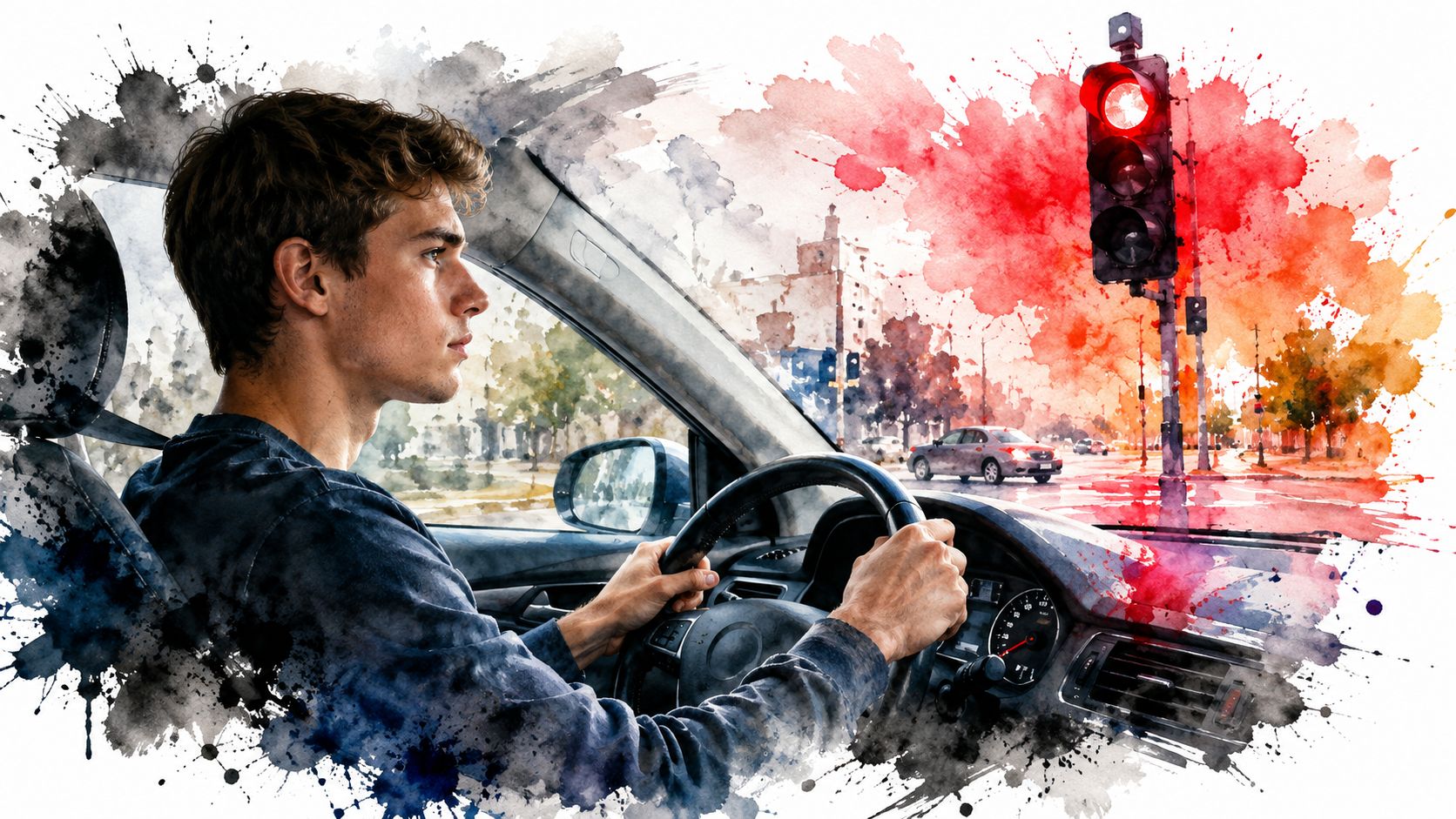
The basic message is simple. Stop completely. Not slow down. Not roll forward. Not decide halfway through the intersection that you can still make it.
A steady red signal legally requires a full stop. If your car enters the intersection after the light has already turned red, that counts as a violation. Drivers who are already lawfully in the intersection when the signal changes are a different situation, which is why timing and position matter.
Practical rule: If you're asking yourself whether you stopped enough, you probably didn't. A complete stop means the car's movement has fully ended.
Why new drivers get confused
Most confusion happens because drivers mix up traffic rules with traffic pressure. A car behind you may seem impatient. You may worry about braking too early. You may think a quick roll is harmless if the road looks empty.
That's where training matters. Good driving means following the signal, not following the mood of the drivers around you. The red light meaning doesn't change because someone behind you wants you to hurry.
A second type of confusion comes from warning lights in general. Cars have dashboard alerts, roads have signals, and both use red or amber to get attention. If you're also learning vehicle basics, this guide on how to diagnose your car's wrench light can help you separate dashboard warnings from roadway signals so you don't mix the two.
The habit that keeps you safe
New drivers do best when they make red-light decisions earlier. That means:
- Scan ahead: Look at the signal before you reach the intersection.
- Cover the brake: Get ready to stop when the light has been green for a while.
- Choose a stopping point: Aim to stop before the white line or crosswalk.
- Stay calm at the line: Once stopped, wait for the legal signal to move.
Parents often focus on parallel parking or highway driving, but intersections deserve just as much practice. A driver who handles red lights well usually shows better control everywhere else too.
Decoding Different Types of Red Traffic Lights
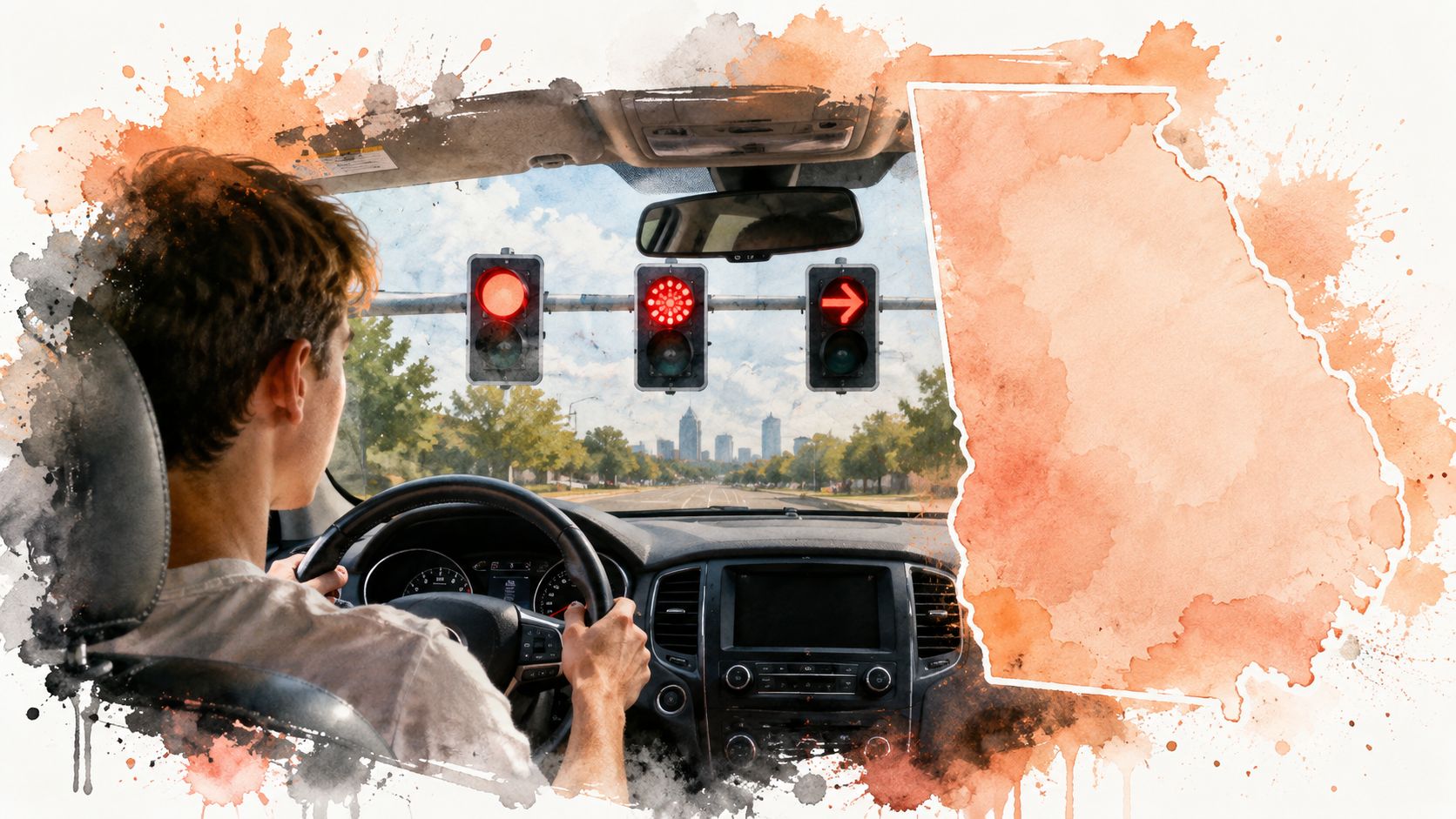
The red light meaning changes slightly depending on the signal you see. That's where many teen drivers freeze up. They know red means stop, but they aren't always sure what kind of stop the law requires.
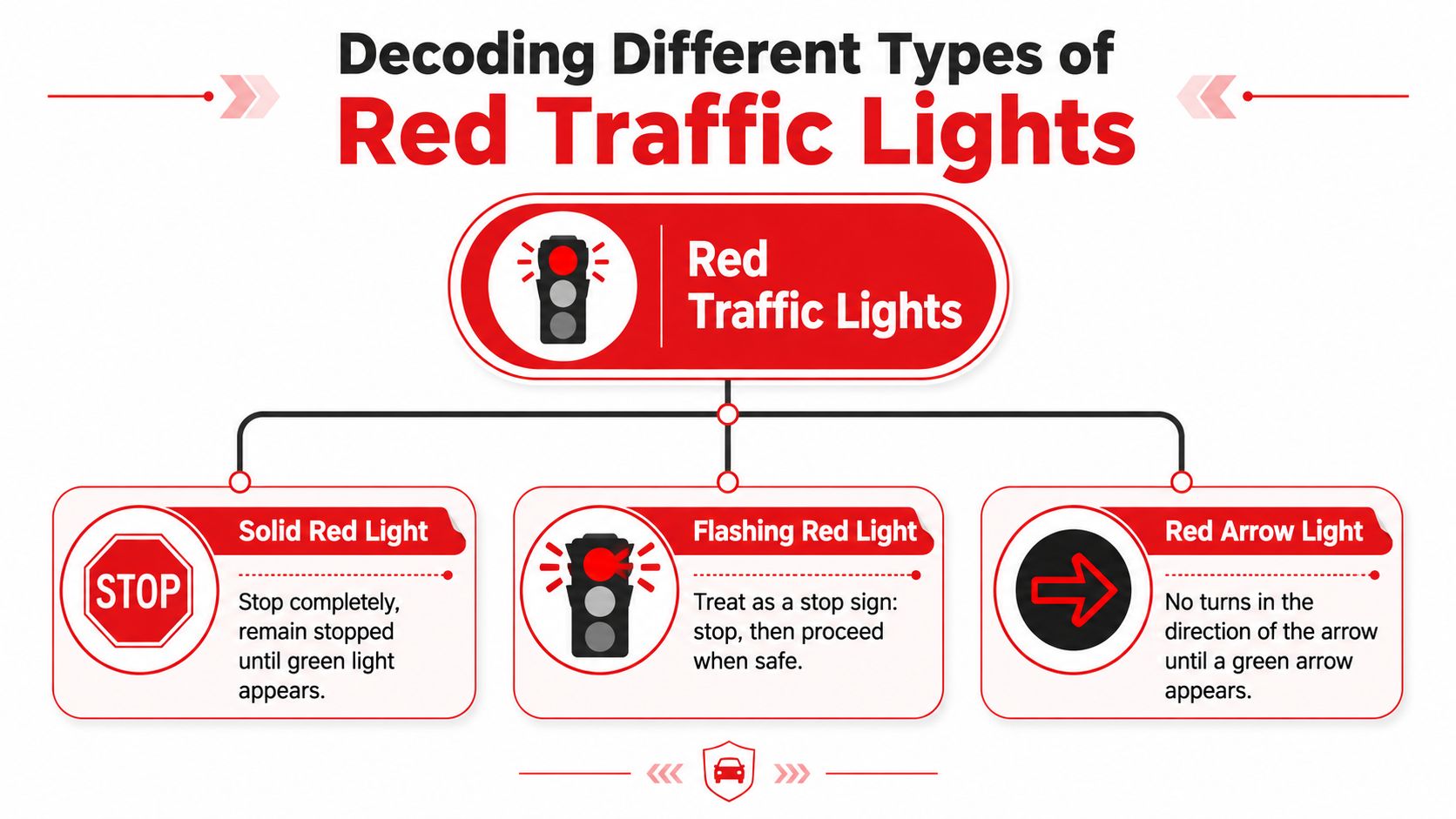
This visual helps separate the three common red signals you'll meet on Georgia roads.
Solid red light
A solid red light means stop completely and remain stopped until you're allowed to move. The stop should happen before the marked stop line. If there's no stop line, stop before the crosswalk. If there's no crosswalk, stop before entering the intersection.
This is the version often pictured first, and it's still the one that causes plenty of trouble on road tests. The common mistake isn't ignorance. It's the rolling stop.
Flashing red light
A flashing red light should be treated like a stop sign. In modern United States law, and as enforced on the Georgia road test, drivers must stop completely and proceed only when the intersection is clear (history and legal meaning of red signals).
That means you stop first, then check left, right, and ahead, and then move when it's safe. You don't get to treat a flashing red as a slow-down light.
If this signal still feels confusing, this guide on what a flashing red light means breaks it down in a very practical way.
A quick video walkthrough can also help you picture how these signals work in real traffic.
Red arrow light
A red arrow is more specific. It means you may not go in the direction of that arrow until a permitted signal appears. If the arrow points right, you can't turn right on that arrow. If it points left, you can't turn left in that direction.
A red arrow is stricter than many new drivers expect. Don't treat it like a regular red light unless the law and the intersection clearly allow that movement.
Here's a simple comparison:
| Signal | What you do |
|---|---|
| Solid red | Stop completely and stay stopped until permitted to go |
| Flashing red | Stop completely, then proceed when clear |
| Red arrow | Don't move in the arrow's direction until allowed |
The safest approach is to identify the signal first, then act. Don't decide based on what the driver next to you does.
Mastering the Right on Red in Georgia
Right on red is one of the most misunderstood moves for beginners. Many teens think it means they're supposed to turn if traffic gives them a chance. That's not the rule. Georgia law allows the turn only after specific steps are followed.
Under Georgia law O.C.G.A. § 40-6-21, a driver may turn right on a steady red light after coming to a complete stop and yielding to cross-traffic and pedestrians, unless a posted sign prohibits the turn (Georgia right on red law).
The three-step method
Use the same routine every time so you don't rush it.
Stop fully first
Your car must stop before the stop line, crosswalk, or edge of the intersection. A slow roll doesn't count.Yield to everyone who has the right of way
That includes vehicles coming through the intersection and pedestrians using the crosswalk. If someone is walking anywhere you might cross, wait.Turn only when the path is clear
If visibility is poor, stay stopped until you can see enough to make a safe decision.
When you cannot turn
There are situations where right on red is not allowed, even if the intersection looks empty.
- Posted restriction: A sign that says No Turn on Red overrides the general rule.
- Pedestrian conflict: If your turn would interfere with a pedestrian, you wait.
- Blocked view: If parked cars, a large truck, weather, or the angle of the road limits what you can see, don't force the turn.
Many failed right-on-red turns start with impatience, not lack of knowledge. The driver knows the rule but skips the full stop.
The mistakes examiners and parents notice
A rushed right turn on red often includes one of these errors:
- Stopping too late: The front of the car creeps into the crosswalk.
- Looking only left: New drivers check for cars but forget to scan for pedestrians on the right.
- Following the car ahead: Another driver's turn doesn't automatically make your turn safe.
- Treating permission as a requirement: You're allowed to turn right on red in some places. You're never required to.
If you want a more detailed breakdown of edge cases, this article on when you can turn right on red gives clear Georgia-specific examples.
The smartest habit is simple. Stop first, think second, move last.
Red Light Violations Fines Cameras and Points
A red light violation doesn't begin and end with an awkward moment at an intersection. It can affect your driving record, your stress level, and how confidently you approach future intersections. For teen drivers, that matters because early habits tend to stick.
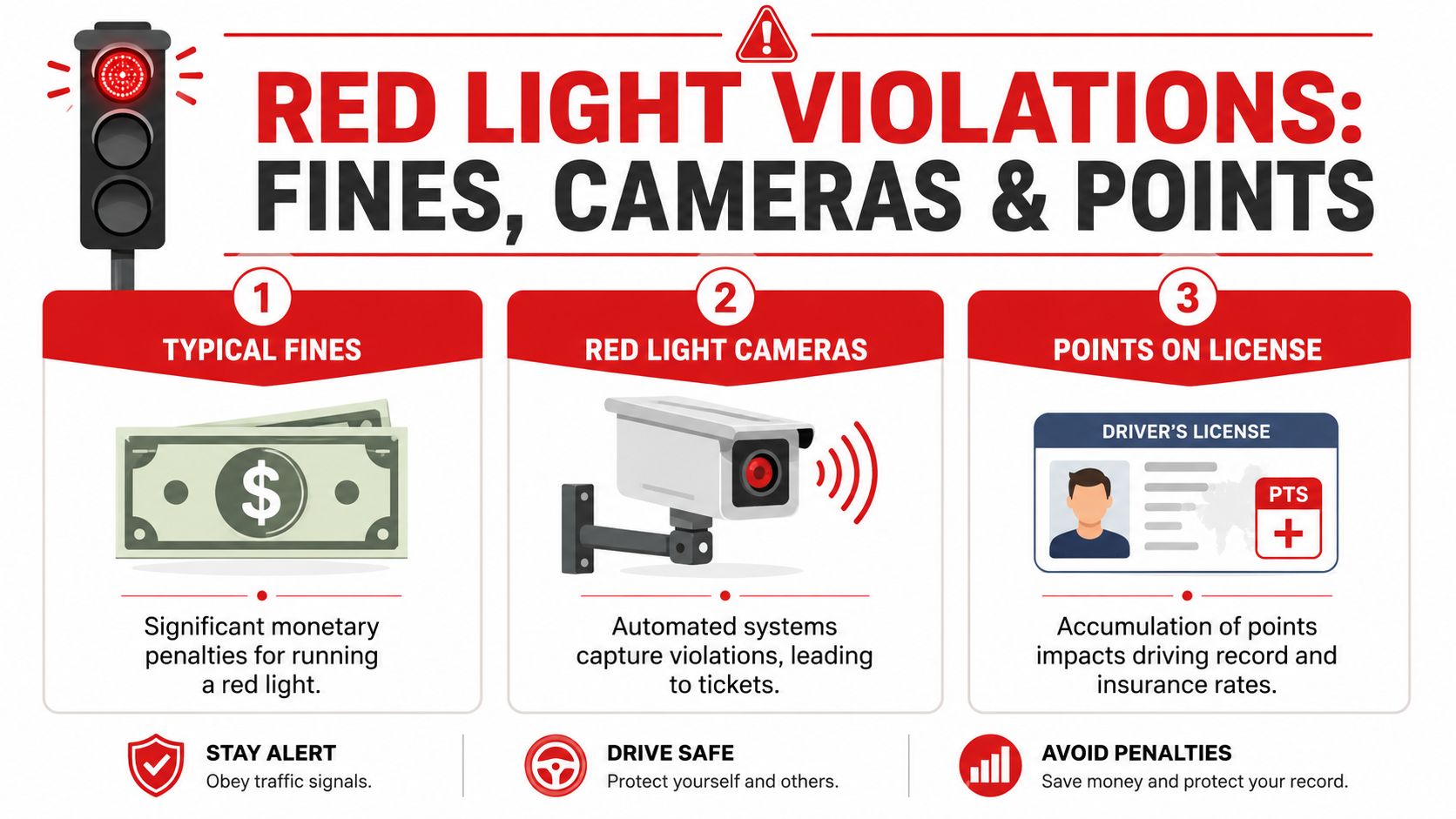
This overview helps organize the consequences many families ask about.
Why cameras are part of the conversation
Some drivers think red light cameras exist only to issue tickets. The bigger safety point is deterrence. Studies by the IIHS found that red light safety cameras reduced the fatal red light running crash rate in large cities by 21%, which is why many safety discussions keep returning to them.
That doesn't mean a camera replaces judgment. It means drivers should assume intersections are monitored and drive correctly whether they see enforcement or not.
What teen drivers should understand about penalties
The exact fine amount, local enforcement process, and point outcome can vary by situation, so the safest approach is not to guess. Instead, focus on what a violation can lead to in practical terms:
- Money: A citation can cost you and your family.
- Driving record issues: Violations can follow you beyond one bad day.
- Insurance concerns: Parents know a traffic mistake can become expensive long after the ticket is paid.
- Stress before the road test: Drivers who get casual about intersections often carry that habit into testing.
How red light camera systems work
Red light camera systems are designed to detect vehicles that fail to stop at red signals and capture plate images clearly enough for enforcement. The systems described in federal performance specifications are built for quick response and legally useful image capture, which is why drivers should assume a rushed entry into an intersection may be documented.
That's also why the best defense isn't a later fix. It's early training. Drivers who build a full-stop habit rarely need to worry about whether a camera saw them because they didn't make the violation in the first place.
You can't out-argue a bad intersection habit. You have to replace it with a better one.
For families, the useful takeaway is simple. Don't teach a teen how to “get away with” a rolling stop. Teach them how to make one clean, repeatable stop every time.
How Red Light Rules Affect Your Georgia Road Test
On the Georgia road test, intersections reveal whether a driver is ready. An examiner doesn't need a long drive to spot weak habits. A single red light can show braking control, observation, lane position, patience, and whether the driver follows directions under pressure.
That's why red-light behavior carries so much weight. A student may handle straight roads well and still struggle once decision-making gets tighter.
Joshua's Law comes before the test
For teens, road-test preparation starts before the examiner ever gets in the car. Joshua's Law requires all 16- and 17-year-olds in Georgia to complete a DDS-approved 30-hour Driver's Education course before they're eligible to apply for a Class D license (Joshua's Law Georgia guide).
That requirement matters because it sets the foundation. The classroom side teaches what the law expects. The driving side proves whether the student can apply it in motion, at the right moment, without reminders.
What examiners watch at red lights
Examiners often focus less on speed and more on control. At a red light, they're watching for a few specific things:
- A true stop: The car must stop fully, not drift.
- Correct stopping position: Don't stop over the line or in the crosswalk.
- Observation: Check traffic and pedestrians before moving.
- Decision-making: If a right turn is legal, it still must be safe and deliberate.
- Patience under pressure: The best test drives look calm, not hurried.
If you want a practical preview of the process, this guide on what to expect on the Georgia road test can help families understand how these moments are evaluated.
The difference between knowing and performing
A lot of teens can answer red-light questions correctly on paper. The harder part is doing everything in order while steering, checking mirrors, and dealing with nerves.
That's where repetition helps. A student who has practiced multiple intersection types usually looks more natural during the test. They don't need to invent a response in the moment. They already have one.
Calm road-test driving usually comes from practice, not personality.
Parents should remember that road-test readiness isn't just about confidence. It's about whether the driver has turned the legal rule into a physical habit.
Start Your Driving Journey with A-1 Driving School
Learning the red light meaning isn't just about memorizing “stop.” It's about knowing what to do at the stop line, what to do with a flashing red, when a right on red is legal, and how to show that skill during your Georgia road test. That kind of confidence comes from structured instruction and enough real driving practice to make the rule automatic.
For Georgia teens and parents, the path is much easier when one school can handle the full process. A-1 Driving School offers Joshua's Law courses, online course options in Georgia, behind-the-wheel driving lessons, lesson packages, and road testing support, so families don't have to piece together training from different places.
Training options that match how students learn
Some teens do best in a traditional classroom. Others need the flexibility of online learning. A-1 provides both, which helps families fit driver education into school, sports, and work schedules.
The biggest difference for many students is the driving lesson side. Reading the rule is one thing. Practicing intersections with an instructor beside you is what helps the habit stick.
- Joshua's Law courses: Required training for Georgia teen drivers who need a Class D license path.
- Online Driver's Education options: Useful for families who need flexible scheduling.
- Driving lessons and lesson packages: Focused practice for intersections, turns, lane control, parking, and test readiness.
- Road testing services: A clearer path from preparation to licensing.
- Scholarship support: The Georgia Driver's Education Scholarship Grant Program may help qualifying families access training.
Why driving lessons matter so much
Many students improve fastest with a trained instructor. A trained instructor can catch the habits that parents often notice but can't always correct clearly. Stopping too far forward. Rolling through a flashing red. Turning right on red before checking the crosswalk. Hesitating too long, then rushing.
Driving lessons packages are especially helpful because they give students time to repeat the same skill in different settings. One red light on a quiet road is easy. A busy multi-lane intersection near school pickup is different. Practice across both makes the driver stronger.
If you're ready to move from reading rules to applying them, the best next step is to explore the school's driver education courses, online options, road test support, and driving lesson packages at A-1 Driving School.
If you want help turning red-light rules into safe, test-ready driving habits, A-1 Driving School offers Joshua's Law training, online driver education in Georgia, road test support, and driving lessons packages built for teens and families who want clear instruction and real practice.