You're probably looking at driving lesson packages, Joshua's Law requirements, and road-test dates while wondering whether you need a handful of lessons or months of training. The honest answer is more useful than a single average: you need enough total practice to drive independently and consistently, with professional instruction filling the gaps that private practice can't.
For many Georgia learners, the planning benchmark is about 45 hours of professional instruction plus 22 hours of private practice, or approximately 67 hours altogether. That doesn't mean every student must book 45 paid lessons. It means you should plan around total driving time, then decide how much should come from an instructor and how much can come from supervised practice.
Why There Is No Single Magic Number
A Georgia parent may start with a simple question: “Should I buy a six-hour package, or does my teenager need more?” Meanwhile, an adult learner may be searching late at night for a package that fits around work, trying to remember how much driving experience still counts after years away from the wheel.
Both are asking for a lesson count, but the better question is, how many hours of guided and supervised driving will produce dependable skills?

Professional lessons and private practice serve different purposes. A certified instructor teaches steering control, lane position, observation, turns, parking, signalling, and test-specific habits. A parent, guardian, or other qualified supervising driver provides repetition between lessons, helping the learner become comfortable making decisions without constant coaching.
That mix changes the number of paid lessons you need. A teen who practises regularly in a suitable vehicle may use instructor time to correct errors and prepare for the test. A learner without access to a supervising driver must build more repetition into the driving-school package. An anxious driver may also need additional instructor time, even when they understand the rules, because confidence and consistency develop at the wheel.
Practical rule: Book lessons based on your starting skill, access to supervised practice, and target test date. Don't choose a package only because its lesson count looks inexpensive.
Georgia's licensing process also differs from nearby states, so learners should verify the rules that apply to their own permit and license path. If your family is comparing requirements across state lines, this Florida driver permit guide offers useful context on how another state structures its process.
The right plan usually has two stages. First, establish a foundation with professional instruction. Then, use targeted private practice to repeat the skills your instructor identifies. If mistakes keep recurring, add lessons. If you can perform the required skills independently in varied traffic conditions, you may not need to keep buying hours to reach an arbitrary number.
Understanding the Total-Hours Benchmark
The most useful UK planning reference is a benchmark of about 45 hours of professional driving lessons plus 22 hours of private practice, for roughly 67 hours total. The figure is cited in UK driving lesson guidance as a practical baseline, not as a universal legal requirement for every learner.
If lessons last one hour, the professional portion equals about 45 lessons. That calculation helps explain why “how many driving lessons do I need?” can produce a misleading answer. A learner may book fewer paid sessions while completing substantial supervised practice, or book more professional hours when private practice isn't available.
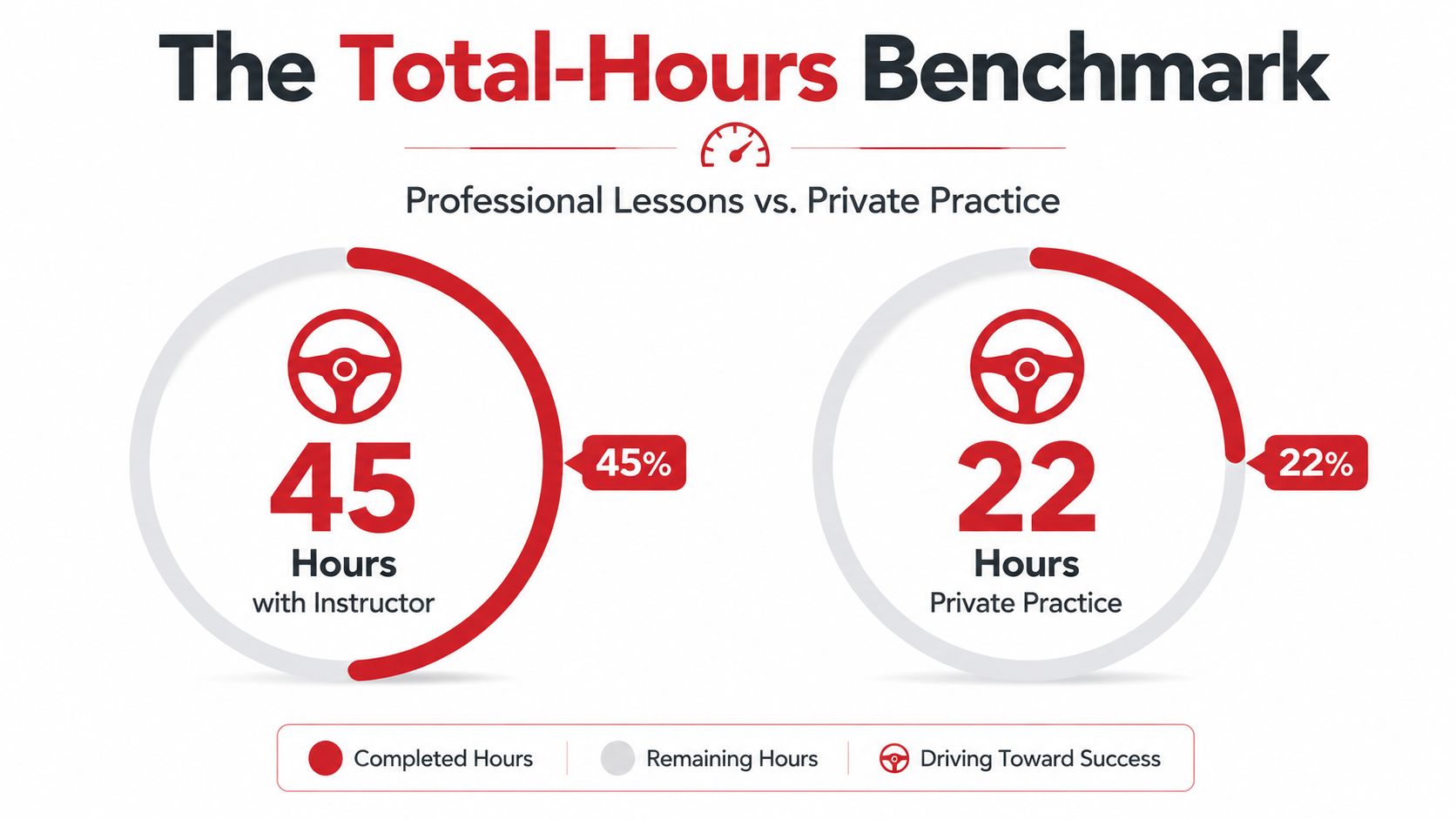
Another UK driver-training reference describes practical-test passers as averaging about 47 hours of professional instruction and roughly 20 to 22 hours of private practice, again placing combined preparation near 67 hours (independent driver-training guidance). The important lesson for Georgia students isn't to copy that exact mix. It's to recognize that supervised mileage and repeated decisions matter more than the number of appointments on your calendar.
What the benchmark does and doesn't mean
The benchmark describes a preparation pattern. It doesn't say every Georgia teen or adult must purchase that many instructor hours, and it doesn't replace an instructor's assessment of actual performance. Some guidance also notes that there's no minimum number of lessons required in certain licensing situations (driver lesson planning guidance).
Use the benchmark as a planning ceiling or reference point, then adjust the mix:
- With regular private practice, paid lessons can focus on correction, difficult traffic situations, and road-test preparation.
- Without private practice, professional lessons need to provide both instruction and repetition.
- With inconsistent performance, additional instructor feedback is more valuable than just driving the same familiar route.
- With strong prior experience, an assessment can identify which skills need refreshing before you commit to a larger package.
The practical mistake is treating “45 lessons” as the answer. The better answer is a total-hours target divided between instruction and supervised practice, then refined through demonstrated competence. For additional perspective on the time required to develop driving skills, review this guide to how long learning to drive can take.
Georgia Joshua's Law and the 30-and-6 Requirement
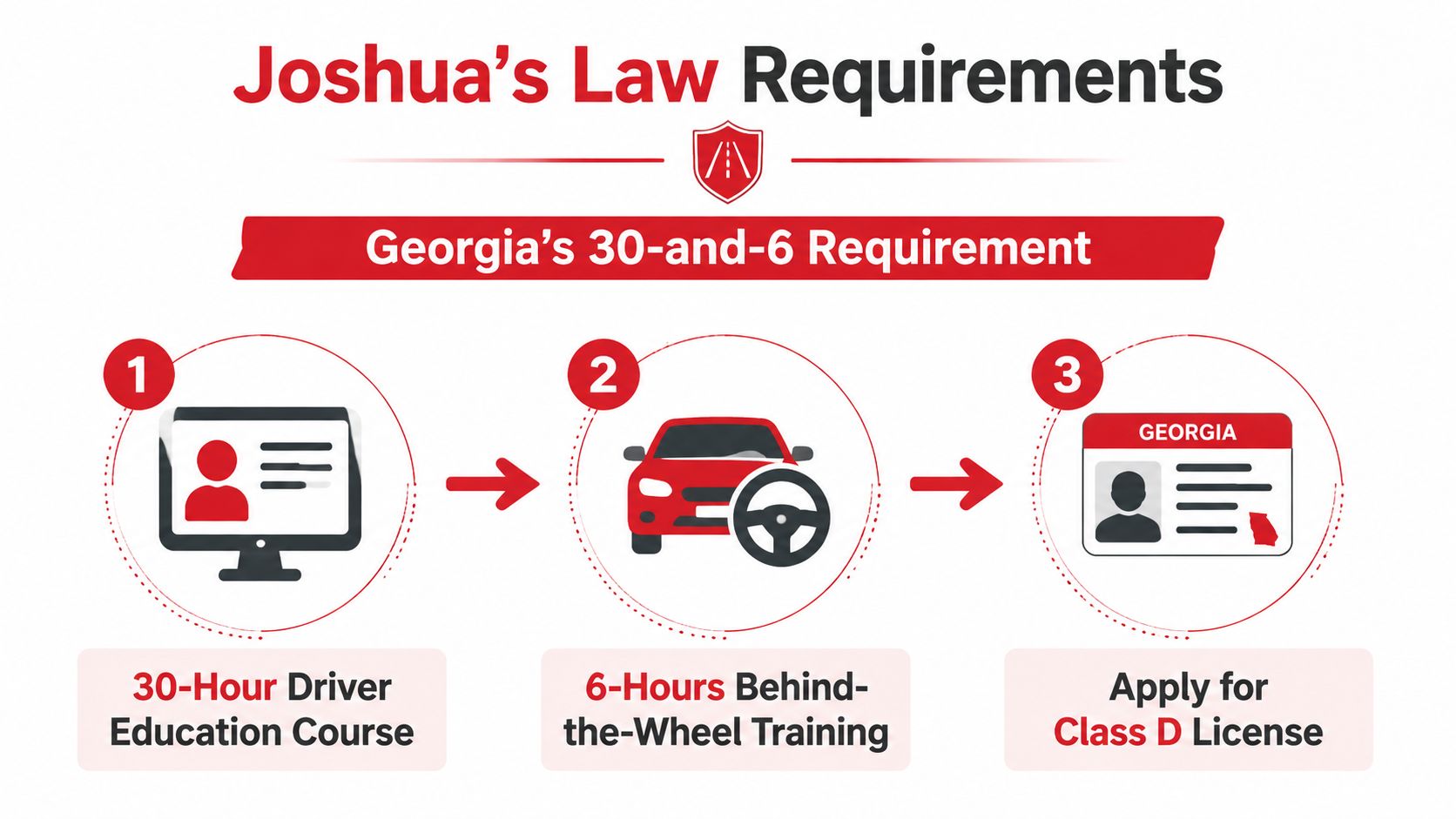
For Georgia teens pursuing a Class D license, Joshua's Law creates a specific education and supervised-driving pathway. The Georgia Department of Driver Services says teen applicants must complete a driver education course and 40 hours of supervised driving, including at least 6 hours at night (Georgia Joshua's Law requirements).
The approved driver education course can include either 30 hours of classroom instruction or 30 hours of online instruction. It must also include 6 hours of behind-the-wheel training at a certified school. That structure is commonly called 30 and 6.
How the requirement fits together
Think of the process as three connected responsibilities:
- Complete driver education. Choose an approved classroom or online course with the required instructional content.
- Complete certified behind-the-wheel training. Finish the required 6 hours with a certified instructor.
- Complete supervised driving. Log the required 40 hours, making sure the required night-driving portion is included.
The 6 hours of instructor-led training is a state requirement, not a promise that you'll be ready for the road test after exactly 6 hours. A new driver may understand the classroom material and complete the minimum behind-the-wheel requirement while still needing more practice with lane changes, parking, junction planning, mirror use, and hazard response.
That distinction matters for parents budgeting for lessons. Joshua's Law tells you what must be completed for the licensing pathway. Your instructor's assessment tells you whether the student can perform safely and consistently.
Online and in-person options
Georgia allows the education portion to be completed online or in a classroom, while behind-the-wheel coaching remains hands-on. An online course can help a teen manage school, sports, work, or family scheduling. An in-person course can give students a fixed learning routine and direct access to classroom instruction.
You can review available Georgia driver's education courses before choosing the format that fits your schedule. Then treat the 30-and-6 structure as the starting framework, not the final lesson recommendation.
A teen with frequent, well-supervised practice may need only targeted additional lessons after completing the requirement. A teen who rarely drives outside lessons may need a larger package to build reliable control. In both cases, the road test should follow demonstrated readiness, not just the completion of paperwork.
Recommended Lesson Packages for Teens and Adults
Teens and adults shouldn't automatically receive the same recommendation. A teenager who has completed Joshua's Law but has limited time behind the wheel starts from a different place than an adult who drove regularly in another country or is returning after a long break.
The state-required behind-the-wheel training establishes a foundation for eligible teens. After that, I'd recommend choosing additional lessons according to practice access and performance, not age alone.
Typical Georgia Lesson Packages
| Learner Type | Starting Point | Typical Lesson Range | Best For |
|---|---|---|---|
| Teen completing Joshua's Law | Begins with required certified training, then adds practice as needed | Start with the required 6 hours, then extend according to readiness | Students with a parent or guardian available for regular supervised practice |
| Teen with little private practice | Has completed education but needs more time in traffic | A larger package than the minimum may be appropriate | Students who rely mainly on professional instruction |
| Adult beginner | Starts without dependable driving habits | A structured beginner package, often in the 20 to 30-hour range offered by some schools | First-time drivers building control, observation, turns, parking, and traffic judgment |
| Adult with some experience | Understands basic vehicle operation but needs Georgia-specific preparation | An intermediate package, often in the 10 to 15-hour range offered by some schools | Drivers who can practice independently but need correction and test preparation |
| Returning or refresher driver | Has prior driving experience but needs skills rebuilt | A refresher package, sometimes 8 hours | Drivers returning after time away or preparing for a road test after a long gap |
The package ranges above reflect how A-1 Driving School frames beginner, intermediate, and refresher training by learner level, but they aren't a guarantee that every student will need the full range. Start with an honest evaluation. If the learner cannot maintain lane position, stop smoothly, or make safe observation checks, a short package is false economy.
A six-hour package is a starting point for some learners, not a universal finish line.
My recommendation by learner profile
For a teen who has completed the Joshua's Law requirement and practises consistently with a supervising adult, begin with the required training and add focused lessons when the instructor identifies weak areas. For a teen without reliable private practice, choose a package that provides enough repetition to cover residential roads, busier streets, intersections, lane changes, parking, and mock-test conditions.
For an adult beginner, choose progressive instruction rather than scattered one-off lessons. Adults often benefit from building control first, then traffic judgment, then test-specific manoeuvres. For an adult with previous experience, begin with an assessment or shorter refresher plan, but don't assume old habits match Georgia test expectations.
The best package is the one that leaves you able to drive without prompts. If the instructor is still reminding you to check mirrors, signal, scan intersections, or complete stops, you're not finished just because the package has ended.
How to Know When You Are Ready for the Road Test
You are ready for the road test when you can handle the vehicle independently, reliably, and under ordinary traffic pressure. Lesson totals matter less than repeatable performance.
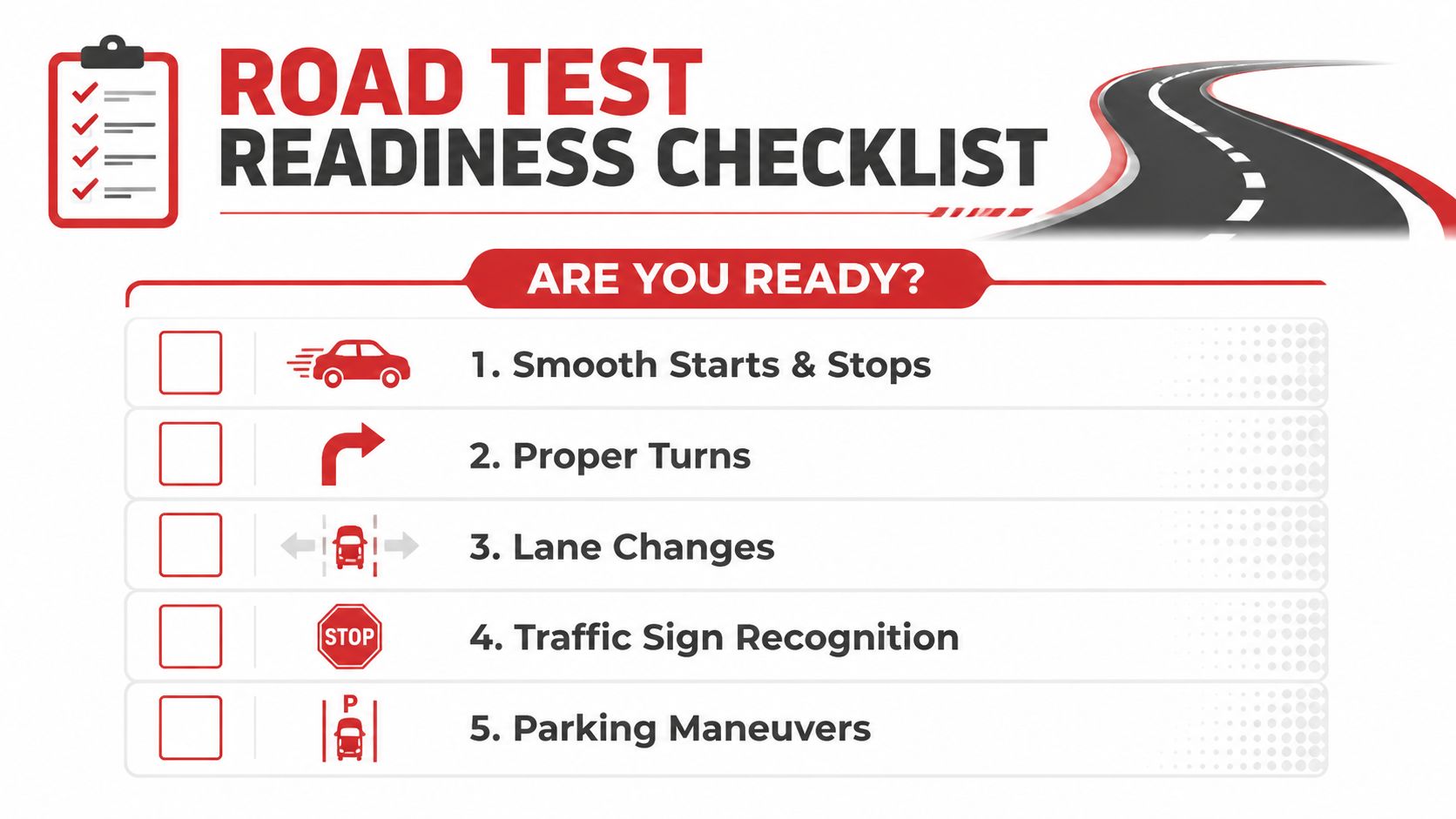
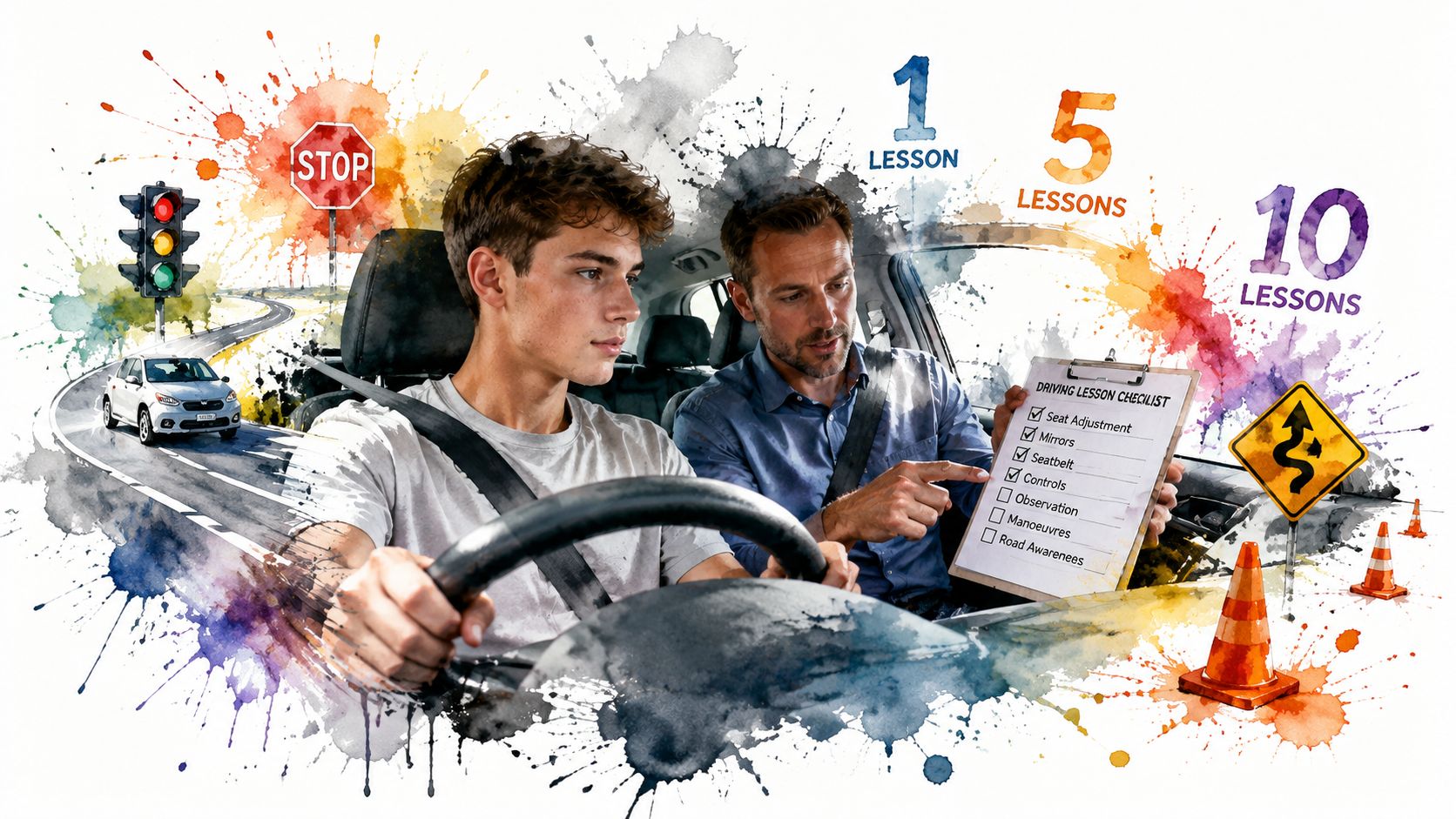
Use a performance checklist
Before booking the test, demonstrate these skills without repeated instructor prompts:
- Smooth starts and stops: Pull away under control and stop fully at the correct point.
- Proper turns: Choose the correct lane, signal in time, maintain control, and finish in the correct position.
- Safe lane changes: Check mirrors, signal, check the blind spot, and move only when the space is clear.
- Traffic-sign recognition: Respond correctly to stop signs, yield signs, speed limits, lane markings, and traffic signals.
- Parking manoeuvres: Reverse under control, position the vehicle accurately, and keep observing throughout.
Practise these skills in more than a quiet, familiar neighbourhood. A learner who drives comfortably on one route but freezes at a busy intersection needs more preparation. Rolling through stop signs, missing signals, skipping blind-spot checks, or losing speed control in heavier traffic are clear signs to schedule more targeted lessons.
Track repeated errors
Ask your instructor to record mistakes that appear across multiple sessions. One isolated error can happen to any learner. A recurring error shows that the habit still needs correction.
The linked report covers UK learner-driver practical-test results, not Georgia DDS testing, and reports a pass rate of about 48% for Spring 2024 (UK practical test pass-rate report). Do not use that figure to predict a Georgia result. Your own performance matters more than any general pass rate.
A certified instructor should assess observation, lane position, speed management, intersection handling, reversing, and emergency responses. A road test through a certified school can simplify logistics when the learner tests in a familiar school vehicle instead of arranging an unfamiliar personal car. Book only when the learner can complete the drive without prompts. Convenience can support the appointment, but demonstrated skill should make the decision.
Funding Your Lessons and Taking the Next Step
Georgia's Driver's Education Grant Scholarship Program can make the education and training pathway more accessible for qualifying teens. The program funds a driver education course consisting of 30 hours of classroom instruction and 6 hours of behind-the-wheel training (Georgia scholarship program rules).
Eligible recipients are Georgia residents ages 15 to 17 who are actively enrolled in school and hold a valid Georgia instructional driving permit or driver's license. Check the program rules and application process before booking so you can confirm eligibility and understand which training costs the grant covers.
A-1 Driving School provides classroom and online driver's education options, customized teen and adult lessons, and Georgia road-test services. Its scheduling network covers 18 or more metro Atlanta locations, giving families more options when school, work, and supervised practice don't fit neatly into one timetable.
The traditional 30-and-6 course format includes at least 30 hours of classroom instruction and 6 hours of behind-the-wheel training with a DDS-certified instructor, who coaches the student and observes driving performance (Georgia DDS driver education FAQs). After that foundation, the next step is simple: identify the learner's weak skills, select a lesson package that provides enough targeted practice, and schedule the road test only when performance is consistent.
If you're looking for scholarship-supported training, review the free driving lessons and grant information for Atlanta students and confirm the current eligibility requirements before enrolling.
A-1 Driving School offers Georgia driver's education courses, online Joshua's Law options, personalized teen and adult driving lesson packages, and road-test services. Visit A-1 Driving School to compare training options, check scholarship eligibility, and choose a package that matches your actual road-test readiness.