

You're sitting outside a Georgia DDS office with the mirrors adjusted, your hands positioned on the wheel, and your appointment only minutes away. Then the examiner approaches, and a simple question starts looping in your mind: Are they watching my speed, my mirrors, or the way I stop?
That nervousness usually comes from treating the road test like a mystery. It's more manageable when you see it as a specific checklist of observable driving decisions. Effective road test lessons don't fill time with aimless cruising. They identify the gaps that can cost you the test, then build reliable habits through focused practice, feedback, and mock testing.
What the Georgia Road Test Really Measures
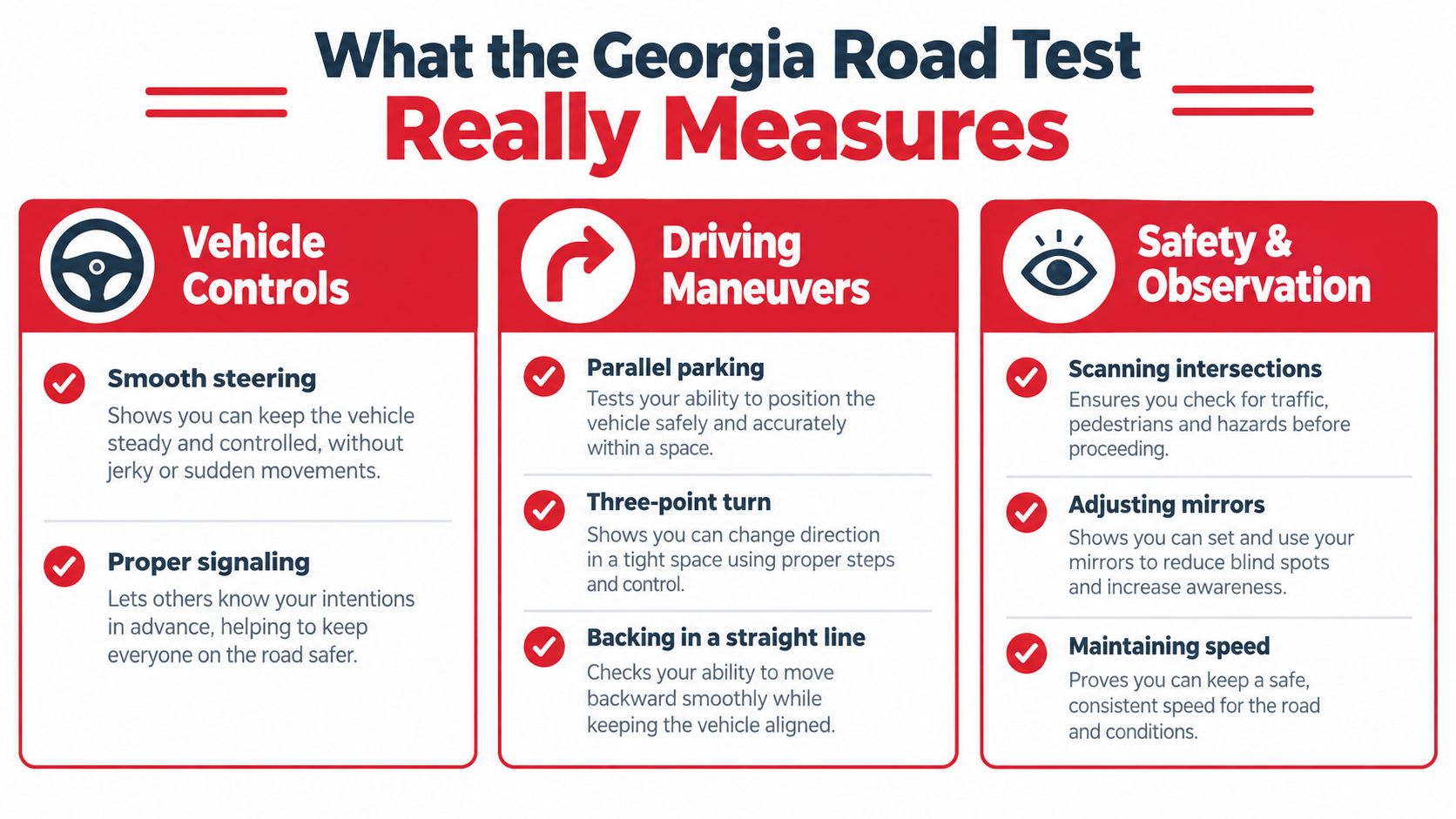
The Georgia Class C road test begins before the vehicle moves. The examiner checks basic equipment such as turn signals, brake lights, the horn, and seat belts. If you arrive unfamiliar with the car's controls, the first few minutes can create unnecessary stress, so a professional lesson should include a deliberate vehicle inspection routine.
Vehicle control and basic maneuvers
The maneuver portion evaluates fundamental control. Depending on the test format and location, you should be prepared to demonstrate backing, controlled turns, lane changes, and parking on a hill. The examiner isn't looking for dramatic technique. They're looking for smooth steering, appropriate speed, proper signaling, and the ability to keep the vehicle under control.
The on-road portion moves those skills into traffic. Examiners observe how you handle intersections, right-of-way decisions, residential speed limits, multi-lane roads, traffic signals, and lane positioning near parked vehicles or cyclists. A driver who handles the wheel well but misses a pedestrian or fails to yield still has a serious safety problem.
The pass or fail threshold
The examiner scores individual maneuvers and safety behaviors rather than assigning a vague overall impression. Automatic disqualifications can include hitting a cone, running a stop sign, or refusing to wear a safety belt. That's why a targeted lesson should connect every drill to a test behavior, not just expose you to more driving time.
Practical rule: Treat every test item as a behavior you can rehearse. The road test isn't a personality test. It's a checklist executed in traffic.
That perspective changes preparation. Instead of asking whether you “feel ready,” ask whether you can consistently scan intersections, control your speed, signal correctly, position the vehicle, and complete each maneuver without prompting.
How a Road Test Lesson Plan Builds Confidence
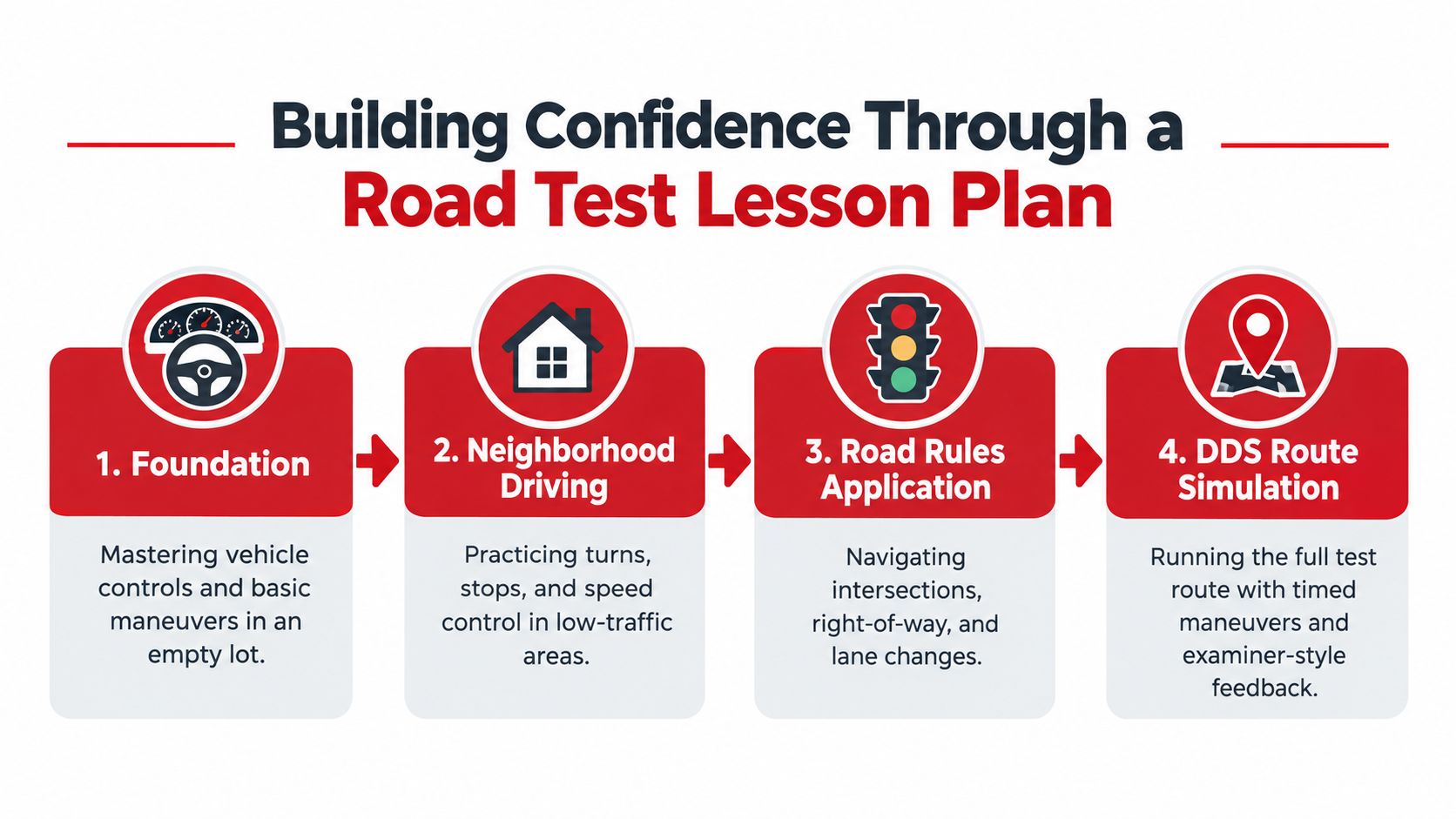
Confidence doesn't come from repeating the same easy drive. It develops when an instructor increases difficulty only after the previous skill has become dependable.
Start with the vehicle
The first layer is cockpit setup. Adjust the seat so you can operate the pedals without stretching, position the mirrors to reduce blind areas, and establish a comfortable posture. An instructor can also correct hand placement and steering technique early, before awkward movements become habits.
Empty parking lots provide a low-pressure setting for foundational repetition. Reverse parking, three-point turns, controlled stops, and straight-line backing belong here. The point isn't to hide from traffic. It's to separate vehicle control from traffic judgment so you can build both without becoming overloaded.
Add traffic decisions gradually
Residential streets introduce stop signs, school zones, pedestrians, rolling terrain, and changing speed expectations. Once those decisions become consistent, training can move to multi-lane roads, traffic signals, lane changes, merging, and highway entrances. Each step adds one layer of pressure while preserving the skills already learned.
A fixed number of hours can feel wasted when every session follows the same comfortable route. The same amount of time can feel transformative when each drive has a clear purpose and the instructor records the next correction.
Finish with a realistic simulation
A mock road test should look and feel different from an ordinary lesson. The instructor gives limited prompts, follows realistic route patterns, observes without rescuing every mistake, and scores the drive against the same categories the DDS examiner evaluates. The debrief then narrows preparation to the two or three drills that matter most before the appointment.
A student who repeatedly misses mirror checks needs a different plan from one who controls the car well but hesitates at intersections. Road test lessons work when the sequence responds to that distinction.
What Instructors Actually Drill During Lessons
The most useful drills target decisions that happen before the vehicle moves. Steering matters, but examiners also need to see that you're observing, predicting, and choosing a safe response.
Observation before action
Approach intersections by scanning early for signs, pedestrians, cyclists, vehicles, and changing traffic conditions. Before changing lanes or merging, check the relevant mirror, signal, and blind spot. On faster roads, keep returning your attention to the mirrors rather than staring straight ahead.
An instructor might use short coaching cues:
- “Scan before you slow.” Look for hazards before arriving at the intersection, rather than braking only after the situation becomes obvious.
- “Mirror, signal, shoulder.” Build a repeatable sequence before moving laterally.
- “See the gap, then commit.” Avoid both unsafe rushing and unnecessary hesitation.
Lane placement and speed
Stay centered in marked lanes, maintain a predictable position near cyclists, and correct drift early during long curves. Speed control also requires active attention. Driving too fast in a school zone is unsafe, but crawling well below the expected flow can show that you're not reading the road confidently.
Good instructors make these skills physical and repeatable. They may ask you to say “one-thousand-one, one-thousand-two” at a stop sign before moving, signal at least 100 feet before every turn, or hold a full steering input for two seconds before pulling out of a parallel parking position. Those cues aren't magic formulas. They create visible habits that an examiner can recognize.
For additional maneuver-specific practice, review how to improve parking skills. The useful question isn't whether you can park once. It's whether you can park while maintaining observation, control, and calm decision-making.
On-Road Practice Tips Between Lessons
Paid instruction gives you correction. Supervised practice gives you repetition. The strongest preparation uses both, with each drive assigned a specific objective instead of becoming another unstructured trip around familiar streets.
Give each drive one target
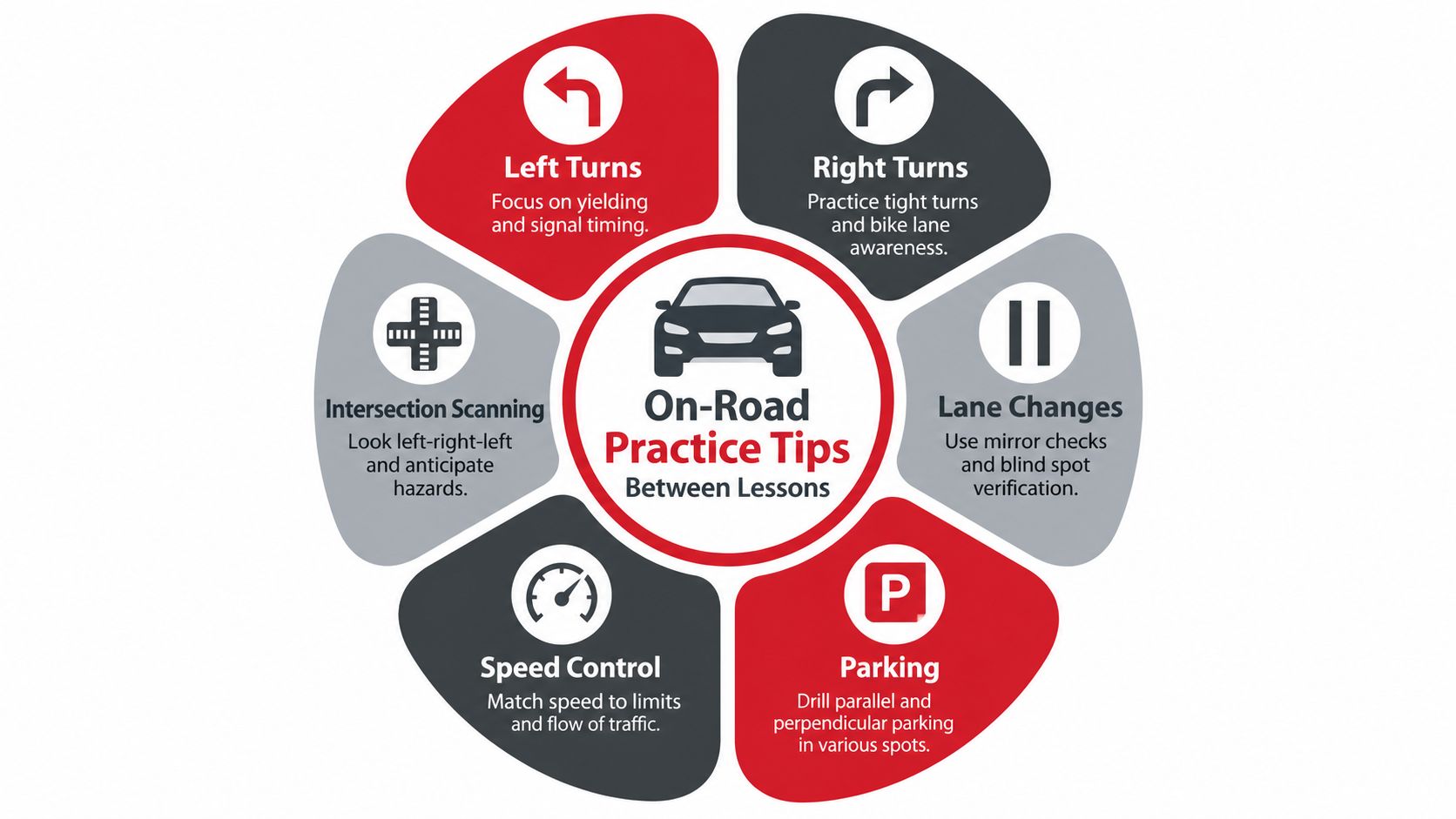
Choose one skill from the DDS checklist and keep it central for the drive:
- Left turns: Focus on yielding, selecting a safe gap, and keeping the turn controlled.
- Highway merging: Practice mirror use, blind-spot checks, acceleration, and lane placement.
- Three-point turns: Repeat the sequence without rushing the steering or backing movement.
- Parking: Use real curb lines and varied spaces rather than relying only on empty-lot markers.
You can still encounter other situations, but one priority keeps the practice measurable. Rotate targets only after you've had enough repetitions to identify a pattern.
Vary conditions and record results
Practice at different times of day so you encounter glare, heavier traffic, school zones, and changing visibility. Ask the supervising driver to observe without commentary for a portion of the trip, then discuss what happened afterward. Too many live corrections can make you dependent on prompts.
After every drive, write three notes:
- One strength, such as consistent mirror checks.
- One repeated error, such as drifting wide on right turns.
- One adjustment, such as slowing earlier before the turn.
Bring that record to your next lesson. It lets the instructor troubleshoot a specific behavior instead of spending the session discovering the problem from scratch. A driving practice log can help organize that process.
Practice should expose weaknesses, not just accumulate miles. If every drive feels easy, choose a busier route, add a new maneuver, or ask an instructor to evaluate whether the practice is reinforcing the correct technique.
Common Road Test Mistakes and How Lessons Prevent Them
Many learners assume a few parking repetitions will carry them through the exam. That assumption misses where lessons often produce the greatest value: stopping errors, observation failures, lane-position problems, and poor judgment under pressure.
| Common Mistake | Lesson Drill That Fixes It |
|---|---|
| Rolling through a stop sign | Make a complete stop behind the limit line, pause, scan, and move only when the path is clear. |
| Drifting wide on a right turn | Use lane references and cone drills to connect steering input with the intended path. |
| Cutting a left turn | Approach with correct lane position, identify the receiving lane, and finish the turn without crossing lane markings. |
| Changing lanes without observation | Use commentary driving, naming the mirror check, signal, shoulder check, and movement in sequence. |
| Exceeding the expected speed | Scan the speedometer regularly and adjust before entering a school zone or residential area. |
| Hesitating at an unprotected left turn | Practice gap selection in realistic traffic and distinguish a safe wait from an unnecessary delay. |
A complete stop deserves special attention because quiet roads tempt drivers to relax. Instructors often build a physical routine around it: release the brake gradually, feel the vehicle settle, confirm the stop, then scan before proceeding. The lesson isn't about performing a theatrical pause. It's about making the vehicle's position and your observation unmistakable.
The examiner can't credit a safety check you only performed mentally. Make the observation visible through head movement, timing, and controlled action.
Commentary driving also reveals where the sequence breaks down. If you can't explain which mirror you checked or why you waited, the instructor has a precise issue to address. Once the process becomes automatic, you can reduce the narration while keeping the behavior.
A-1 Road Test Prep, Packages, and Joshua's Law Options
Road test preparation works better as a connected plan than as a random stack of individual appointments. A package can combine behind-the-wheel instruction, a timed mock test, route-style practice, and a debrief that identifies what still needs attention before the official exam.
For students completing Georgia's Joshua's Law pathway, the compliance requirements are specific. Georgia DDS states that 16- and 17-year-olds seeking a Class D provisional license must complete an approved driver education route that includes 30 hours of classroom or online instruction, 6 hours with a certified instructor or an approved parent-taught equivalent, and 40 hours of supervised driving, including 6 nighttime hours. These requirements are listed by the Georgia Department of Driver Services, and the DDS driver manual describes the same classroom, instructor, and supervised-practice structure for Georgia applicants.
Online education and behind-the-wheel preparation
An online Joshua's Law course can handle the classroom component from home, while instructor-led lessons focus on vehicle control and road decisions. That separation is useful for families balancing school, work, and transportation. A-1's online driver's education and behind-the-wheel packages connect those parts so families can plan classroom completion and driving practice together.
Eligible students may also investigate Georgia's Driver's Education Scholarship Grant Program. The program is limited to Georgia residents who are actively enrolled in school, are ages 15 through 17, and hold a valid Georgia instructional permit or driver's license, according to the Georgia administrative rule. Confirm current eligibility and application details before booking.
A-1 Driving School offers road test preparation, behind-the-wheel lessons, and package options through its Georgia locations. Families comparing providers can also review driving school TV ads to understand how schools present their programs, but the deciding factor should be the actual lesson structure, instructor continuity, mock-test process, and scheduling fit.
Road Test Lesson Questions Georgia Drivers Ask
How many lessons should I book?
There isn't a universal hour count for Georgia drivers. Start with an evaluation if you're unsure, then book enough targeted road test lessons to demonstrate consistent control, observation, lane positioning, speed management, and maneuver performance. Beginners who receive regular supervised practice may need a different plan from adults returning to driving or learners who already perform the basics reliably.
How far apart should lessons be?
Spread sessions closely enough that skills don't fade between appointments. If you can practice with a qualified supervising driver, use the days between lessons to repeat the instructor's assigned drills. Without access to a practice vehicle, schedule lessons with enough frequency to build repetition during paid instruction.
Can lessons fit around school or work?
Ask about early, evening, and weekend availability when you book. Georgia DDS requirements for teen education and supervised driving still need to be completed, so map classroom, instructor time, parent practice, and the test appointment before choosing a target date.
What should I bring?
Bring your learner's permit or required identification, prescription glasses or contacts if you drive with them, comfortable closed-toe shoes, and your practice log. Arrive ready to discuss the last error you're working to correct.
When should I request a mock test?
Schedule it after you've practiced the main maneuvers and driven in real traffic, not as your first lesson. A same-day mock test can be useful when you already drive consistently and need a final readiness check, but it can't replace foundational instruction.
What happens after an unsuccessful attempt?
Record the examiner's feedback while it's fresh. Book a focused correction lesson around the exact fault, repeat the relevant route conditions, and schedule another mock test only after the underlying behavior has changed.
A-1 Driving School provides Georgia driver's education, Joshua's Law online course options, behind-the-wheel instruction, road test preparation, and lesson packages that connect targeted practice with mock-test feedback. Visit A-1 Driving School to review available courses, locations, and road test lesson options, then choose a plan based on the skills you still need to prove.