
A Saturday morning at a Georgia Department of Driver Services counter can feel more complicated than expected. Your teenager has a learner's permit, you've brought a folder of documents, and someone is still checking whether the next step is a class, more practice, or a road test. The confusion usually comes from treating the process as one requirement instead of a sequence of checkpoints.
Georgia's teen licensing path combines eligibility, driver education, supervised driving, permit tenure, ADAP or eADAP, school documentation, testing, and final license issuance. This guide translates the GA license requirements into a practical route for teens and parents, with special attention to Joshua's Law choices, online course options, driving lessons, lesson packages, the road test, and the state scholarship program.
What Georgia Drivers Need to Know Before the First Drive
A teenager may arrive at DDS expecting to complete one final form and leave with a license. Instead, the clerk may ask for proof that the teen completed driver education, held the permit long enough, finished supervised practice, completed ADAP or eADAP, and meets the school-status requirements. Georgia's official Class D license guidance makes clear that these pieces work together.
The Class D license is Georgia's provisional, non-commercial license for qualifying teen drivers. It commonly applies to first-time teen drivers, certain younger out-of-state transfers, and some license-reinstatement situations. The exact route depends on the applicant's age and record, so families should confirm their individual status with DDS rather than relying on a friend's timeline.
The checkpoints families should expect
Think of the process as a sequence rather than a single appointment:
- Eligibility: The teen must meet Georgia's age and licensing conditions.
- Permit: The learner's permit must be valid and held for the required period.
- Education: The teen must complete the applicable Joshua's Law or driver-education pathway.
- Practice: The household must complete supervised driving, including nighttime practice.
- Compliance: ADAP or eADAP, school enrollment proof, signatures, and other records must be ready.
- Testing: The teen must complete the required knowledge, vision, and road testing.
- Issuance: DDS can issue the Class D license only after the full file is complete.
Practical rule: A completed driver-education course doesn't erase the permit waiting period, and turning 16 doesn't automatically make a teen eligible to test.
Georgia requires a 16- or 17-year-old to hold a valid learner's permit for at least 1 year and 1 day before applying for a Class D provisional license. The state also specifies 30 hours of classroom or equivalent online instruction, 6 hours of behind-the-wheel training or an approved parent and teen guide option, and 40 hours of supervised driving with at least 6 hours at night. Families who plan around the full sequence avoid the common mistake of booking a test before the permit has matured.
Joshua's Law and the Four Ways to Complete It
Joshua's Law is Georgia's teen driver-education requirement for qualifying applicants under 18 who seek a Class D license. In plain language, the rule connects formal education with supervised practice. The official Joshua's Law requirements identify the core benchmark as 30 hours of driver education plus 40 hours of supervised driving, including 6 hours at night.
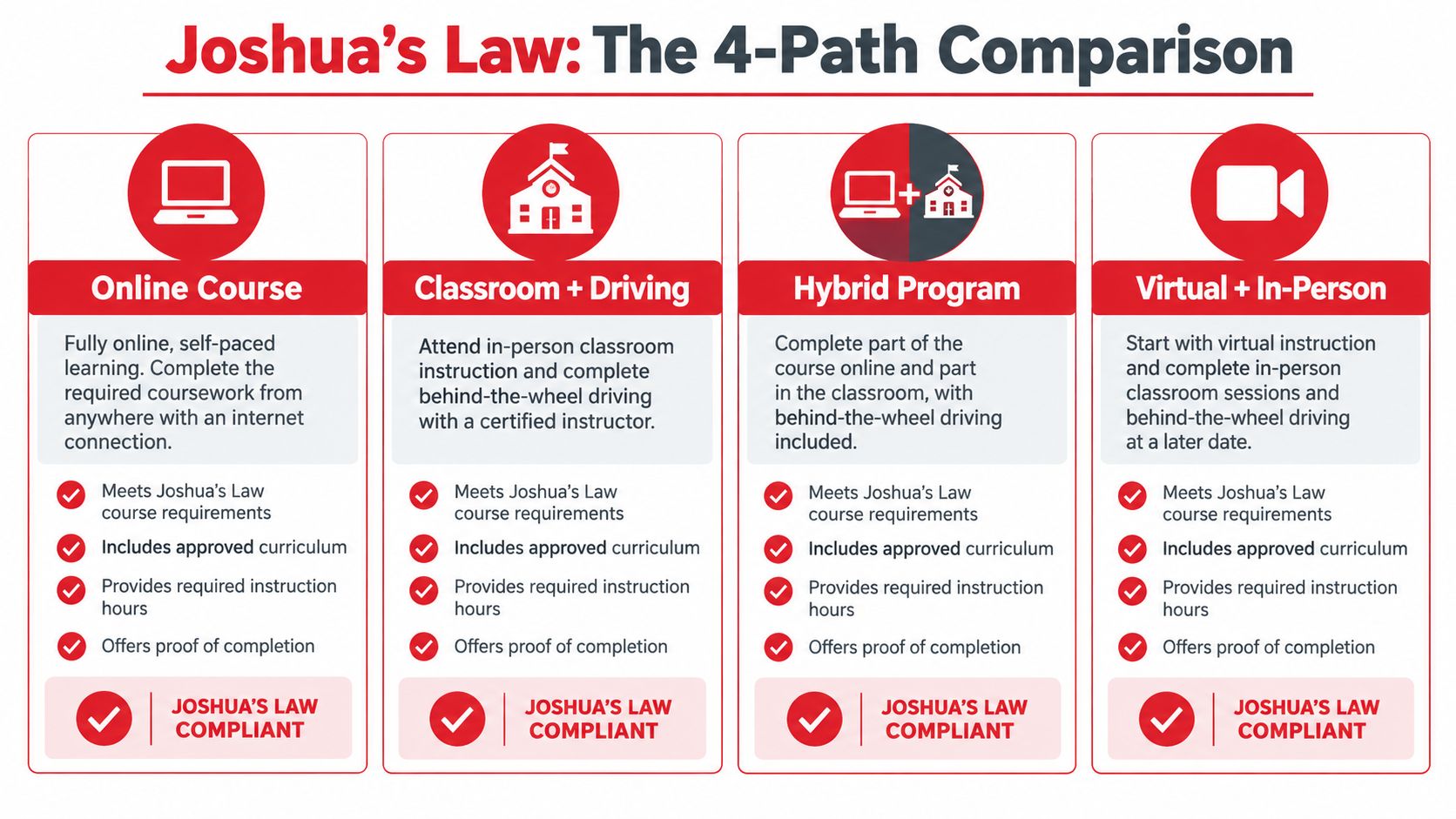
Families often hear “30-6-40” and assume every teen must complete the same package in the same way. Georgia allows multiple completion combinations. The classroom portion can be completed through a certified school or online instruction, while behind-the-wheel training can be completed with an approved instructor or through the parent and teen guide option.
The four compliance paths in practical terms
The standard 30-6-40 path combines 30 hours of classroom or equivalent online education, 6 hours of instructor-led behind-the-wheel training, and 40 hours of supervised driving at home, including the required nighttime practice. This is often the clearest route for families who want a professional instructor to establish basic vehicle control before parents take over practice.
The classroom plus parent-taught driving path uses the formal education requirement and the approved parent or teen guide for behind-the-wheel instruction. The household still has to complete and document the supervised practice requirement. This route can fit families with a qualified adult who has enough time, patience, and access to a suitable vehicle.
The online classroom path replaces in-person classroom attendance with approved online instruction. It doesn't eliminate the driving requirements. A teen still needs the applicable behind-the-wheel instruction or approved parent-taught option and the supervised practice record.
The parent and teen guide combination places more responsibility on the household for both the educational and practical parts, where permitted by the state's listed completion options. Parents should verify that the selected course and guide produce the documentation DDS accepts, rather than assuming any informal practice arrangement qualifies.
The fastest route depends on circumstances, not just course length. A self-directed student may prefer online instruction, while a teen who needs accountability may learn better in a classroom or live virtual setting. Working parents should compare instructor availability, evening practice time, vehicle access, and who will maintain the driving log. Military-enlisted 17-year-olds may qualify for an exception to the permit period, so those applicants should check the current DDS guidance directly.
For a plain-language review of course and compliance choices, families can compare the Georgia Joshua's Law course requirements before enrolling.
Permit Tenure, Age Rules, and Required Documents
The learner's permit is the starting point, not the finish line. A teen generally begins the process by visiting DDS with a parent, legal guardian, or qualifying responsible adult, completing the required application steps, and passing the official knowledge examination. Once issued, the permit creates the timeline for supervised driving and the later Class D application.
The date on the permit matters. Georgia requires the teen to hold a valid learner's permit for 1 year and 1 day before applying for the Class D provisional license, as stated on the Georgia DDS introduction to licensing. A teen who receives a permit on a birthday may still need to wait beyond the corresponding date the following year because the rule includes one additional day.
Build the document folder before test day
Families frequently focus on lessons and forget the paperwork. Prepare the documents DDS requests, including:
- Identity record: Bring an original birth certificate, not a photocopy.
- Social Security record: Bring the Social Security card or accepted documentation.
- Georgia residency: Prepare two proofs of Georgia residency in the parent or guardian's name.
- Adult authorization: Complete the signed DDS Parent or Guardian Affidavit.
- School status: Keep proof of school enrollment available for the licensing file.
- Driver records: Confirm the permit, ADAP or eADAP completion, and supervised-practice documentation are ready.
The permit period also comes with operating restrictions. The supervising adult and passenger rules, curfew provisions for Class D permit holders, and cell phone restrictions apply while the permit is active. Parents should read the current permit conditions with the teen and treat them as operating rules, not suggestions.
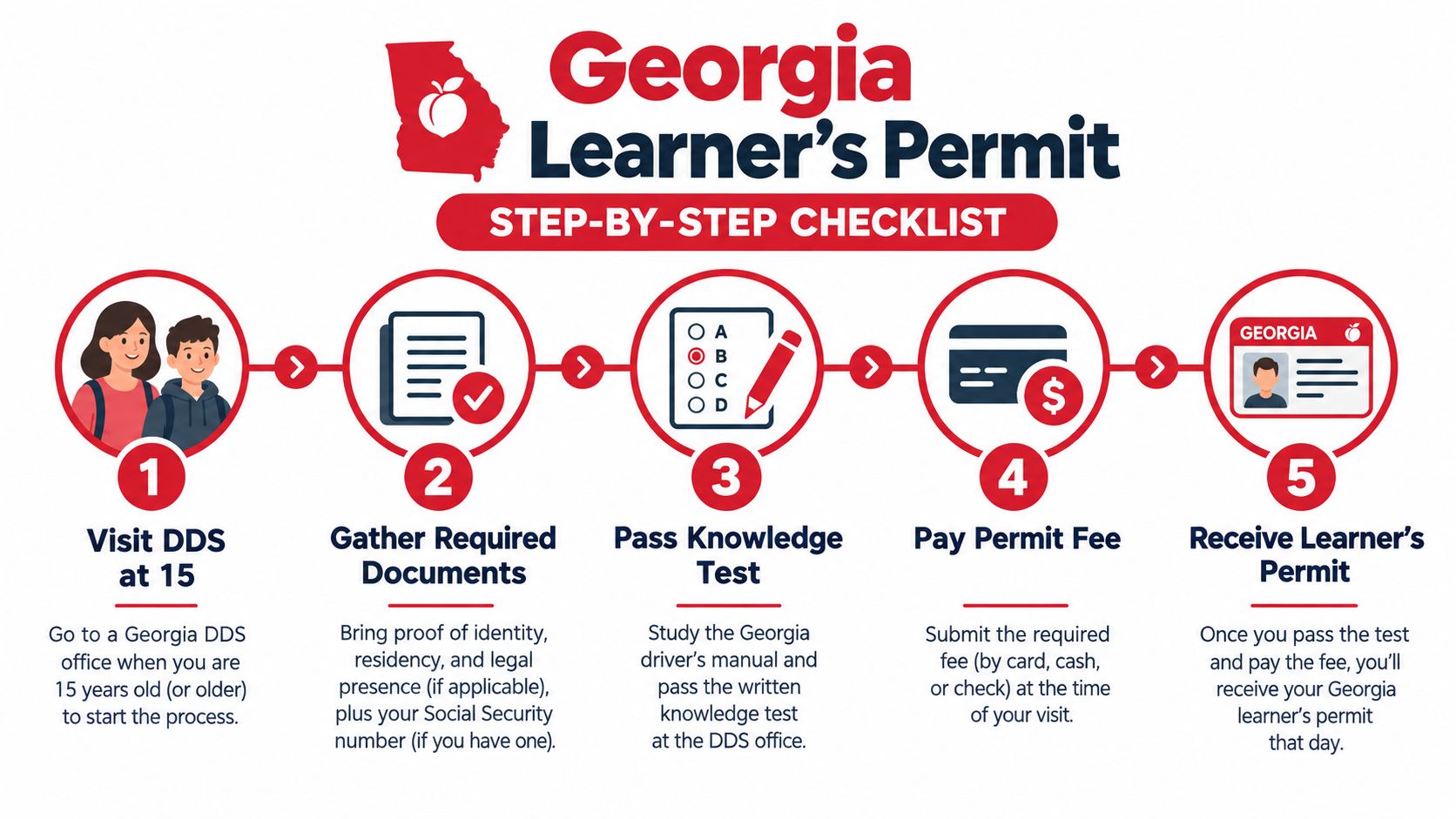
Print this short checklist and keep it with the driving log:
- Confirm the permit issue date.
- Mark the date when 1 year and 1 day has passed.
- Record supervised driving and nighttime practice.
- Complete driver education and ADAP or eADAP.
- Gather identity, residency, school, and affidavit documents.
- Schedule testing only after every checkpoint is satisfied.
A detailed review of the Georgia driver's permit requirements can help parents check the early paperwork before the first DDS visit.
Choosing Between Online, Virtual, and Classroom Driver's Ed
The right driver's education format depends on how the teen learns and how the household manages time. Georgia recognizes classroom or equivalent online instruction for the required education component, so the practical question is whether the format helps the student complete the material carefully and retain it.
| Format | Schedule | Instructor Access | Best For |
|---|---|---|---|
| Classroom | Set sessions at a physical location | Direct, in-person questions and feedback | Students who need routine and a fixed learning environment |
| Live virtual | Scheduled online sessions with a teacher | Real-time interaction through a virtual classroom | Teens balancing sports, band, advanced classes, or commuting |
| Fully online | Self-paced access | Digital instruction with less live structure | Self-starters and families without a convenient nearby provider |
Classroom instruction
In-person classes give students a predictable schedule and immediate access to an instructor. That structure can help a teen who procrastinates or who learns better by asking questions aloud. The tradeoff is less flexibility when school activities, work, or transportation conflict with class times.
Live virtual instruction
A live virtual course keeps the scheduled accountability of a classroom while removing the commute. Teens can participate from home and ask questions in real time. Parents should still confirm attendance rules, completion records, and how the provider connects the classroom certificate with behind-the-wheel training.
Fully online instruction
Self-paced online education can work well for organized students. It lets the teen study around family obligations and school commitments, but flexibility requires discipline. Online instruction replaces the classroom portion, not the supervised driving obligation, nighttime practice, or the permit-tenure requirement.
All three formats should be judged by the full plan. Ask who will deliver the driving lessons, how the provider documents completion, whether parents can practice between sessions, and whether the teen needs additional road-test preparation. The course format is only one checkpoint in the larger licensing sequence.
Road Test Requirements and How to Skip the DDS
Road-test day can fail before the car leaves the parking space if the vehicle or documents aren't acceptable. Georgia DDS states that the test uses a four-wheel vehicle, and the applicant must provide it. The vehicle needs valid registration or an acceptable temporary dealership tag with proof of purchase under the conditions described in the official DDS road-test rules.
The applicant must also hold a valid Georgia non-commercial learner's permit and pass the driver's license knowledge examination before taking the road test. Families should bring the current permit, certified birth certificate, Social Security card, proof of school enrollment, and the parent-signed affidavit documenting supervised practice, including nighttime driving.
Check the vehicle before leaving home
Use this inspection list:
- Registration: Confirm the plate or temporary-tag paperwork is valid.
- Insurance: Carry current insurance documentation.
- Lights and signals: Test headlights, brake lights, turn signals, and hazard lights.
- Brakes: Confirm the braking system works properly on both sides where applicable.
- Mirrors: A two-door test vehicle needs a functional passenger-side mirror.
- Interior: Remove loose items and make sure the examiner can enter and work safely.
The examiner evaluates ordinary driving decisions, not theatrical maneuvers. Expect attention to turns, lane changes, backing, mirror use, positioning, speed control, and communication with other road users. A teen who only practices on empty residential streets may need more experience with traffic, larger intersections, and changing road conditions.
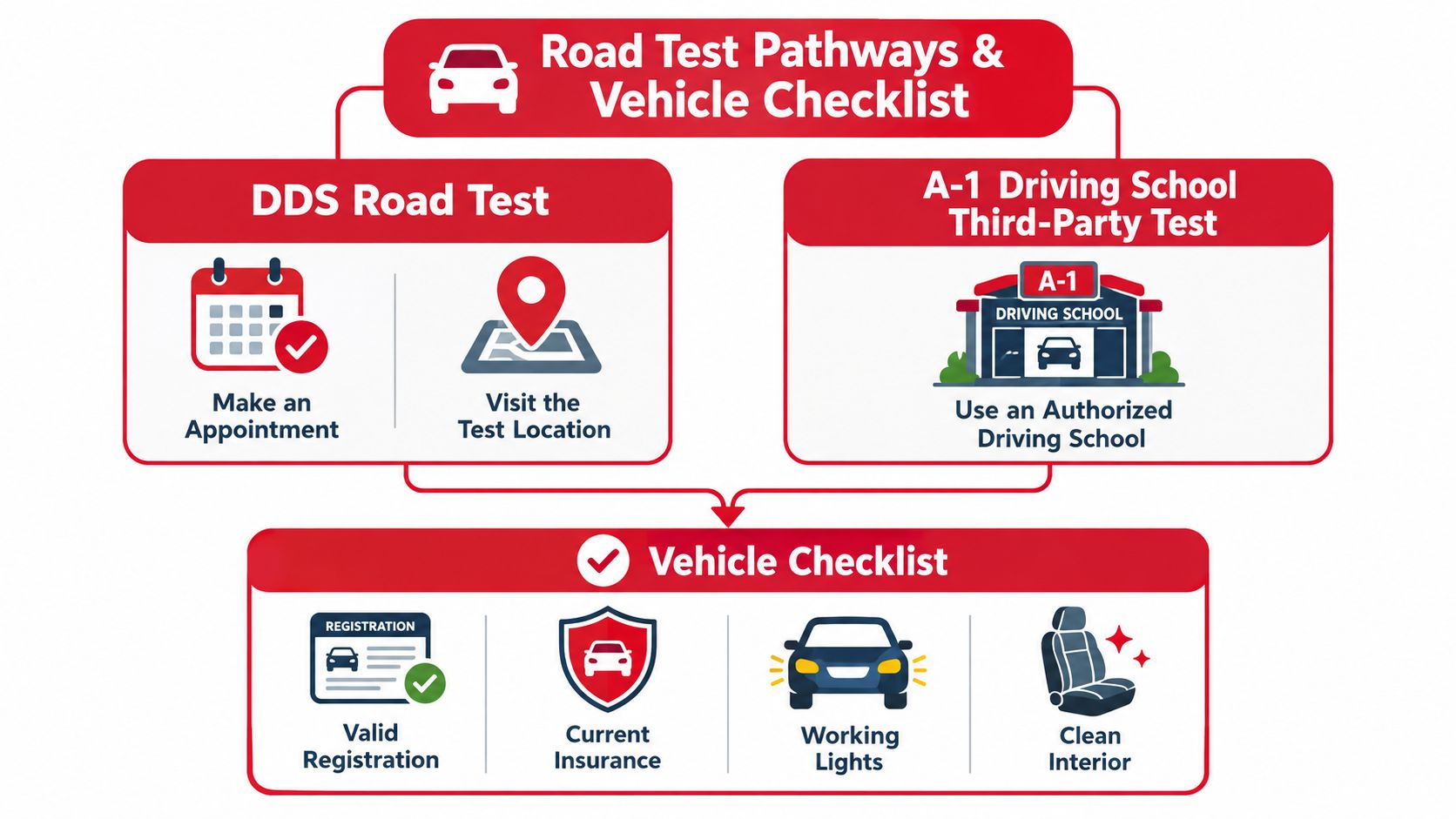
Some families choose a DDS-authorized third-party testing site instead of waiting for a DDS appointment. A-1 Driving School offers a same-day road test option for eligible applicants, subject to its scheduling and documentation rules. The state licensing outcome still depends on satisfying Georgia's requirements and completing the issuance process.
A short visual guide can help teens rehearse the vehicle inspection and appointment path before test day.
Driving Lessons and Lesson Packages That Build Real Skill
Driver education explains the rules. Professional driving lessons turn those rules into repeatable habits, especially when a teen needs more than informal practice with a parent. A structured instructor can identify late braking, poor mirror checks, weak lane positioning, or hesitation at intersections before those habits appear during the road test.
A useful lesson sequence begins with vehicle controls, steering, braking, starting, stopping, and parking. Later practice can move to residential and arterial roads, then to highways, complex intersections, backing, and parallel parking. The instructor should adjust the pace to the student rather than rushing through a fixed script.
Match the package to the household
The standard 6-hour Joshua's Law package can suit a family focused on completing the instructor-led training component while using parent-supervised driving for continued practice. A longer package may be more realistic for a teen who has limited access to a licensed parent, feels anxious behind the wheel, or needs a stronger bridge between the permit and the road test.
A household might compare:
- 6-hour package: Focused behind-the-wheel training connected to the Joshua's Law requirement.
- 10-hour package: More time to reinforce control, traffic judgment, and test routines.
- 20-hour package: A broader option for students who need repeated exposure to varied roads.
- 30-hour package: An intensive path for beginners or teens who need substantial instructor-guided practice.
The right choice depends on the teen's starting skill, home practice opportunities, and test readiness. Pickup and drop-off can simplify scheduling, while dual-control vehicles give instructors an additional safety tool during instruction. Families should ask how completion certificates are issued and how the provider records the training.
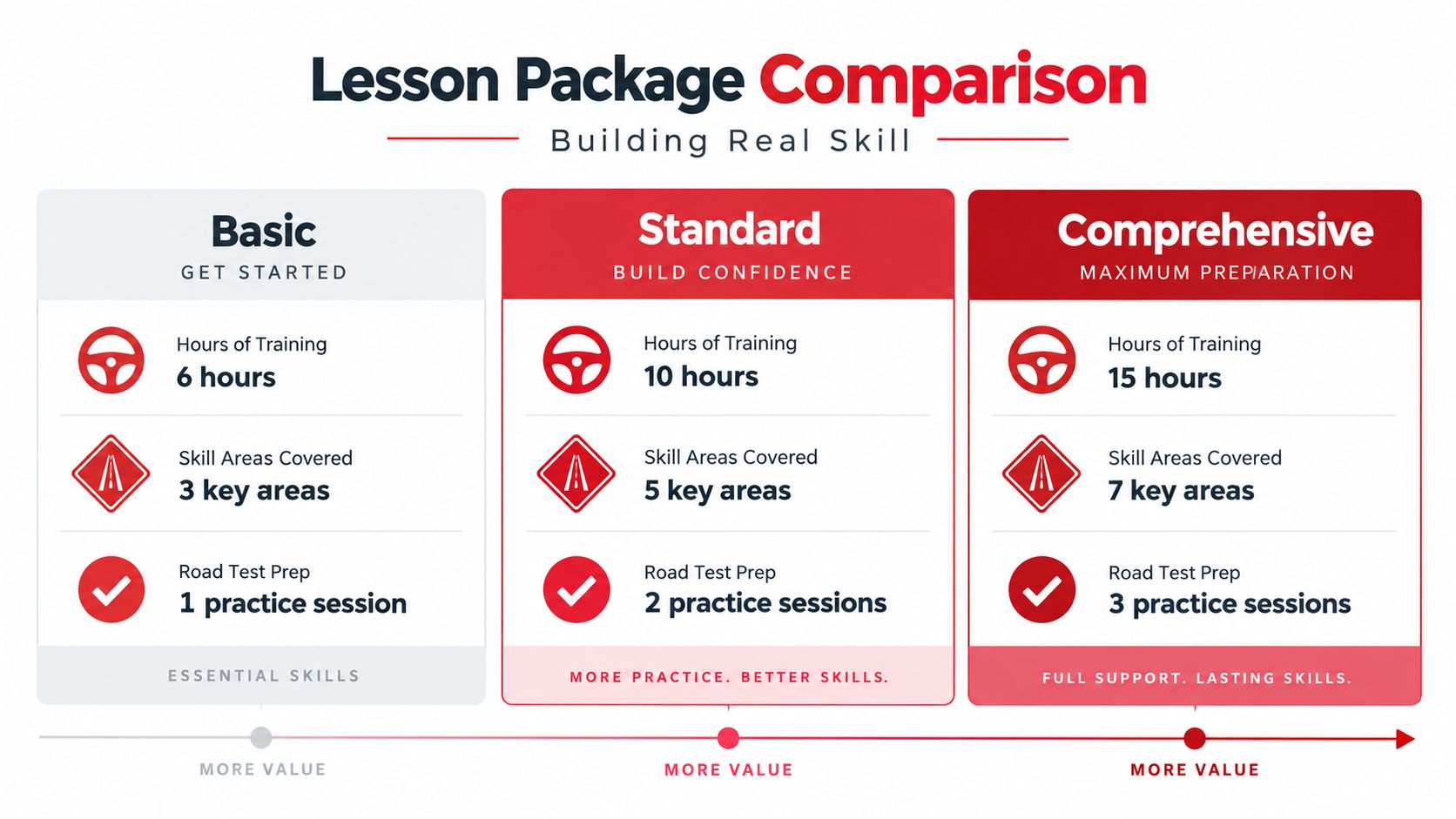
A-1 Driving School provides instructor-led lessons and packages that connect classroom education, behind-the-wheel practice, and road-test preparation. Its course and lesson scheduling can be reviewed alongside the family's supervised-practice plan, so the teen isn't treating the certificate as a substitute for real driving experience.
The Georgia Driver's Education Grant Scholarship Program
The Georgia Driver's Education Grant Scholarship Program helps eligible students pay for approved Joshua's Law instruction. Georgia administrative rules define eligibility around residency, active school enrollment, age 15 through 17, and possession of a valid Georgia instructional permit or driver's license. Georgia budget materials state that a scholarship can be up to $500, paid directly to the approved course provider after completion. See the Georgia administrative rule for the scholarship program.
The scholarship is designed to cover 30 hours of classroom instruction and 6 hours of behind-the-wheel instruction with an approved instructor. It doesn't automatically pay for every driving lesson a teen may want, and families should confirm what remains due for additional practice, road-test preparation, or other services.
A practical way to approach the benefit
Start by confirming that the student is actively enrolled in school, meets the age range, lives in Georgia, and has the required permit or license. Next, select an approved provider and ask how the scholarship is applied, what documentation the family must submit, and whether the provider handles the payment process after completion.
The grant can reduce a major barrier for families who otherwise might postpone formal instruction. It should still be treated as one part of the plan. The teen must complete the applicable permit, supervised-practice, ADAP or eADAP, documentation, and testing checkpoints.
Putting the Whole GA License Path Together
The complete path is easier to manage when each milestone has an owner and a target date. A parent can maintain the documents and driving log, while the teen completes the course, practices consistently, and prepares for testing.
Use this sequence:
- Earn the learner's permit: Apply with the required adult, complete the knowledge test, and preserve the permit issue date.
- Complete approved education: Finish the selected Joshua's Law classroom or online route and obtain completion documentation.
- Schedule professional practice: Complete the applicable behind-the-wheel training and use driving lessons to build control and road judgment.
- Practice at home: Record 40 hours of supervised driving, including at least 6 hours at night, following the official DDS teen-driver guidance.
- Complete compliance items: Finish ADAP or eADAP, maintain school enrollment proof, and secure required signatures.
- Wait for permit tenure: Apply for the Class D license only after holding the permit for 1 year and 1 day.
- Pass the road test: Use DDS or an eligible third-party testing path with an acceptable vehicle and complete documentation.
- Receive the license: DDS issues the Class D provisional license once the file and testing requirements are complete.
A simple calendar keeps the family from cramming the process into one week. At the permit stage, record the issue date and gather documents. During the following months, complete education, schedule lessons, and log supervised practice. Before the permit anniversary, verify nighttime hours, ADAP or eADAP, school records, affidavits, vehicle paperwork, and test readiness. At age 18, the licensing path may change, including eligibility for a Class C license, so confirm the applicable DDS rules at that time.
Enroll with A-1 Driving School for driver's education, scholarship-eligible training options, driving lessons and lesson packages, and road-test scheduling support. Visit A-1 Driving School to choose a course and practical training path that matches your teen's timeline and Georgia license requirements.