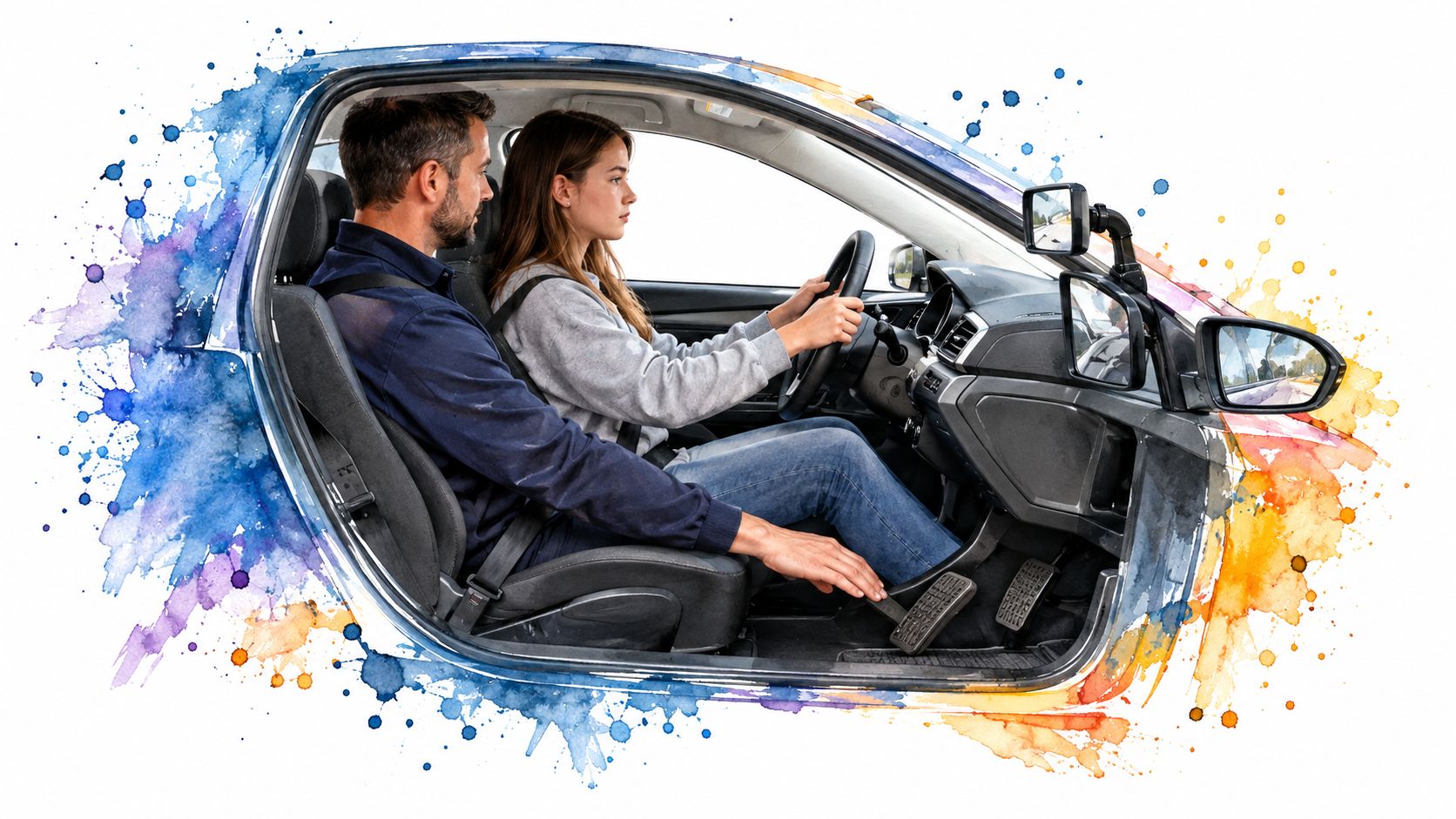
Your teen has both hands on the wheel, the car is creeping toward a busy Atlanta intersection, and you can almost feel the tension from the passenger seat. The light changes. A left turn is coming. Your new driver hesitates, presses the brake a little late, and suddenly that question hits every parent at once: what happens if they freeze?
That's where dual control vehicles matter.
For nervous teens, dual controls can make the first few lessons feel possible instead of overwhelming. For parents, they answer a different question: how can a student get real road practice without being thrown into traffic with no safety backup from a trained instructor? In Georgia, that matters even more because learning to drive isn't just about “getting comfortable.” It connects directly to Joshua's Law, supervised practice, and getting ready for the road test.
A lot of families look up dual controls and find a vague definition like “a car with an extra brake.” That's true, but it misses the bigger point. In real lessons, dual controls aren't a gadget. They're a teaching advantage. They let the student do the driving while the instructor keeps a mechanical backup ready for the rare moment when words alone aren't enough.
This is especially helpful for teens who need a calm path from classroom learning to behind the wheel training. Georgia's system gives families more than one route for the theory side, including online options, and then asks students to build real experience on the road. That's why so many parents want to understand how lessons feel before they book anything.
Introduction What Dual Control Vehicles Mean for New Drivers
A first driving lesson usually doesn't start with confidence. It starts with stiff shoulders, overthinking, and a foot that can't decide how hard to press the brake.

I've seen this with teens pulling out of a parking lot for the first time. They know the rules in their head, but the car suddenly feels bigger than expected. A stop sign comes up quicker than it looked from the sidewalk. A right turn feels too tight. The student starts to panic, and the lesson can go one of two ways. Either fear takes over, or a trained instructor calmly steps in, steadies the moment, and helps the student keep learning.
That second outcome is exactly why dual control vehicles were created.
Why this matters to Georgia families
Parents usually aren't researching dual controls because they love car equipment. They're trying to answer practical questions:
- Is my teen safer with a professional instructor?
- Will lessons help with Joshua's Law requirements?
- Can we combine online classwork with behind the wheel training?
- What helps a student get ready for road testing without adding more stress?
Those are the right questions.
Dual control vehicles give instructors a direct backup during live driving practice. That changes the feeling inside the car. The student still steers, judges speed, and makes decisions. But the instructor has a way to intervene if the student rolls too fast toward a stop, misjudges following distance, or freezes during a turn.
A dual control lesson works best when the student knows one simple truth: you're still the driver, but you're not alone.
A skill-building tool, not vehicle trivia
The history of dual controls goes back much farther than many people realize. Veigel traces a dual control system for a driving school vehicle back to 1925 and treats that invention as a founding milestone, showing that this setup was created early in the history of professional instruction, not added much later as a convenience (Veigel company history).
That long history matters because it shows the original purpose clearly. Dual controls were built for teaching. They were meant to help instructors coach beginners in real traffic while keeping a mechanical safety backup within reach.
For a Georgia family, that turns dual controls from an abstract feature into something much more useful: a bridge between first-lesson nerves, Joshua's Law training, online theory options, and road test readiness.
How Dual Control Vehicles Work in Simple Terms
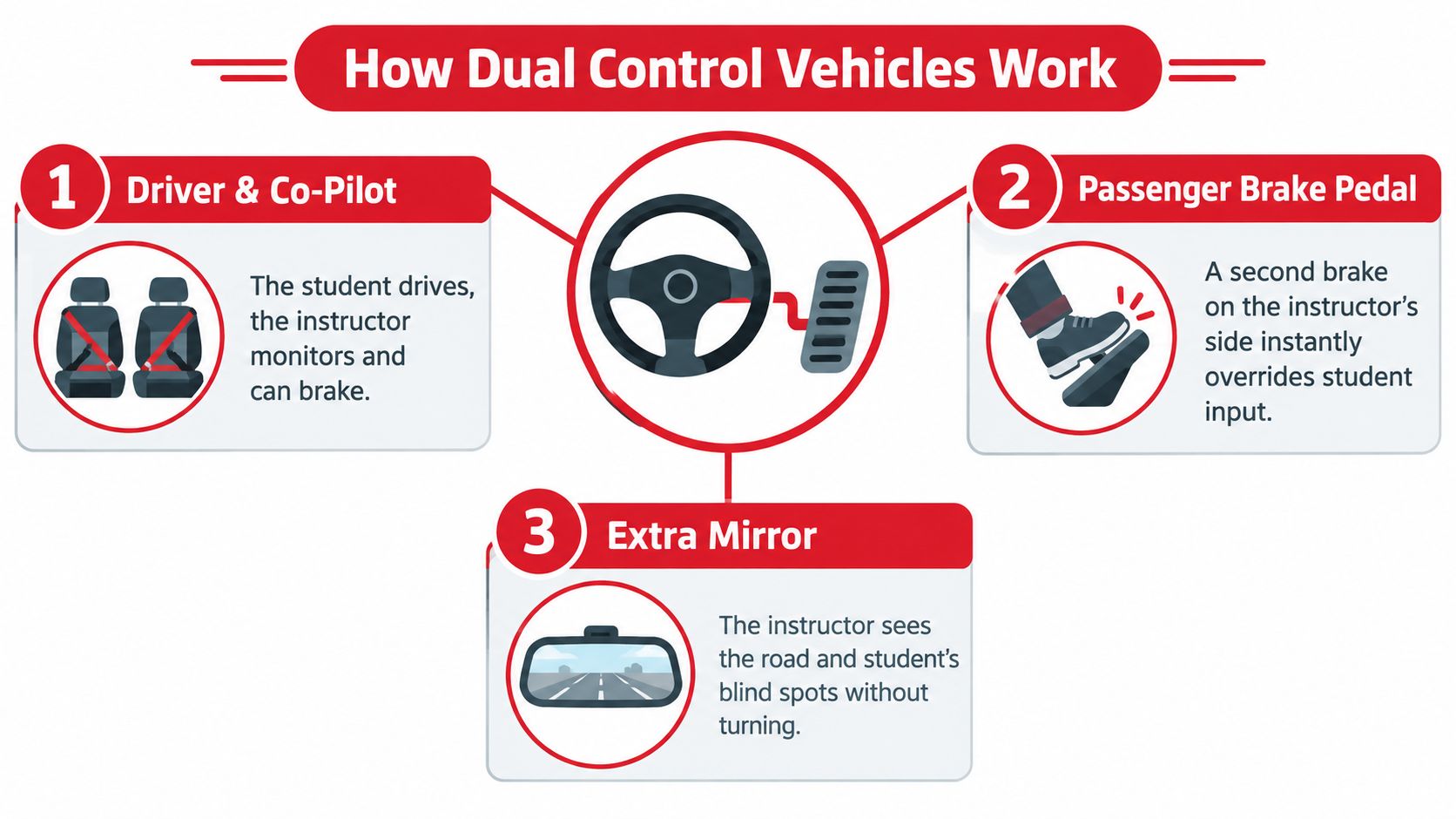
The easiest way to understand dual control vehicles is to think of the instructor as a co-pilot with one very specific job. The student does the driving. The instructor watches, coaches, and can brake if needed.
The basic setup
Focus on the extra brake pedal, and that's the heart of it. On the passenger side, the instructor has access to a brake pedal linked to the braking system. The instructor also usually has an extra internal mirror so they can watch traffic conditions and student awareness without twisting around awkwardly.
That means the instructor can do two things at once:
- Coach verbally by telling the student when to slow, check mirrors, or reset position.
- Intervene physically if the student doesn't respond in time.
It's not autopilot. The car isn't driving itself. The instructor isn't secretly controlling every move. The whole point is that the student remains active and responsible throughout the lesson.
Practical rule: In a good lesson, the instructor uses words first and the backup brake only when needed.
What the instructor can and can't do
Students often get confused.
An instructor in a dual control vehicle can't replace your judgment. They can't make you understand right of way by magic. They can't build smooth steering habits for you. You still have to look, decide, steer, signal, and manage speed.
What the instructor can do is stop a small mistake from becoming a scary one. If you approach a parked car too closely or don't brake firmly enough at a stop line, the instructor has a direct safety tool.
That changes the emotional experience of learning. Students usually relax faster when they understand there's a backup system in the car. Parents relax too.
Why proper fitment matters
Dual controls only help when they're installed correctly. Some jurisdictions treat this as a regulated vehicle modification, not a casual add-on. The Northern Territory of Australia, for example, requires approval in principle before modification and specifies a passenger-side brake pedal, an additional internal rear-view mirror, and a dashboard label stating the vehicle is fitted with dual controls, along with detailed fitment rules about pedal position, structural mounting, and matching response (Northern Territory dual control fitment specification).
Those details sound technical, but the reason is simple. If the instructor's pedal sits at the wrong angle or responds differently from the driver's brake, intervention can feel delayed or awkward. Proper fitment helps the backup work naturally and helps the vehicle stay compatible with modern safety design.
A quick mental picture
Driver's ed with a safety net:
- You drive the car
- Your instructor scans the road and your decisions
- A second brake is ready if timing breaks down
- The goal is fewer panic moments and more useful repetitions
That's why dual control vehicles make so much sense for beginning drivers. They support learning without taking learning away.
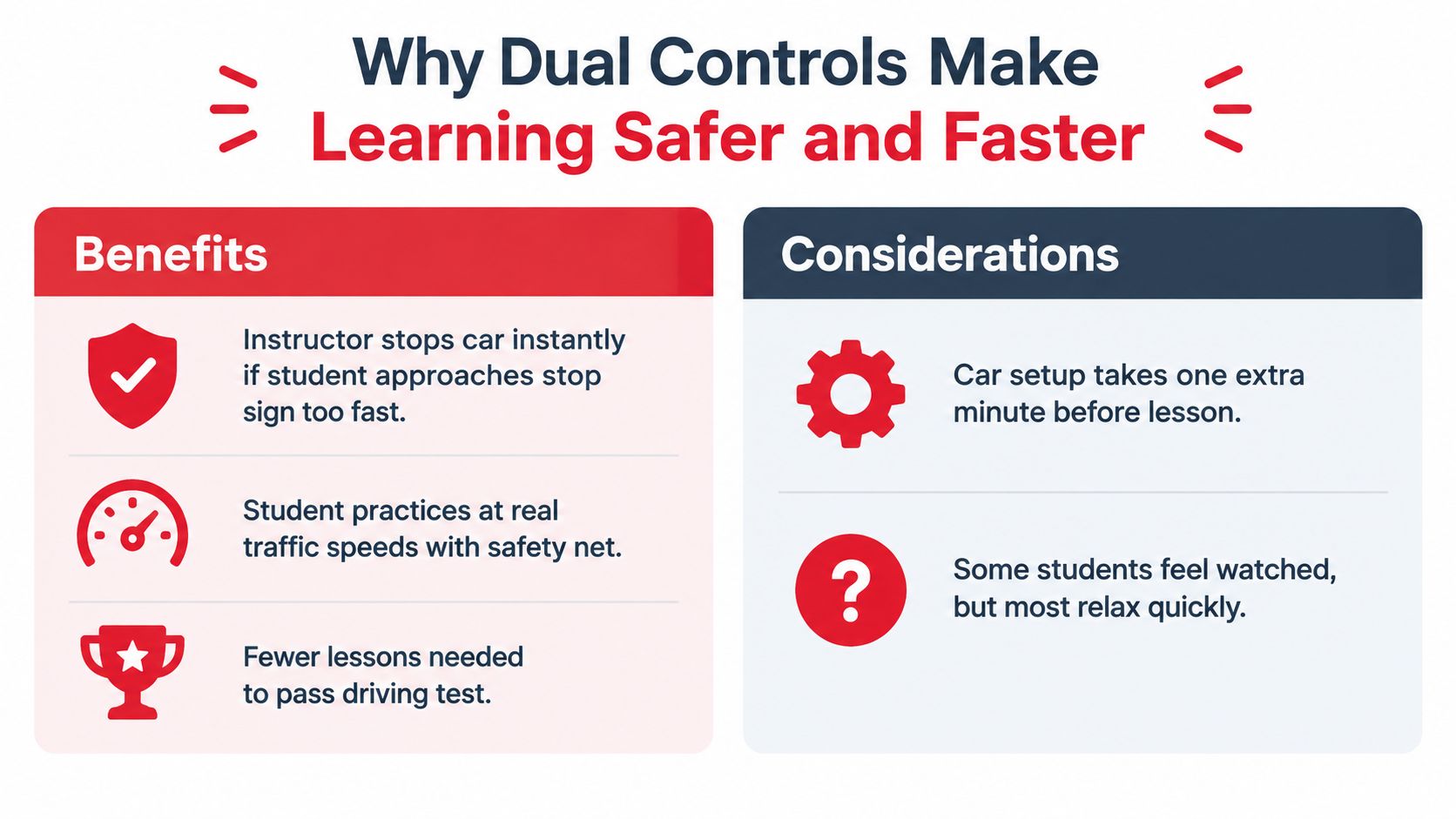
Why Dual Controls Make Learning Safer and Faster
Students learn best when they can practice real driving tasks without feeling like one mistake will ruin the whole lesson. That's the hidden value of dual controls.
The safety net changes behavior
A teen approaching a stop sign too quickly often needs two things at once: a calm voice and immediate backup. If the instructor can say “brake now” and also has the ability to assist if the student hesitates, the student gets a clear correction without the lesson spiraling into fear.
The same thing happens with left turns, lane changes, and crowded parking lots. Students can work at normal traffic pace instead of staying stuck in the easiest possible environments forever. That means they get more meaningful repetitions, and repetition is where confidence comes from.
Confidence doesn't come from the instructor driving for you. It comes from practicing the hard parts while knowing someone can catch the mistake before it grows.
Redundancy has a long safety history
The broader idea behind dual controls is redundancy. If one control path fails or isn't used correctly in time, another path helps keep the vehicle safe.
That principle showed up in mainstream vehicle safety design too. In the United States, NHTSA reported that dual master cylinders were installed on 9% of model-year 1962 and 1963 cars and 7% of model-year 1964 and 1965 cars, then became standard in most new cars from model-year 1967 onward. The same NHTSA analysis estimated that dual master cylinders prevent 0.7% of fatal crashes involving passenger cars and save about 260 lives per year when all passenger cars are equipped with them. The same federal publication also notes patent-era development around dedicated training-related dual brake concepts in the late 1960s (NHTSA dual master cylinder analysis).
Instructor pedals aren't the same thing as dual master cylinders. But the teaching logic is related. A backup control path can reduce the consequences of failure, delay, or inexperience.
Why lessons often feel smoother
Students usually improve faster when they aren't bracing for disaster. Parents sometimes assume the fastest learner is the boldest teen. In my experience, the fastest learner is often the teen who feels safe enough to stay teachable.
That's one reason many families choose professional instruction instead of trying to handle every lesson themselves. If you want a good overview of what instructor-led practice adds, this page on the benefits of taking driving lessons from an instructor lays out the practical value well.
A dual control car doesn't remove mistakes. It makes mistakes more usable. That's a big difference.
What to Expect Inside an A-1 Dual Control Lesson
The first few minutes of a lesson usually matter more than families expect. If the student understands the car and the plan, nerves come down quickly.
Before the car moves
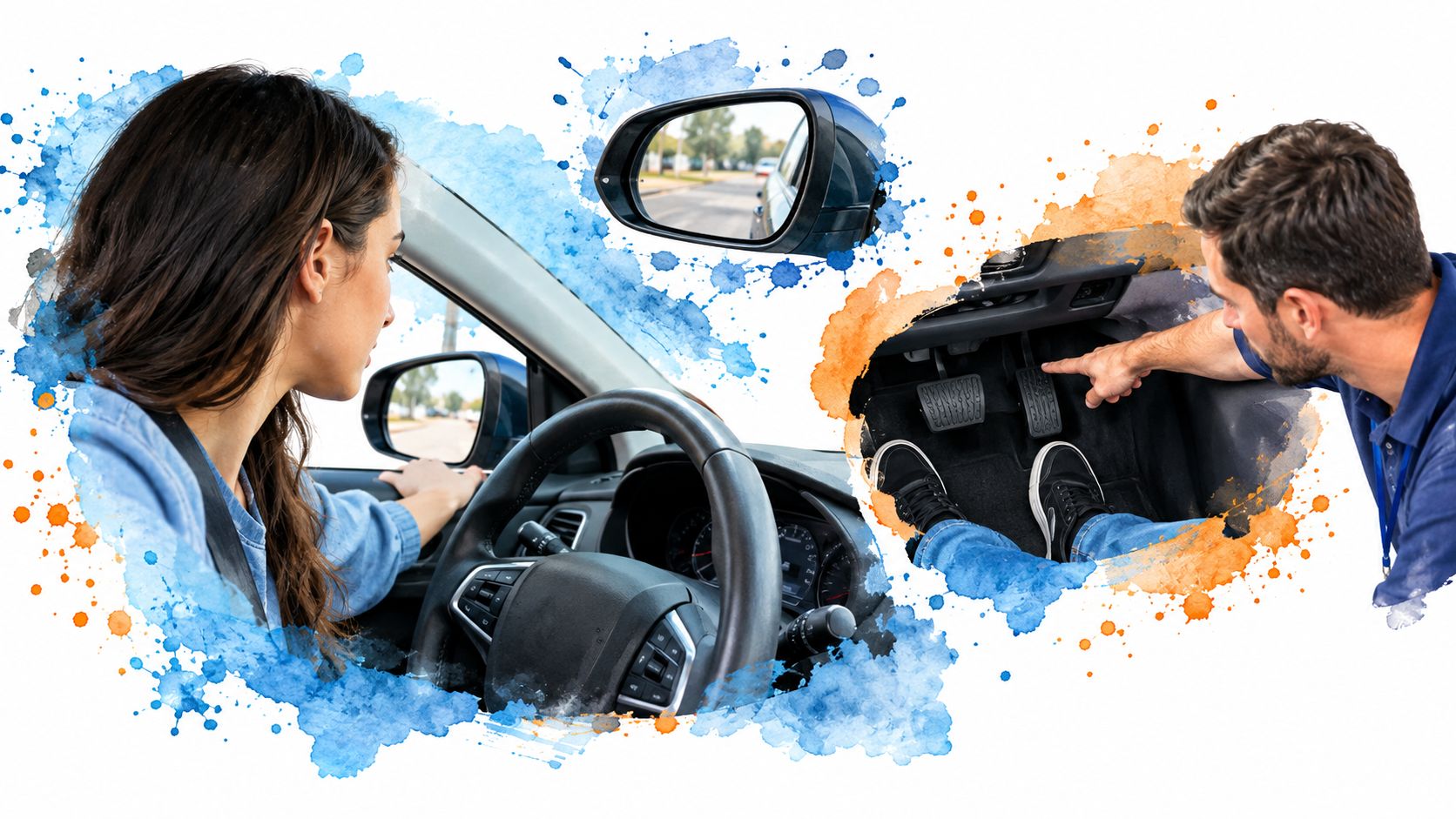
A typical lesson starts with orientation. The instructor checks seat position, mirrors, hand placement, and pedal reach. Then the student gets a short explanation of the dual control setup so there are no surprises.
That explanation usually clears up the biggest fear right away. Students learn that the instructor isn't going to be randomly stomping on the brake. The extra pedal is there for backup, and good instructors rely on coaching first.
The early part of the drive
Most beginners don't start by merging into heavy traffic. They begin in lower-pressure areas where they can build habits one layer at a time.
A lesson often progresses like this:
- Start simple: quiet lots or low-speed roads to practice smooth starts, gentle stops, and steering control.
- Add scanning tasks: mirror checks, turns, stop sign approach, and lane position.
- Build decision-making: residential streets, light traffic, then more complex intersections as the student settles in.
Students are often surprised by how verbal the lesson is. The instructor is talking them through what to notice, what to ignore, and what to do next. If intervention is needed, it's usually paired with immediate explanation so the student learns from the moment instead of just feeling corrected.
The best intervention is the one that keeps the situation calm and turns into a usable lesson within seconds.
How lessons connect to test skills
A strong dual control lesson isn't just “go drive around.” It builds toward the actual skills Georgia drivers need for independent road use and road test performance.
That usually includes practice with:
- Smooth stopping: not too early, not too late, and without jerking the car
- Turns and lane placement: entering and exiting cleanly
- Mirror use and lane changes: checking before moving, not during the move
- Parking and backing: controlled speed, clear observation, steady steering
For students who prefer an automatic vehicle, this kind of automatic driving lesson can be a practical fit, especially when the goal is to reduce first-lesson overload and focus on road awareness.
Why families look at lesson packages
Some students need a short confidence boost. Others need a fuller plan with multiple sessions spaced over time. That's where lesson packages often make more sense than one isolated drive. They let skills build in sequence instead of restarting from scratch every time.
A-1 Driving School is one Georgia option families consider for this kind of structured training because it offers teen and adult lessons, road test preparation, and scheduling across 18+ locations in metro Atlanta, according to the publisher information provided for this article.
That structure matters. A nervous student usually doesn't need “more pressure.” They need a repeatable lesson rhythm in a dual control vehicle where skills can stack one at a time.
Choosing the Right Training Path in Georgia
Georgia families usually aren't choosing between “take driver's ed” and “don't.” They're choosing the path that fits the student's age, schedule, confidence level, and license goal.
What Joshua's Law asks for
For teens seeking a Class D license, Georgia's Joshua's Law requires an approved driver education course with 30 hours of classroom instruction or 30 hours of online instruction, plus either 6 hours of behind-the-wheel training at a certified school or parent-taught training through the state guide, and 40 hours of supervised driving that includes 6 hours at night (Georgia DDS Joshua's Law requirements).
That requirement helps explain why dual control lessons are so valuable. The theory part teaches rules and judgment. The practical part is where the student has to turn those ideas into real driving behavior.
Georgia Driver Training Options at A-1
| Training Option | Format and Hours | Best For |
|---|---|---|
| Teen driving lessons | Behind-the-wheel sessions in training vehicles | Teens who need guided road practice and skill-building |
| Adult driving lessons | Behind-the-wheel sessions paced to experience level | New adult drivers or adults rebuilding confidence |
| Lesson packages | Multiple driving lessons grouped into a training plan | Students who learn best through steady repetition |
| Joshua's Law classroom course | In-person theory meeting the state's required classroom route | Teens who prefer face-to-face instruction |
| DDS-approved online course | Online theory meeting the state's allowed online route | Teens with busy schedules or who learn well at home |
| Road test preparation | Practice focused on test-day maneuvers and habits | Students close to testing who want a final skills review |
How to choose without overcomplicating it
Some families make this harder than it needs to be. A few questions usually point to the right path.
- If your teen is anxious: start with professional driving lessons before relying heavily on family practice.
- If your schedule is packed: online theory may fit better than attending a classroom at a fixed time.
- If your student learns by doing: prioritize lesson packages that create momentum, not one-off sessions.
- If the road test feels close but stressful: choose training that focuses on test habits, parking, stops, observation, and calm repetition.
Public guidance also shows that dual controls aren't governed the same way everywhere. Pennsylvania has a dedicated permit process, the Northern Territory specifies fitment requirements, and UK-oriented guidance treats dual-control cars as preferred for instruction but not universally required for testing. That variation is one reason families should treat dual controls as a compliance and training question, not just a generic learner-car feature (Pennsylvania dual-control permit guidance).
For Georgia families, the bigger point is practical. Choose a path that covers the state requirement and gives the student enough real road coaching to feel steady, not rushed.
How A-1 Connects Lessons to Online Courses Scholarships and Road Testing
A lot of frustration comes from treating each part of driver training like a separate project. Families sign up for theory somewhere, scramble for lessons later, then realize they still need help preparing for testing. The smoother route is to think in one chain: learn the rules, practice with support, document the required driving, then test.
Online theory and behind the wheel work together
Georgia explicitly allows the theory portion of driver education to be completed online through DDS-approved courses, and the DDS states that driver education has two parts, a theoretical component and a practical component (Georgia DDS Section 6 continued).
That matters because some teens do better when they can complete the knowledge side on a flexible schedule. Then they can use behind-the-wheel lessons to apply those rules in real traffic with an instructor beside them in a dual control vehicle.
Families who want both pieces connected in one place often look for combined options such as online drivers ed and behind the wheel packages.
Scholarship help for eligible teens
Cost can be a real barrier, especially for families trying to do this the right way with formal instruction. Georgia has a specific support path for some teens. The Driver's Education Grant Scholarship Program is open to Georgia residents ages 15 through 17 who have a valid instructional permit or driver's license, and it is designed to cover the required 30 hours of classroom instruction and 6 hours of behind-the-wheel instruction with an approved instructor (Georgia scholarship program rule).
That's worth checking early if your teen qualifies.
Road testing and the final step
Road test readiness isn't just about turns and parking. It also connects back to the supervised practice requirement. Georgia DDS requires applicants to sign an affidavit confirming 40 hours of supervised road driving, including 6 hours at night, before the road test process (Georgia DDS road test information).
For families trying to keep the process organized, it helps when one school can support the path from Joshua's Law theory to driving lessons to test preparation. According to the publisher information, A-1 has served Georgia drivers since 1987 and works with Fulton County Schools through its Board of Education contract. For many parents, that kind of continuity matters because they want one steady system instead of piecing things together from different providers.
Start Your Driving Journey With Confidence at A-1
Most teens don't need a lecture before their first lesson. They need a car that's set up for learning, an instructor who stays calm, and a plan that turns nerves into practice.
That's what makes dual control vehicles so helpful. They support the student without replacing the student. The learner still builds judgment, braking habits, scanning skills, and confidence. The instructor has a backup when timing matters most.
For Georgia families, the bigger win is how this fits into the full licensing path. A teen can complete the theory side through a state-approved route, build practical skill through driving lessons, log the required supervised hours with parents, and prepare for road testing without guessing at each next step.
Good next steps for parents and teens
- Pick the theory format that fits your schedule: classroom or DDS-approved online learning
- Schedule behind-the-wheel lessons early: especially if your teen is hesitant or brand new
- Ask about lesson packages: they often create better continuity than isolated sessions
- Check scholarship eligibility: this can make formal driver education more accessible
- Plan for road test readiness: don't wait until the last minute to practice test-specific skills
If your teen feels nervous, that's normal.
Most good drivers started there too. The goal isn't to erase that feeling in one day. The goal is to give it structure, guidance, and a safer place to improve.
If you want a complete Georgia path from Joshua's Law courses to dual control driving lessons, lesson packages, scholarship-related training options, and road test support, visit A-1 Driving School. Their programs are built for teens and families who want clear next steps, flexible course options, and real behind-the-wheel practice that builds confidence from day one.