
A Georgia teen's sixteenth birthday can feel like a finish line. The learner's permit is in hand, the road test is on everyone's mind, and the family may already be counting down to independent driving. But Georgia doesn't treat licensing as one large exam. It's a sequence of separate requirements involving driver education, supervised practice, permit time, testing, and paperwork.
The most common problems happen when one part is finished while another is still incomplete. A teen may complete a course but not have held the permit long enough. Another may meet the practice-hour requirement but arrive for testing without the right vehicle documents. This guide follows the full path in order, so you can see what needs to happen, when it needs to happen, and where families tend to get stuck.
Getting Your Georgia License Starts With One Simple Roadmap
Maya got her learner's permit and immediately started looking at the calendar. Her family assumed that once she turned 16, she could schedule a road test and receive a license. That's a common assumption, but Georgia's process has several gates between a learner's permit and a Class D provisional license.
The first step is holding a valid Class CP learner's permit. During that permit period, the teen needs to complete a DDS-approved driver education program, accumulate supervised driving experience, and keep a reliable record of that practice. The permit itself must be held for 1 year and 1 day before the teen can apply for the Class D license, as explained in Georgia's official teen driver guidance.
Driver education and behind-the-wheel practice serve different purposes. A course builds knowledge of traffic rules and decision-making. Professional instruction develops vehicle-control skills. Parent-supervised driving provides repeated experience in ordinary situations, from neighborhood streets to traffic and nighttime conditions.
The sequence matters
Think of the process as a checklist with independent boxes:
- Hold the Class CP learner's permit.
- Complete the approved Joshua's Law education and training requirements.
- Log the required supervised driving, including nighttime practice.
- Hold the permit for the full required period.
- Confirm that the permit has not been suspended because of a major traffic violation.
- Prepare the required documents and a properly documented four-wheel vehicle.
- Pass the knowledge, vision, and road skills tests.
Completing one box doesn't erase the others. Finishing a driver education course early won't shorten the permit-holding period, and completing the permit period won't replace the required course or driving log.
Parents can use the Georgia learner's permit guide to organize the first stage, but the practical work begins immediately after the permit is issued. Start driving regularly, record each session carefully, and treat the permit year as a training period rather than a waiting period.
The goal isn't just to arrive at DDS on the right day. It's to arrive with eligibility, experience, documents, and confidence all ready at the same time.
How Age Shapes Your Path to a Georgia Driver's License
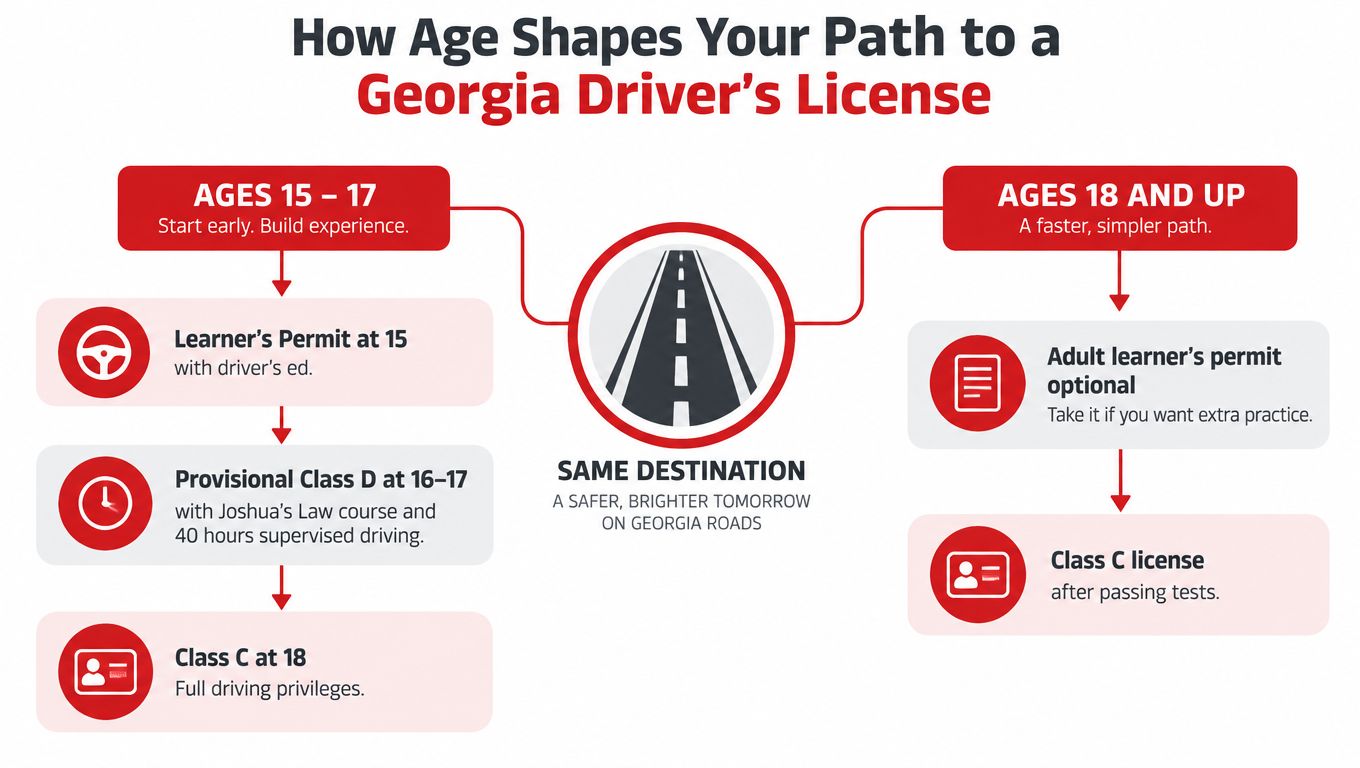
Georgia has two different doors into licensed driving. The door for a teen leads through graduated licensing and Joshua's Law. The door for an adult first-time applicant can lead directly to a Class C license after the required tests.
A teen who is 16 or 17 and seeking a Class D license must follow the graduated licensing path. That means using a Class CP learner's permit, completing the approved education and supervised-driving requirements, waiting through the required permit period, and passing the road skills test.
An applicant who is 18 or older and applying for a first-time non-commercial license may apply directly for a Class C license. Georgia still requires that applicant to pass the knowledge, vision, and road skills tests, but the adult path doesn't require the teen Class D sequence or Joshua's Law.
Why the distinction matters
A parent helping a 16-year-old often searches for “Georgia license requirements” and finds adult and teen information mixed together. That creates confusion. The adult Class C route may describe tests without mentioning the 1 year and 1 day permit requirement, while the teen route depends heavily on Joshua's Law and documented practice.
New residents have another deadline to manage. Georgia requires new residents to apply for a license within 30 days, according to the Georgia DDS license FAQ. An adult first-time applicant can generally proceed toward Class C testing, while an under-18 applicant must use the graduated licensing process.
Out-of-state permit time can also matter. If a teen used an out-of-state permit, the total permit time still needs to add up to 1 year and 1 day before the teen can advance to Class D. Keep documentation from the previous state instead of assuming the time will automatically appear in Georgia's records.
Practical rule: Identify the applicant's age, permit type, and residency situation before choosing a checklist.
For most families reading this article, the relevant route is the teen Class D path. The Georgia provisional license requirements are easier to manage when the family treats the process as a ladder. The teen must complete each rung before stepping onto the next one.
Joshua's Law Requirements Every Georgia Teen Must Meet
Joshua's Law is the central education requirement for Georgia teens seeking a Class D license. It applies to 16- and 17-year-olds and combines classroom knowledge, professional or parent-taught vehicle instruction, and supervised driving.
The classroom portion can be completed in a traditional setting or through an approved virtual equivalent. The behind-the-wheel portion has two permitted routes, but both routes still require the teen to build a larger record of supervised experience.
Core requirement: A teen must complete approved driver education, satisfy the behind-the-wheel option, and record 40 hours of supervised driving, including 6 hours at night, before moving forward.
The two course paths look similar at first, but the difference is who provides the in-car instruction.
Approved Joshua's Law Course Paths Compared
| Course Path | Classroom/Online Hours | Behind-the-Wheel Requirement | Supervised Driving |
|---|---|---|---|
| Instructor-supported path | 30 classroom hours, or an approved online equivalent | 6 hours with a certified instructor | 40 total hours, including 6 at night |
| Parent-taught path | 30 classroom hours, or an approved online equivalent | Parent-taught driving using the DDS Parent/Teen Driving Guide | 40 total hours, including 6 at night |
The 40-hour supervised-driving requirement applies in both paths. The parent-taught option doesn't remove the need for a complete driving log, and the instructor-supported option doesn't replace the family's responsibility to continue supervised practice.
The permit clock runs separately from the course and driving hours. A teen could finish the classroom work and professional lessons early, yet still need to wait until the Class CP permit has been held for 1 year and 1 day. Conversely, a teen may reach the permit anniversary without completing the course or practice log and still be ineligible.
Keep proof organized
Save course completion records, instructor documentation, and the supervised-driving log together. Write down dates and driving conditions while they're fresh, rather than trying to reconstruct them later from memory.
Georgia DDS provides the governing details in its Joshua's Law requirements. Families can also review a practical Joshua's Law course guide before choosing between instructor-led and parent-taught training.
The best route is the one your family can complete accurately and consistently. A flexible course with no reliable practice plan won't solve the problem, and a detailed practice plan won't substitute for approved education.
Choosing Between Classroom, Online, and Parent-Taught Driver's Ed
The right format depends less on which option sounds easiest and more on how the teen learns and how the family schedules practice.
A traditional classroom course gives students a fixed structure. An instructor can explain traffic rules, answer questions, and keep the group moving through the material. This option often suits teens who focus better with a scheduled class and parents who want a clear education timeline.
An approved online or virtual course gives families more control over when the classroom material is completed. Georgia DDS recognizes an equivalent online virtual course in place of the classroom portion, but online learning doesn't eliminate the behind-the-wheel or supervised-driving requirements.
Compare the main options
| Format | Strength | Possible challenge | Good fit for |
|---|---|---|---|
| Instructor-led classroom | Direct explanations and scheduled accountability | Requires attendance at set times | Teens who learn through discussion and routine |
| Approved online virtual course | Flexible access around school, sports, or work | Requires self-management | Busy students and families with changing schedules |
| Parent-taught route | Lets the family manage in-car instruction | Parents must follow the approved guide and maintain consistent records | Families prepared to coach patiently and document practice |
Georgia DDS says an approved course for a 16- or 17-year-old includes 30 hours of classroom instruction or an equivalent online virtual course, plus 6 hours of on-road experience with a certified instructor or completion of the DDS Parent/Teen Driving Guide. The teen must also complete 40 total hours of supervised driving, including 6 hours at night, as outlined in the state's driver education guidance.
A family living far from a classroom may prefer an approved online program paired with scheduled driving lessons. A teen who needs accountability may do better in person. A parent who wants professional help with vehicle control can choose the instructor-supported path and continue family practice afterward.
A-1 Driving School offers in-person, online, and virtual driver education options, including programs connected with schools in the Fulton County school system. Families can compare formats and choose an enrollment path that fits the teen's schedule without losing sight of the in-car requirements.
Logging Your Learner's Permit Hours the Right Way
The learner's permit period should become a gradual coaching plan. A new driver shouldn't wait until the final part of the permit period to begin practicing difficult situations. Start in quiet areas, then add traffic, unfamiliar roads, parking, weather changes when conditions are safe, and nighttime driving.
Georgia requires 40 hours of supervised driving, with 6 hours at night. The hours should represent real practice, not just time spent moving a vehicle from one familiar location to another.
Build variety into the log
A useful practice record can include:
- Vehicle control: Smooth starts, controlled stops, steering, and basic positioning.
- Traffic experience: Intersections, lane changes, merging, and following appropriate distances.
- Parking practice: Pull-in parking, backing, and other maneuvers the teen needs to perform calmly.
- Night driving: The required nighttime hours should be scheduled deliberately, not treated as an afterthought.
- Changing conditions: Practice on different roads and in safe weather conditions so the teen learns to adjust observation and speed.
The log should show the date, approximate time, supervising driver, and conditions required by the family's chosen recordkeeping method. Store it where both the teen and parent can find it. Missing entries are difficult to recreate months later.
The permit timer is just as important as the driving log. Georgia's Class D rule requires a valid Class CP learner's permit to have been held for 1 year and 1 day, with no major traffic violations that caused the permit to be suspended, as stated by Georgia DDS for Class D applicants.
The safest schedule is steady practice throughout the permit period, not a rush to complete every hour before test day.
Parents should also set expectations before each drive. Choose one or two skills to practice, keep instructions calm, and end the session with a short review. The teen needs enough repetition to make good habits automatic, but also enough variety to recognize hazards outside the neighborhood.
Passing the Knowledge, Vision, and Road Tests in Georgia
Testing day involves more than turning the steering wheel. Georgia uses knowledge, vision, and road skills testing to confirm that the applicant understands the rules, meets the vision standard, and can operate a vehicle safely.
The knowledge test checks understanding of road rules and signs. Prepare with the current Georgia driver information and practice questions, but focus on understanding why a rule applies instead of memorizing isolated answers.
The vision exam uses a mechanical device. Georgia requires at least 20/60 vision in one eye, with or without corrective lenses, plus a 140-degree field of vision. If the applicant fails the field test, a licensed optometrist or ophthalmologist must complete a Vision Report form, according to the state's testing and examination information.
Prepare the vehicle before the appointment
The road test requires a four-wheel vehicle supplied by the applicant. The vehicle needs valid registration and a license plate. If it has a temporary dealership tag, bring a bill of sale proving the purchase occurred within the last 30 days, or within 7 days for a third-party purchase.
That vehicle documentation can stop a test before the driving begins. Check the registration, plate, insurance materials, and required documents well before the appointment. Don't assume that completing Joshua's Law guarantees that the test center will accept the vehicle.
The road skills test is designed to evaluate safe motor-vehicle operation. During preparation, instructors commonly work with students on smooth starts and stops, turns, lane changes, parking, observation, and speed control. A certified driving school may also offer road test preparation or testing assistance, while DDS remains the state licensing authority.
Bring a qualified vehicle and complete documents. A strong driver can still lose a test appointment because the car or paperwork isn't ready.
Arrive with enough time to check the vehicle calmly. The teen should know where the controls are, adjust the seat and mirrors, and avoid last-minute practice that creates anxiety. Preparation should make the test feel like a demonstration of skills already practiced, not a first attempt.
Cutting Costs With the Georgia Driver's Education Grant Scholarship
Driver education can feel like an unexpected expense, especially when a family is also planning for professional lessons and road test preparation. Georgia's Driver's Education Grant Scholarship Program may help eligible families cover approved training.
The statewide program is available to Georgia residents ages 15 through 17 who hold a valid Georgia instructional permit or driver's license. It covers driver education that satisfies Joshua's Law, including 30 hours of classroom instruction and 6 hours of behind-the-wheel instruction with an approved instructor, according to the Georgia Driver's Education Grant Scholarship Program.
Check eligibility and application details before enrolling, because the scholarship has specific requirements. If approved, the program can make the instructor-supported route more accessible while giving the teen a structured foundation for supervised practice.
Professional lessons remain valuable even when a family plans to do most practice at home. A parent may know how to drive safely but struggle to explain mirror checks, lane positioning, turning technique, parking references, or how to correct a mistake without overwhelming the student. A driving instructor can isolate those skills and give the teen focused repetition.
Lesson packages can also help families plan beyond the minimum. One session may focus on vehicle control, another on traffic and lane changes, and another on road test preparation. The purpose isn't to replace the required family practice. It's to make that practice more productive and give the parent a clearer coaching plan.
The following video can help families understand the role of structured driving instruction before choosing a course or lesson plan.
When comparing providers, look for a program that connects education with actual driving practice. A useful package may combine Joshua's Law coursework, behind-the-wheel lessons, flexible scheduling, and preparation for the Georgia road test. Families should also ask how the provider documents completion and what the student needs to bring on testing day.
Your Action Plan From Permit to Class D License
Put the requirements for a Georgia license into a working calendar instead of keeping them as a loose list.
- Get the Class CP learner's permit. Keep the permit information and issue date in a place the family can access.
- Choose an approved Joshua's Law route. Select classroom, approved online learning, instructor-supported training, or the parent-taught option.
- Start the supervised-driving log immediately. Build toward the required 40 hours and schedule the 6 nighttime hours deliberately.
- Track the permit anniversary. The teen must hold the permit for 1 year and 1 day, so finishing coursework early doesn't remove the waiting period.
- Check eligibility and documents. Confirm the permit status, course records, driving log, identity documents, and any required forms.
- Prepare the test vehicle. Verify the four-wheel vehicle's registration, license plate, or qualifying bill of sale before the appointment.
- Practice for all three tests. Review knowledge material, address vision needs early, and use professional road test preparation if the teen needs focused coaching.
The hardest part is often coordination. Paperwork, permit dates, course completion, supervised hours, and vehicle readiness must line up. Families who keep records from the beginning are less likely to discover a missing requirement at the last minute.
Responsible driving preparation may also support broader household planning. Once the teen is licensed, parents can review coverage options and resources that explain how to lower your Georgia premium while keeping the new driver properly insured.
Start this week by checking the permit date, selecting the education format, and scheduling the first supervised drive. A clear course and a well-planned driving lesson package can turn a stressful process into a series of manageable steps.
A-1 Driving School offers Georgia driver education courses, Joshua's Law options, driving lessons, lesson packages, and road test preparation for teens and adults. Visit A-1 Driving School to compare available programs, choose an online or in-person path, and begin preparing for the Class D licensing process.