

A Georgia high school junior sits at the kitchen table with a parent, a laptop open to college scholarship pages and a driver's education enrollment form waiting in another tab. The family is trying to answer two questions at once: how can they reduce future college costs, and how can the teen complete the training required for a Class D license?
Many families search for scholarship grants for high school students and think only about tuition. That search can also uncover support for practical education, including driver training. In Georgia, an eligible teen may be able to use the Georgia Driver's Education Grant Scholarship Program to complete the education and behind-the-wheel instruction connected to Joshua's Law.
Navigating Scholarship Grants for High School Students
A Georgia family may have two deadlines on the same calendar: a college scholarship application and a teen's driver's education enrollment. The student understands that grades, activities, essays, and financial need can affect college awards. They may not realize that funding can also cover a defined educational requirement, such as driver training. A license can affect access to school, work, sports, internships, and family responsibilities.
Start with a full list of education-related costs. Include tuition and applications, along with books, supplies, testing, transportation, and required training. A grant for driver's education serves a different purpose from a college scholarship. For an eligible Georgia teen, the Georgia Driver's Education Grant Scholarship Program can provide a free route to approved driver education and behind-the-wheel instruction through A-1 Driving School, subject to program requirements.

Start before a deadline becomes urgent
Begin scholarship research early. Federal student aid guidance recommends starting as early as the summer between junior and senior year because some deadlines may arrive a full year before college enrollment. Awards can come from schools, local organizations, states, or national providers. Early research gives the student time to compare eligibility rules instead of applying only to the first opportunity found. The Federal Student Aid scholarship guidance offers a useful starting point for reviewing scholarship timing and conditions.
Use the same habit for driver's education. Before a road test is near, confirm the teen's age, permit or license status, required course components, and possible grant routes. Review the high school graduation requirements guide while planning, then place driver's education beside school responsibilities rather than treating it as a separate project.
Practical rule: Write every funding deadline on one shared family calendar, next to the enrollment date and planned road test.
A short parent-teen meeting can clarify the plan. List what the teen must complete, separate state requirements from college goals, and record each application deadline. Once those details are visible, families can judge whether the Georgia grant program and other scholarship grants for high school students fit the student's schedule and needs.
Understanding Scholarship Grants for High School Students
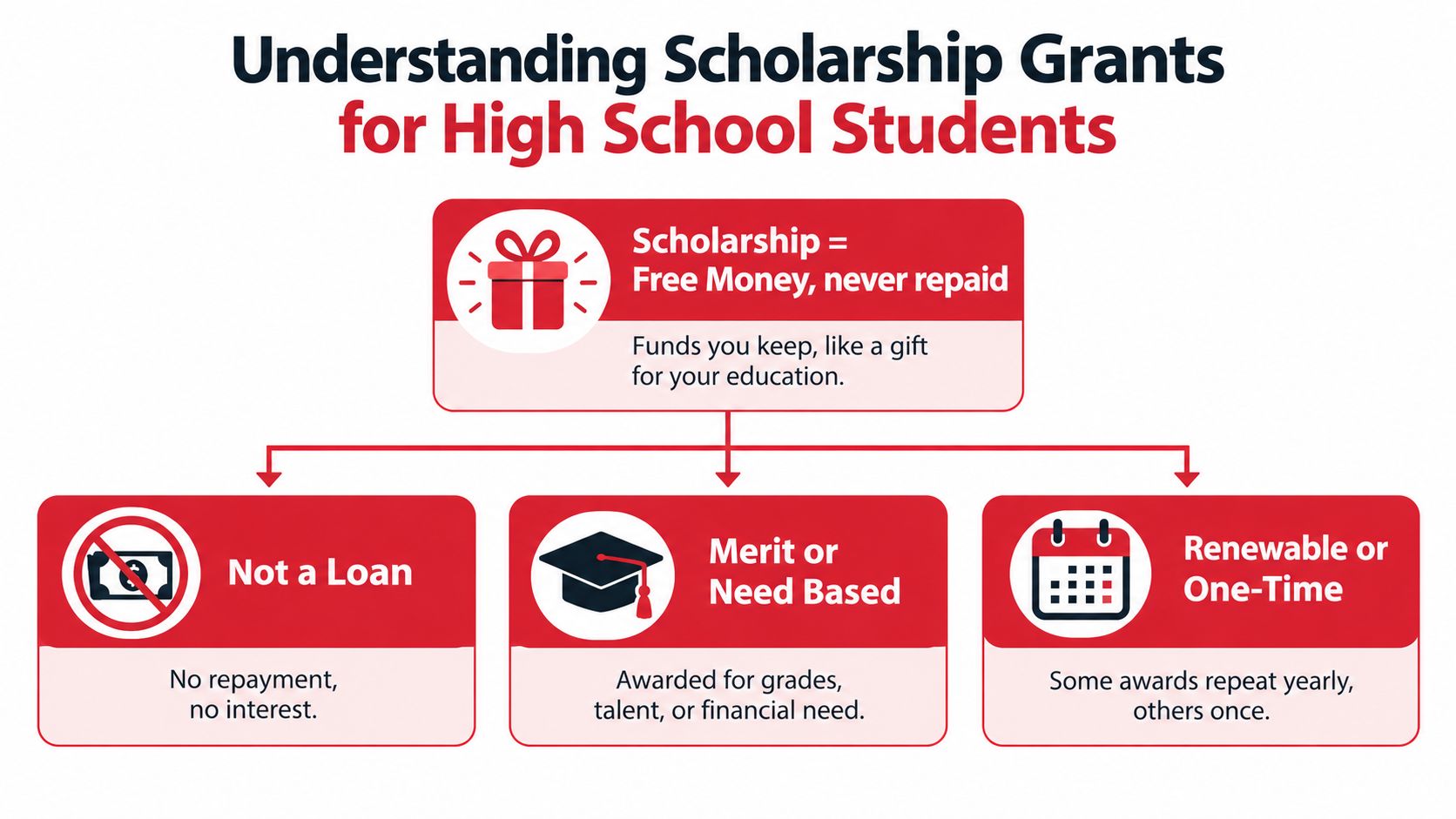
Member organizations of the National Scholarship Providers Association awarded about $8.11 billion in scholarship dollars during 2022–23, with an average scholarship amount of $1,517, according to association data summarized by Federal Student Aid. Those figures show the size of organized scholarship funding, although they do not guarantee that any particular student will receive an award. To assess an opportunity, start by separating a grant or scholarship from a loan.
A scholarship or grant generally does not need to be repaid when the recipient follows its conditions. A loan creates an obligation to repay borrowed money, often with interest. In practice, an award may be tied to eligibility, enrollment, achievement, financial need, or a defined educational purpose.
The word “scholarship” covers several categories. Merit-based awards may consider GPA, transcript strength, class rank, test participation, leadership, extracurricular involvement, or service. Need-based grants focus on financial circumstances. Specialized awards support a particular activity, population, training path, or educational requirement. Driver's education assistance can fit this last category because the funding may be connected to an approved course rather than unrestricted school spending.
Three questions to ask about any award
Before spending time on an application, read the eligibility language and funding conditions.
- What does the award pay for? Some funding supports broad education costs. A specialized grant may pay only for an approved course, classroom instruction, or another defined training component.
- Who can apply? Check residency, age, school status, grades, household circumstances, permit or license status, and provider restrictions.
- What must the recipient complete? Requirements may include enrollment, documentation, attendance, a deadline, or use through an approved organization.
Selection may be competitive. The National Merit Scholarship Program screens more than 1.3 million U.S. high school entrants through the PSAT/NMSQT, as described by the Nebraska Department of Education scholarship resource. One strong grade does not guarantee an award, and smaller or specialized programs can still deserve attention.
Application effort also matters. A Canadian youth scholarship study described by GrantBoost found that complex forms, multiple essays, and requests to focus on hardship can discourage applicants, particularly underrepresented students. Families should compare an award's purpose with the time, paperwork, and personal information it requires, especially when evaluating a Georgia driver's education grant alongside other scholarship options.
Georgia Driver's Education Grant Scholarship Program
A 16-year-old with a Georgia Instructional Permit may be ready for driving practice but unsure how the family will cover driver education. The Georgia Driver's Education Grant Scholarship Program can connect an eligible teen with the required training at no cost to the family under the program's terms.
The program is available to Georgia residents ages 15 through 17 who have a valid Georgia Instructional Permit or Driver's License and want to satisfy Joshua's Law through approved instruction. It covers the 30-hour classroom component and 6 hours of behind-the-wheel instruction with an approved instructor, according to the Georgia Driver's Education Grant Scholarship Program information.
Unlike a general scholarship, this grant works like a pass for a specific course. The funding is tied to approved driver education, so the student receives access to classroom learning and supervised road practice rather than unrestricted money.
A practical enrollment sequence
Confirm the basic eligibility. Check Georgia residency, the teen's age, and whether the student has a valid Georgia Instructional Permit or Driver's License. If a condition is not met, ask the program or school what must happen before enrollment.
Match the grant to the required training. The approved route includes classroom instruction and behind-the-wheel lessons. Ask how each part will be scheduled, recorded, and completed so the family knows what the award covers.
Apply through the program pathway. Follow the current application process and submit the requested information. A general scholarship application does not automatically qualify a student for this specialized grant.
Enroll with an approved provider. A-1 Driving School, which holds the exclusive Fulton County Board of Education contract described in the program materials across Fulton County schools and numerous Atlanta high schools, participates in the program and provides the approved course pathway. An approved student receives a redemption code for eligible driver education classes, including classroom instruction and behind-the-wheel lessons. Read the full Georgia Driver's Education Grant Scholarship Program overview to confirm current eligibility and redemption steps.
Keep confirmation details. Save approval messages, the redemption code, enrollment information, scheduling notices, and completion records. These documents give the family a clear trail if a question arises before the next licensing step.
The grant can remove the course cost for a qualifying student, but it does not remove the attendance, completion, or Georgia licensing requirements. Families should confirm current class availability, locations, and enrollment instructions before choosing a schedule. With those details organized, a teen can approach driver education as a planned requirement rather than an unexpected expense.
Joshua's Law and Driver's Education Requirements
A Georgia teen may have scholarship funding for driver education, a place in class, and a planned licensing date, yet still need to match the course format to Joshua's Law. For 16- and 17-year-olds applying for a Class D license, Georgia requires an approved driver education course. The state's Georgia Department of Driver Services Joshua's Law requirements outline the accepted paths.
One path combines 30 hours of classroom instruction with 6 hours of behind-the-wheel training. The other combines a 30-hour online or virtual course with 6 hours of behind-the-wheel training through a certified school. Online learning changes the location of the classroom work. It does not remove supervised driving practice.
Choosing classroom or online instruction
An in-person classroom may suit a student who learns through live explanations, questions, and group discussion. A fixed schedule also gives families a clear attendance plan. Teens who need immediate feedback may find it easier to stay engaged when an instructor is present.
An online or virtual course may fit a student balancing school, activities, work, or family responsibilities. The flexibility comes with a different responsibility: the student must complete the course correctly, keep proof of completion, and arrange the required driving instruction with a certified provider.
| Student situation | Format to consider | What still matters |
|---|---|---|
| Learns best with an instructor present | In-person classroom | Complete the classroom hours and driving instruction |
| Has a crowded weekly schedule | Online or virtual classroom | Finish the course and arrange certified behind-the-wheel training |
| Needs more practice than the minimum path provides | Classroom or online plus additional lessons | Build skills before testing, not just course completion |
| Feels nervous about the road test | Either approved classroom format | Add focused practice, review testing conditions, and prepare the vehicle and supervising adult |
The available choices can include instructor-led instruction, online coursework, and customized driving lessons. Families should keep two goals separate: meeting the educational requirement and developing enough practical skill to drive independently. Completing the course checks one part of the process. Repeated practice builds control, observation, and sound traffic decisions.
Georgia also permits virtual non-commercial road tests. The vehicle uses a dual-facing camera and a hands-free device, while a licensed adult age 21 or older must be present, according to the Georgia DDS road test information. Review the current testing conditions before scheduling so the vehicle, equipment, and supervising adult meet the stated requirements.
Use A-1 Driving School's Georgia course options to compare online and in-person driver's education. A scholarship can make an approved course accessible, while the right format and steady practice help a teen prepare responsibly for the road test.
Driving Lessons and Package Options at A-1 Driving School
A student can finish the classroom requirement, sit in the driver's seat, and still feel unsure at the first busy intersection. Knowing the right-of-way rule is different from judging a gap, holding lane position, controlling speed, or responding calmly when traffic changes. A-1 Driving School's lesson options help families connect scholarship-funded education with the practical skills a teen must build through guided driving.
A package should match the student's current ability, not just offer the largest number of lessons. A first-time driver may need instruction in vehicle controls, steering, braking, and quiet-road practice before entering heavier traffic. A teen who has practiced with a parent may need targeted work on parking, mirror checks, lane changes, intersections, and road-test maneuvers. A nervous student often benefits from repeated practice over time instead of one rushed appointment before testing.
Match the package to the student
Parents can begin by identifying the student's immediate goal. Is the family trying to complete approved driver's education, prepare for the road test, or strengthen specific skills after the required training? These goals can overlap, but they are not identical. Course completion documents education. Practice develops the judgment and vehicle control needed for independent driving.
Scheduling also affects whether a package works. A-1 Driving School offers different appointment times and locations across metro Atlanta, including Athens. Families should ask which location and schedule they can maintain, then leave time for supervised practice between lessons. A plan that fits the calendar gives the teen more consistent opportunities to repeat each skill.
Families seeking an online classroom option can review the online driver's education and behind-the-wheel packages. This arrangement may suit a household that wants coursework completed online while retaining supervised driving instruction through an approved school. The grant may cover approved training, so confirm the program's rules before paying for a package or adding optional lessons.
Licensing rules differ by location. Families outside Georgia can use G1 prep for Milton teens as a reminder to check the requirements for their own jurisdiction rather than transfer another region's process to Georgia.
What a parent should ask before enrolling
- Starting level: Does the student need beginner instruction, refresher practice, or test-focused coaching?
- Package scope: Which classroom, behind-the-wheel, and preparation elements are included?
- Scheduling: Can the family reserve appointments that fit school and other responsibilities?
- Grant use: Which parts of the package can the approved grant pay for?
- Next step: What should the student practice before the next lesson?
A short video can help parents and students see how the school presents its course and lesson pathways:
During practice, parents can watch for mirror checks, intersection scanning, steady speed, lane placement, and calm responses to corrections. Those observations help the instructor and student choose the next lesson focus, while grant approval can make eligible training more accessible.
Key Takeaways for Scholarship Grant Recipients
A Georgia student may pursue more than college funding. The Driver's Education Grant Scholarship Program can support an approved driver education pathway, helping an eligible teen work toward licensing without treating driving instruction as an afterthought. Families should manage college scholarships and driver education grants as separate applications, since each program has its own eligibility conditions, deadlines, and documentation.
Use this checklist before enrolling:
- Start early: Review grant and scholarship opportunities before deadlines create pressure.
- Check eligibility: Confirm residency, age, permit or license status, academic conditions, financial requirements, and provider approval.
- Match the training to the student: Decide whether the teen needs beginner instruction, extra practice, or preparation for the knowledge or road test.
- Separate required and optional instruction: Joshua's Law education and behind-the-wheel training support the required licensing pathway. Additional lessons may help a student who needs more time to build reliable habits.
- Compare formats: An online or virtual classroom may suit one student, while another may learn better through in-person instruction.
- Keep records: Save approval notices, redemption details, enrollment confirmations, completion records, and test appointments.
- Ask before paying: Confirm which parts of the selected package the grant covers and whether the provider is approved.
The grant's value is practical. Classroom completion provides the map, while supervised driving builds the judgment needed to follow that map on real roads. A family can then plan the next stages in order: approved education, behind-the-wheel practice, and road test preparation.
Parents should judge readiness by driving behavior, not age or classroom completion alone. Look for steady vehicle control, regular mirror checks, careful intersection scanning, safe speed, accurate lane placement, and calm responses to corrections. The teen should also explain why a decision is safe. If these skills are inconsistent, more instruction may be the sensible choice.
A student who does not qualify can still compare approved courses and lesson packages. A qualifying student should confirm grant coverage before paying for eligible training. Ask the provider about eligibility, approval, scheduling, redemption, and the move from driver education to testing.
A-1 Driving School provides Georgia driver education, Joshua's Law course options, online and in-person learning, behind-the-wheel instruction, road test preparation, and lesson packages for teens and adults. Families can review the available choices and request guidance on building a practical path from grant eligibility to licensed driving.