
Approximately 1.19 million people died in road crashes worldwide in 2021. Defensive driving rules reduce your exposure to predictable hazards by helping you manage speed, space, attention, and decisions before a mistake becomes a collision.
For Georgia drivers, defensive driving isn't a collection of test answers. It's a practical method for handling Atlanta congestion, rain, nighttime glare, sudden lane changes, pedestrians, cyclists, and drivers who don't see a developing hazard. The same habits can also support Joshua's Law compliance, road-test preparation, and responsible point management.
Why Defensive Driving Rules Matter for Georgia Drivers
A young driver approaches an Atlanta intersection on a rainy afternoon. The traffic signal is green, but a vehicle in the cross street is moving too quickly to stop comfortably. A defensive driver doesn't accelerate because the light permits it. They scan the intersection, ease off the accelerator, keep an escape path, and prepare to stop.
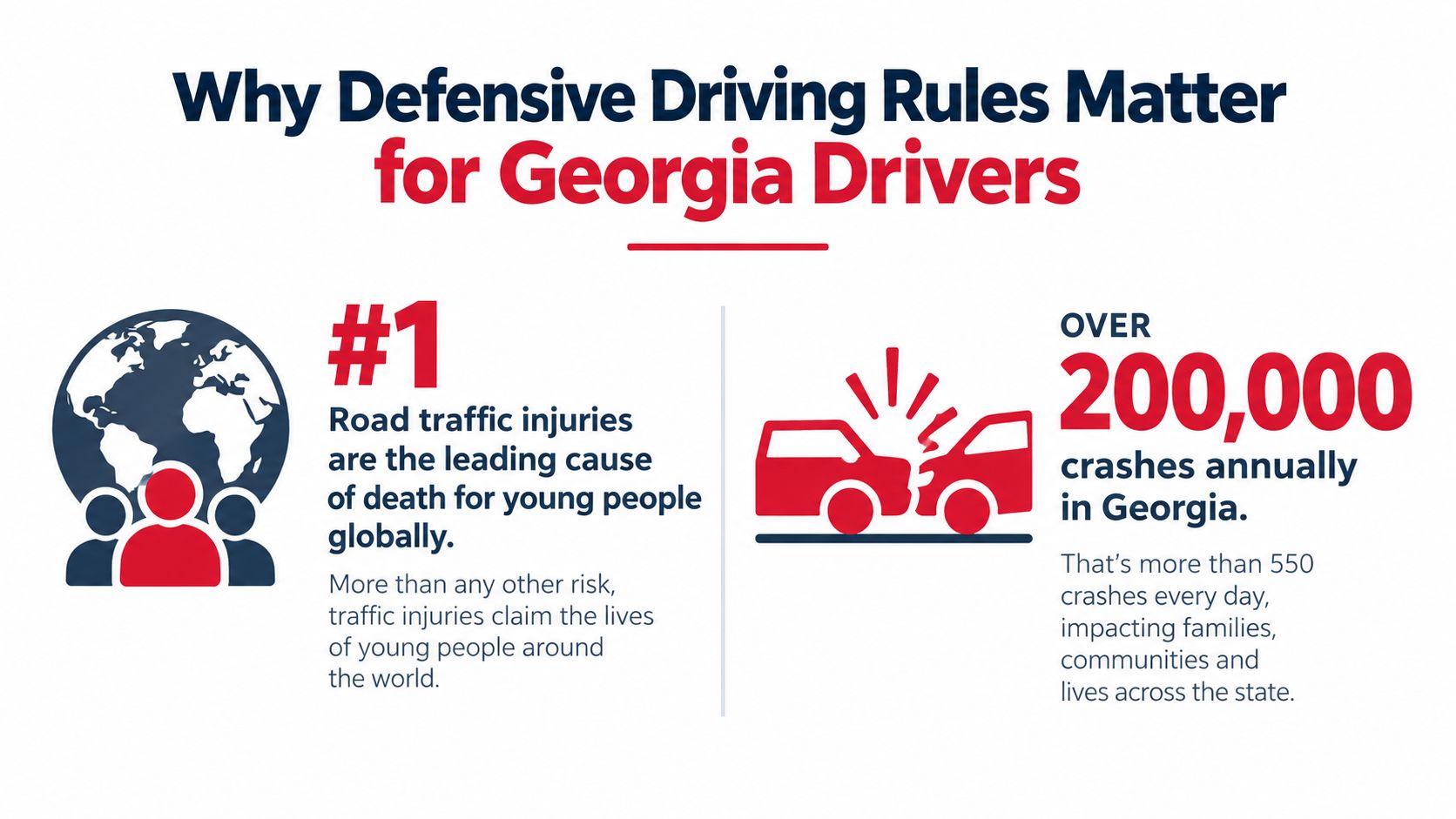
That ordinary decision reflects the scale of the problem. The World Health Organization's 2023 Global Status Report on Road Safety reported that approximately 1.19 million people died in road crashes worldwide in 2021, equal to about 15 deaths per 100,000 people. Road traffic injuries remained the leading cause of death for children and young adults ages 5–29, and more than half of fatalities involved vulnerable road users, including pedestrians, cyclists, and motorcyclists.
Defensive driving responds to human error
You can't control whether another driver checks a blind spot, follows too closely, or notices a pedestrian. You can control whether you leave room to react. Scanning, space management, lawful speed selection, yielding, and distraction prevention give you more time when another road user makes a poor choice.
The WHO report also found that only six countries had laws meeting best-practice standards for all five major risks, while 140 countries had best-practice legislation for at least one. The point for Georgia drivers isn't to memorize global legislation. It's to recognize that speeding, impairment, seat-belt nonuse, distraction, and vulnerable-road-user exposure create recurring risks across road systems.
Georgia rules make safety practical
For a teen working toward a Class D license, defensive driving supports the observation and control skills tested on the road examination. For an adult driver, it can help preserve a license after a citation, provided the driver follows Georgia Department of Driver Services requirements. In both cases, the foundation is the same: operate lawfully, expect mistakes, and create time and space before you need them.
Core Defensive Driving Rules Every Georgia Driver Should Know
Defensive driving becomes easier when you treat it as a repeatable process. See the hazard, decide what response gives you the most margin, and act early without creating a new risk.
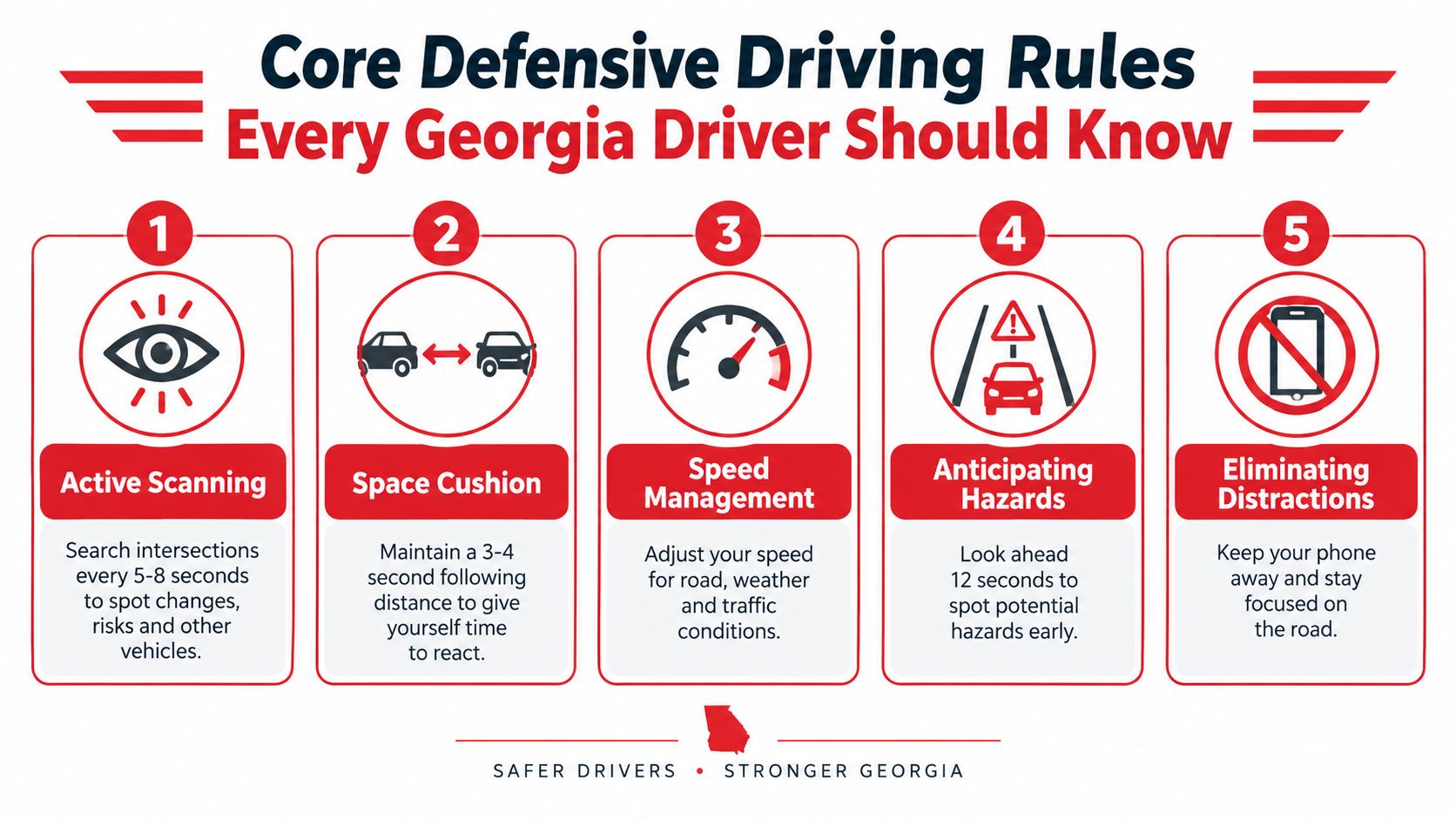
Scan actively
Don't stare only at the vehicle directly ahead. Check the roadway, both sides, mirrors, intersections, sidewalks, driveways, bike lanes, and your intended path before changing direction. At an I-85 merge, look for vehicles entering from behind and beside you before moving over. In a Fulton County school zone, watch for a child or crossing guard who may enter the roadway unexpectedly.
Maintain a space cushion
The NHTSA driver-education framework recommends maintaining at least four seconds of time and space behind the vehicle ahead. Choose a fixed roadside point, such as a sign or light pole. After the lead vehicle passes it, count “one-thousand-one” through “one-thousand-four.” If you reach the point sooner, increase the gap.
Rain, darkness, congestion, construction, slippery surfaces, and large vehicles that block your view all require more time. A four-second interval is a time-based rule, not a fixed number of car lengths, so the physical distance grows as speed increases.
Select speed for conditions
A posted limit is a legal maximum under stated conditions, not a guarantee that the same speed is safe during heavy rain, poor visibility, a crowded road, or a pedestrian-heavy area. If you can't maintain a safe stopping distance, reduce speed and adjust your lane position.
Speed-related factors appeared in 52% of fatal collisions compared with 34% of all collisions in recent Great Britain collision data. “Too fast for conditions” was recorded in 25% of fatal collisions, while exceeding the posted limit appeared in 29%, according to the Great Britain road-safety factors report. The lesson applies directly to Georgia: driving below the limit isn't automatically defensive if conditions still make that speed unsafe.
Remove distractions before moving
Put the phone away, set navigation before departure, and finish eating or adjusting controls while parked. Distraction includes mental overload, not just hand-held phone use. If anger, fatigue, or a difficult conversation has taken your attention from traffic, pause in a safe location before continuing.
Keep a response available
Look for places where you could stop or move safely if traffic changes. Don't swerve sharply without checking the adjacent space. If the vehicle hydroplanes, ease off the accelerator and keep steering smooth. If a hazard appears, brake firmly while looking toward the open path, rather than fixing your eyes on the object you want to avoid.
Practical rule: A defensive driver doesn't wait for certainty. They identify risk early and make a measured adjustment while options remain available.
How Defensive Driving Reduces Points and Protects Your Georgia License
Georgia's point system gives speed management a direct legal consequence. A driver who treats the posted limit as the only consideration may still choose a speed that leaves too little time for traffic, weather, or road design.
The Georgia Department of Driver Services point schedule assigns:
- 2 points: Driving 15–18 mph over the limit.
- 3 points: Driving 19–23 mph over the limit.
- 4 points: Driving 24–33 mph over the limit.
- 6 points: Driving 34 mph or more over the limit.
A Georgia license is generally suspended after 15 or more points within a 24-month period. Drivers under 21 can face suspension for a single four-point conviction, and drivers under 18 can face suspension after four points within 12 months. Those consequences make anticipation and speed selection more than classroom topics.
Course completion has limits
Georgia DDS treats Driver Improvement and Defensive Driving as interchangeable six-hour courses, and only DDS-certified providers are approved for this purpose. Eligible Georgia residents may reduce up to seven assessed points once every five years, but course completion doesn't automatically erase the conviction or guarantee an insurance-premium reduction.
The original completion certificate must be submitted to DDS as required. Before enrolling, confirm that the provider is certified and that the course fits the purpose of your court order or point-reduction request. A useful overview of the process is available in this guide to reducing points on a Georgia license.
The safest approach is to treat a course as both compliance work and a skills reset. Review speed decisions, following distance, intersections, and attention habits so the next trip doesn't repeat the behavior that caused the citation.
Joshua's Law Requirements and Defensive Driving Course Options
A general defensive driving course and a Joshua's Law program serve different purposes. Confusing them can delay a teen's Class D licensing process.
Joshua's Law applies to applicants ages 16 and 17 seeking a Class D provisional license. Georgia requires an approved driver-education program and supervised driving. One approved pathway includes:
- 30 hours of classroom instruction.
- 6 hours of behind-the-wheel training with a certified instructor.
- 40 hours of supervised driving with a parent or guardian.
- At least 6 nighttime hours within the supervised practice.
The Georgia DDS Joshua's Law requirements also allow equivalent combinations involving parent-taught driving or an approved online theoretical course. The selected combination still has to satisfy DDS requirements.
Compare the options carefully
An instructor-led program gives students classroom guidance and direct vehicle practice. An approved online theoretical course can provide flexibility for families managing school, work, or transportation. Parent-taught driving can add frequent practice, but the family must document the required supervised hours and choose an approved education pathway.
A defensive driving certificate alone doesn't fulfill Joshua's Law. It also doesn't replace supervised driving, the approved education component, or the road-skills examination.
| Path | What it can provide | What still matters |
|---|---|---|
| Instructor-led education | Structured classroom and professional driving instruction | Supervised practice and DDS documentation |
| Approved online theory | Flexible academic instruction | Required behind-the-wheel and supervised driving components |
| Parent-taught option | Practice with a parent or guardian | Approved combination, logged hours, and required nighttime driving |
Families should verify the provider before paying or beginning coursework. The Joshua's Law program information can help parents compare requirements, but DDS remains the governing authority for eligibility and documentation.
Road Test Preparation and Practical Driving Skills
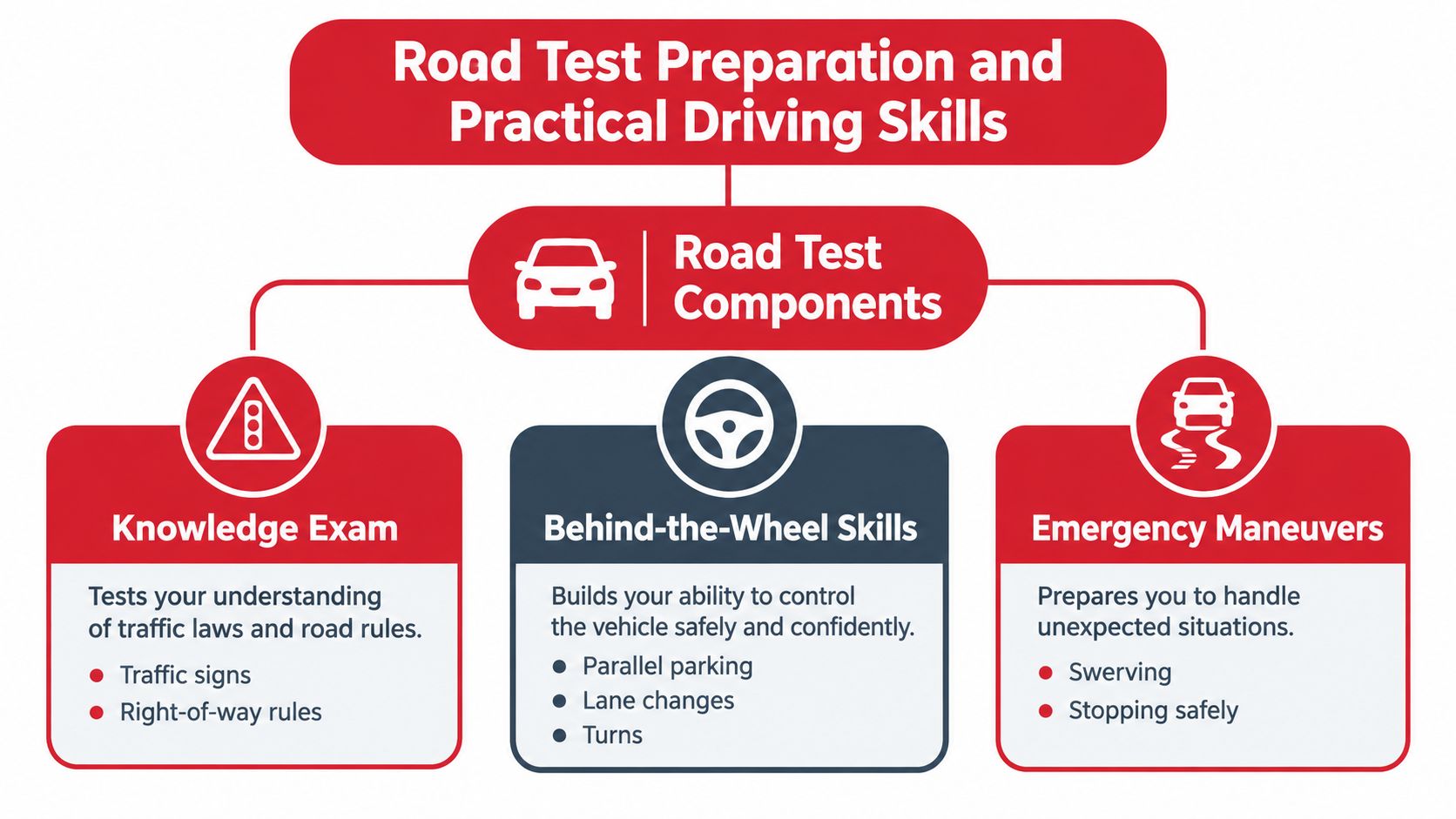
A student can know every sign in a study guide and still struggle on the road test. The examination measures whether the driver can turn knowledge into controlled behavior while managing the vehicle, roadway, and surrounding traffic.
Georgia separates the knowledge examination into a Road Rules Test and a Road Signs Test. Each requires at least 15 correct answers out of 20, according to the Georgia DDS testing information. Studying signs and right-of-way rules helps, but practice must also develop observation, signaling, lane control, turning, stopping, and maneuvering.
Prepare the vehicle as well as the driver
For the road test, the applicant must provide a vehicle with valid liability insurance and registration. The vehicle must pass the required safety inspection, and its license plate can't be expired.
A prepared student should practice the sequence, not just isolated maneuvers:
- Before moving: Adjust mirrors, fasten the seat belt, and check the surroundings.
- During each turn: Signal in advance, scan for pedestrians and cyclists, control speed, and finish in the correct lane.
- During lane changes: Check mirrors, check the blind spot, signal, and move only when the space is clear.
- At stops: Stop completely before the limit line or crosswalk, then check before proceeding.
- During maneuvers: Use smooth steering and controlled speed rather than rushing to finish.
The road-skills examination requires a minimum score of 75% to pass. Defensive habits help because they make the student's actions deliberate. A driver who routinely scans before steering is less likely to turn into a hazard. A driver who leaves space is less likely to brake abruptly. A driver who practices with feedback can correct a rolling stop or missed signal before test day.
Behind-the-Wheel Training and Certified Driving Lessons
Classroom education explains the rule. Driving lessons build the physical routine that allows a student to apply it under pressure.
A certified instructor can introduce skills progressively. The first lesson may focus on vehicle controls, stopping, starting, steering, and mirror use. Later practice can add turns, lane changes, parking, intersections, freeway entrances, dense traffic, and more demanding weather or visibility conditions. Immediate feedback matters because small habits, such as late signaling or weak mirror checks, become harder to change after months of repetition.
Why packages help students progress
A single lesson may identify a problem. A driving lessons package gives the student repeated opportunities to correct it, practice the correction, and demonstrate consistency. That structure is useful for teens completing the behind-the-wheel portion of Joshua's Law and for adults who need focused preparation before the Georgia road test.
A-1 Driving School offers instructor-led driving lessons and packages across 18+ metro Atlanta locations, including Athens, with scheduling options for teens and working adults. Its Georgia auto driving lessons are designed around practical vehicle control, road-test skills, and safer decision-making in real traffic.

Use each lesson deliberately
Ask the instructor to identify the student's highest-risk habit first. Then practice that skill in manageable conditions before adding traffic complexity. Parents can reinforce the same language during supervised driving, such as “check, signal, space, move,” so the student hears a consistent process.
Professional lessons don't remove the need for family practice. They give that practice a safer foundation and help the student understand what competent, defensive driving feels like.
Georgia Driver Education Scholarship Grant Program Access
Cost shouldn't force a Georgia student to postpone driver education or rely on an unapproved program. The Georgia Driver's Education Scholarship Grant Program offers driving training at state expense to qualifying students, creating an access route for families who need financial support.
Eligibility and application details can change, so students and parents should confirm the current requirements through the relevant school or state program channel. Start early, gather the requested documents, and ask whether the approved provider can deliver the classroom, behind-the-wheel, and road-test components needed for the student's plan.
A-1 Driving School holds the Fulton County Board of Education contract and delivers Driver's Education across all Fulton County Schools and numerous Atlanta high schools. That school-based access can make it easier for eligible students to connect scholarship support with an approved education pathway.
The grant should be viewed as part of a complete plan rather than a standalone certificate. Students still need to coordinate Joshua's Law education, supervised driving, nighttime practice, ADAP completion, permit timing, and the road-skills test. A parent or school coordinator can help track each requirement so funding, coursework, and practice work together instead of creating separate delays.
Your Complete Path to Safe Georgia Driving
A safe and compliant path looks different depending on where you are starting.
For a teen pursuing a Class D license: confirm Joshua's Law eligibility, choose an approved education option, complete the required classroom or online theory work, schedule professional behind-the-wheel instruction, log supervised driving with the required nighttime hours, complete ADAP, and prepare for both knowledge tests and the road-skills examination. DDS states that applicants generally need an Instructional Permit for 12 months and one day before applying for the Class D license, along with the required education, supervised driving, ADAP, and road test.
For an adult managing a citation: verify whether a DDS-certified six-hour course is accepted for your purpose, complete it within the required timeframe, submit the original certificate as instructed, and confirm how the course affects your assessed points. Don't assume it erases the conviction or guarantees an insurance change.
For a parent: choose approved education, schedule driving lessons early, supervise practice consistently, and focus on scanning, space, speed, signaling, and distraction prevention in every session. A complete plan connects instruction to real driving, not just to a certificate.
Defensive driving rules protect people first. They also support road-test performance and responsible license management when Georgia drivers apply them consistently.
A-1 Driving School offers Georgia driver's education, Joshua's Law programs, online and live learning options, road-test preparation, and instructor-led driving lessons packages for teens and adults. Visit A-1 Driving School to choose the training path that fits your license, practice, and defensive-driving goals.