There's no single “don't text and drive scholarship” created specifically for Georgia teens, but families can combine national essay awards such as the $1,000 Digital Responsibility scholarship with Georgia's Driver's Education Scholarship Grant Program and affordable driving lesson packages to reduce training costs.
A student may begin by searching for an essay prompt, while a parent is trying to answer a more practical question: how will we pay for the course, driving practice, and road test? The strongest answer usually isn't one award. It's a plan that connects safe-driving advocacy with Georgia's licensing requirements, available financial assistance, and enough supervised practice to build dependable habits.
Why Texting While Driving Matters More Than You Think
A teen is waiting at a traffic light when a notification appears. The car ahead hasn't moved yet, so checking the screen feels harmless. Then the light changes, traffic closes the gap, and the driver looks up already behind the situation.
That habit matters because a text takes more than a quick glance. The U.S. Bureau of Transportation Statistics explanation of texting-related distraction reports that sending or receiving a text takes a driver's eyes off the road for an average of 4.6 seconds. At 55 mph, that equals traveling the length of a football field without looking at the roadway.

A traffic light doesn't make phone use safe. A driver still has to monitor pedestrians, cyclists, lane movement, turning vehicles, and the actions of other motorists. The vehicle may be stopped for a moment, but the next driving decision begins as soon as traffic moves.
Why young drivers receive so much attention
Federal safety data show why teen-focused education remains necessary. In 2013, the National Highway Traffic Safety Administration reported 3,154 deaths and an estimated 424,000 injuries in crashes involving distracted drivers, with drivers aged 15 to 19 representing the highest proportion of distracted drivers in fatal crashes, according to the U.S. Department of Transportation's distracted-driving campaign announcement.
Young drivers are still learning how quickly a situation can change. They may have less experience judging closing distances, scanning far enough ahead, or recovering from a missed signal. That's why a scholarship essay should avoid treating phone use as a silly mistake. A strong submission explains the visual, manual, and mental demands involved, then shows how the student will change conduct.
Practical rule: A pledge is a starting point. A phone routine, practiced before every trip, is the behavior that matters.
Students researching the dangers of distracted driving should connect the issue to everyday choices. Put the phone out of reach before moving. Turn on a do-not-disturb setting. Ask a passenger to handle navigation or messages. If the phone must be used, pull over somewhere legal and safe.
A “don't text and drive scholarship” has greater value when it encourages those specific actions. The best applications show that the writer understands the difference between saying safe driving matters and making safe driving automatic.
Georgia's Joshua's Law Requirements Explained
Georgia teens and parents often hear “Joshua's Law” and assume it means taking one online class. It doesn't. The licensing pathway combines driver education, practical training, supervised driving, and a required timeline.
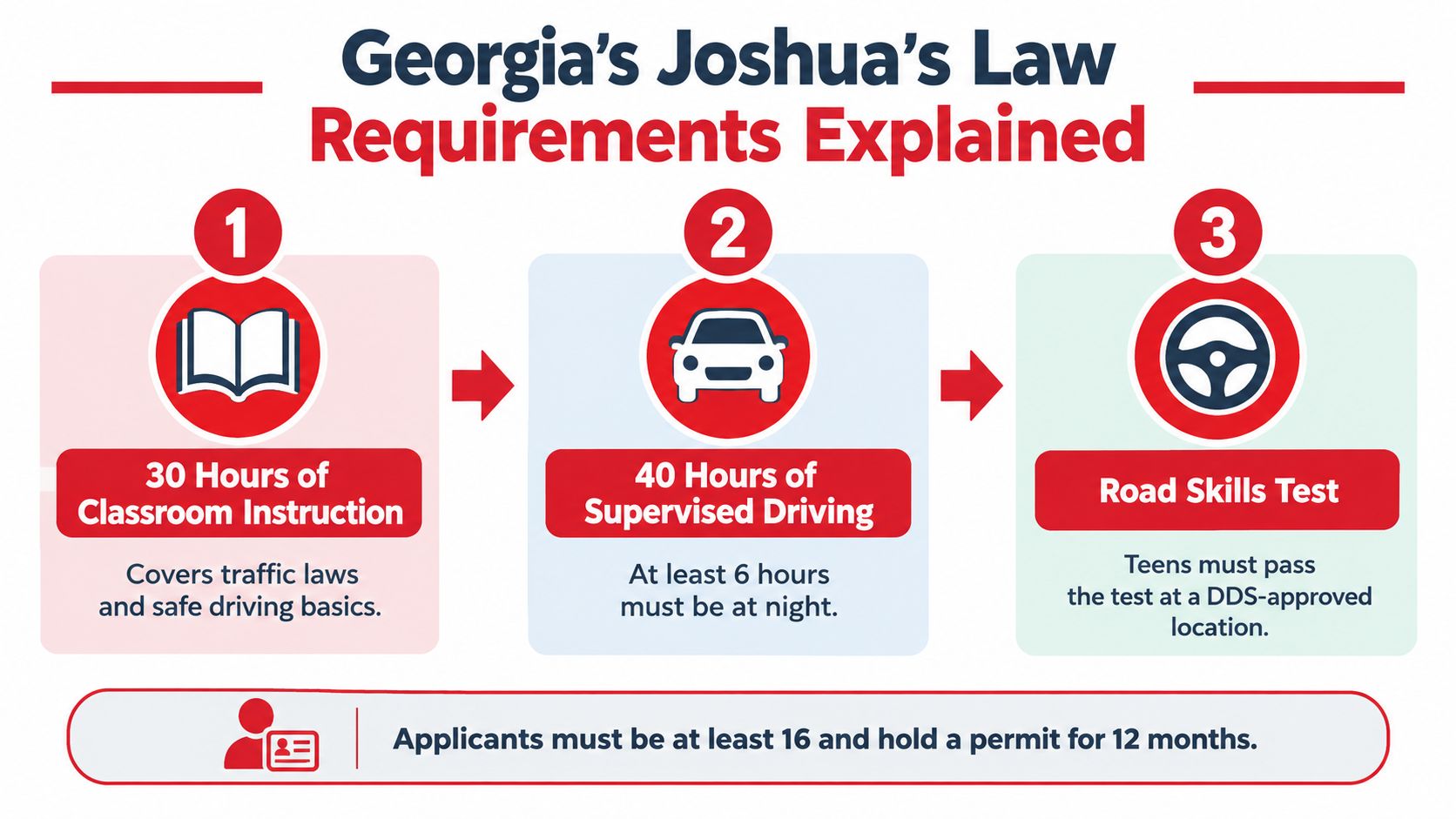
For eligible 16-year-olds applying for a Class D license or motorcycle permit, and for 17-year-olds applying on or after July 1, 2021, Georgia recognizes defined training pathways. The Georgia Department of Driver Services Joshua's Law requirements identify 30 hours of classroom instruction, 6 hours of behind-the-wheel training at a certified school, and 40 hours of supervised driving with a parent or guardian, including at least 6 nighttime hours.
The three parts families need to track
First, complete driver education. A student can take classroom instruction or an approved online or virtual course. The coursework covers traffic laws, decision-making, defensive habits, and the responsibilities that come with operating a vehicle.
Second, complete practical instruction. Online learning can explain mirror checks, braking, lane positioning, and hazard recognition. It can't replace time behind the wheel with a qualified instructor. The permit is required for behind-the-wheel training, so families should arrange the permit before booking practical lessons.
Third, complete supervised driving. Georgia requires 40 hours with a parent or guardian, including 6 hours at night. Those hours should be more than unstructured practice. A useful log includes the route, weather, traffic conditions, skills practiced, and whether the student handled distractions correctly.
The student must hold a learner's permit for 1 year and 1 day before receiving a Class D license, according to the state requirements. That waiting period gives families time to build experience rather than rushing through the minimum training steps.
Online instruction has a place, but it isn't the whole journey
An approved virtual course can be a good fit for students with sports, work, school, or transportation commitments. It may also help families in areas where attending a classroom course is difficult. But online instruction doesn't necessarily replace practical requirements, and it won't give a new driver the feel of steering, braking, scanning, and managing real traffic.
The Joshua's Law requirements guide can help families compare the classroom, virtual, behind-the-wheel, and supervised-driving pieces. Treat the process like a checklist, not a single purchase.
Before enrolling, confirm that the provider is certified for the course or practical training being used. Keep completion documents, the learner's permit information, the supervised-driving log, and parent or guardian records together. Missing paperwork can delay an otherwise prepared student.
Types of Scholarships and Financial Aid Available
Families should separate competitive essay awards from need-based driver-training assistance. They may support the same goal, but they aren't interchangeable.
A national Digital Responsibility award is commonly presented as a $1,000 opportunity with an essay or pledge component. Eligibility can include U.S. citizenship or permanent residency restrictions, so students should read the current rules carefully before spending time on an application. The award may help with training, but it doesn't automatically enroll the student in a Georgia-approved course or guarantee that every licensing requirement will be covered.
Georgia's Driver's Education Scholarship Grant Program addresses a different problem. It is designed to help qualifying students obtain driver training through state-funded assistance. The central questions are practical: Does the student meet the current need-based criteria? Which documents are required? Is the student eligible under Georgia rules? Which providers and redemption periods apply?
A national essay competition rewards a persuasive submission. A state grant may focus more directly on access to instruction. Families should compare both instead of assuming that the most visible scholarship is the most useful one.
| Program Type | Award Amount | Eligibility | Application Process |
|---|---|---|---|
| National Digital Responsibility essay award | $1,000 | Review the current citizenship or residency rules and any age or education conditions | Submit the required essay, pledge, or supporting materials by the published deadline |
| Georgia Driver's Education Scholarship Grant Program | Varies by current program rules | Qualifying Georgia students who meet the program's need-based and documentation requirements | Complete the state or approved-provider application and confirm training, provider, and redemption rules |
| Family-funded lesson package | Varies by provider | Any student who meets the provider's enrollment and permit requirements | Compare lesson content, scheduling, cancellation rules, and payment options |
| Combined funding plan | Depends on approved sources | Student qualifies separately for each award or grant | Confirm that funds can be combined and identify which expense each source will pay |
Access deserves attention because licensing can be harder for students in disadvantaged areas. A 2025 U.S. Department of Transportation research project found that 21% of under-25 residents in disadvantaged transportation districts completed driver training and obtained a license before age 18, compared with 43% in non-disadvantaged districts, as summarized by Scholarships360's scholarship and driver-training coverage.
That gap doesn't prove that one scholarship solves the problem. It does show why families should ask about training access, transportation, permit status, documents, and deadlines, not just essay quality. The guide to grants and scholarships can be a useful starting point, but families should verify current program rules before relying on any award.
How to Build a Competitive Scholarship Application
A strong application does more than announce that texting is dangerous. It explains what the student noticed, what behavior will change, and how the student will know whether the change lasts.
A committee has likely read many versions of “I promise never to text while driving.” Replace the general promise with a routine. For example, the student might explain that the phone will go into a bag in the back seat before the vehicle moves, notifications will be silenced, and a passenger will manage navigation. The application becomes stronger when the writer explains how that routine will work during school commutes, family trips, and rides with friends.

What makes the essay credible
Use a real observation rather than an invented dramatic story. A student might describe seeing a driver reach for a phone at a light, hearing friends pressure a driver to answer a message, or realizing that passengers can create distractions too. The point isn't to embarrass someone. It's to show that the applicant understands how social pressure affects driving.
Then connect the message to action. A student could propose a family phone-storage rule, a classroom presentation, a peer campaign, or a parent-teen driving agreement. The plan should identify what will be done, who will participate, and what will be checked later.
Evidence from enforcement and publicity campaigns supports this emphasis on measurable conduct. NHTSA demonstration projects recorded observed handheld-phone-use declines from 6.6% to 2.9% in Hartford and from 3.7% to 2.5% in Syracuse, according to the NHTSA evaluation of distracted-driving demonstration projects. Those results don't guarantee that an individual essay campaign will produce the same outcome, but they show why a coordinated intervention is more meaningful than collecting pledges alone.
Application checklist
- Read the current eligibility rules: Confirm residency, citizenship, age, school, and enrollment requirements before drafting.
- Record the deadline: Save the official deadline in a calendar and set an earlier personal target.
- Answer every prompt: Address the requested question directly instead of submitting a general safety essay.
- Use specific actions: Name the phone routine, passenger expectation, parent involvement, or school activity.
- Add measurable checks: Track completion, protocol performance, observed phone handling where appropriate, and whether the routine continues after the initial campaign.
- Collect documents early: Keep identification, school records, permit information, recommendation details, and grant materials together.
- Proofread for clarity: Remove exaggerated claims, unsupported statistics, and language that sounds copied.
- Review privacy: Don't include another person's name, medical information, crash details, or photograph without permission.
A useful test: If the essay promises change, a parent, teacher, or reviewer should be able to ask, “How will you check that?” and receive a clear answer.
Students should also avoid claiming that a short survey proves fewer crashes. Self-reported intentions can be useful, but they aren't the same as observed behavior. A careful application distinguishes awareness, participation, correct protocol performance, and sustained conduct.
Combining Scholarships with A-1 Driving School Programs
A scholarship helps most when it covers a specific licensing need. A student may win an essay award and still need an approved course, behind-the-wheel instruction, supervised practice, or road-test preparation. Before enrolling, the family should list each remaining requirement and assign available funds to it.
Start with the cost the student still has to cover. If a grant pays for classroom instruction, scholarship money could fund driving lessons or a lesson package. Completing an online course may still leave the student needing certified behind-the-wheel instruction and a schedule for supervised driving hours.
A-1 Driving School offers in-person and online driver education, Joshua's Law courses, individual lessons, lesson packages, and Georgia road-test preparation and testing assistance. Families can compare those options with the student's schedule, permit status, transportation, and confidence behind the wheel. The right choice is the one that fits the licensing stage, rather than just the one with the broadest package.
Where lesson packages add value
A single lesson can uncover a problem. A package gives the instructor time to correct it, observe the student again, and build consistency. That repeated practice helps students who steer late, brake abruptly, skip mirror checks, or lose focus when traffic becomes busy.
Each lesson should reinforce a clear anti-texting routine. Before moving, the student can silence or put away the phone. During practice, the instructor can work on intersection scanning, passenger management, and pulling over safely when attention is needed elsewhere. Those actions give practical meaning to the safety commitment made in a scholarship application.
Georgia's distracted-driving rules also make phone handling part of responsible driver training. Students should review the Georgia DDS distracted-driving rules and ask an instructor to explain how the rules apply during supervised practice. Training cannot remove every risk, but it can give a new driver a repeatable process for managing attention.
Families should ask these questions before combining funds:
- Confirm allowable expenses: Check whether each award or grant covers classroom instruction, practical lessons, testing, or only a named service.
- Match funding to gaps: Use restricted funding first, then apply flexible scholarship money to remaining lessons or preparation.
- Check provider rules: Verify approved providers, payment timing, redemption windows, and required documents.
- Keep records: Save award notices, receipts, completion certificates, lesson logs, and grant confirmations.
- Avoid overbooking: Schedule lessons around the student's permit timeline and readiness, not only around available funds.
A simple funding record can prevent missed requirements. List the award, permitted use, payment deadline, provider, and remaining balance before booking lessons. That record helps the family connect safe-driving advocacy with a practical Georgia licensing path, including the training needed to meet Joshua's Law requirements.
Next Steps for Getting Started
Start with the student's current position. Does the student have a learner's permit? Is the classroom or virtual course complete? Has the family begun logging supervised driving? Does the student need confidence-building lessons, a full package, or help preparing for the road test?
Write those answers down before calling a school. Then gather the permit, parent or guardian information, school records, scholarship notices, and any grant documents. A clear file helps the provider explain which course or lesson option fits and prevents families from paying for a requirement they've already completed.
Road-test preparation deserves its own plan. Georgia DDS says the automobile road-skills test is appointment-only. The applicant must bring an eligible four-wheel vehicle with valid registration or a qualifying temporary dealership tag, current liability insurance, and a safe vehicle. The applicant must also arrive with a licensed driver who is at least 21 years old, and only the applicant and accompanying driver may be inside the vehicle during the test, according to the Georgia DDS road-test requirements.

For students who need help organizing schoolwork alongside driving practice, a reputable tutoring resource such as Tutorbase can help families find academic support while the student completes driver education. The driving plan still needs its own schedule, but reducing school-related conflicts can make consistent practice easier.
A simple starting sequence
- Check scholarship and grant eligibility. Confirm current requirements directly with the awarding organization or Georgia program.
- Confirm the permit and Joshua's Law pathway. Identify whether classroom, virtual, behind-the-wheel, supervised, nighttime, or road-test requirements remain.
- Choose instruction that fills the gap. Compare individual lessons with packages based on skill level and available funding.
- Schedule practical training early. Leave time to correct habits instead of booking a single lesson immediately before the road test.
- Build a no-phone routine. Put the device away before moving, and make the same choice every trip.
- Prepare the test vehicle and documents. Confirm insurance, registration, safety condition, appointment details, and the accompanying licensed driver.
The goal of a “don't text and drive scholarship” isn't only to produce a well-written essay. It's to help a young driver turn a safety message into sound decisions, adequate practice, and a responsible path to a Georgia license.
A-1 Driving School offers Georgia Driver's Education and Joshua's Law courses, online and in-person options, individualized driving lessons, lesson packages, and road-test preparation. Visit A-1 Driving School to compare programs, review available support, and take the next step toward safer, better-prepared driving.