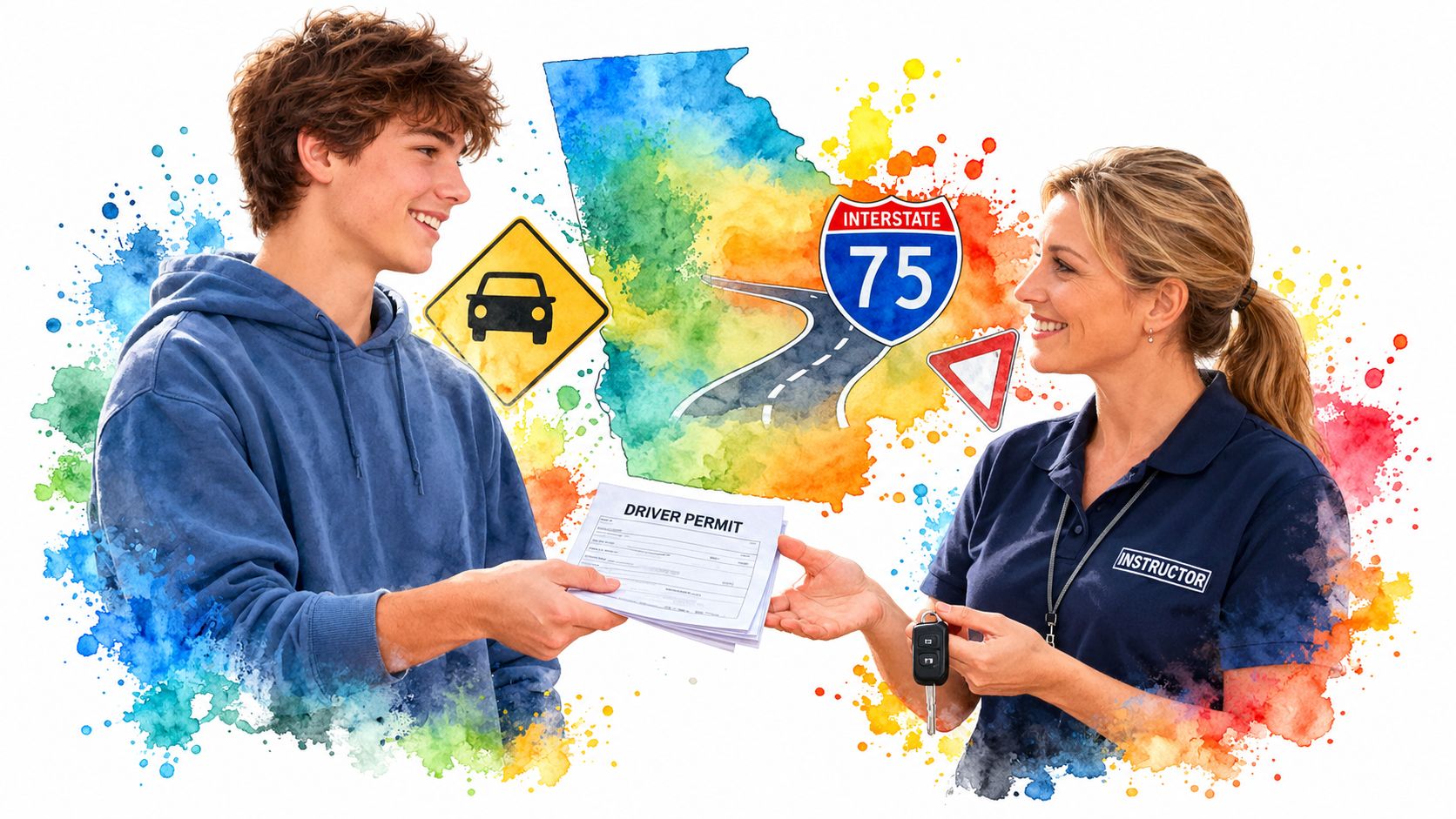
To get a Georgia learner's permit, teens must be at least 15, pass vision and knowledge tests, provide identity, lawful-presence, and Georgia-residency documents, and pay a $10 fee. That's only step one, because reaching a Class D provisional license requires a structured journey that includes at least 1 year and 1 day of permit holding, supervised practice, driver education, and road testing.
Your family may be standing at the kitchen counter with a DDS checklist, trying to work out which documents belong in the folder and what happens after the written test. The process can feel complicated, but it becomes manageable when you treat the permit as the starting point for training rather than the finish line.
Georgia's system is designed to move a teen from basic knowledge to supervised experience and then to practical driving skill. Professional lessons, a suitable Joshua's Law course, and a consistent practice plan can connect those stages and make the road test feel like the next step in training, not a surprise exam.
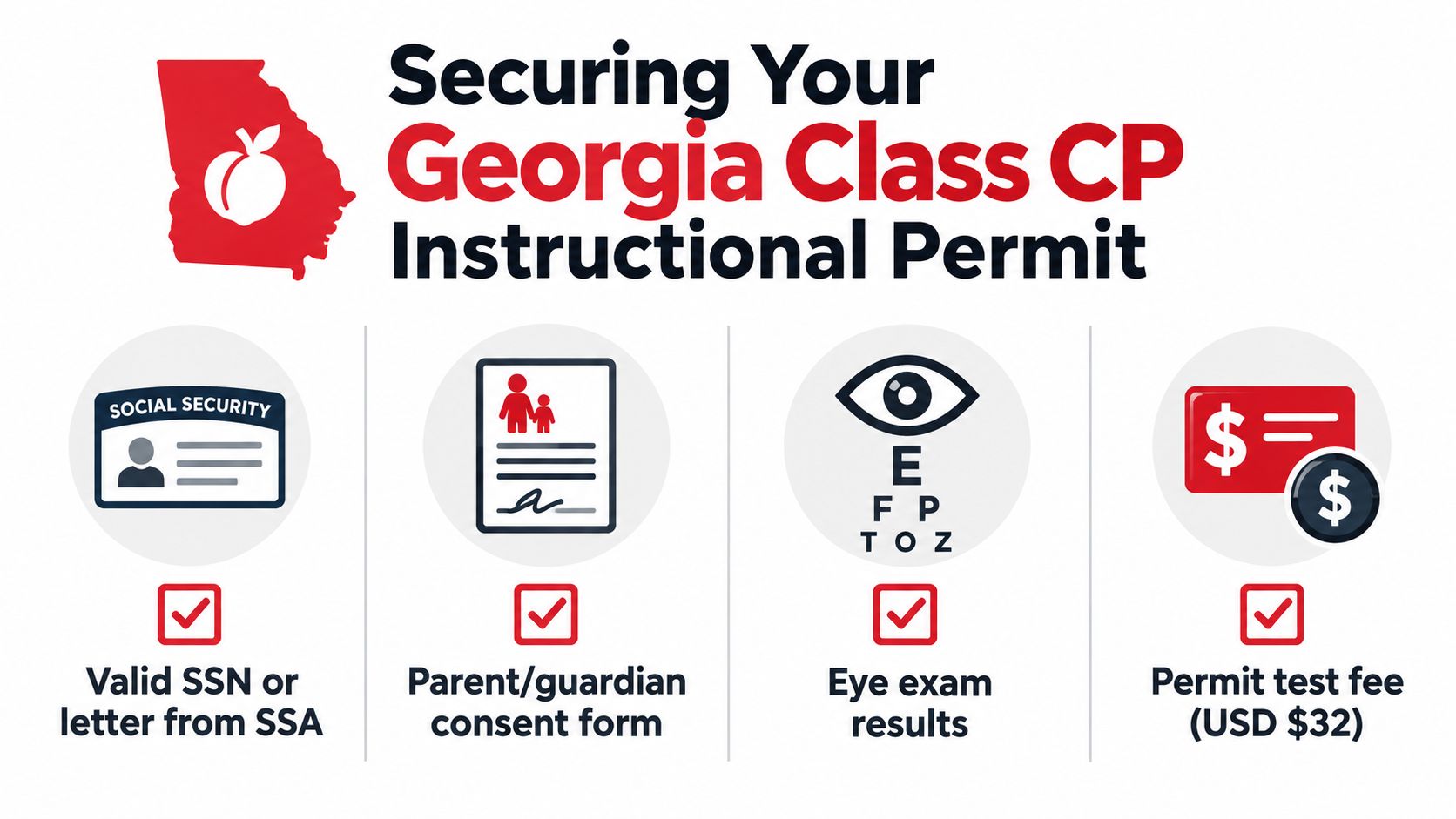
Securing Your Georgia Class CP Instructional Permit
The Class CP Instructional Permit is the first formal credential for most Georgia teens learning to drive. A teen may apply at 15 or older, but age alone isn't enough. The applicant must prepare documents, complete testing, and secure the required consent if they're under 18.
Before visiting a DDS Customer Service Center, organize proof of identity, lawful presence, and Georgia residency. Requirements can depend on the applicant's circumstances, so families should review the current Georgia DDS learner's permit requirements and bring the documents listed for their situation. Missing paperwork can delay the visit even when the applicant is ready for the exams.
The permit visit checklist
The applicant must pass two examinations:
- Vision screening: This confirms that the applicant meets the basic visual standard for driving.
- Knowledge examination: This covers Georgia road signs and road rules, so studying both subjects matters.
- Consent for minors: Applicants younger than 18 need approval from a parent, legal guardian, or responsible adult.
- Permit fee: The Class CP permit fee is $10, according to Georgia DDS permit guidance.
The knowledge test checks whether a student understands written rules. It doesn't prove that the student can position a vehicle, judge a gap, or control the car on a busy road. That distinction is important because passing the test authorizes supervised learning, not independent driving.
Practical rule: Treat the DDS appointment as a document check, testing appointment, and beginning of a training plan. A folder prepared in advance helps your teen focus on the exam instead of scrambling at the counter.
Understanding Permit Supervision Rules and Restrictions
A Class CP permit doesn't let a teen drive alone. Georgia treats it as a supervised-learning credential, which means every drive must include a qualified adult who can respond immediately if the student makes a mistake.
The supervising adult must be at least 21 years old, hold a valid Class C license, sit in the front passenger seat, and be capable of taking control of the vehicle. These aren't casual recommendations. The adult's position beside the learner gives them the opportunity to respond to a missed stop, unsafe lane movement, or developing hazard.
Why the front seat matters
A supervising adult sitting in the back seat may be able to offer advice, but they can't intervene as quickly. Georgia's rule creates continuous, immediate supervision by placing the licensed adult next to the permit holder. The adult should remain alert, avoid distractions, and watch the road rather than assuming the student will handle every situation correctly.
Families should plan practice around an eligible supervisor instead of assuming any experienced driver can accompany the teen. Review the practical details in this guide to driving with a permit in Georgia before the first practice session.
A useful progression starts in a quiet area, then moves to ordinary neighborhood streets, intersections, lane changes, parking, and more complex traffic as the student becomes ready. The permit period gives the family time to repeat skills until they become consistent, but practice should still have a purpose.
Supervision means readiness to intervene. The adult isn't just a passenger. They're responsible for maintaining a safe learning environment and taking control when necessary.
Parents can make practice more productive by choosing one or two goals per drive. One session might focus on smooth stops and turns. Another might work on observation, lane position, and mirror checks. This approach gives the student clear feedback without turning every trip into an overwhelming evaluation.
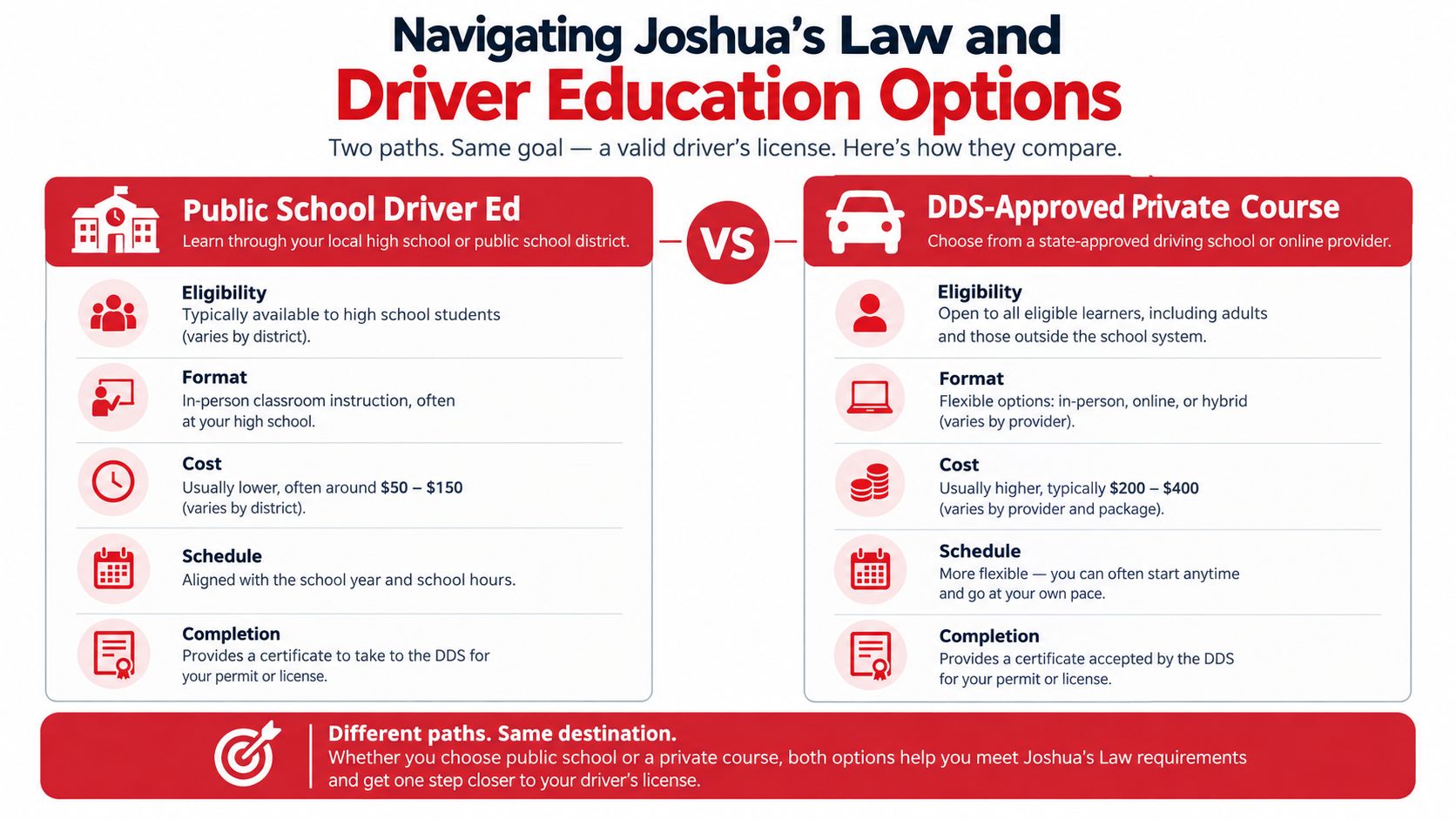
Navigating Joshua's Law and Driver Education Options
For many 16- and 17-year-olds pursuing a Class D provisional license, earning a permit is only the starting point. Georgia's Joshua's Law pathway combines formal driver education, supervised driving, and practical training. The requirements include at least 30 hours of approved classroom or equivalent online instruction, plus either 6 hours of behind-the-wheel instruction at a certified school or the approved parent-training alternative, as explained in the Georgia DDS Joshua's Law requirements. Families can also review this guide to Joshua's Law requirements when mapping out the training pathway.
Families usually choose between classroom instruction and an approved online course. The right option depends on the student's schedule, study habits, and need for live support.
Classroom and online learning compared
| Option | Useful when | What families should confirm |
|---|---|---|
| In-person classroom | A student learns well with a teacher, scheduled sessions, and group discussion | The program is approved for the required driver education component |
| DDS-approved online course | A student needs flexible access from home or wants to work around school and activities | The course satisfies the applicable Georgia requirement |
| Certified behind-the-wheel training | A student needs objective feedback and structured vehicle practice | The provider is certified and the training fits the licensing pathway |
Online instruction can make the theory portion easier to schedule, particularly for students who study effectively at home. Classroom learning may work better for teens who benefit from asking questions in real time and hearing other students' questions. Both approaches explain the rules. Neither creates the steering, braking, observation, and decision-making habits needed on the road.
The Georgia Driver's Education Scholarship Grant Program may help qualifying families pay for driver training. Check eligibility and program details before enrollment, since funding rules may affect the course or provider a student can use.
A strong plan connects classroom knowledge with practice. A student may learn a right-of-way rule during a course, then apply it at an intersection with an instructor or qualified supervising adult. That repeated connection turns written answers into usable decisions and helps bridge the gap between passing the knowledge test and preparing for the road test.
Building Real Road Skills with Professional Driving Lessons
A parent can provide valuable practice, but parent-led driving alone may not reveal every habit that needs correction. Students often repeat small problems, such as turning too wide, checking mirrors too late, braking unevenly, or drifting within a lane, without realizing those habits could affect road-test performance.

A professional instructor brings an objective view and a planned sequence of exercises. Instead of just driving until the student feels comfortable, the instructor can observe vehicle control, steering, braking, lane placement, scanning, and decision-making. Lessons can then target the specific skill that needs work.
Why lesson packages help
A single lesson may introduce techniques, but a driving lessons package gives the student repeated opportunities to apply feedback. A package can be organized around foundational control first, followed by intersections, lane changes, parking, observation, and road-test preparation. The student gets time to improve rather than trying to correct every weakness in one appointment.
This is especially useful in complex Atlanta-area traffic, where students may need to manage multiple lanes, changing traffic speeds, unfamiliar intersections, and frequent decisions. Professional lessons don't replace the required parent-supervised practice. They make that practice more focused by giving the family concrete skills to reinforce.
Read more about the benefits of taking driving lessons from an instructor when deciding how to combine family practice with professional training.
A practical lesson plan might begin with a vehicle-control assessment, continue with customized teen or adult lessons, and finish with road-test preparation. A student who knows what the examiner expects can concentrate on driving safely and consistently instead of guessing which habits matter.
Here's a closer look at the kind of structured instruction families may use while preparing for the practical stage:
The aim isn't to make a student dependent on an instructor. It's to help the student become independent with better judgment, reliable control, and enough varied experience to handle the test and everyday driving.
Transitioning from Permit to Class D Provisional License
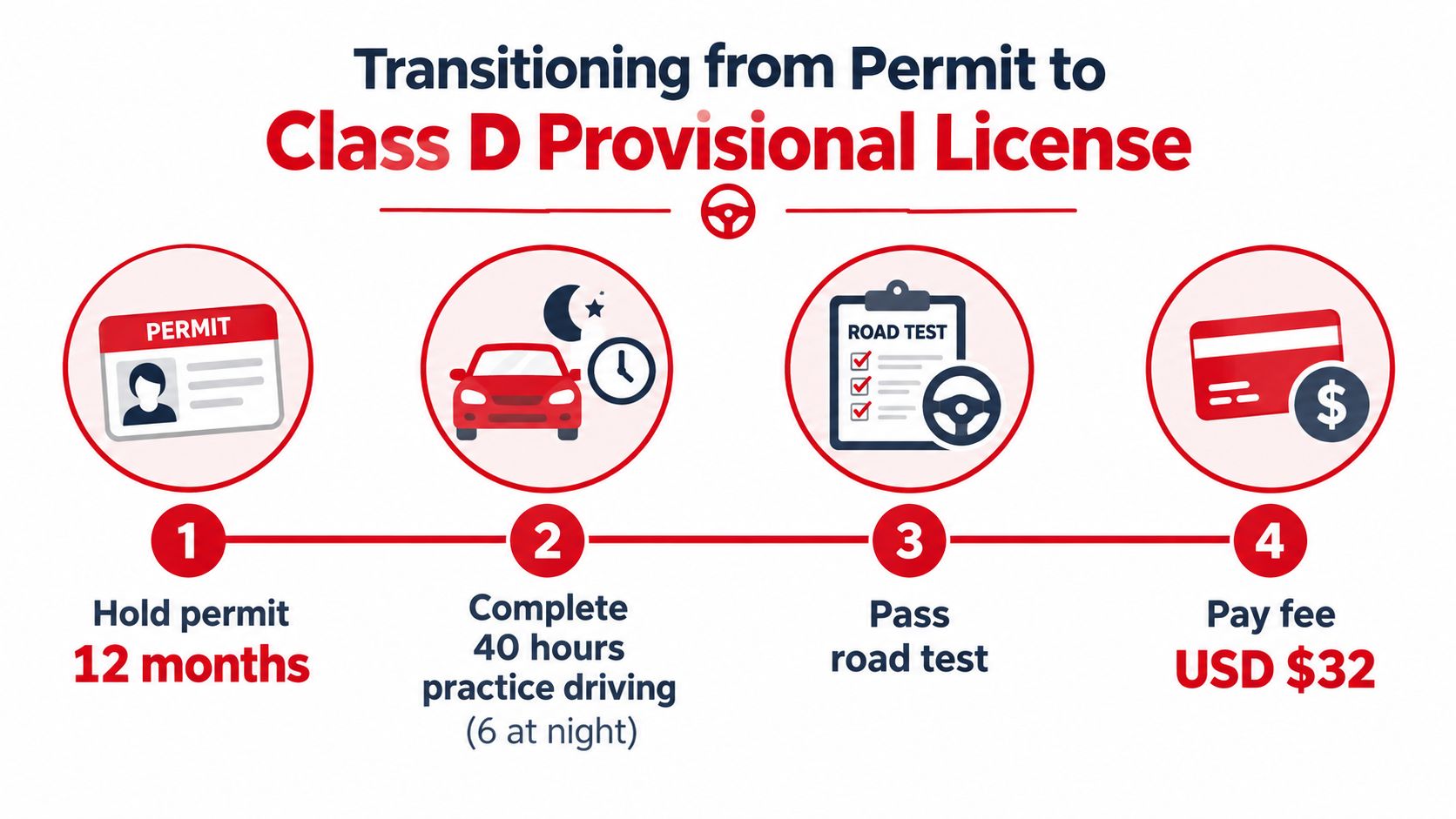
The move from Class CP to Class D is based on readiness and eligibility, not just passing the permit exam. For most 16- and 17-year-old applicants, the permit must be held for at least 1 year and 1 day, and the applicant must complete the required education, practice, and testing.
Use the following checklist as the final planning framework:
- Complete the holding period. The applicant must have held the instructional permit for at least 1 year and 1 day, according to the Georgia DDS teen driving requirements.
- Finish supervised practice. The applicant must complete at least 40 hours of supervised driving, including 6 hours at night.
- Complete education requirements. Applicants under 18 must satisfy the applicable Joshua's Law driver-training requirements.
- Pass the final examinations. The applicant must pass the vision exam and road-skills test.
- Prepare the vehicle and documents. DDS requires a scheduled road-test appointment, required documents, and a properly equipped vehicle, as detailed in the Georgia Class D road-test guidance.
Handling the practice-hour requirement
DDS says a driving log isn't required, but a parent, guardian, or certified instructor must affirm under penalty of law that the applicant completed the required practice, including the nighttime hours. Families may still keep their own record because it helps identify gaps in experience and prevents a last-minute scramble.
Practice should cover more than a familiar neighborhood. A student needs repeated opportunities to control the vehicle, observe traffic, maneuver accurately, and respond calmly to ordinary road situations. Professional preparation can focus on these skills while parents provide additional supervised practice between lessons.
The road test appointment and state requirements remain governed by DDS. A driving school may offer road-test preparation or testing assistance, but the applicant still needs to meet the state's eligibility rules and arrive with an acceptable vehicle and documents.
Your Action Plan for Georgia Driving Success
The smoothest path starts before the DDS visit. First, confirm that the teen is at least 15, gather identity, lawful-presence, and Georgia-residency documents, arrange consent if needed, and prepare for the vision and knowledge examinations. Once the Class CP permit is issued, schedule supervised practice with an eligible adult rather than treating the permit as permission to drive independently.
Next, choose an approved education route that fits the student's schedule. A classroom or approved online course can provide the theory component, while certified behind-the-wheel instruction can address the physical skills that written study can't teach. Families who qualify should also investigate the Georgia Driver's Education Scholarship Grant Program before paying for training.
Then build a calendar around the full licensing pathway. Include the permit holding period, the required supervised driving with nighttime experience, professional lessons or the approved practical alternative, and enough time to prepare the vehicle and documents for the road test. DDS explains the available education and practice paths in its driver education FAQ.
A practical family timeline
- Before the DDS visit: Gather documents, study signs and rules, and confirm the permit fee.
- After receiving the permit: Arrange qualified front-seat supervision and begin purposeful practice.
- During the permit period: Complete the approved theory course, practical training, and supervised driving.
- Before scheduling the test: Review vehicle controls, observation habits, maneuvering, and road-test procedures.
- At the final stage: Confirm eligibility, schedule appropriately, and bring the required vehicle and documents.
The most useful mindset is steady progress. A teen doesn't need to master every road situation immediately, but they do need regular practice, honest feedback, and enough time to turn instructions into reliable habits.
A-1 Driving School offers Georgia driver education, including online options that support Joshua's Law requirements, customized teen and adult driving lesson packages, and road-test preparation and testing assistance. Visit A-1 Driving School to review course options, explore available training support, and book the next step toward your Georgia Class D license.