You've finished your driving lessons, your parent says you're ready, and then one question stops everything: how do you schedule a road test in Georgia? The answer depends on where you are in the licensing pathway, whether your training is complete, and whether your vehicle and documents will pass the check-in requirements. A little planning prevents the most frustrating outcome, arriving for an appointment and learning you can't test.
Understanding the Georgia Road Test Pathway
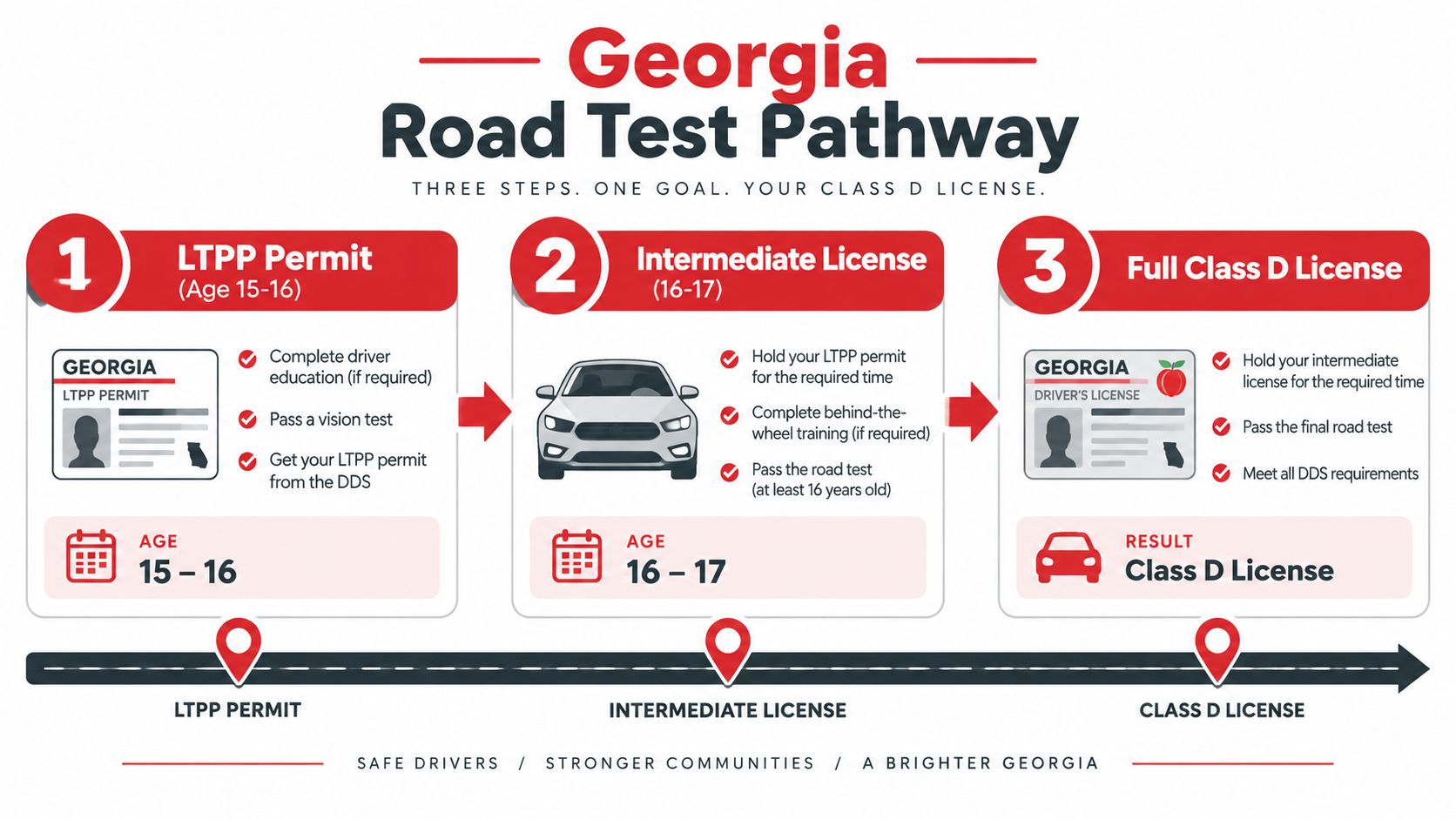
Georgia treats the Class D road test as the final assessment in a staged licensing process, not as an isolated appointment. A teen may have a permit, substantial driving experience, and completed lessons, yet still be unable to schedule the test if the required milestones aren't complete.
For a provisional Class D license, the applicant must be at least 16 years old and must have held a Class CP instructional permit for at least 1 year and 1 day. The applicant must also complete a vision examination and pass a road-skills test that evaluates safe vehicle operation. Applicants younger than 18 must complete 40 hours of supervised driving, including 6 hours at night, and qualifying applicants must complete Joshua's Law training. These requirements are described by the Georgia Department of Driver Services Class D licensing pathway.
Find your place in the process
Consider a student who received a Class CP permit and immediately began practicing with a parent. The student may feel ready after several months, but the permit holding period still matters. Scheduling too early creates a wasted appointment and can disrupt the family's practice plan.
An adult applicant follows a different preparation path. Adults still need the appropriate Georgia learner's permit and must satisfy the requirements that apply to their license application, but the teen-specific Joshua's Law and supervised-driving conditions described above apply to applicants ages 16 and 17 seeking a Class D provisional license. Confirm your individual status with DDS before choosing an appointment.
Practical rule: Don't schedule from memory. Check your permit date, age, completed training, and supervised-driving documentation first.
The pathway is easier to manage when you treat it as a sequence:
- Hold the instructional permit for the required period.
- Complete approved education and practical training.
- Log supervised driving and required night driving if you're under 18.
- Prepare the vehicle and documents.
- Book and attend the road-skills test.
The road test is therefore a milestone inside a larger preparation process. Knowing your stage helps you avoid booking before you're eligible or assuming that passing a lesson evaluation automatically satisfies DDS requirements.
Joshua's Law Requirements You Must Complete
Joshua's Law connects classroom education, behind-the-wheel instruction, and supervised practice for Georgia applicants ages 16 and 17 seeking a Class D provisional license. Before you focus on appointment times, identify which education and training pathway you'll use.
Complete approved driver education
The theory requirement is at least 30 hours of classroom or online instruction, and the course must be approved by the Georgia Department of Driver Services. DDS recognizes classroom and web-based instruction as alternatives, but an online format alone doesn't automatically satisfy every practical requirement. The DDS driver education FAQs distinguish the approved theory component from behind-the-wheel and supervised-driving obligations.
A course that isn't DDS-approved can create a serious documentation problem. Before enrolling, verify that the provider's course is approved and keep completion records with your other licensing documents. A-1 Driving School's Joshua's Law requirements and course information can help families compare the available training components.
Choose the practical training route
The practical requirement can be completed through 6 hours of behind-the-wheel instruction with a certified instructor or through completion of the approved DDS Parent/Teen Driving Guide, depending on the selected Joshua's Law method. Read the pathway carefully before assuming that a parent's practice sessions and professional lessons are interchangeable.
Professional driving lessons can be useful even when a family chooses the Parent/Teen Guide. An instructor can identify habits that parents may overlook, such as drifting toward a lane line, turning without a full mirror check, or braking late at intersections. Lessons should complement supervised practice, not replace the required documentation.
Document supervised experience
Applicants under 18 must document at least 40 hours of supervised driving, including at least 6 hours at night. Night driving represents at least 15% of that required experience, calculated as 6 of 40 hours, according to the DDS requirements for the Class D pathway.
Use a consistent record rather than trying to reconstruct hours just before the appointment. Record the date, approximate route or driving activity, conditions, and whether the session occurred at night. Parents or guardians should review the entries as practice continues, because missing or unclear documentation can delay the application.
A useful practice pattern includes neighborhood driving, traffic signals, lane changes, parking, turnabouts, and roads with different traffic levels. The aim isn't merely to accumulate time. It's to build reliable decision-making before test day.
How to Schedule Your Georgia Road Test Appointment
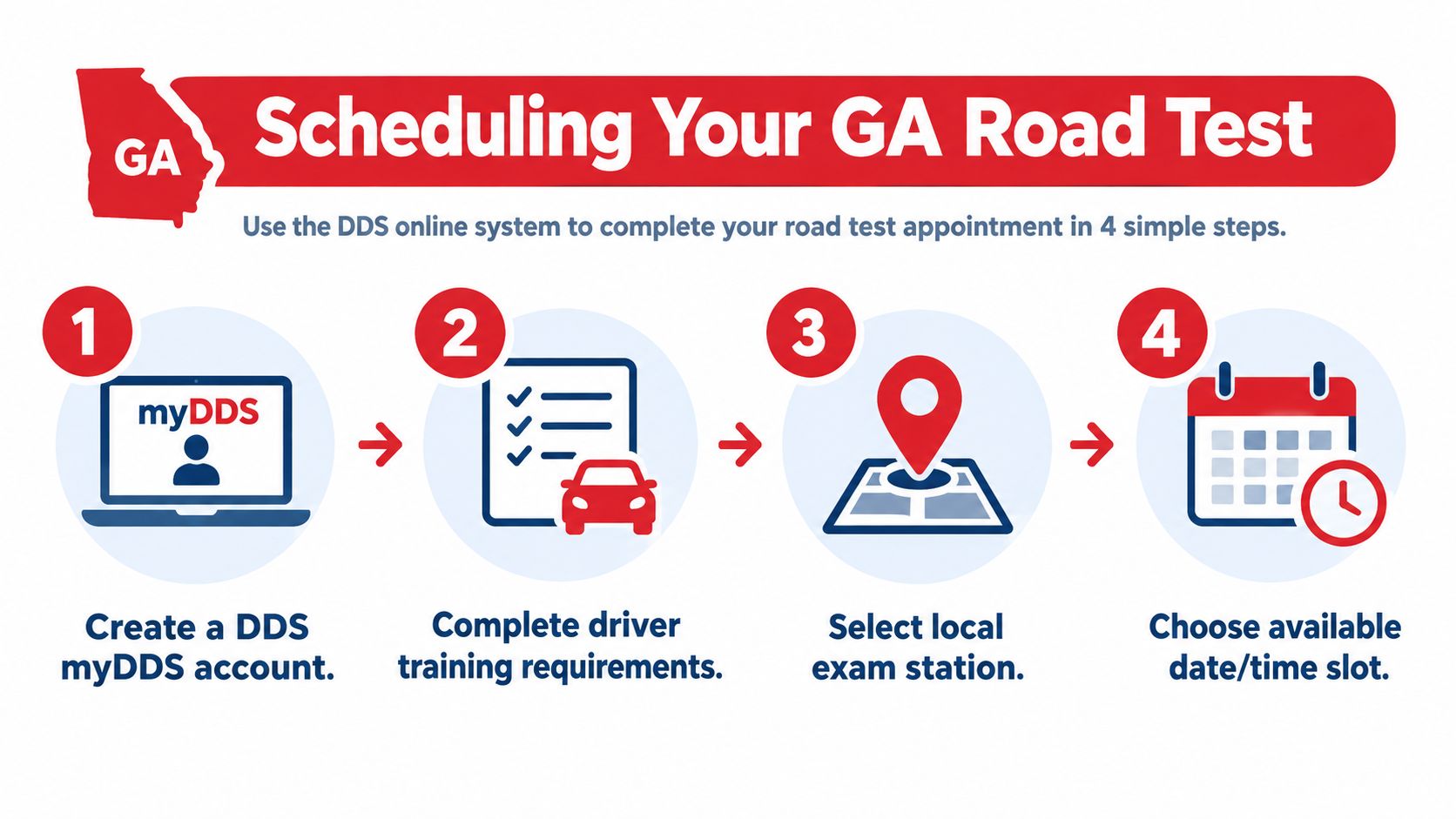
Georgia DDS requires applicants to submit the Online License/ID/Permit Form before scheduling a behind-the-wheel test, and walk-ins aren't accepted. Start with the official DDS process, then work through the vehicle and applicant conditions before confirming the appointment.
Follow the scheduling sequence
- Complete the Online License/ID/Permit Form. Submit it before trying to reserve the road test.
- Use the DDS appointment system. Select the appropriate road-skills testing service and a convenient location.
- Save the appointment details. Keep the appointment number and scheduling email available.
- Plan the arrival. Bring the applicant, the required vehicle, documents, and a licensed driver age 21 or older.
Noncommercial road-test reservations are free. The appointment number and scheduling email are needed if you must modify or cancel the reservation, so don't delete the confirmation message.
This video about Georgia road-test preparation and scheduling can help you visualize the process before you begin.
Use the right decision path
Your situation determines what to check next:
| Your situation | What to do |
|---|---|
| First-time applicant | Confirm your permit, education, practical training, supervised-driving record, and identification documents are ready before booking. |
| Retest applicant | Review the previous weak areas, verify that your permit and documents remain valid, and confirm whether any DDS instructions affect the new appointment. |
| Personal vehicle | Check registration, insurance, safety equipment, and general condition before the test date. |
| Rental vehicle | Make sure you're named on the rental agreement, bring the contract and proof of insurance, and confirm that the rental agreement allows driver training or testing. |
| Permanent tag | Carry the current registration and insurance documents. |
| Temporary tag | Bring the acceptable temporary-tag documentation and, for a recently purchased vehicle, supporting paperwork such as the bill of sale. |
A rental car deserves special attention. Many rental agreements prohibit driver training or testing, so having the keys doesn't mean DDS will accept the vehicle. If the appointment must change, use the confirmation details rather than failing to appear.
For families coordinating several appointments, a clear confirmation and reminder process reduces missed bookings. The broader principles behind appointment setting at scale are also useful for keeping the applicant, supervising driver, vehicle, and documents aligned.
A-1 Driving School also provides same-day road-test information for applicants who prefer assistance through an authorized testing option. Check current eligibility and availability directly with the provider.
Vehicle and Document Checklist Before Test Day
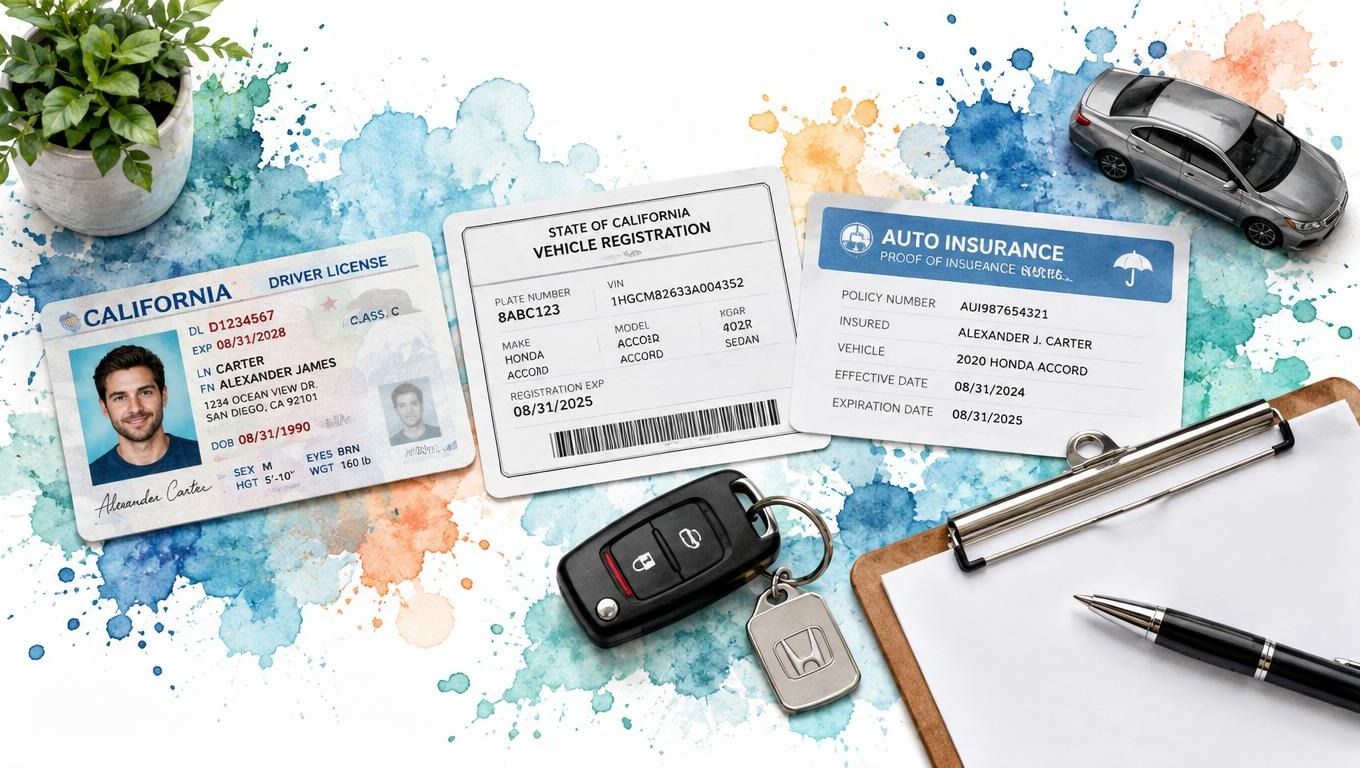
A prepared driver can still be turned away before scoring begins if the vehicle lacks valid paperwork or fails the safety inspection. DDS requires a four-wheel vehicle, valid registration or an acceptable temporary-tag document, liability insurance, and the vehicle itself for testing. A licensed driver age 21 or older with a valid license must accompany the applicant as the passenger.
Inspect the car before leaving home
Do a practical inspection several days before the appointment, not in the parking lot on test morning. Ask another adult to walk around the car while you activate each control.
- Brake lights: Confirm that they illuminate correctly.
- Turn signals: Check both sides and the dashboard indicators.
- Tires: Look for safe condition and adequate inflation.
- Mirrors: Make sure the interior and exterior mirrors are present, clean, and secure.
- Seat belts: Verify that the applicant and passenger can buckle securely.
- Windshield: Check for damage or visibility problems.
- License plate: Confirm that it's properly displayed.
- Registration and insurance: Carry the required documents in accessible form.
DDS permits vehicles with advanced driver-assistance technology, but the applicant must demonstrate that they can operate the vehicle without relying on those systems. Disable or avoid features that take over steering, braking, parking, or lane control unless the examiner directs otherwise.
A more detailed vehicle inspection checklist can help you organize this review. The supervising driver should also bring a valid license and arrive with enough time to handle check-in calmly.
Before you go: Put the registration, insurance, appointment confirmation, permit, and identification documents together the night before.
Weather can affect testing. DDS may decline to administer a road test when weather or other conditions are unsafe, so keep a backup date in mind and check for updates before departure. Don't treat a weather cancellation as a driving failure. It's an operational safety decision.
What the Georgia Road Test Actually Evaluates
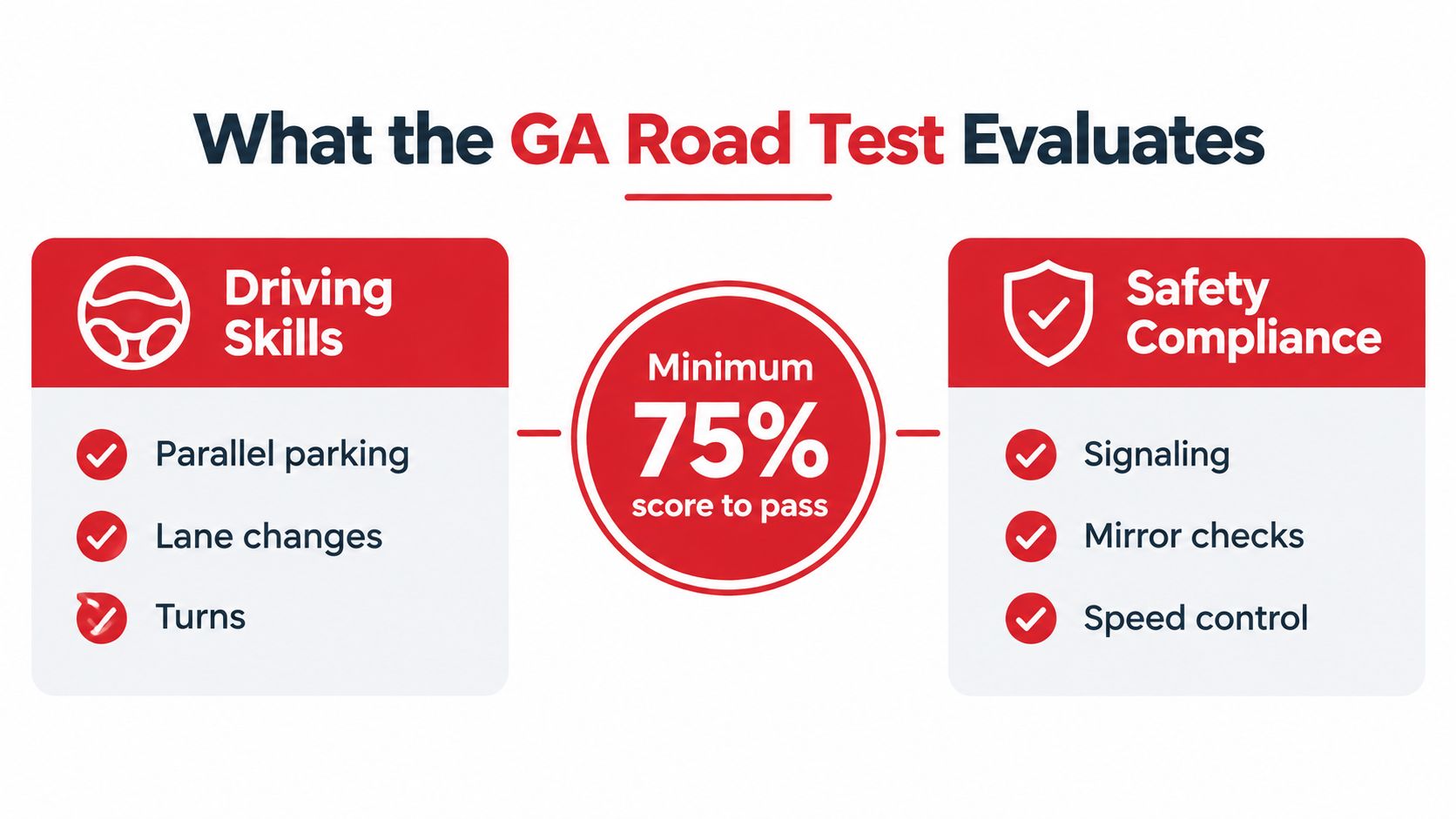
Georgia's traditional road test uses a 75% minimum passing score. That threshold applies to a structured evaluation of multiple driving tasks, so a driver who parks well can still lose enough points through unsafe decisions elsewhere.
Practice the DDS sequence
Rehearse the maneuvers in the order described by DDS. Familiarity with the sequence reduces mental overload and gives your instructor or supervising driver a clear way to evaluate each skill.
- Parallel parking: Park midway between the standards and keep the vehicle within 18 inches of the curb.
- Straight-line backing: Back for approximately 50 feet at no more than 10 mph, turning your head to look behind rather than relying only on mirrors.
- Signs and signals: Approach in the correct lane, signal properly, stop before the pedestrian crosswalk, and remain stopped until movement is safe.
- Turnabout: Complete a turnabout in a confined space using a two-, three-, or five-point turn.
DDS also evaluates turning, passing, following distance, and vehicle control. During practice, use verbal cues such as “mirror, signal, position” or “look, slow, stop” until the sequence becomes automatic.
Understand why points disappear
The 75% score is a benchmark, not a guarantee of success. Repeatedly touching a boundary, failing to look rearward while backing, signaling late, or following too closely can consume enough points to result in failure even when the applicant handles parallel parking competently. The examiner is looking for controlled operation and safe decisions, not a single impressive maneuver.
For example, a student may enter a turn correctly but fail to signal early enough, then approach the next intersection in the wrong lane. Another student may back smoothly but keep looking only at the mirrors. These aren't cosmetic issues. They show whether the driver is actively observing the environment and controlling the vehicle.
Practice should therefore include full test runs, not only isolated parking drills. Ask the supervising driver to observe lane position, mirror checks, signaling, speed, stops, spacing, and right-of-way decisions.
Your Next Steps and How A-1 Driving School Can Help
Use a simple timeline. Confirm your permit stage, complete the DDS-approved education pathway, finish the required practical training and supervised driving, prepare the vehicle, then book the appointment or arrange an authorized testing option.
A-1 Driving School offers instructor-led and online Driver's Education courses, customized teen and adult driving lessons, driving lesson packages, and Georgia road-test preparation and testing assistance at a certified facility. It also participates in the Georgia Driver's Education Scholarship Grant Program, which can provide training at no cost to qualifying students. A-1 holds the Fulton County Board of Education contract for Driver's Education and offers services across its Georgia locations.
If you're preparing for a first test, choose lessons that target the DDS maneuvers. If you're retesting, use the prior result to focus on the specific habits that cost points instead of repeating every lesson unchanged.
Enroll in an approved Joshua's Law course, book focused driving lessons or a lesson package, and arrange road-test preparation with A-1 Driving School so your training, vehicle, and appointment are ready together. Contact the school to discuss online or instructor-led education, supervised practice support, and available Georgia road-testing services.