
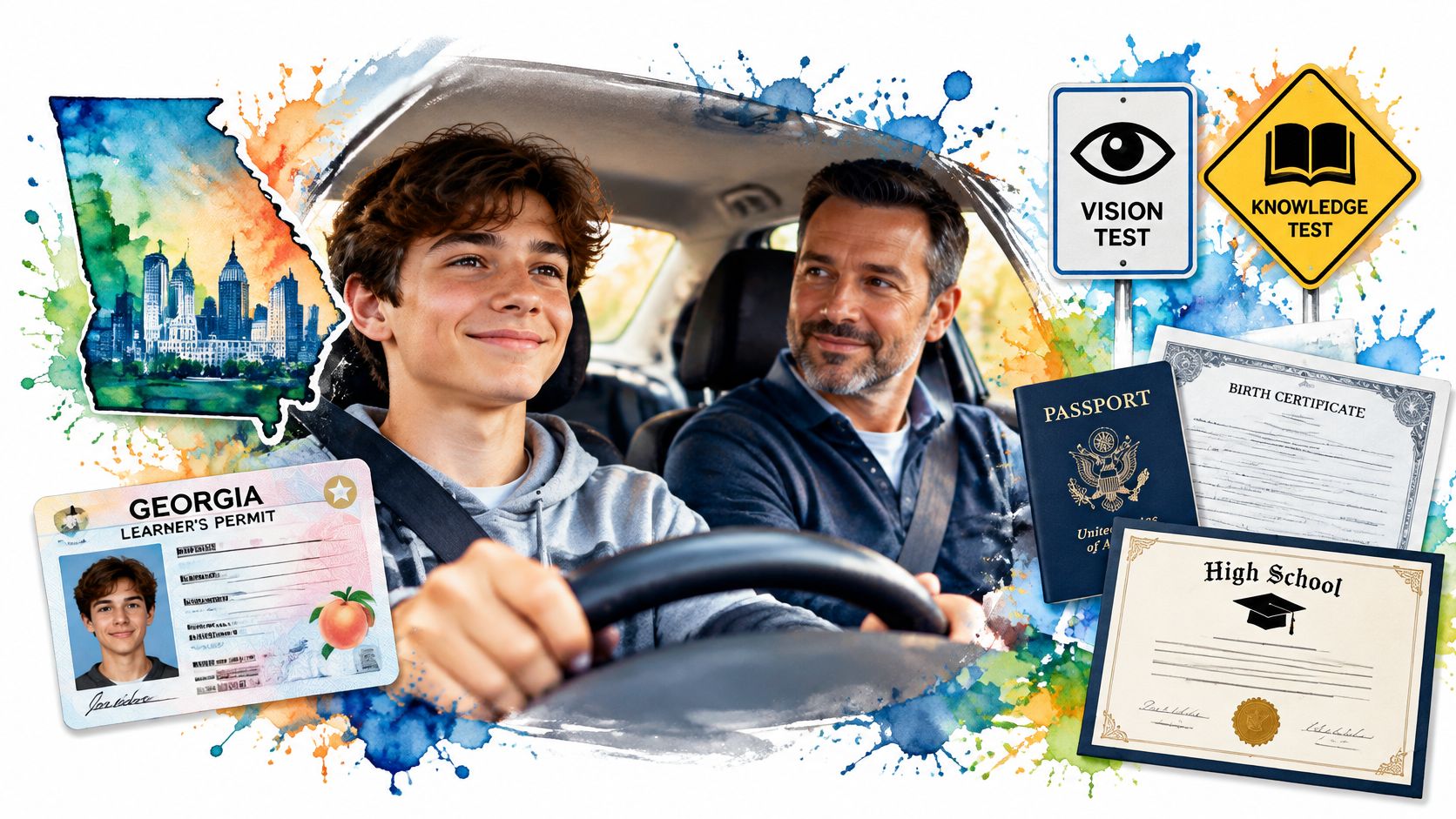
Your teen is ready to take the permit test, and you're trying to work out what to bring, who needs to sign, and when driving lessons can begin. The school enrollment form is somewhere in an email, the identity documents are in a drawer, and everyone's focused on passing the written exam.
The better approach is to treat Georgia driving permit requirements as a year-long family project, not just a trip to the Department of Driver Services (DDS). Start with the documents, then build a plan for approved education, driving lessons, supervised practice, and road-test readiness.
Permit Requirements and Documents by Applicant Type
Find your row by age and school enrollment status, then check whether the new-resident requirements also apply. Georgia.gov's Class CP application guide establishes the document requirements and timing windows summarized below, including school enrollment documentation and certified records for missing out-of-state credentials.
Georgia learner permit requirements by applicant type
| Applicant | Minimum age | Exams required | Signature needed | Key timing or proof |
|---|---|---|---|---|
| Teen under 18, enrolled in school | 15 | Vision and knowledge | Parent, guardian or authorized driver-training instructor | Notarized Certificate of School Enrollment (DS-1), signed within the previous 30 days |
| Teen under 18, not enrolled | 15 | Vision and knowledge | Parent or guardian | Diploma or GED may substitute for enrollment proof |
| Adult 18 or older | 18 | Vision and knowledge | No parental signature | Identity, Georgia residence, Social Security number, and citizenship or lawful status |
| New Georgia resident, any age | 15 or older | Vision and knowledge | Minor applicants need an authorized adult's signature; adults sign for themselves | Surrender out-of-state credential; certified motor-vehicle report dated within 30 days if it was lost or stolen |
These aren't separate permit types. They're different document situations for the same Class CP Instructional Permit application.
The baseline file should contain original documents proving identity, Georgia residence, Social Security number, and U.S. citizenship or lawful status. Documents must be in English, and minors should also prepare the parent's or guardian's identification.
Find the document most likely to stop your application
For an enrolled student, the likely blocker is the DS-1's signing date. Request it close enough to the DDS visit that it remains valid, but leave time for the school to prepare and notarize it. School holidays can make that coordination harder.
For a teen who's no longer enrolled, the likely blocker is missing substitute education proof. Don't assume that explaining the situation at the counter will replace a diploma, GED, or other qualifying enrollment evidence.
For an adult, focus on the complete identity and residency file. Not needing parental consent doesn't remove the obligation to establish identity, residence, and lawful status.
For immigrant families, check original lawful-status records and matching names. A missing original or a name spelled differently across records can prevent DDS from completing the application. Resolve discrepancies before the visit rather than expecting the counter staff to reconcile them.
For new residents, the likely blocker is the old credential or acceptable replacement record. An uncertified website printout isn't a substitute for the certified motor-vehicle report described in the state guide.
Audit the file before visiting DDS
Use our Georgia ID requirements checklist to organize the paperwork, then inspect the actual documents rather than relying on a mental checklist.
- List each document. Write down which record proves each required category.
- Check its date. Separate time-sensitive school and motor-vehicle records from documents without that short validity window.
- Match name spelling. Compare the application, identity records, school documents, and lawful-status records.
- Resolve expiring items before booking. Coordinate school signatures, notarization, and certified records before committing to a visit.
The DDS guide to obtaining a license, permit, or ID listed a $10 knowledge-test fee in 2024, along with vision and road-rules-and-signs examinations. Confirm the current fee before visiting rather than treating that historical amount as today's price.
Practical rule: A teen can be well prepared for the test and still have an incomplete application. Audit the paperwork with the same care you give test preparation.
How the Class CP Permit Fits Graduated Licensing
A permit authorizes supervised learning. It isn't permission to drive independently, even when your teen feels comfortable controlling the car.
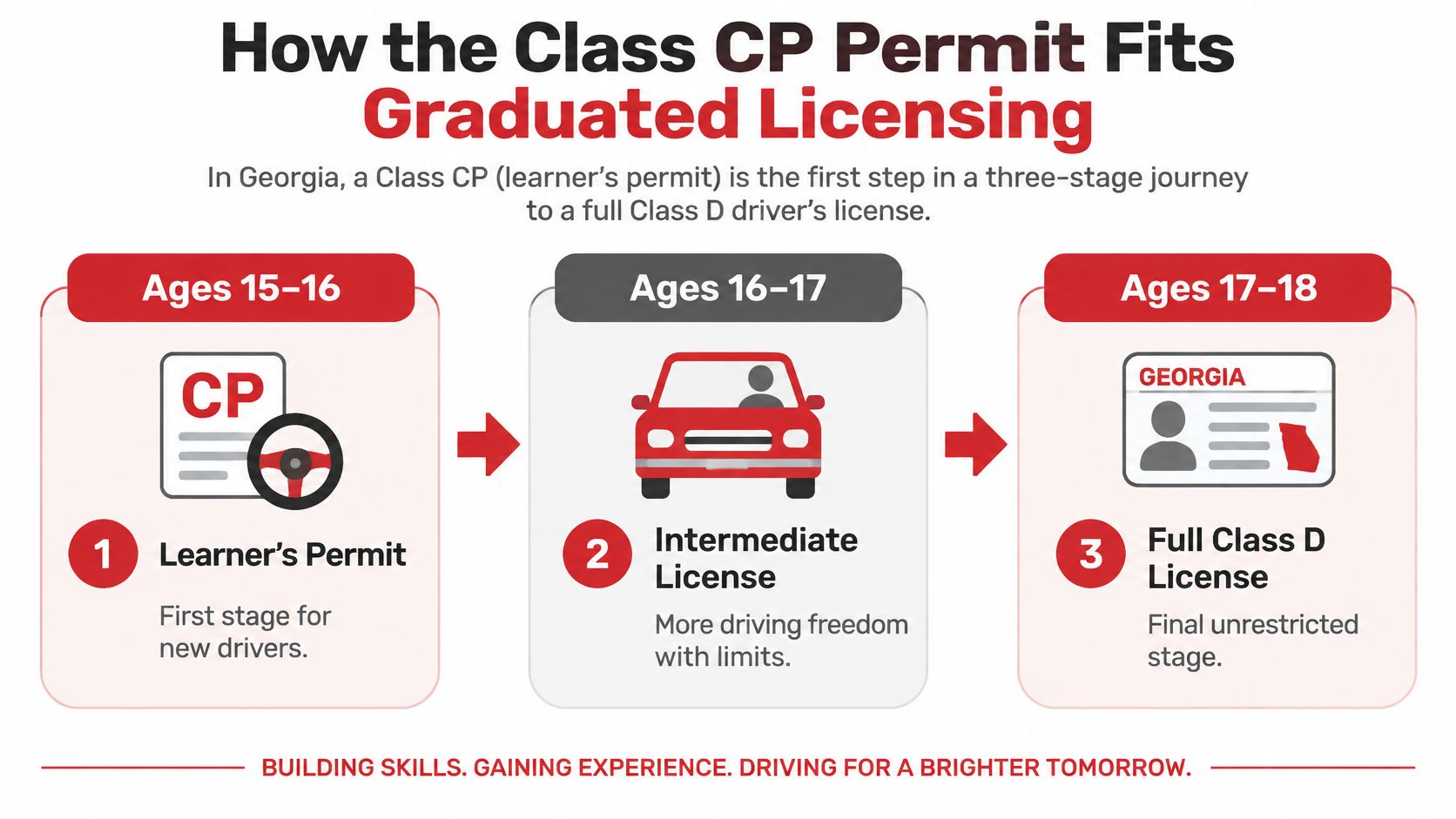
The DDS learner's permit guide identifies Class CP eligibility beginning at age 15 and describes Georgia's TADRA graduated licensing program for ages 15 through 18 as three stages: the learner's permit, provisional Class D license, and unrestricted Class C license. Applicants younger than 18 need a parent, guardian, or authorized driver-training instructor to sign.
The same DDS guide requires the supervising adult to be at least 21, hold a valid Class C license, be physically capable of taking control, and sit beside the learner. That seating requirement matters: an otherwise qualified adult riding in the back isn't providing the required supervision.
The visual below introduces the progression. For the official class names, use CP, then provisional D, then unrestricted C; Class D isn't the unrestricted stage.
Follow the application sequence
Think of the permit like a student pilot's authorization to learn under supervision. Passing a knowledge assessment establishes a starting point, not independent operating ability.
- Apply with the complete file. The documents establish eligibility, while the required adult signature supplies consent for a minor.
- Complete the vision examination. Driving requires the ability to recognize signs, road users, and changing conditions.
- Pass the knowledge examination. Study both traffic rules and sign recognition rather than treating them as interchangeable subjects.
- Pay the applicable fee. Verify the current amount with DDS before leaving home.
- Receive the permit before driving. Passing an exam alone isn't the credential you need for practice.
Set the supervision routine before the first drive
Choose who'll supervise, inspect that person's license, and agree on where practice will begin. Start with seat adjustment, mirrors, pedals, steering, and controlled stops before adding complex traffic decisions.
A permit holder can develop skills through properly supervised practice and valid-permit driving lessons. They can't drive alone, take a quick solo trip around the block, or replace the qualified supervising adult with an unqualified friend.
The supervision rule applies to the drive itself, not just to who gave permission to borrow the car.
Joshua's Law Hours Every Teen Must Complete
For families using the combined education, instructor-training, and parent-supervised pathway, the DDS teen-driver requirements establish 30 hours of theory, 6 hours of practical training, 40 hours of supervised driving including 6 at night, and a permit-holding period of 1 year and 1 day for eligible teens seeking Class D licensure.
Joshua's Law hour requirements for Georgia teens
| Requirement | Amount | Applies to | How to document |
|---|---|---|---|
| Driver education theory course | 30 hours | Ages 16 and 17 seeking Class D | Course completion certificate; classroom or online |
| Behind-the-wheel training | 6 hours | Ages 16 and 17 seeking Class D using this pathway | Certificate from a certified instructor or school |
| Supervised driving log | 40 hours, including 6 at night | Permit holders pursuing Class D | Affidavit signed by parent, guardian, or responsible adult |
| Permit holding period | 1 year and 1 day | Class CP holders pursuing Class D | Permit issue date and proof of holding period |
| Supervising adult | Age 21 or older with valid Class C | Every supervised drive | Qualified adult seated beside the driver |
The table separates requirements that families sometimes combine into a single idea of “driver's ed.” Coursework, professional instruction, supervised experience, and elapsed time serve different purposes. Finishing one doesn't automatically satisfy the others.
Connect instruction to parent practice
Theory instruction introduces road rules and decision-making before the student must apply them in traffic. Behind-the-wheel lessons let an instructor evaluate how the teen steers, brakes, scans, turns, and selects safe gaps.
Parent-supervised practice gives the learner opportunities to repeat those skills. Say an instructor identifies late blind-spot checks during lane changes. The parent can reinforce the correct sequence on suitable roads between lessons rather than letting the teen repeat the same mistake.
Keep practice progressive. A learner who's still struggling with lane position needs more work on manageable roads before highway merging becomes a useful exercise. Night driving should also be introduced deliberately, beginning on familiar routes where the teen can concentrate on visibility and headlight glare.
Keep evidence as you go
Use a paper log or spreadsheet with columns for the date, duration, route, supervising adult, skills practiced, and nighttime driving. Record the drive promptly instead of reconstructing it before the test.
Our Joshua's Law requirements guide can help families organize the education pathway. Our Driver's Education and Driving Lessons courses include Georgia DMV-approved Joshua's Law / Driver's Education courses, including all education and road testing.
Keep these items together:
- Course certificate. Retain evidence that the approved theory course was completed.
- Lesson certificate. Save the instructor or school's practical-training completion record.
- Practice log and affidavit. Maintain an accurate log to support the adult's signed certification.
- Nighttime subtotal. Track it separately so ordinary practice time doesn't hide a nighttime shortfall.
A tidy file won't replace driving competence, but it prevents completed work from becoming difficult to verify.
Online vs Classroom Driver's Education Options
Choose the format your teen will complete and understand. A classroom provides a set schedule and direct interaction; online study gives families more flexibility around school, work, and transportation.
The DDS license-requirements overview accepts a certified driver's education class or a 30-hour online course for the education completion requirement for applicants under 18, while preserving the separate practical-training and supervised-driving obligations.
Driver's education options under Joshua's Law
| Option | Hours | Best for | Does not replace |
|---|---|---|---|
| Classroom driver's education | 30 hours theory | Learners who need instructor-led structure | Behind-the-wheel hours or supervised log |
| Online driver's education | 30 hours theory | Teens with school, work, or distance constraints | Behind-the-wheel hours or supervised log |
| Behind-the-wheel lessons | 6 hours minimum in this pathway | Class D applicants aged 16 and 17 | Classroom theory requirement |
| Supervised practice | 40 hours including 6 night | Permit holders with a qualified adult | Approved driver education |
Choose by learning habits, not convenience alone
A classroom may suit a teen who asks questions readily and benefits from an instructor noticing confusion. It also creates a clear boundary between attending class and being finished with the day's work.
Online instruction may suit a student who can manage assignments independently. Give it a regular place in the household schedule, with a quiet workspace and enough attention to understand the material rather than move through screens.
Neither choice turns a course-completion certificate into road-test eligibility. The student still needs the applicable driving experience, practical instruction, permit-holding period, and testing preparation.
Choose the theory format around how your teen learns. Choose driving lessons around the skills your teen needs to demonstrate.
Build an education schedule you can maintain
As a planning target, consider booking the course during the first few months of the permit period. That's a family scheduling recommendation, not a separate DDS deadline.
- Choose the format. Compare classroom structure with online flexibility.
- Coordinate lessons. Give the teen opportunities to apply classroom ideas behind the wheel.
- Protect practice time. Put parent-supervised drives on the calendar instead of relying entirely on spare time.
- File the certificate. Keep completion evidence with the permit records.
The Georgia Driver's Education Scholarship Grant Program may be a funding source for eligible families. Check eligibility directly with the program before building your budget around an award; don't assume that applying guarantees funding.
Compare course formats and enrollment options through our driver's education course website, then choose a schedule that leaves room for lessons and supervised practice.
Timeline From Permit to Class D and Edge Cases
Say your teen passes the knowledge exam and receives the permit. The useful question that evening isn't, “When can we book the road test?” It's, “What needs to happen between this issue date and a test-ready driver?”
The DDS Class D application guide requires a permit-holding period of at least 1 year and 1 day and explains that transferred out-of-state permit time must contribute to a combined period reaching that threshold. Completing education late or leaving practice undocumented can delay licensure even after the holding period has elapsed.
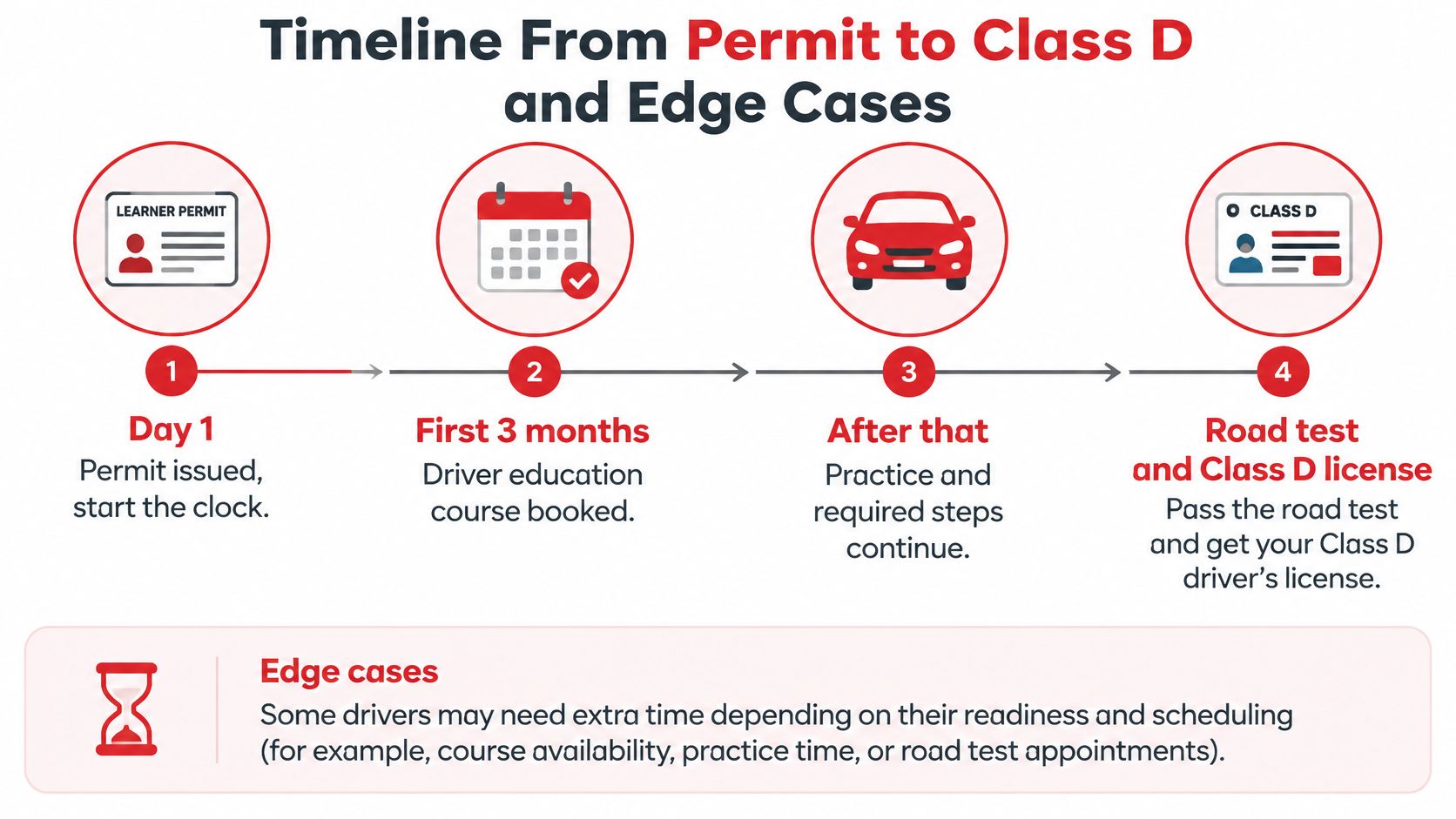
Use this timeline as a planning aid, not a substitute for checking individual eligibility.
Turn permit day into a working plan
On permit day, save a copy of the credential and record its issue and expiration dates. Create a folder for education certificates, lesson records, the driving log, and later testing paperwork.
Early in the permit period, choose the education format and reserve lesson time. The timeline's early-course target is a practical way to avoid a last-minute scramble, not an additional legal deadline.
Across the remaining months, alternate instruction with practice. After a lesson on intersections, for example, plan supervised drives that reinforce stopping position, scanning, yielding, and turn completion.
As testing approaches, review both the paperwork and the teen's performance. A full log doesn't tell you whether the learner can make decisions without repeated coaching. Equally, confident driving doesn't erase missing education evidence or an unfinished holding period.
Resolve unusual situations with records
Lost permit. Request a replacement promptly and prepare proof of identity. Keep any available issue-date record and ask DDS to confirm the holding-period date in its system rather than assuming the replacement card's printing date changes eligibility.
Expired permit. Check expiration regularly and don't continue driving on an expired credential. Ask DDS what renewal or replacement documentation is needed and how any lapse affects eligibility; don't assume either that the clock automatically restarts or that an expired permit preserves every privilege.
Moving from another state. Transfer the permit and arrange to surrender the old credential. Bring records that establish the original issue date so DDS can evaluate the combined holding period.
A supervising adult's eligibility changes. A suspended or expired license can create a problem even when the adult has supervised many earlier drives. Stop using that person as the supervisor until qualified, preserve accurate records, and ask DDS how to handle any questionable practice entries.
| Situation | Record to check first |
|---|---|
| Missing permit | Identity proof and available permit record |
| Expired credential | Expiration date and DDS renewal instructions |
| Interstate move | Old permit and evidence of original issue date |
| Supervisor eligibility concern | Adult's current license status and affected log entries |
| Missing completion evidence | Course or lesson completion record |
Identify the situation, inspect the document, confirm the date, and contact DDS before the next lesson or practice drive if eligibility is uncertain. That sequence is more useful than trying to solve a record problem on road-test day.
Book Driving Lessons Before Your Road Test
Start with the test-day requirements, then prepare the skills the examiner will assess. The DDS road-test instructions require an appointment, the applicable learner's permit, and an accompanying licensed driver at least 21 years old; applicants under 18 also need the appropriate adult to sign an affidavit confirming 40 hours of experience, including 6 at night. DDS also specifies at least 15 correct answers out of 20 on each knowledge-test portion, Road Rules and Road Signs.
Use the booking information below alongside your permit and completion records.
Practice measurable skills rather than hoping for a pass
The DDS traditional road-test guide sets a minimum passing score of 75 percent and requires liability insurance, valid registration or acceptable registration proof, and a vehicle safety inspection. It describes parallel parking within 18 inches of the curb in a 22-by-10-foot space and straight-line backing for approximately 50 feet at no more than 10 miles per hour while looking behind the vehicle.
Those are concrete practice targets. Have the learner approach the parking space, position the vehicle, complete the maneuver, and evaluate the result without constant prompts.
Backing practice should develop slow control and direct observation behind the car, not dependence on a camera alone. DDS also notes that hand signals may be necessary when a vehicle lacks illuminated turn signals; don't assume that means a vehicle with defective equipment will pass inspection.
Structured lessons can connect these maneuver drills with the broader skills parents need to reinforce, including lane changes, intersections, and appropriate nighttime practice. Use our road-test lesson information to plan preparation around specific weaknesses rather than repeating only familiar routes.
The video provides another way to review the driving-school information before arranging your next step.
Arrange the first lesson once the permit is in hand
We provide driving lessons in Atlanta and Athens, and our Driver's Education Hotline is (770) 603-3320. Students must have a valid Learner's Permit or Driver's License to take a driving lesson.
When scheduling a driving lesson package, explain the teen's current experience and request a plan covering the practical-training requirement, nighttime skill development, and Class D maneuver practice. Confirm the package's specific inclusions before booking rather than assuming every option includes the same training or testing arrangements.
A-1 Driving School offers Joshua's Law driver's education, driving lessons, and Georgia Road Testing to help families connect permit requirements with practical preparation. Once the permit is in hand, visit A-1 Driving School to book the first lesson and coordinate a driving lesson package with your teen's education and road-test plan.