

You shut the car off, and the examiner is already marking the sheet. Maybe it was a rolling stop at the last sign. Maybe the test never started because the insurance card didn't match the car. You're in the lot, phone in hand, trying to decide whether tomorrow is the right move.
A road test fail in Georgia is usually one of two problems, and they don't share a fix. I sit in the passenger seat after these tests often enough to be blunt about it. Most driving misses are habits you can drill out. A paperwork or vehicle miss is not a driving problem at all.
Figure out which one you had before you spend another morning at the testing site.
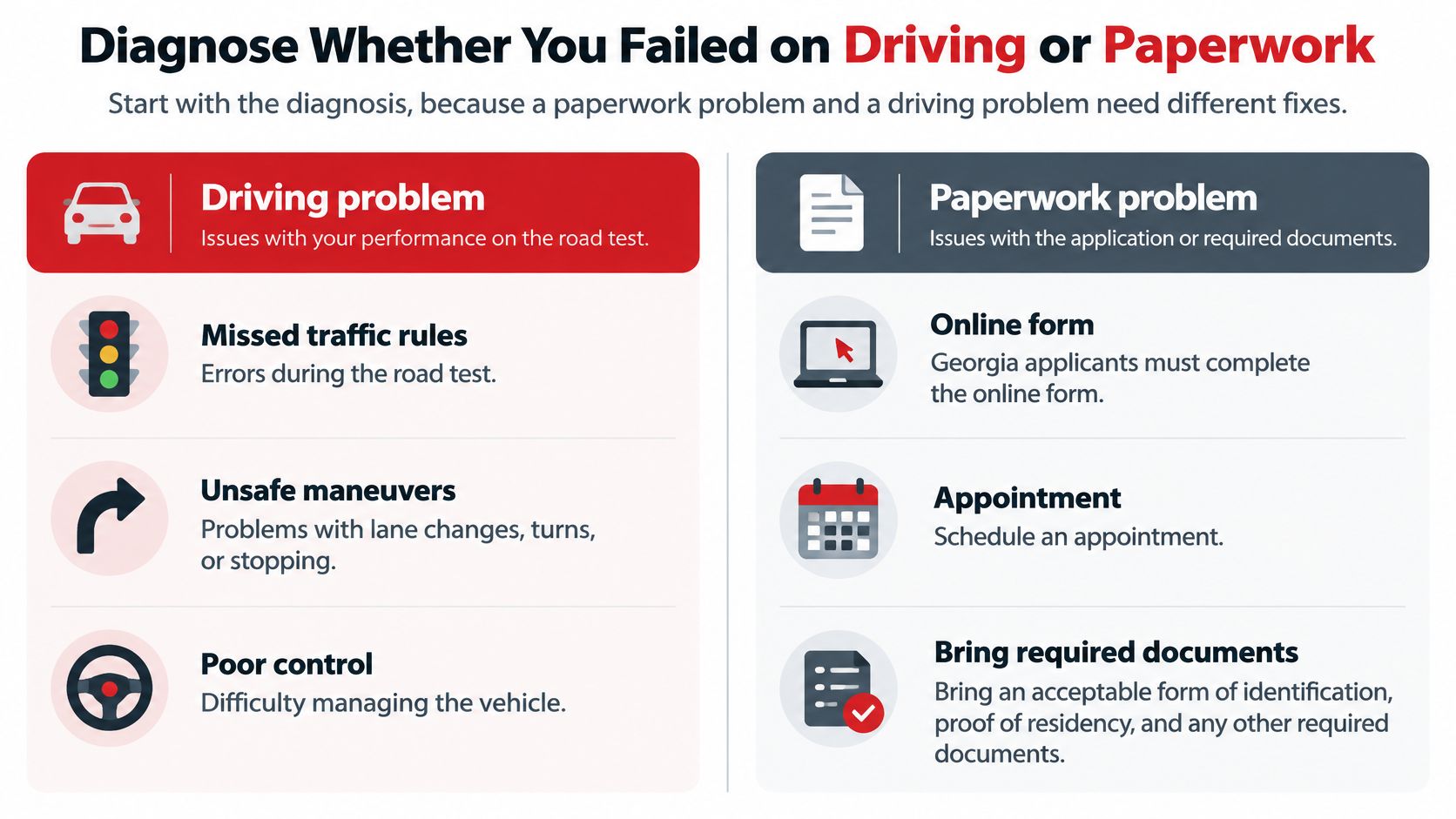
Diagnose Whether You Failed on Driving or Paperwork
The fix depends on the cause. Georgia DDS road test guidance shows you can be turned away, or never tested, when the vehicle lacks valid registration, liability insurance, required documentation, or a successful safety inspection. You must complete the required online form, schedule an appointment, and bring an eligible licensed adult. Walk-ins are not accepted.
Start with that split. A paperwork problem and a driving problem need different fixes.
Audit the car before you blame the drive
Work these rows tonight. A failed row is a paperwork or repair job, not another lap.
| Check | Pass condition | If it fails |
|---|---|---|
| Registration | Valid and matches the vehicle | Renew before rebooking |
| Liability insurance | Active policy for the vehicle | Verify coverage with the insurer |
| Safety inspection | Passed and current | Repair and reinspect |
| Lights, signals and horn | All working | Repair before the appointment |
| Documents | Match the vehicle and the applicant | Correct or replace before booking |
| Rental car | Renter listed on agreement and insurance provable | Confirm the contract allows testing |
A rental is allowed only if you're listed on the agreement and can prove insurance. Many rental contracts still ban testing and training, so read the contract before you book the car or the appointment.
If the sheet shows real driving errors, sort every deduction into observation, vehicle control, lane positioning, turns and parking, or rule compliance. The fullest bucket is the practice target. Match the glove box against what you need to take the driver's test before you leave home.
Practical rule: If the car and documents pass the audit, the remaining work is driving practice. If a missing document or a vehicle fault stopped you, fix that first.
This clip shows how a route is run. Line it up with the marks on your own sheet.
Retest Waiting Periods Georgia Drivers Must Follow
The waiting period after a failed Georgia road test is set by DDS, and it changes with your attempt history. A first failed road skills test gets the shortest interval. A second or later failure gets a longer one. A failure that involved a crash or a traffic violation gets the longest wait. DDS publishes the current intervals with its road test guidance, so confirm the exact number before you pick a date.
| Situation | Waiting period | What to do during the wait |
|---|---|---|
| First failed road skills test, no crash or violation | Shortest DDS interval. Confirm the current number before booking | Review the score sheet and drill the failed maneuver |
| Second or later failed road skills test | Longer DDS interval. Confirm before rebooking | Book lessons before rebooking |
| Failure involving a crash or traffic violation | Longest DDS interval for this case. Confirm the current rule | Structured retraining on unfamiliar routes |
| Passed the Road Skills Test | No retest wait applies | Keep the score sheet and build more supervised miles |
A wait is a scheduling rule, not a readiness test. Rebooking on the first legal morning only helps if the fault that cost the points is already fixed. Use the time to read the examiner's notes and name the category that hurt you most. If the sheet shows a crash or violation, ask the examiner which waiting category applies before you leave the office.
Write down three things before you book: the category that cost the most points, your attempt number, and the earliest date DDS allows. If that date does not fit a practice plan you can finish, wait past the minimum. A short wait with the same error just buys another fail.
Fix Score-Sheet Errors With Repeatable Drills
The Georgia driver's manual treats a Class D road test as a scored checklist, not one lucky drive. Before you roll, confirm the car is eligible and the controls work. On the route, the examiner watches observation, signaling, lane position, speed, turns, stops, and whether you follow the traffic laws. Then you run the maneuver they call. Afterward, the examiner can review the score sheet with you. That review is the assignment. Find the behavior that cut the score instead of repeating the whole drive with no diagnosis.
A near-pass is not readiness. Several small deductions add up under the passing line, so a drive that felt fine can still fail. The other trap is practicing only the familiar loop by your house. You already know the next turn there. Examiners don't give you that warning.
Pair each miss with a fix
| Score sheet error | Usual cause | Fix before retesting |
|---|---|---|
| Rolling or incomplete stops | Rushing, treating the stop as a slowdown | Full stop, count to three, then look both ways |
| Missed mirror or blind-spot checks | Checking without deciding | Say what you see before every lane change |
| Late or missing turn signal | Signal treated as an afterthought | Signal early, then confirm it cancels after the turn |
| Drifting in the lane | Staring at the hood or lane markings | Look far ahead and hold the lane center on straight roads |
| Speed too slow or erratic | Nerves and over-correcting | Hold steady speed to the limit and practice smooth braking |
| Weak intersection scanning | Watching only the signal light | Scan left, right, left before entering |
| Parking or backing out of line | Poor reference points | Pick fixed landmarks and practice the same line each time |
Drill until the fault is gone
Run the fixes in this order, out loud, with a licensed adult in the passenger seat.
- Pre-drive check. Before the engine starts, say the car, the documents, and your seat position out loud.
- Structured scan. At every block, call the far zone, the near zone, the mirrors, intersections, parked cars, pedestrians, and your escape space. End with a decision, then change speed or lane position if the scene calls for it.
- Stop-and-count. For ten minutes, make a full stop at every sign and signal, count to three, then look both ways.
- Lane-change drill. Say the mirror check, the blind spot, and the signal. Move only when the gap is clear.
- Unfamiliar-route run. A passenger gives turn directions with no warning, the way an examiner does.
NHTSA's young-driver countermeasures guide describes hazard-anticipation training as scanning for risks you can see and risks still hidden, keeping your eyes on the forward roadway, and predicting how a hazard develops. Research summarized by NHTSA found that a RAPT hazard-awareness program produced a 23.7% lower crash risk for trained male drivers than controls. Earlier NHTSA evaluation data reported inferred attention failures in 23% of crashes examined, while trained novice drivers recognized the relevant risk in 63% of on-road field trials and 76% of simulator trials.
Memorized mirror checks without a decision still lose points. The examiner is scoring whether the look changes what the car does.
Practice on at least three routes, including streets you don't know. Log each run and write one fault. A fault is fixed only after three consecutive runs with no faults in that category. Mark those runs against the driving test rubric while your passenger calls the turns.
A clean loop on the street you already know does not count as the third clean run.
Retest Costs and Scheduling Timeline
Confirm the Road Skills Test fee directly with the Georgia Department of Driver Services before you pay. Budget for two attempts, not one. The second attempt is what catches people who spent the first fee and planned no further.
Sort the failure before you sort the calendar. A paperwork or vehicle-readiness fail costs you a trip and a fresh appointment. A driving-error fail adds lesson fees and practice hours. That distinction decides whether your next payment buys a slot or a fix.
The earliest legal retest date depends on the failure. First failure, next day. Second or later, seven days. Accident or traffic violation during the test, 30 days. Appointments go through the online form. Open slots move, so check availability before you pick a target date.
Add the trip, any repair or reinspection from the audit, and the lessons that close the score-sheet gap. Write one line: test fee, repairs, lessons, and the date you can be test-ready. If money is tight, look at state help for driver education before you lock that date.
Book Your Retest and Lock In Driving Lessons
Your retest date is a scheduling decision, not a reward for feeling ready. Treat paperwork and driving as separate gates. The car can pass every inspection item and still fail the drive. A sharp drive cannot rescue an expired registration.
Run this checklist before you touch the online form.
- The wait is over. You are past the legal date for this attempt, not just eager to be done.
- The audit is clean. Registration, insurance, inspection, lights, horn, and documents would pass tonight.
- The drills are clean. Three fault-free runs in the weak category, on at least two different routes.
Then schedule the appointment and bring an eligible licensed adult. Showing up without that adult wastes the slot.
Joshua's Law if you're 16 or 17
The Georgia DDS Joshua's Law requirements set the Class D pathway. You need 30 hours of classroom instruction, in person or through an approved online or virtual program. One road path is 6 hours of behind-the-wheel training with a certified driving school plus 40 hours of supervised driving with a parent or guardian, including at least 6 nighttime hours. The other is the parent-taught option in the official Parent/Teen Driving Guide. You also hold the instructional permit for 1 year and 1 day before a Class D license.
An online driver's education course can cover those classroom hours. It does not replace the road work. Lessons are where a late signal or a weak scan gets called out in real traffic, with someone giving examiner-style directions instead of a parent who already knows your habits.
Put the lesson package on the calendar first
A-1 Driving School has 38 years in business, and the pattern after a road test fail is predictable. Drivers who only repeat the same neighborhood loop bring back the same marks. Drivers who practice the missed category, on unfamiliar streets, change the sheet.
A-1 Driving School offers road testing, including the Georgia Road Test, and driving lessons for students and adults. Build the package around the errors on your score sheet, not a generic hour of "more driving." Teens can pair an instructor-led or online Joshua's Law driver's education course with those lessons. If you qualify, ask us about our Scholarship Grant Program for help with the cost of training.
You can schedule a driver's test in Georgia once the car, the papers, and the practice line up. Book the lesson package first. Set the retest date only after the clean runs, not the morning the wait expires.
A date on the calendar is not a practice plan. The lessons are.
A road test fail is a scored list of habits, and those habits change when the lessons match the sheet. A-1 Driving School offers Joshua's Law driver's education in the classroom and online, driving lesson packages for teens and adults, Georgia road testing, and the Scholarship Grant Program for drivers who qualify. Visit A-1 Driving School and book the lesson package that matches your score sheet before you lock the retest.