
Your teen passed the permit test, the Joshua's Law course is on the calendar, and somebody in the family group chat has already asked when the road test happens. That's the moment most Georgia families start counting weeks. The trouble is that a driving test for teens in Georgia isn't a single event you can book whenever the calendar opens up. It sits at the end of a chain: permit issued, course finished, supervised hours logged, documents assembled, appointment scheduled.
Think of the road test as one checkpoint in a longer sequence rather than the finish line. The permit clock, the quality of the practice drives and the first six months of solo driving all shape whether your teen stays safe. Here's the Georgia path in the order it applies, with the rules that trip families up spelled out plainly.
Georgia Requirements for the Teen Driving Test
A Georgia teen can take the Class D road test only after meeting a sequence of conditions, not by passing one exam. The Georgia DDS teen drivers guidance states that an applicant must be 16 or 17, hold a Georgia instructional permit for 12 months and 1 day, complete the applicable Joshua's Law requirements, satisfy the Alcohol and Drug Awareness Program requirement and pass the road-skills test. DDS also states that applicants must not have committed a major traffic violation.
| Requirement | Georgia rule | What to check |
|---|---|---|
| Age for Class D | 16 or 17 | Applicant falls in the teen Class D pathway |
| Instructional permit | Held for 12 months and 1 day | Count from the permit issue date, not the course start |
| Joshua's Law driver education | 30 hours classroom or an approved online virtual course | Confirm the course is approved for Georgia teens |
| Behind-the-wheel training | 6 hours with a certified instructor or completion of the DDS Parent/Teen Driving Guide | Keep the completion certificate |
| Supervised driving | 40 hours with a parent or guardian, including 6 at night | Keep a dated log of every session |
| Alcohol and Drug Awareness Program | Completion required | Keep proof of completion |
| Road skills test | Must be passed | Book an appointment in advance |
| Parent or guardian consent | Required under 18 | Bring the signed consent |
| Major traffic violations | None committed | Check the driving record before booking |
Why the rules stack
Finishing driver education doesn't qualify a teen for a provisional license on its own. A teen who completes the classroom course in a single week still waits out the permit period, still logs supervised driving and still has to pass the road skills test at the end. The permit issue date is the anchor for everything else, which is why it belongs on the family calendar in ink.
One practical consequence: the permit comes before professional instruction, not after. Students must have a valid learner's permit or driver's license to take a driving lesson with us, so a teen who hasn't been to DDS yet can't start behind-the-wheel training.
Before you book anything: confirm the age, the permit issue date and the hours log. Those three answers tell you whether a test date is realistic or premature.
How Joshua's Law Driver Education Works
Joshua's Law is the core of Georgia teen driver education, and it's built from two different kinds of learning. The course builds knowledge: traffic laws, road signs, right-of-way rules, safe driving basics and the risks of distraction and impairment. In-car hours build the skill to apply that knowledge at speed, with traffic moving around you.
The Georgia DDS Joshua's Law requirements apply to 16- and 17-year-olds seeking a Class D license and set the education pathway at 30 hours of classroom instruction or an equivalent approved online virtual course, plus 6 hours of behind-the-wheel training with a certified instructor or completion of the DDS Parent/Teen Driving Guide. Read those as two halves of one requirement, not alternatives to each other.
Classroom or online, and what online doesn't cover
An online course is a legitimate way to meet the 30-hour knowledge component, and for a teen juggling school, sports and a part-time job it's often the only format that fits. What it can't do is replace the wheel time. Online students still need in-car training and documented supervised practice before licensing, so budget for both when you compare options.
- Classroom format: fixed schedule, an instructor answering questions in real time, and a pace set for the group rather than the individual.
- Online format: self-paced modules a teen can spread across evenings, with the same approved content and the same in-car obligation afterward.
Whichever format you pick, confirm the course is approved for Georgia teens before you pay. Our instructor-led and online Joshua's Law courses are Georgia DMV-approved and include all education and road testing, so a student can complete the pathway with one provider rather than stitching pieces together. You can review the Joshua's Law course requirements in detail before enrolling.
Keep the Alcohol and Drug Awareness Program certificate filed with the driver-education certificate. It's a separate requirement from the education pathway, and families lose time on test day because they assumed one document covered both.
How to Build Supervised Practice That Counts
Hours alone don't make a ready driver. An NHTSA analysis of supervised driving requirements found no evidence that mandates of 30 versus 60 supervised hours produced different fatal-crash rates for 16- or 17-year-old drivers. What separates a useful practice year from a wasted one is variety, feedback and repetition until a behavior is stable.
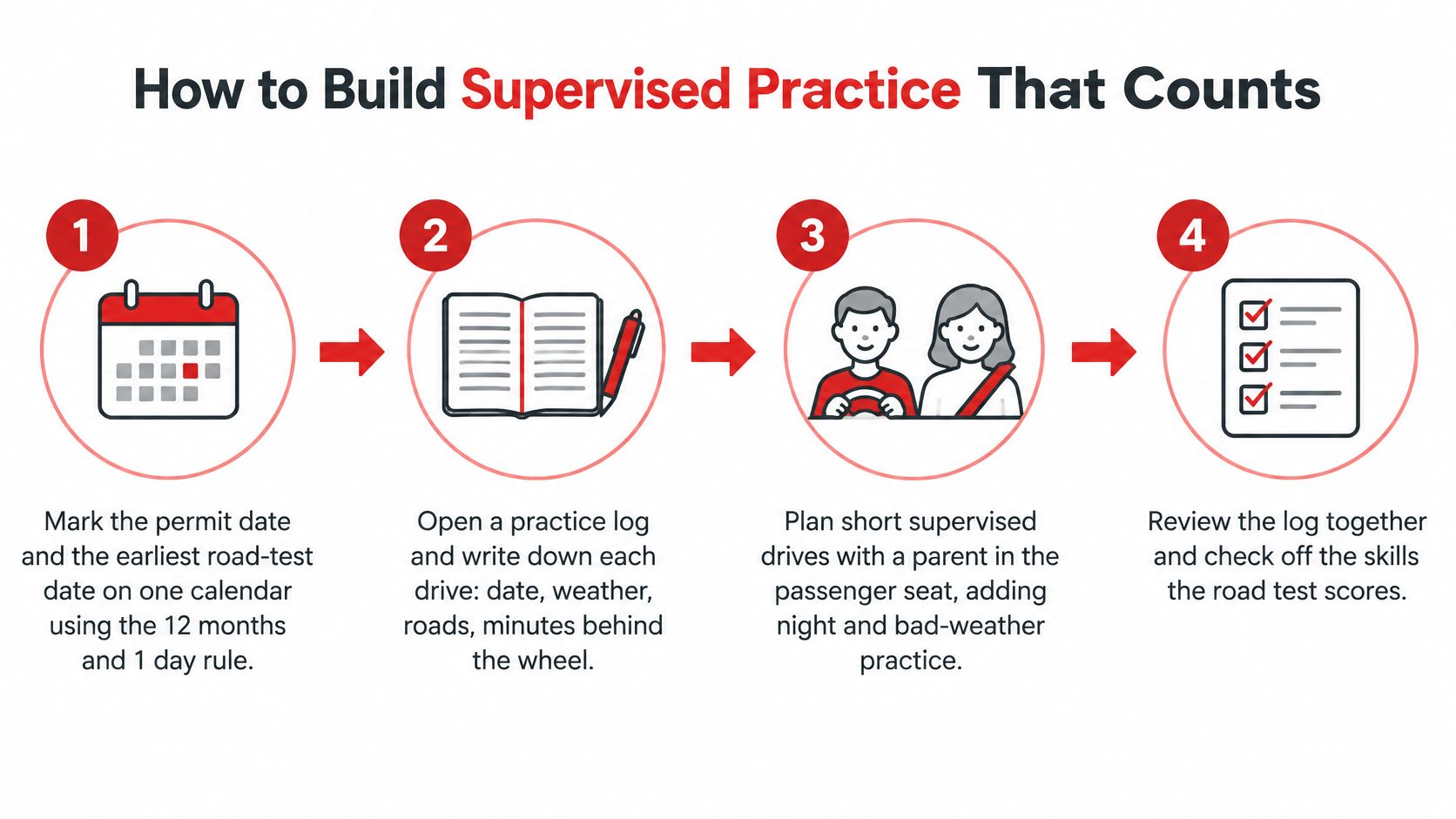
Start this routine the day the permit is issued, not the month before the test.
- Put two dates on one calendar. Write the permit issue date and the earliest legal road-test date side by side, counting the 12 months and 1 day from issuance. Families who count from the course completion date instead routinely book a slot they can't use.
- Open a log and record the conditions, not just the minutes. Date, start and end time, road type, weather, and whether the drive happened after dark. A driving practice log that captures conditions proves variety, which a bare total never does.
- Spread the 40 hours across months, with at least 6 after dark. Night hours are the ones families postpone, then cram into the final week. Schedule them early, on familiar roads, so darkness isn't also a new route.
- Begin in empty lots and quiet residential streets. Low traffic lets a teen learn pedal pressure, steering input and mirror habits without a queue of cars behind them. Move to two-lane roads once stops and turns are smooth.
- Add complexity only when the previous layer is boring. Multilane traffic, lane changes, turns across oncoming traffic and freeway merges each deserve their own session. If a teen is still prompting-dependent on lane changes, a merge lesson is premature.
- Debrief every drive with two things done well and one correction. Name the correction specifically ("signal before you brake, not after") and repeat it at the start of the next session. Vague praise teaches nothing.
- Book the test when unfamiliar routes run without prompts. Pick a road neither of you knows and stay silent. If the teen stops, turns and changes lanes cleanly without coaching, that's readiness.
The two most common slips: logging every hour on the same three streets, and booking the appointment before the permit clock has actually run out.
When a parent can't supervise a difficult skill, or the coaching turns into an argument, a professional behind-the-wheel lesson fills the gap without the family friction.
How Examiners Score the Road Test and Where Teens Fail
The examiner is answering one question: can this driver handle normal traffic safely, without help? That's broader than parking. A scored drive in practice covers much more.
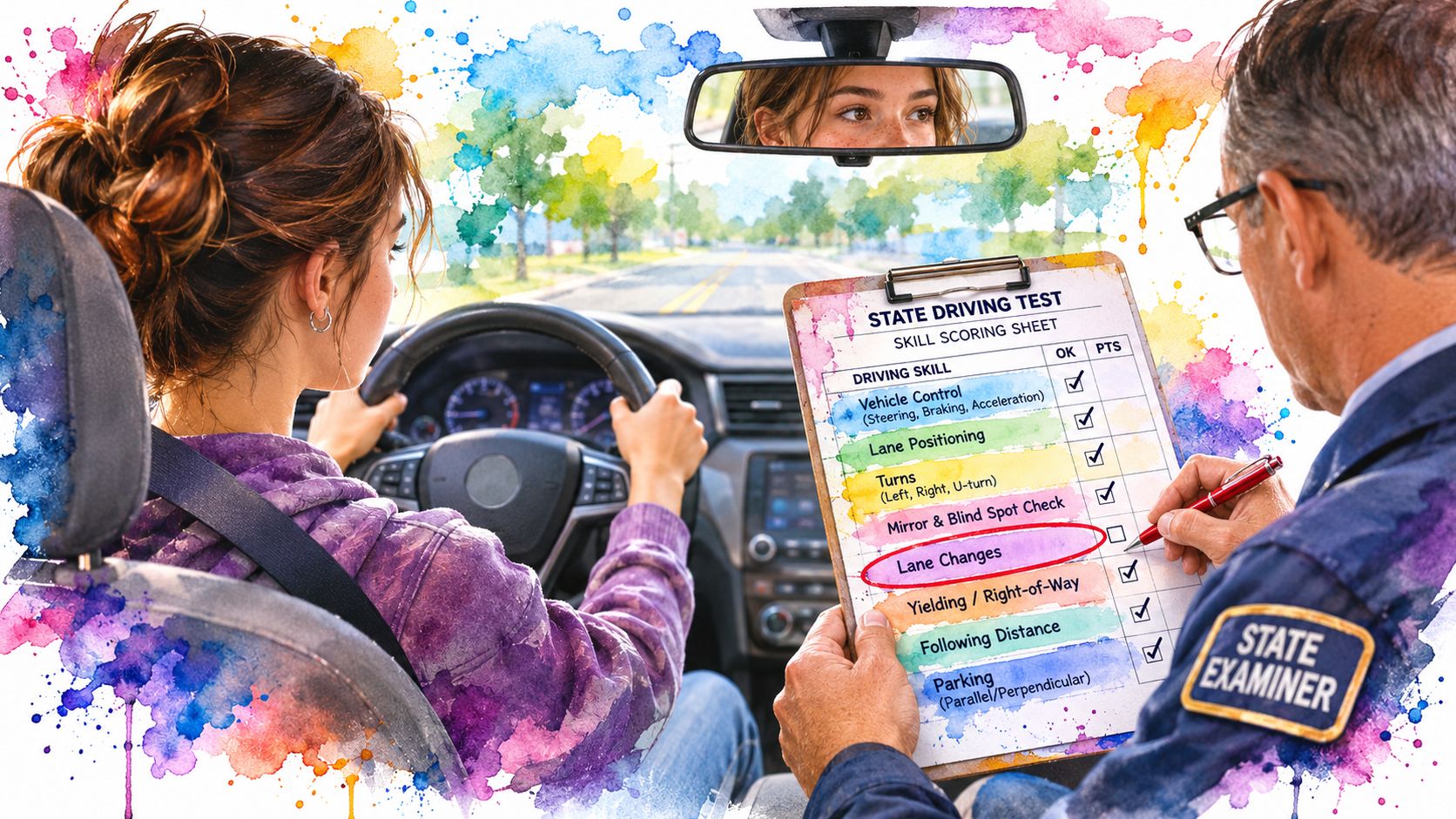
| Skill area | What the examiner scores | Practice drill |
|---|---|---|
| Basic control | Smooth start, stop and steering centred in the lane | Repeat stops in an empty lot, then on quiet streets |
| Turns and intersections | Correct lane, full stops and yielding | Practise right and left turns at signals and stop signs |
| Lane changes | Mirror and blind-spot checks, early signal | Practise on two-lane roads with light traffic |
| Parking | Parallel or between lines, depending on the test site | Practise both styles and confirm which one the test site uses |
| Observation | Pedestrians, cyclists, signs and following distance | Narrate hazards aloud on every drive |
| Speed control | Speed matched to traffic, weather and road | Drive at the posted limit and slow for rain and heavy traffic |
The errors that cost the most
Most failed attempts come down to a short list: rolling through stop signs, forgetting to signal, driving too fast or too slowly for conditions, skipping the blind-spot check, and unravelling after one small mistake. That last one is fixable with rehearsal. A teen who clips a curb during parking and then keeps driving calmly usually recovers; one who freezes and stops checking mirrors does not.
Examiners score judgement alongside control. A teen who scans an intersection early, covers the brake for a pedestrian and picks a safe gap scores better than one who parks beautifully but follows too closely. Novice risk comes from limited experience and weak hazard perception, which is exactly why scanning and gap selection carry weight. NHTSA's graduated licensing guidance reports that the strongest systems, requiring at least a six-month learner period, a nighttime restriction beginning by 10 p.m. and no more than one teen passenger, are associated with a 38% reduction in fatal crashes and a 40% reduction in injury crashes among 16-year-old drivers.
Work through a road test scoring rubric with your teen and have them say aloud what they're checking before each lane change and turn. Watch the sequence in action here.
Road Test Day Rules and Appointment Logistics
Ready skills don't guarantee a test happens. Georgia's appointment and vehicle rules stop plenty of prepared teens at the door.
The Georgia DDS road test page states that walk-ins aren't accepted for applicants under 18, so the appointment must be scheduled ahead. The applicant must meet all Class D requirements and arrive with a licensed driver who is at least 21 years old. Only the applicant and that accompanying driver may be in the vehicle. Other minors, children and pets are prohibited during the test.
Run this checklist the night before, not in the parking lot:
- Confirm the appointment time and the exact location, including which entrance the test line uses.
- Bring the accompanying driver, 21 or older, holding a valid license.
- Lay out every Class D document and the signed consent form in one folder.
- Arrive early with the vehicle fueled, clean and ready to drive.
- Leave siblings, friends and the dog at home.
If the first attempt doesn't pass
Get the score sheet and read it with an instructor rather than guessing at what went wrong. Schedule practice targeted at those specific errors, then rebook once the teen repeats the corrected behavior cleanly on unfamiliar roads. Rebooking on hope wastes another appointment slot and another round of nerves.
Rules and document lists change. Check the official DDS road test page again before you confirm the appointment, especially if you prepared using an older checklist from a sibling.
Permit-to-License Timeline and the First Six Months
A teen who receives a permit on 2 March 2026 can plan the process like a chain of checkpoints. The permit clock starts first, the road test comes later, and the first months after passing deserve the same attention as test day.
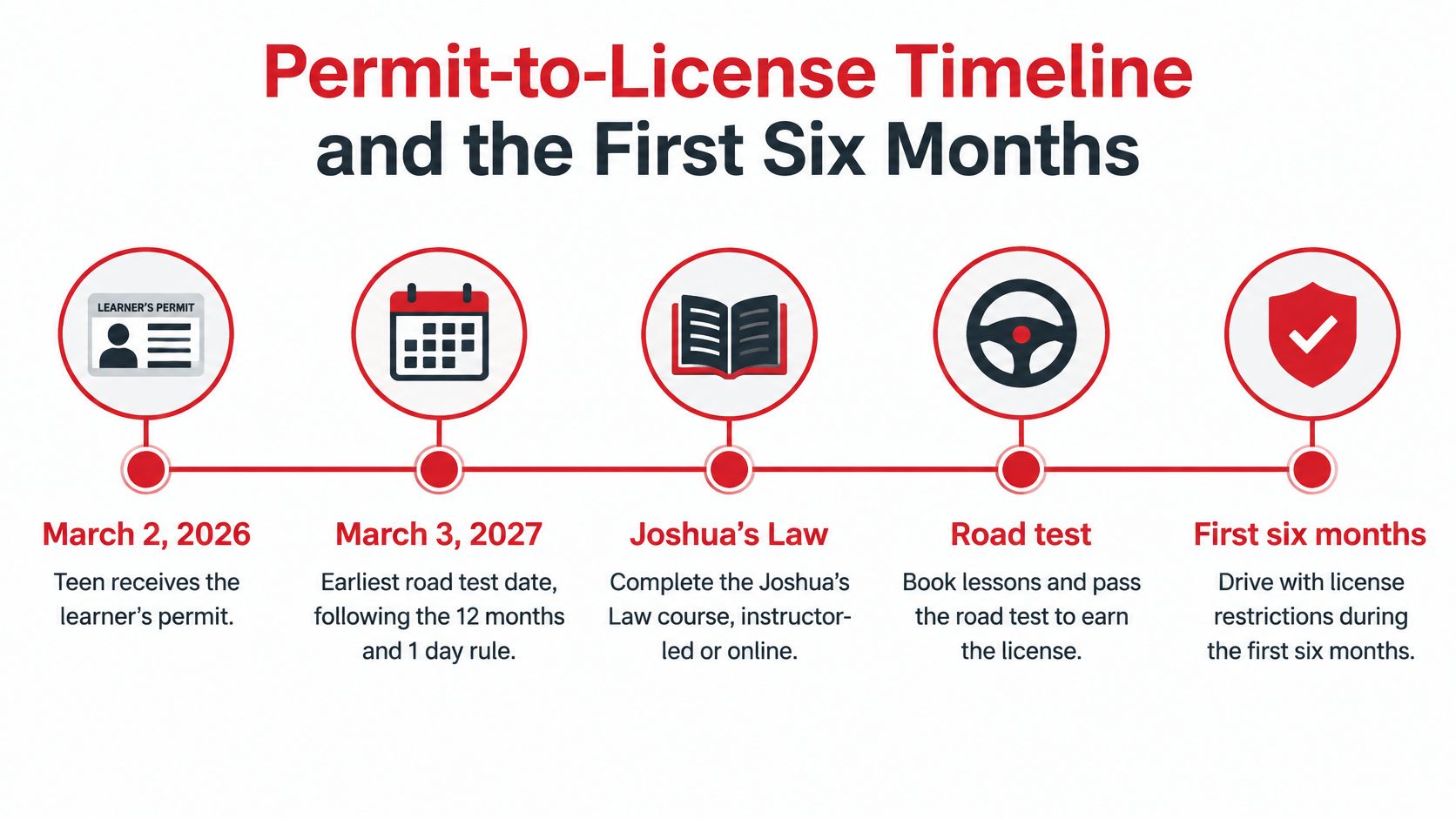
For this example, the earliest road test date is after the permit has been held for the required year, and the teen must also be 16 by then. That means the family should count backward from eligibility, not from the teen's birthday or the school calendar. Think of the permit as the learner's phase. The license is the checkpoint that changes how much freedom the teen has, so the preparation should already be steady before the appointment is booked.
During 2026, the teen can finish the Joshua's Law course, in classroom or online form, and begin in-car lessons on quiet streets. Family practice then expands the same way a student learns math: simple examples first, mixed problems later. Early sessions can focus on smooth starts, lane position and parking. Later sessions add 40 supervised hours with 6 at night, then move from residential roads to multilane traffic and merges. Once the permit clock, age requirement, course work and practice log all line up, the road test becomes the final checkpoint rather than a surprise. Passing it earns the Class D license.
The planning should continue after that. NHTSA's teen driving overview reports that novice teens have the highest crash rates of any age group during their first six months of unsupervised driving, even though they rarely crash while supervised by adults.
A family driving agreement works like a training plan for that stretch. Keep it plain enough that a teen can follow it without guessing:
- Night driving: agree on cutoff times and which routes are allowed after dark.
- Passengers: set a limit for the first months, and revisit it only after clean driving.
- Phone use: phone out of reach, navigation set before the car moves.
- Route planning: new or complex routes get driven with a parent first, including Atlanta interstates.
Review near-misses without punishment, and revisit the agreement every few weeks. A missed turn or a hard brake is useful information when the family treats it as practice data. The road test grants the license, but steady habits during the first six months show whether the teen is ready for wider independence.
Book Your Joshua's Law Course and Road Test
Once the paperwork is done and the practice hours are logged, the remaining decision is smaller than it looks: pick a course format, then schedule driving lessons and the test itself. Both course formats cover the same approved knowledge content, so choose based on your teen's schedule rather than on which one sounds more rigorous.
A-1 Driving School offers an instructor-led Drivers Education Joshua's Law Course and an online Drivers Education Joshua's Law Course, so a teen can learn in a classroom or around a job or practice schedule. Driving lessons are available for both students and adults. Booking lessons in the weeks before the test gives an instructor time to work through weak spots one at a time, such as gap selection in one session and intersection judgment in the next, instead of squeezing everything into a single lesson the day before.
We also provide road testing, including the Georgia Road Test, so a student can train and test with the same provider. Same standard of feedback, start to finish.
Three steps to take this week
- Confirm eligibility. Check the permit issue date, your teen's age, and the supervised hours log against the requirements before you spend anything. A student also needs a valid Learner's Permit or Driver's License to take a driving lesson.
- Choose the format and enroll. Classroom or online, both are Georgia DMV-approved Joshua's Law courses.
- Book driving lessons and a test date. Set the road test for after the permit clock completes, with lessons spread across the weeks leading up to it.
Families who qualify can look into the Scholarship Grant Program offered by A-1 Driving School, which helps make quality driver training accessible. Check eligibility before enrolling rather than after, since it may shape which option you choose.
We have been teaching Georgia drivers since 1987, with instructor-led and online Joshua's Law courses, teen and adult driving lessons, and Georgia road testing across our metro Atlanta and Athens locations. A-1 is also the only school in the state holding the Fulton County Board of Education contract, which allows it to teach Driver's Education in all Fulton County Schools across metro Atlanta. If your teen's permit clock is running, book driving lessons now so the weeks before the test build real skill instead of last-minute nerves. Visit A-1 Driving School to compare course formats, review lesson scheduling, and ask about the Scholarship Grant Program.