
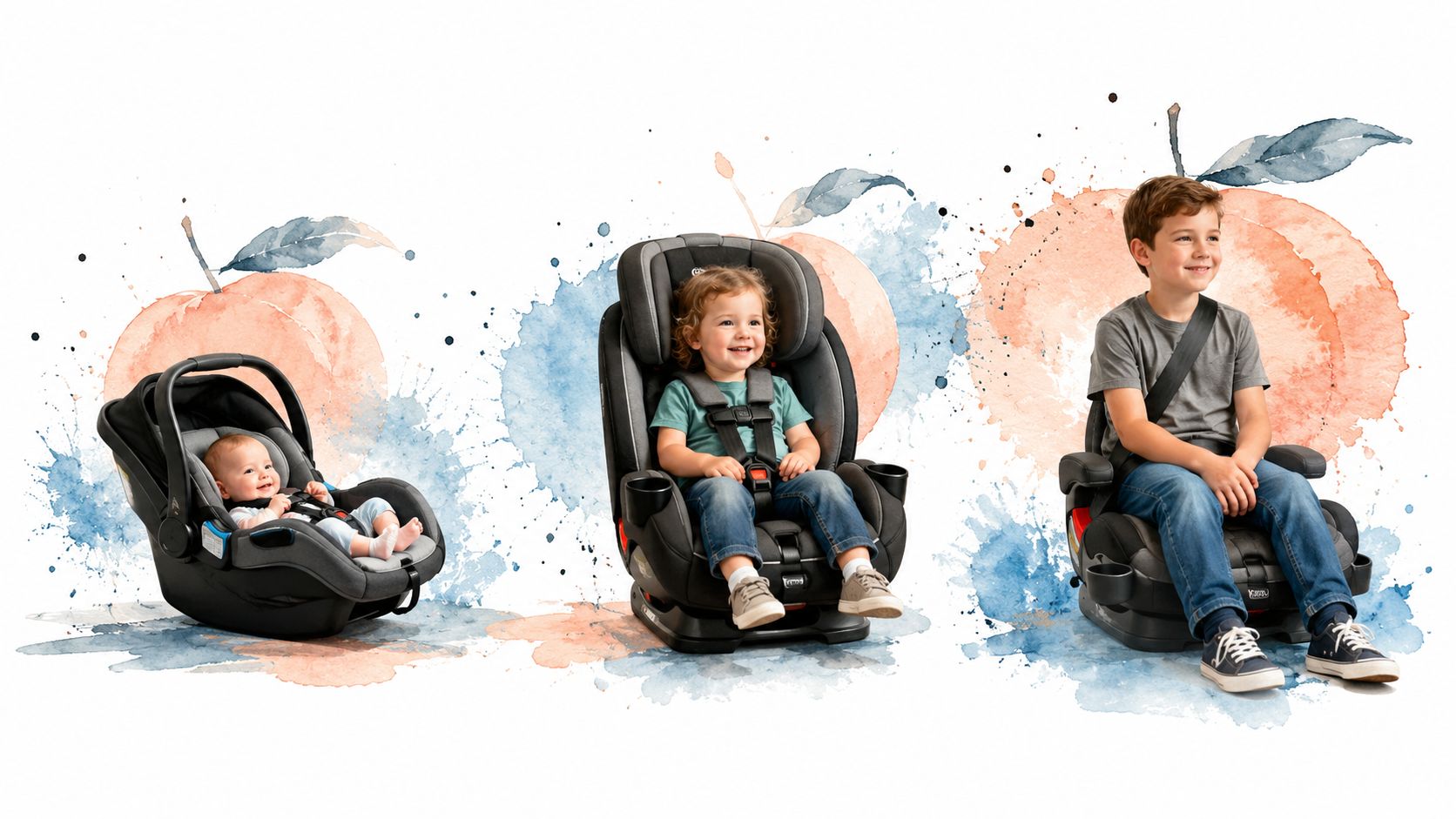
All children under age 8 and shorter than 57 inches must ride in Georgia's back seat in an appropriate car seat or booster seat. A child may ride in the front only under limited conditions, including proper restraint and a weight of at least 40 pounds.
You're buckling a baby into the car before a pediatrician visit, helping a toddler climb into a harnessed seat, or loading several children for school pickup. Then the questions start: Is this seat facing the right way? Does my child still need a booster? What happens if every back-seat position is already occupied?
Georgia's child seat requirements are easier to follow when you treat them as a fit-and-progression system, not a single age rule. The seat should match the child's development, size, and the vehicle's belt or anchor system. Think of it as a protective shell that must fit the child the way a well-fitted helmet fits a rider.
The law provides the minimum standard. Safe habits often mean keeping a child in the current stage until the seat's limits are reached and the vehicle belt fits correctly. The guidance below uses Georgia's age and height thresholds, explains the limited weight-based exceptions, and shows how driver education can help families build safer routines as children grow.
Introduction to Georgia Child Seat Requirements
A family leaving for a short trip may focus on distance rather than restraint details. A child may be properly buckled for a long highway drive, yet sit incorrectly during a quick run to school or the grocery store. Georgia's rule applies to those ordinary trips too.
Children under age 8 and shorter than 57 inches must ride in the back seat in a car seat or booster seat appropriate for their age and height, according to the Georgia child passenger safety guidance. The front-seat allowance is narrow. If the vehicle has no back seat, or other restrained children already occupy it, a child under 8 may ride in front only when properly restrained and weighing at least 40 pounds.
That rule answers where many children must sit, but it doesn't answer every fit question. A child can meet an age threshold and still need a harness or booster because the vehicle belt doesn't rest correctly on the body. National guidance places infants rear-facing at least through age 1, toddlers in forward-facing harnessed seats around ages 1 to 4, and children around ages 4 to at least 8 in belt-positioning boosters until they reach about 4 feet 9 inches, or 57 inches. The Safe Kids Georgia law tracker connects that progression with Georgia's height-based threshold.
Practical rule: Move a child up because the current seat has been outgrown, not because the next seat looks more grown-up.
The reason for this careful progression is physical protection. A properly used restraint helps manage the forces of a crash by keeping the child positioned and reducing the chance of ejection. Parents don't need to memorize crash engineering to apply the principle. They need to select the right stage, install it according to the manuals, and check the harness or belt before every ride.
Understanding How Child Seat Requirements Work
Child seat requirements use several measurements because children develop at different rates. Age helps describe development, weight helps determine whether a restraint can support the child, and height helps determine whether the harness or vehicle belt fits correctly. No single number can answer every seat-selection question.
A restraint works much like a support structure. The harness should hold the child against the seat's protective shell, while the shell and vehicle system manage movement. During a crash, correctly used restraints lengthen the time over which the child slows down, spread forces across stronger parts of the body, and reduce ejection risk. An evidence synthesis on child restraint systems summarizes an estimated global reduction in child deaths of about 60 percent, while NHTSA estimates a 71 percent reduction in fatality risk when restraints are properly installed and used.
The progression parents can remember
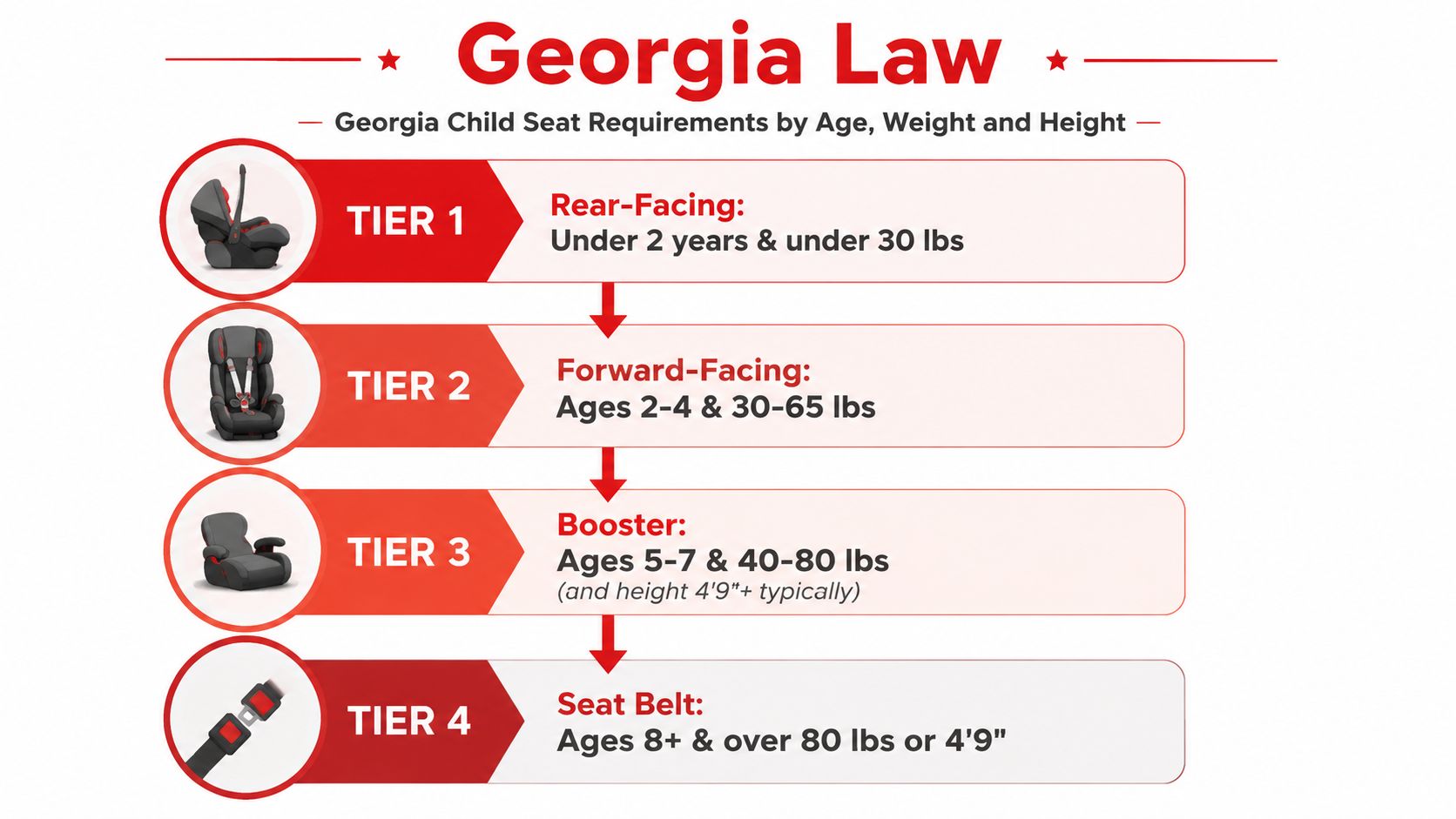
Rear-facing first. A rear-facing seat supports the child's head, neck, and back together. National guidance recommends rear-facing travel at least through age 1, while the seat manufacturer's height and weight limits determine how long that particular seat can be used.
Forward-facing with a harness next. Once a child outgrows the rear-facing limits, a forward-facing seat with its harness provides restraint suited to a larger child who still needs the seat's built-in protection.
Booster when the vehicle belt needs help. A booster raises the child so the lap belt rests low across the hips or upper thighs and the shoulder belt crosses the chest and shoulder. Georgia's 57-inch threshold makes height especially important.
Seat belt when it fits. A child shouldn't leave a booster just because the child reaches a certain birthday. The belt must stay in the right position while the child sits upright.
This is why a one-size approach fails. Two children of the same age may have different heights, weights, sitting ability, and seat fit. Read the child-seat manual and vehicle owner's manual together, then evaluate the actual belt path and harness position.
Regulations also change over time and differ between markets. UNECE i-Size systems use ISOFIX anchorage-based installation, while Australian rules include approved restraints with a top tether and six-point harness requirements. These examples show how product standards focus on installation geometry and misuse reduction, while state laws tell families when and where children must be restrained.
Georgia Child Seat Requirements by Age Weight and Height
Georgia's rules become more manageable when you see them as a visual path. Start with the child's current stage, confirm the seat's limits, and then check whether the restraint fits the vehicle.
Stage one for infants
Infants should ride rear-facing at least through age 1, following the seat manufacturer's instructions for maximum height and weight. The harness should lie snugly against the child, with the straps routed at the correct position for rear-facing use. A rear-facing seat gives the child's developing body a broad, supported surface during sudden movement.
Don't turn the seat forward simply because the child's legs look bent or touch the vehicle seat. Those signs alone don't mean the rear-facing stage has ended. The manufacturer's limits and the child's fit matter more than appearance.
Stage two for toddlers
Toddlers typically move to a forward-facing seat with a harness around ages 1 to 4, but the exact transition depends on the rear-facing seat's limits and the child's size. Keep the harness snug and use the top tether when the seat and vehicle instructions require it. A forward-facing seat still provides more positioning support than a vehicle belt alone.
Stage three for booster riders
Children around ages 4 to at least 8 generally use a belt-positioning booster until they reach about 4 feet 9 inches, or 57 inches, and the vehicle belt fits properly. Georgia requires children under 8 and shorter than 57 inches to use an age- and height-appropriate car seat or booster in the back seat.
A booster is doing its job when the lap belt sits low on the hips or upper thighs, not across the abdomen, and the shoulder belt crosses the center of the chest and shoulder. The child should be able to sit upright without sliding under the belt or moving it behind the back.
| Stage | Age and size guideline | Seat type and fit check |
|---|---|---|
| Rear-facing | Infants, at least through age 1, within the seat's limits | Harness is snug, seat is installed at the manufacturer's angle |
| Forward-facing | Toddlers around ages 1 to 4, within the seat's limits | Harness stays snug and the top tether is used as directed |
| Booster | About ages 4 to at least 8, under 57 inches when the belt doesn't fit | Lap belt stays low, shoulder belt crosses the chest |
| Seat belt | After the child reaches the required size and the belt fits correctly | Child remains upright with the belt positioned correctly |
For a closer explanation of the transition, parents can review Georgia booster seat age requirements. The central idea is simple: don't graduate a child based only on age. Check size, seat limits, belt position, and the child's ability to stay correctly seated for the entire ride.
Where Children Must Sit and Common Exceptions in Georgia
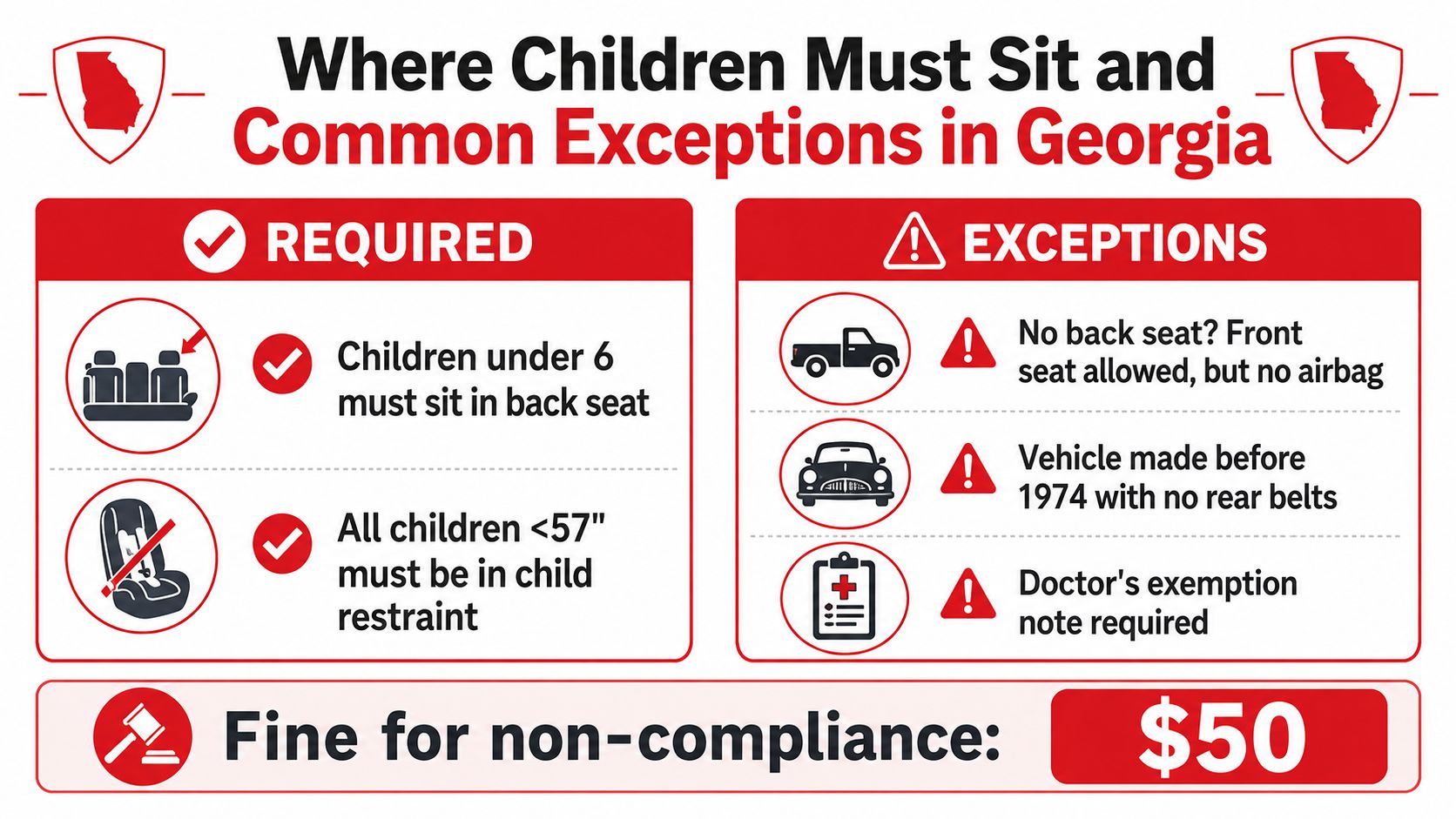
Georgia's back-seat rule is easiest to remember as a location rule with specific conditions. A child under 8 and shorter than 57 inches belongs in the back seat and must use an appropriate car seat or booster. The front seat isn't a convenient alternative just because a child asks to sit beside the driver.
A front-seat exception can apply when the vehicle has no back seat or when other restrained children occupy the available back-seat positions. The child must still be properly restrained and weigh at least 40 pounds. Parents should also follow the vehicle and restraint manuals, especially where airbags and seat placement are involved.
Everyday examples
Consider a small pickup with no usable back seat. The front-seat exception may apply only if the child meets the weight requirement and is properly restrained. A family carpool creates a different situation. If other children occupy the back seat in approved restraints, a qualifying child may be allowed in front, but that doesn't erase the need for careful restraint selection.
Georgia also provides a specific rear-seat belt exception. A child weighing at least 40 pounds may use a lap belt when lap-and-shoulder belts are unavailable or already being used to secure other children. This is a limited belt-configuration exception, not permission to let a child ride unrestrained.
Before using an exception, ask three questions: Is the back seat unavailable or occupied? Does the child weigh at least 40 pounds? Is the child restrained in the manner Georgia permits?
A taxi, rideshare, borrowed vehicle, or imported vehicle can create compatibility problems. Check whether the vehicle has the needed belt type, lower anchors, top-tether anchor, and a seating position that accepts the restraint. A legal exception doesn't guarantee that a particular seat is easy to install safely.
Parents should repeat the same inspection every time they change vehicles. Read both manuals, confirm the belt or anchor route, press the seat firmly into place, and check that the harness or belt remains correctly positioned. If the installation feels uncertain, a hands-on inspection is safer than relying on a guess.
How to Install and Check Your Child Seat Correctly
A correctly chosen seat can still fail to protect a child if the installation is loose or the harness is incorrectly positioned. Treat installation as a repeatable process rather than a one-time project. The vehicle manual and child-seat manual are the controlling references for anchor locations, belt paths, recline settings, and tether use.
A practical installation routine
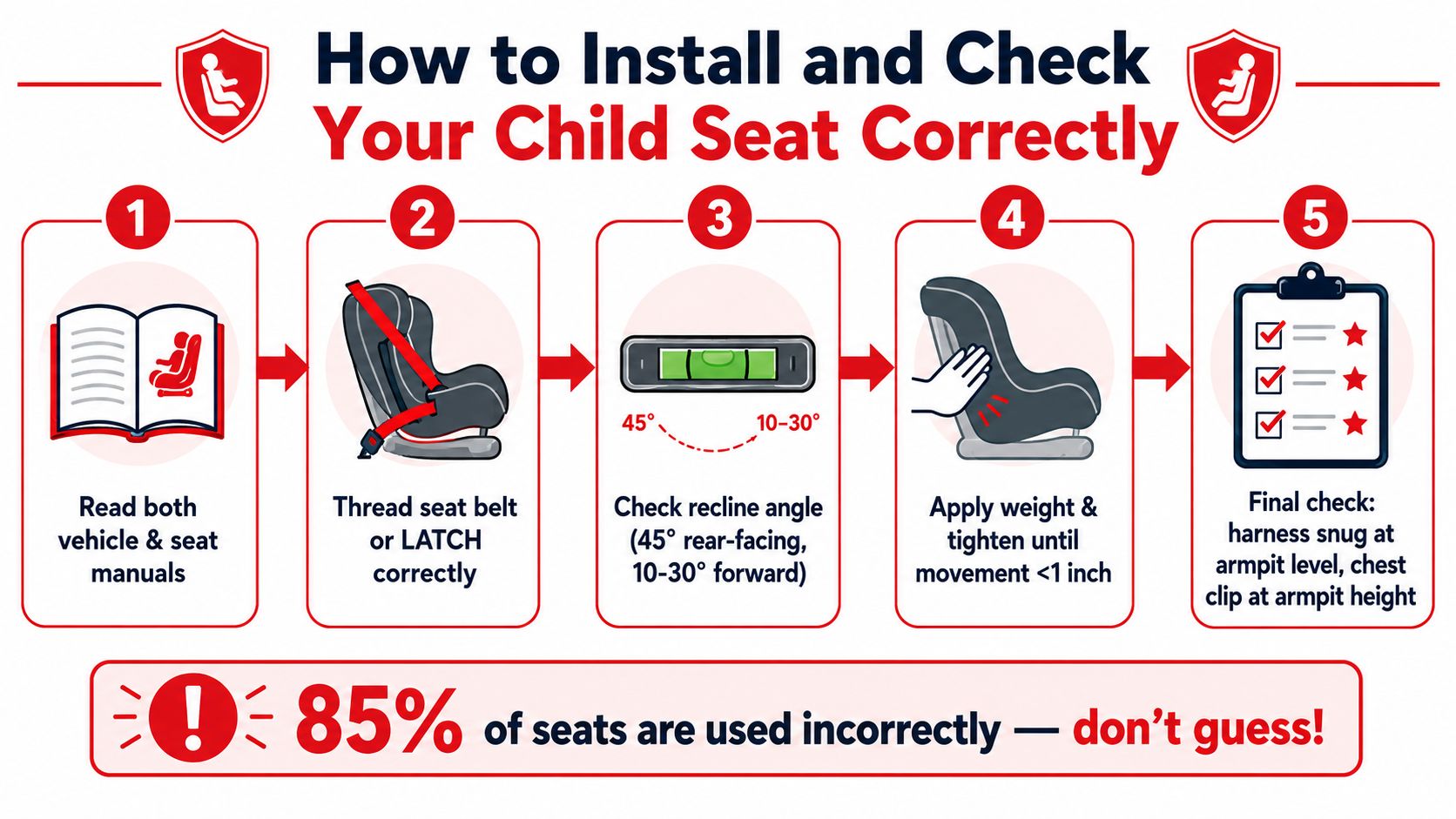
Read both manuals. Find the approved seating positions, anchor locations, belt path, recline setting, and top-tether instructions.
Choose one installation method. Use the lower anchors or the vehicle seat belt as directed. Don't combine methods unless the manufacturer specifically allows it.
Set the recline correctly. Rear-facing and forward-facing seats use different angles. Use the indicator and instructions on the seat rather than estimating by eye.
Tighten the installation. Apply pressure while removing slack from the belt or anchor strap. Check the seat at the approved belt path for excessive movement.
Secure the child. Harness straps should lie flat and snug. The chest clip belongs at armpit level, and bulky clothing should not create hidden slack.
A useful final check includes expiration information, recall notices, visible damage, and whether the seat has been involved in a crash. A newer model isn't automatically necessary merely because a standard is changing. Consumer Reports has reported that the federal FMVSS 213a side-impact standard was set for June 30, 2025, with a later proposal extending it to December 5, 2026, so parents should distinguish new-seat manufacturing requirements from the condition and correct use of a seat already in the home.
The safest installation is the one you can explain. If you can't identify the belt path, anchor route, harness position, and final fit check, pause before driving.
Inspection support matters because families use different vehicles, seats, and seating arrangements. UNICEF reporting cited by the Governors Highway Safety Association identifies only 33 countries with both child-seat and child-seat-anchor legislation, a reminder that laws and infrastructure don't always provide the same practical support everywhere.
For a Georgia-focused walkthrough, parents can use A-1 Driving School's child safety seat installation guide. Families who use child bicycle seats for short trips can also consult Rider 18 parent cycling tips, while remembering that bicycle restraints and vehicle child restraints are separate safety systems with different instructions.
Penalties Inspections and Where Georgia Parents Can Get Help
A penalty is meant to discourage unsafe transport, but avoiding a ticket is only the smallest reason to follow child seat requirements. Correct restraint use protects a child during the sudden forces of a crash, while an incorrectly routed belt or loose harness can leave the child poorly positioned.
The CDC reports that child restraints are estimated to have saved 11,606 children under age 5 since 1975 in the United States. The same CDC child passenger safety resource reports a 71 percent reduction in fatality risk for infants younger than 1 and a 54 percent reduction for children ages 1 to 4 in passenger cars when the appropriate restraint is used. Yet 2023 U.S. crash data recorded 1,019 child passenger deaths among children age 14 and under, and 43 percent were not buckled up, according to that source.
Turn uncertainty into a hands-on check
Parents don't have to troubleshoot every installation alone. Georgia families can look for certified child passenger safety technicians, Safe Kids Georgia events, and local fire-station checks where available. Call before visiting, because inspection schedules and technician availability vary.
Bring the child seat, the vehicle, and the child if the inspection provider requests them. A technician can often identify a twisted belt, incorrect recline, loose installation, harness problem, or incompatible seating position that isn't obvious from a quick visual glance.
Keep a written routine in the family's shared notes:
- Before each trip: Confirm the child is in the correct seat and the harness or belt is positioned correctly.
- After switching vehicles: Recheck the installation instead of assuming the same method works everywhere.
- After growth or a seat change: Revisit the manufacturer's limits and belt fit.
- For every caregiver: Explain the same back-seat rule, exception limits, and harness routine.
Parents teaching older teens to drive can connect passenger safety with broader driver training. A-1 Driving School offers Georgia driver education, Joshua's Law courses, online course options, behind-the-wheel lessons and lesson packages, road-test preparation and testing assistance, and information about the Georgia Driver's Education Scholarship Grant Program for qualifying students. Families comparing broader restraint rules can also review Georgia seat belt laws.
Staying Compliant and Building Safe Driving Habits for Families
Child passenger safety works best as a household routine. Keep younger children in the back seat, match the restraint to the child's current size and developmental stage, and check the harness or belt before the vehicle moves. When a child reaches 57 inches, don't stop checking automatically. Confirm that the vehicle belt stays low across the hips or upper thighs and crosses the chest and shoulder while the child sits upright.
Parents also set the tone for future drivers. A teenager who watches adults buckle every passenger, remove distractions, and check the vehicle before leaving learns that safe driving is a daily behavior, not something reserved for a road test. Driver education, supervised practice, and calm conversations about passengers build that family culture over time.
For families preparing for a first outing with a newborn, these tips for first trips with baby can complement vehicle-specific restraint guidance. The seat manual and vehicle manual should remain the final references for installation and fit.
Remember the progression:
- Rear-facing for infants at least through age 1, within the seat's limits.
- Forward-facing with a harness for the next stage, according to the seat's instructions.
- Booster use until the vehicle belt fits correctly and the child reaches the applicable size threshold.
- Back-seat travel for children under 8 and shorter than 57 inches, subject to Georgia's limited exceptions.
Families can also use ongoing driver education to prepare teens for Georgia licensing, including Joshua's Law courses, online learning, driving lessons, lesson packages, road testing, and scholarship resources.
A-1 Driving School offers instructor-led and online Georgia driver education, Joshua's Law courses, behind-the-wheel driving lessons and lesson packages, road-test preparation and testing assistance, and information about the Georgia Driver's Education Scholarship Grant Program. Visit A-1 Driving School to choose a course or lesson option and start building safer driving habits for every passenger in your family.