
Your child's eighth birthday is coming up, and they've probably already asked the question that catches a lot of parents off guard, “Can I stop using my booster seat now?” You may know Georgia law mentions age eight, but that doesn't always match what you see in the back seat. If the seat belt still looks awkward on their body, your concern is justified, and this guide will help you sort out the difference between the legal minimum and the safer choice.

For many families, this is a real milestone. A child wants to feel big, a parent wants to follow the law, and both want to avoid making the wrong call too soon. The safest answer usually comes down to one thing, does the seat belt fit the child, or is the booster still doing important work? If you're also teaching your child that buckling up matters every time, it helps to reinforce that habit with simple reminders like always use seatbelts.
Is Your Child Ready to Ditch the Booster Seat
The hardest part is that your child can look ready before their body is. A child who just turned eight may be legally closer to the transition point, but that doesn't mean the lap belt sits low enough or the shoulder belt stays in the right place. Parents often notice the mismatch before the law or the birthday does.
The booster exists for one reason, to raise a child so the adult seat belt fits the body the way it was designed to fit. Without that lift, the belt can ride too high on the stomach or too close to the neck, which is exactly why the “big kid seat” still matters after the birthday candle is blown out. A child who wants to graduate early may still need the booster for several more months, or longer, depending on size and seating position.
Practical rule: If the seat belt looks like it was made for a taller body, the booster is probably still doing its job.
That's why this topic causes so much confusion. Parents hear booster seat age requirements and expect a single cutoff, but the actual answer is tied to fit, not just age. Before you decide your child is done, look at the body in the seat, not just the number on the calendar.
Georgia's Booster Seat Law Explained
A child can be close to the legal cutoff and still not fit the seat belt correctly. Georgia's rule is straightforward, but it is easy to oversimplify. The CDC's state-law map groups Georgia with states that require child restraints for children age 7 or younger, and the Georgia statute, O.C.G.A. § 40-8-76, requires restraint for any child under eight years of age (CDC state-law map). In plain English, a child who is 7 or younger needs to be properly secured in an age-appropriate child restraint.
The legal question does not end with age alone. A child still has to ride in a restraint that fits their height and weight, which is why the law and safety guidance both look at more than a birthday. For many Georgia families, that means the booster is still the right choice even when a child is close to age eight.
Georgia gives you the minimum legal floor, not the safest possible target. That difference matters in real vehicles, because belt fit can change from one seat to another. If you want a reminder that vehicle design affects how a child fits, you can evaluate Toyota Camry safety and see how seat setup plays a role in restraint fit.
| Criteria | Georgia Law (O.C.G.A. § 40-8-76) | NHTSA and AAP Recommendation |
|---|---|---|
| Age focus | Children under eight years of age must be restrained | Continue booster use until the seat belt fits properly |
| Fit focus | Child restraint must be appropriate for the child's size | Fit, not age alone, should determine the change |
| Practical takeaway | Legal compliance is the baseline | Safety best practice may continue beyond the legal minimum |
Why the Law Is Just the Minimum Standard
A law can tell you when you're allowed to stop, but it can't tell you whether the seat belt fits your child correctly. That's why safety experts keep pushing beyond the minimum. The booster seat raises the child so the vehicle belt sits over stronger parts of the body instead of soft tissue, which is the whole reason the seat exists.
The crash-protection case for boosters is strong. CDC guidance says booster seats reduce the risk of serious injury by 45% for children ages 4 to 8 compared with seat belts alone, and NHTSA says children should stay in a booster until they're about 4 feet 9 inches tall and between 8 and 12 years old (NHTSA booster seat guidance). That's the gap parents need to understand, Georgia law may allow movement at one point, but best-practice safety may point to a later one.
Law versus safety guidance
| Issue | Georgia minimum | Expert recommendation |
|---|---|---|
| When to stop using a booster | Under eight years of age must still be restrained | Keep using a booster until the belt fits properly |
| What matters most | Legal compliance | Correct belt geometry and child size |
| Best use case | Basic legal standard | Better real-world crash protection |
The reason is simple. A booster helps the lap belt sit low across the upper thighs instead of the abdomen, and it keeps the shoulder belt off the neck. When the belt rides wrong, the restraint can turn into a problem instead of a protection. That's why a child who is technically old enough may still be safer in a booster.
A child isn't ready just because the birthday came first.
The safest decision comes from fit, not impatience. If your child still sits awkwardly in the seat belt, the booster is not a baby seat they've outgrown, it's the thing keeping the belt aligned correctly until their body is ready for the adult system.
The 5-Step Test for Seat Belt Readiness
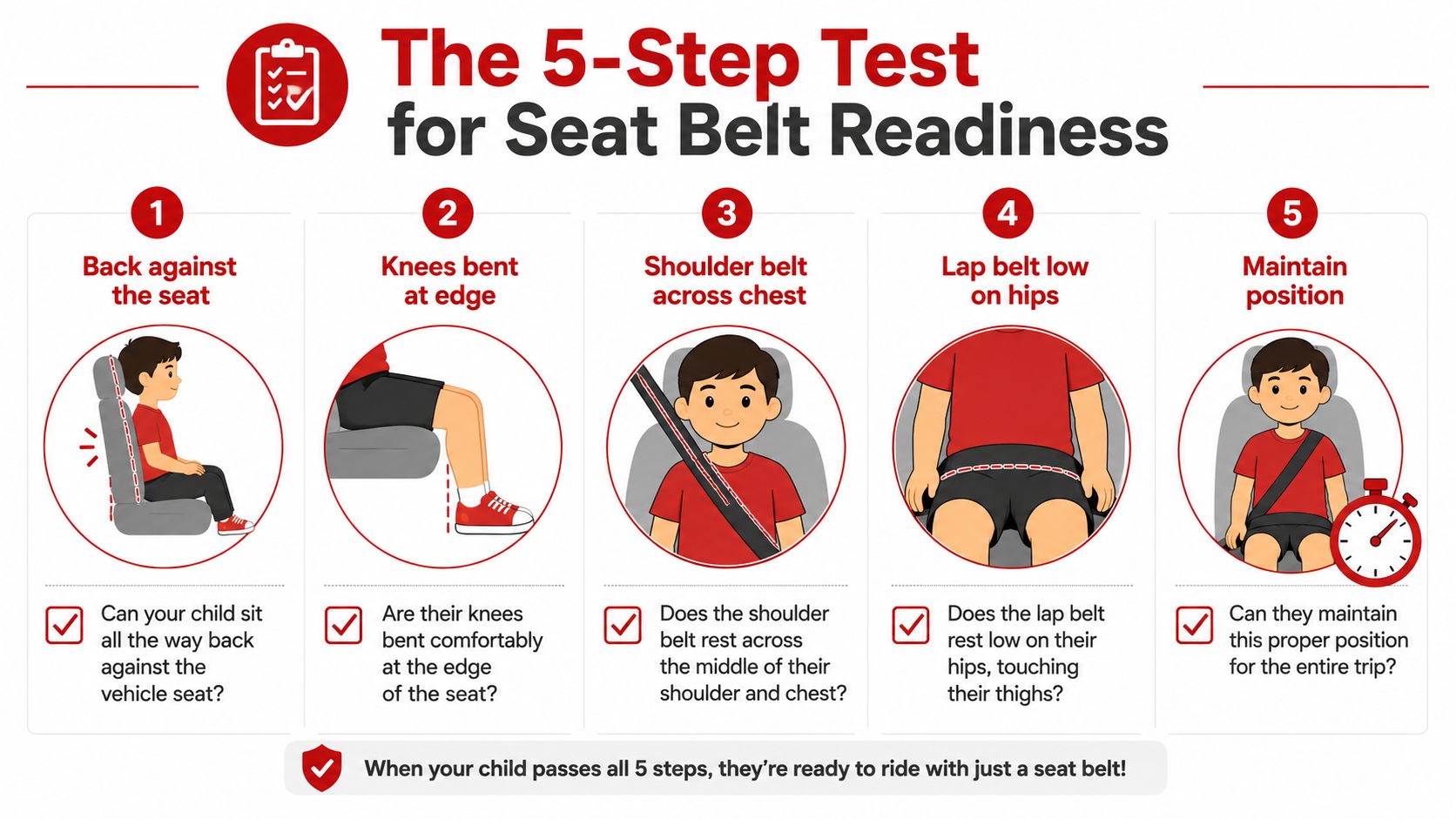
The easiest way to stop guessing is to run the 5-Step Test in your own car. This is the check that tells you whether the seat belt fits correctly without a booster, and it's especially helpful when the child is close to the legal age but not clearly ready. The American Academy of Pediatrics says booster use typically continues until a child reaches 4 ft 9 in (145 cm) and is roughly 8 to 12 years old, because that's when they can usually pass this fit test (CDC child passenger safety guidance).
Step by step
Back against the seat. Your child should sit all the way back with their back flat against the vehicle seat. If they have to lean forward to reach the belt, that's a warning sign.
Knees bent at the edge. Their knees should bend naturally at the edge of the seat. If their legs stick straight out or they have to slide forward, the fit isn't right yet.
Shoulder belt across chest. The shoulder belt should cross the middle of the shoulder and chest, not the neck and not the face.
Lap belt low on hips. The lap belt should rest low across the upper thighs and hips. If it sits on the stomach, the child still needs the booster.
Stay in position. Your child has to hold that posture for the entire ride, not just the first 30 seconds. If they slump, twist, or put the belt behind them, they're not ready.
If they can't sit correctly every time, the booster is still the safer choice.
That last step is the one many parents underestimate. Children can pass a quick test in the driveway and fail it on the road when they get tired, bored, or fidgety. A booster is only useful if it helps keep the belt where it belongs for the whole trip.
Common Booster Seat and Seat Belt Mistakes to Avoid
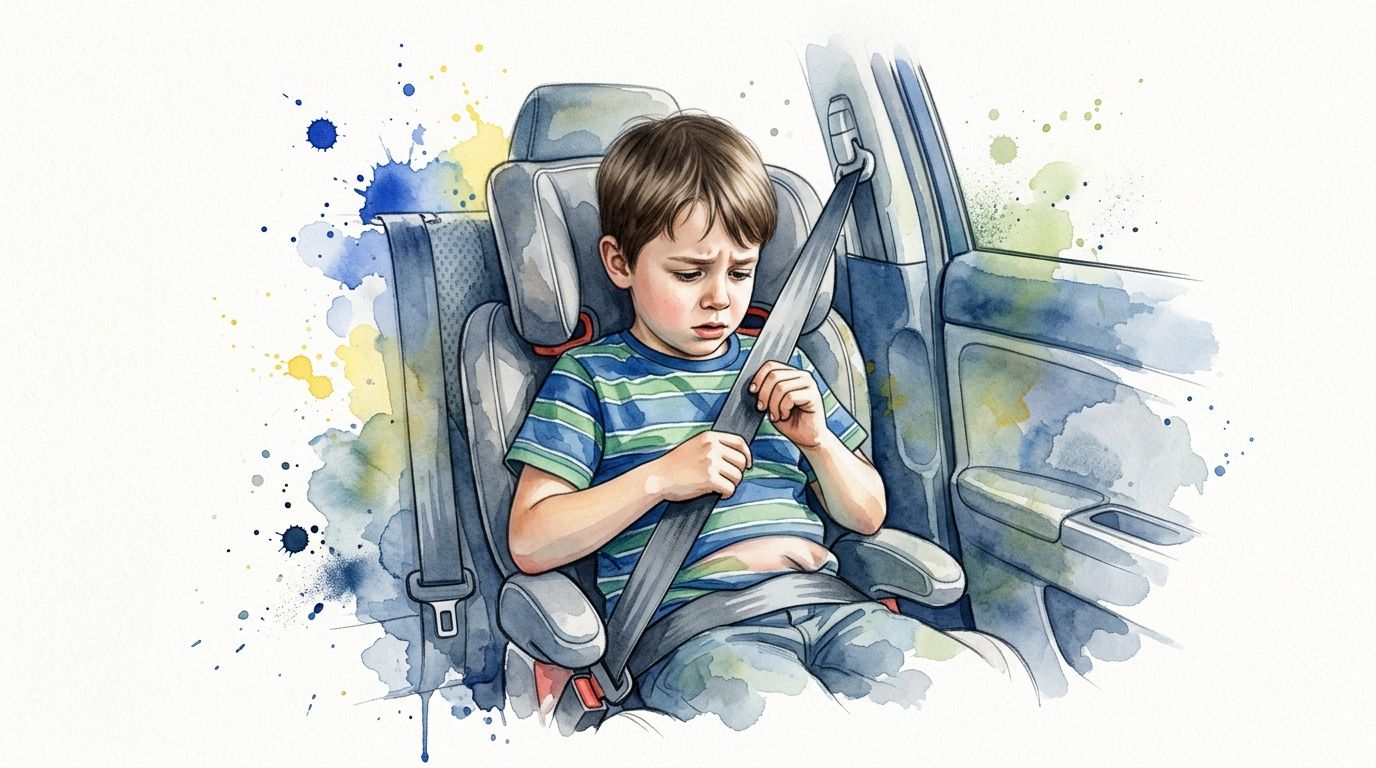
A lot of seat belt mistakes happen because a child wants to feel bigger. Others happen because a parent assumes “close enough” is fine once the child reaches a certain age. The problem is that small positioning errors can undo the whole point of the booster.
- Moving too soon: Age pressure from siblings or friends doesn't change belt fit. If the child can't pass the 5-Step Test, the booster stays.
- Putting the shoulder belt behind the back: That removes the shoulder restraint from the system and leaves the child with unsafe belt placement.
- Placing the belt under the arm: This can put the belt across the wrong part of the body and create a dangerous crash position.
- Letting them slouch: Slouching shifts the lap belt upward and makes the seat belt less effective.
- Treating the booster like an optional habit: The booster only works when the child uses it consistently.
A helpful habit is to check the fit every single time, especially on longer rides or when a different adult is driving. If your child rides in more than one vehicle, use the booster in each one and make sure the belt still sits correctly. For families who want a refresher on proper placement and setup, child safety seat installation is worth reviewing before the next school run.
When parents talk about booster seat age requirements, the hidden issue is often behavior, not age. A child who can't stay upright or keeps misusing the belt isn't ready to graduate, no matter what the calendar says.
From Safe Passenger to Safe Driver The Next Steps
The lessons your child learns as a passenger don't stay in the back seat forever. A child who practices correct belt use, stays still, and respects the rules of the car is already building habits that matter later when they begin driving. That discipline is a small but important part of growing into a safe road user.
Technical guidance notes that a child needs enough maturity to sit still for the entire ride without slouching or misusing the seat belt, and that same self-control matters when a teen eventually gets behind the wheel (Nationwide Children's guidance). Safe passenger habits make driver training easier because the mindset is already there, follow the rules, stay alert, and treat the car like a safety environment, not a play space.
For Georgia families preparing for the next stage, A-1 Driving School offers Joshua's Law Driver's Education, online course options, driving lessons, driving lesson packages, Georgia road test support, and the Georgia Driver's Education Scholarship Grant Program. If your teen is moving from passenger safety to driver readiness, A-1 Driving School can help you take that next step with training that fits your schedule and your family's goals.