
Your hands feel tight on the wheel before the test even starts. You know how to signal, stop smoothly, check mirrors, and make a proper turn. Then the examiner steps in, your chest gets heavy, and simple things suddenly feel harder than they did yesterday.
That doesn't mean you can't drive. It usually means the pressure changed how your brain and body are working in the moment.
I've seen this pattern with nervous teen drivers again and again. A student can do fine in practice, then rush a turn, forget a mirror check, or overcorrect during parking because they're thinking about the result instead of the task. The good news is that performance under pressure can be trained. For the Georgia road test, that training needs to connect directly to what happens in the car.
Why Your Mind Races Before the Georgia Road Test
Most road test nerves come from three thoughts happening at once. This matters. I could fail. Someone is judging me.
That combination speeds up your breathing, narrows your attention, and makes you want to do everything perfectly. In driving, perfectionism is a problem. Safe driving depends on calm, repeatable actions, not dramatic effort.
Pressure changes normal performance
This isn't just a beginner issue. Even elite performers can struggle when the moment gets tight. Researchers studying NBA free-throw data found that players shot on average 5 to 10 percentage points worse than normal in the final seconds of very close games, according to this analysis of NBA pressure performance.
That matters for driving students because it explains something important. Pressure doesn't always create better focus. Sometimes it pulls you away from your usual skill level.
Practical rule: On test day, your goal isn't to drive better than ever. Your goal is to drive as steadily as you do in a solid practice lesson.
Overthinking is often the real problem
A nervous driver usually isn't lacking information. More often, the problem is mental traffic. They're thinking about the score, the examiner, the last mistake, and the next turn all at once.
That's why it helps to understand why overthinking causes anxiety. When your mind starts stacking too many what-ifs, your body treats the moment like a threat, even if the task itself is familiar.
Common signs that overthinking is taking over:
- You replay mistakes immediately: You miss one small detail and mentally turn it into a disaster.
- You drive ahead of the car: Instead of handling the lane you're in, you worry about the next three maneuvers.
- You confuse tension with effort: You grip the wheel harder and mistake that for control.
- You rush to prove you're ready: Fast decisions replace clear ones.
If that sounds familiar, it helps to work on both skill and anxiety at the same time. A useful place to start is this guide on how to overcome driving anxiety.
The important shift is simple. Stop labeling yourself as a bad test-taker or a nervous driver. Start treating this as a performance under pressure problem. That's more accurate, and it's much easier to train.
Master Your Mind Before You Turn the Key
A strong test drive usually starts before the engine does. If your body shows up tense and your thoughts are scattered, the first few minutes of the road test can feel harder than they need to.
You don't need a complicated routine. You need one you can repeat.
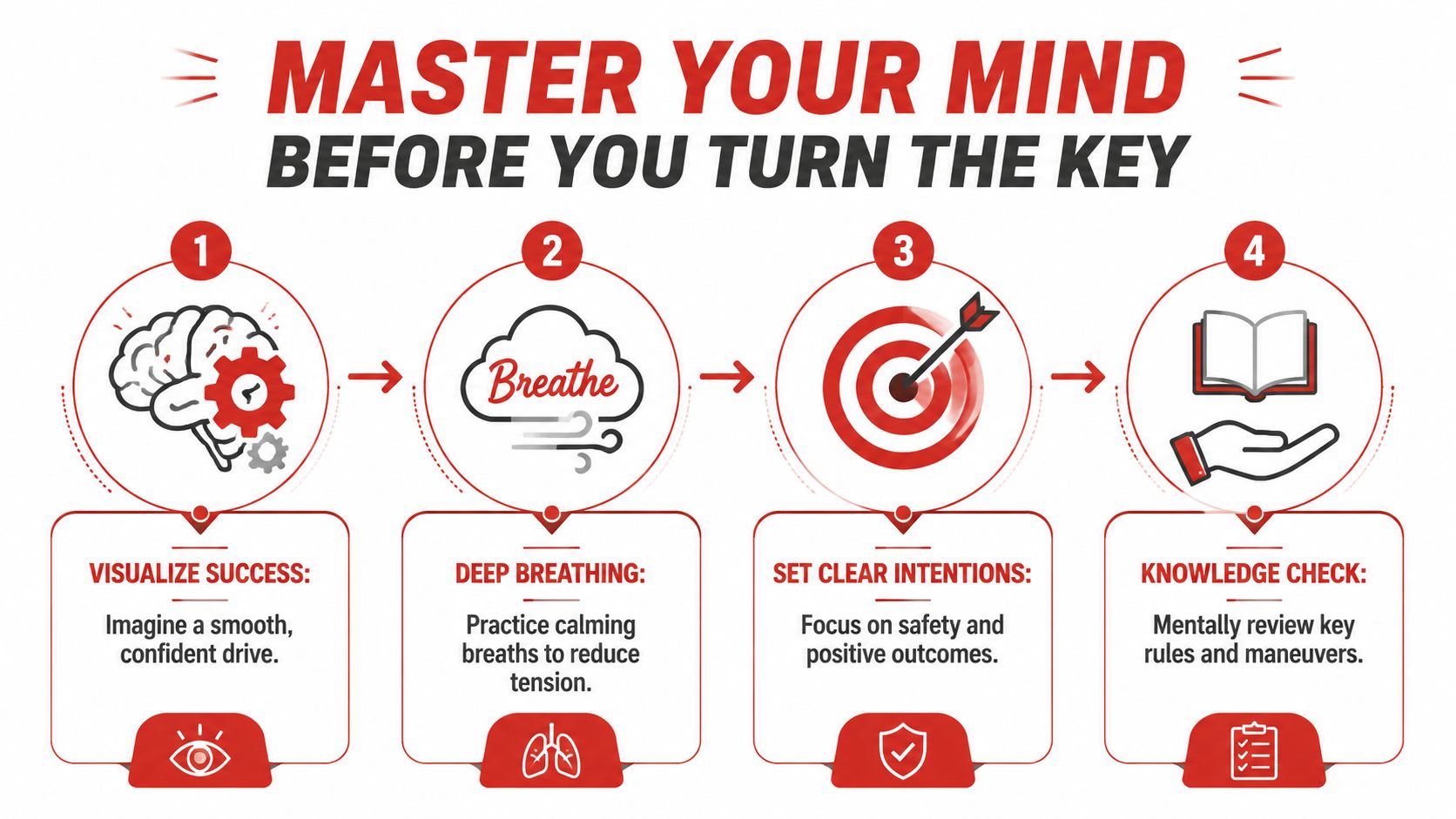
Use breathing to lower the noise
The fastest way to settle your system is controlled breathing. Not dramatic breaths. Just slow, even ones.
Try this before you get in the car:
- Inhale gently
- Hold briefly
- Exhale slowly
- Pause and repeat
Do that for a few rounds while your shoulders drop and your hands loosen. The point isn't to become sleepy or detached. The point is to stop your body from acting like it's in danger.
If you've ever looked into mental performance coaching in Vernon, you've probably seen the same basic principle. Calm is trainable when you practice it before the stressful event, not only during it.
Visualize the drive in the right way
A lot of students misuse visualization. They tell themselves, “I'm going to pass.” That's not enough. A useful visualization is specific and physical.
See yourself doing these actions:
- Adjusting the seat and mirrors
- Checking left, right, then left again at a turn
- Braking early and smoothly
- Backing with steady observation
- Parking without rushing the wheel
Don't imagine a perfect movie where everything goes easily. Imagine a normal, clean test drive where you stay composed and correct.
A good visualization sounds like this in your head: “Signal. Mirror. Check space. Smooth brake. Full stop. Look. Go when clear.”
Build a pre-test routine you can repeat
A routine keeps your brain from improvising under stress. The best ones are short enough that you'll use them.
A practical example:
| Step | What to do | Why it helps |
|---|---|---|
| Arrive settled | Get there early enough to sit quietly for a moment | Rushing creates fake urgency |
| Reset posture | Drop shoulders, relax jaw, loosen grip | Physical tension spreads into steering |
| Run one cue sentence | “Smooth and safe beats fast and perfect” | Keeps your focus on execution |
| Review only essentials | Signals, mirrors, speed control, full stops | Prevents last-minute overload |
Keep that routine the same for lessons, practice drives, and test day. Familiarity lowers mental friction.
Turn Practice Miles into Pressure-Proof Skills
A lot of teens practice for the road test in a way that feels productive but doesn't transfer well. They drive familiar roads, talk casually with a parent, and repeat the parts they already like. That builds comfort, but it doesn't always build test readiness.
The better approach is targeted practice. Qualitative sport psychology research emphasizes that pressure responses are highly person-specific, so individualized scenarios are more effective than one-size-fits-all drills for skill transfer. That applies directly to driving lessons. One student freezes during backing. Another rushes left turns. Another does fine until someone starts watching.
Drill one, the silent drive
This drill feels simple, but it exposes where anxiety shows up.
Have your supervising driver give instructions only when needed, then stay quiet. No coaching during turns. No constant reminders. No rescue commentary unless safety requires it.
What this reveals:
- Decision gaps: You'll notice whether you naturally check mirrors and signals without prompting.
- Stress habits: Many drivers speed up or tighten their turns when the car gets quiet.
- Attention control: Silence feels a lot like test conditions.
Run the same short route more than once. If your driving falls apart only when the support disappears, the issue probably isn't knowledge. It's pressure.
Drill two, the commentary drive
This one works in the opposite direction. The student talks through the drive out loud.
Examples of useful commentary:
- “I'm checking my mirror before moving over.”
- “I'm easing off the gas because the light may change.”
- “I'm turning my head to check behind before backing.”
This does two things. It slows the mind down, and it links thought to action. Nervous drivers often skip steps because their thinking gets too fast. Saying the process out loud makes the sequence visible again.
Say what you see, then do what you said. That's one of the cleanest ways to reduce rushed mistakes.
Drill three, the mistake recovery lap
Most students don't fail because they made one imperfect move in practice. They struggle because one mistake turns into three.
In this drill, the supervising driver intentionally pauses after a minor error and says, “Reset. Keep driving.” Then the student continues without discussion until the route ends.
That matters because road tests reward recovery. If you stop a little abruptly, the useful response is not panic. It's to settle down and handle the next task correctly.
A few smart ways to structure these sessions:
- Use short routes: Fatigue and frustration build quickly in long practice drives.
- Train the weakest skill first: Don't hide from parking, lane changes, or backing.
- Practice with realistic instructions: Use calm, brief commands like an examiner would.
- End with one clean repetition: Finish on composed execution, not emotional exhaustion.
For students who need more direct, pressure-focused coaching, driving lessons that target weak spots and test skills usually help more than repeating random miles with no plan. A-1 Driving School also offers lesson packages and road test preparation that let students rehearse in a structured setting with instructor feedback tied to actual test tasks.
How to Coach a Nervous Driver Without Adding Stress
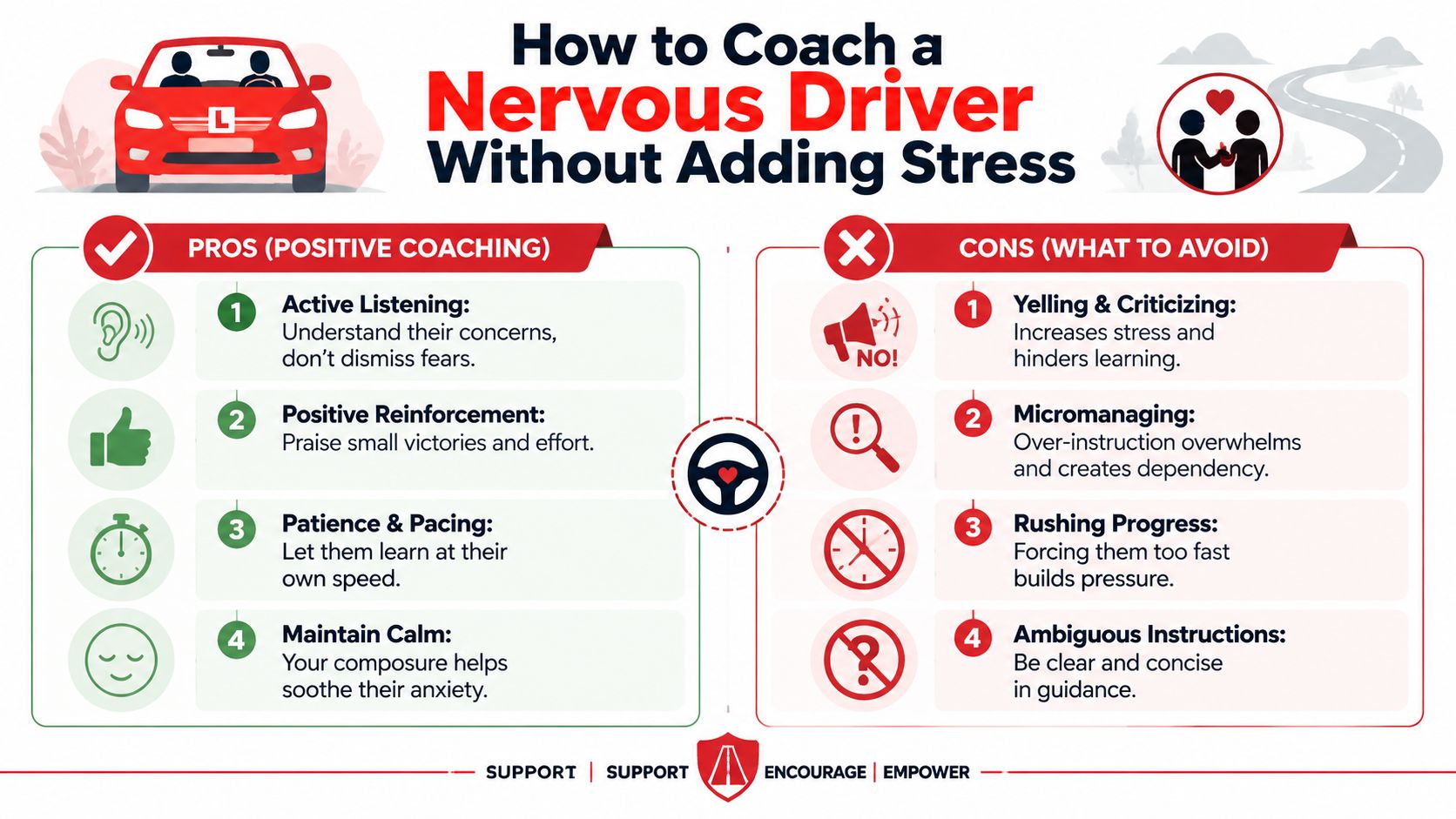
Parents and supervising drivers often mean well, then accidentally make the car harder to learn in. Tone matters. Timing matters. Word choice matters.
A nervous driver can improve quickly with calm, clear coaching. The same driver can tighten up fast if every mistake gets a sharp reaction.
Say this, not that
Here's a practical comparison that works better than generic advice.
| Instead of this | Try this |
|---|---|
| “Why do you always do that?” | “Let's do that turn again more slowly.” |
| “You're not listening.” | “Take one instruction at a time.” |
| “Brake, brake, brake!” | “Start braking earlier.” |
| “You know this already.” | “You know the skill. Let's steady the timing.” |
The stronger phrase is usually the one that tells the student what to do next. Criticism often describes the problem without giving a usable correction.
Correct one thing at a time
Over-coaching is a common mistake. A teen makes one wide turn, and the adult responds with a full lecture on hand position, speed, mirror checks, and focus. That overwhelms the driver and usually worsens the next maneuver.
Use this order instead:
- Name the main issue: “That stop was late.”
- Give one fix: “Begin braking earlier.”
- Repeat the situation: Let them try again soon.
- Acknowledge improvement: “That was smoother.”
This approach teaches faster because it reduces mental clutter.
Coach's reminder: A calm voice after a mistake teaches more than a long speech after the drive.
Structure practice so it feels winnable
Many nervous drivers dread practice because every session feels like a judgment. Change that. Build sessions around one or two goals.
Examples:
- A parking session: Focus only on setup, speed, and wheel timing.
- A neighborhood session: Work on stops, scanning, and right turns.
- A test-route style session: Use short directions, quiet observation, and limited feedback.
If you're helping a teen at home, this guide on how to teach a teenager to drive can help you keep your feedback clear and productive.
Your Georgia Road Test Pathway with A-1
Most students do better when their preparation follows a clear sequence. Confusion adds pressure. A clean pathway lowers it.
Start with the classroom side. If you're a Georgia teen working toward a Class D license, the Joshua's Law requirement is often the first major step. Some students do better in an in-person setting. Others focus better with online course options that let them work through the material on a flexible schedule.
Build the right order
The most practical sequence usually looks like this:
- Complete driver education requirements
- Add behind-the-wheel instruction
- Use targeted road test prep
- Take the test in a familiar process
That order works because knowledge alone doesn't calm test nerves. Skill under observation does.
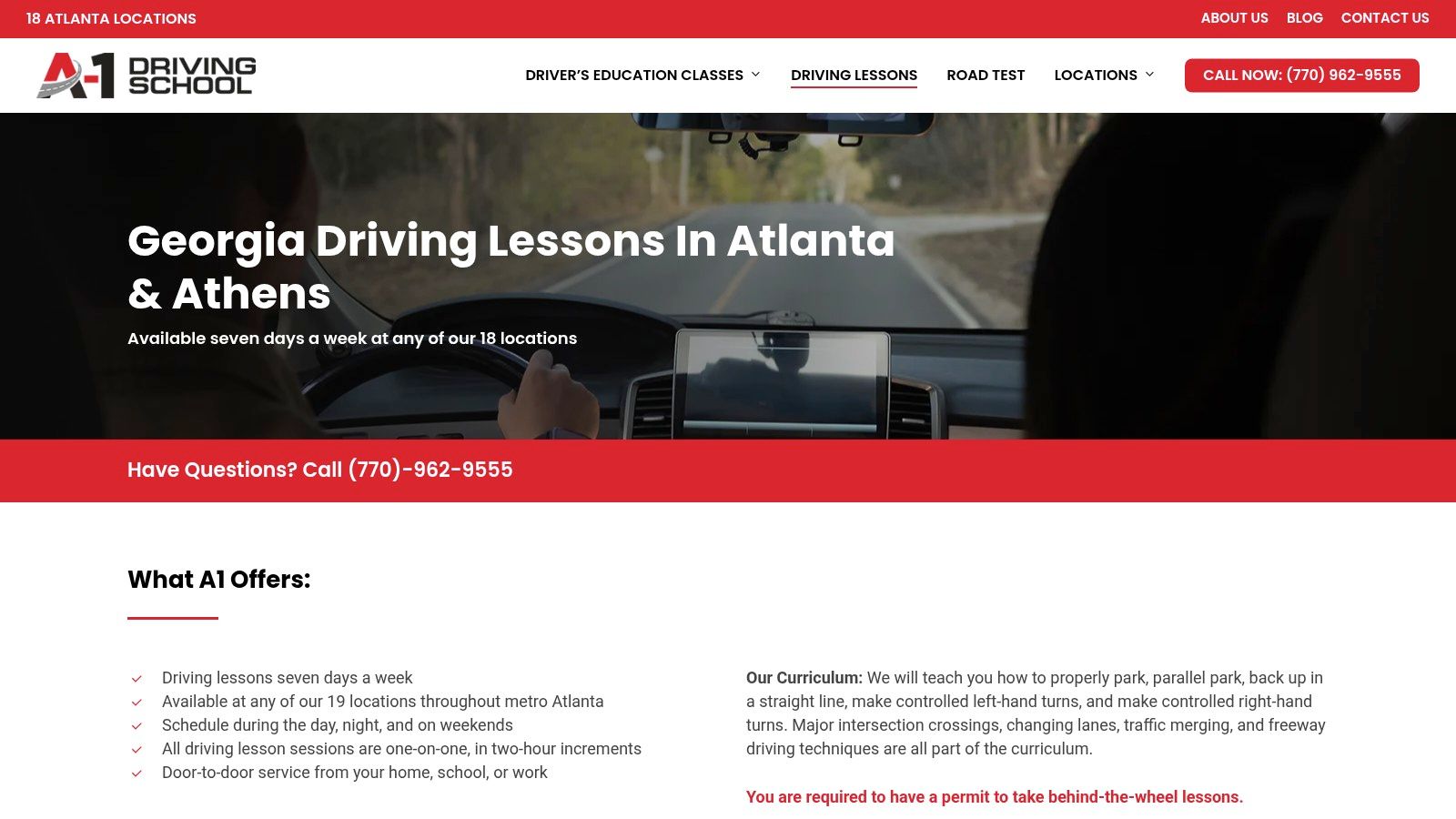
The next step is where many students make the biggest jump. Driving lessons and lesson packages give you a chance to work directly on the parts that tend to break down under pressure, such as parking setup, stop timing, lane position, scanning, backing, and following instructions without rushing.
Here's the kind of training many families look for when the road test is approaching:
Keep the process connected
A connected process helps nervous drivers because they don't have to keep changing systems. The same general principle applies whether you're choosing online coursework, in-car instruction, or road testing support. Familiar expectations reduce unnecessary stress.
When families ask what to prioritize, the answer is usually this:
- Choose a Joshua's Law course format you'll complete
- Book lessons around your weakest test skills, not your favorite ones
- Practice with realistic test-style instruction
- Look into on-site road testing if that fits your schedule and comfort level
- Check whether the Georgia Driver's Education Scholarship Grant Program applies to you
For a lot of teens, the scholarship question matters because access changes confidence. When training is easier to schedule and afford, students get more chances to practice correctly instead of stretching too much between drives.
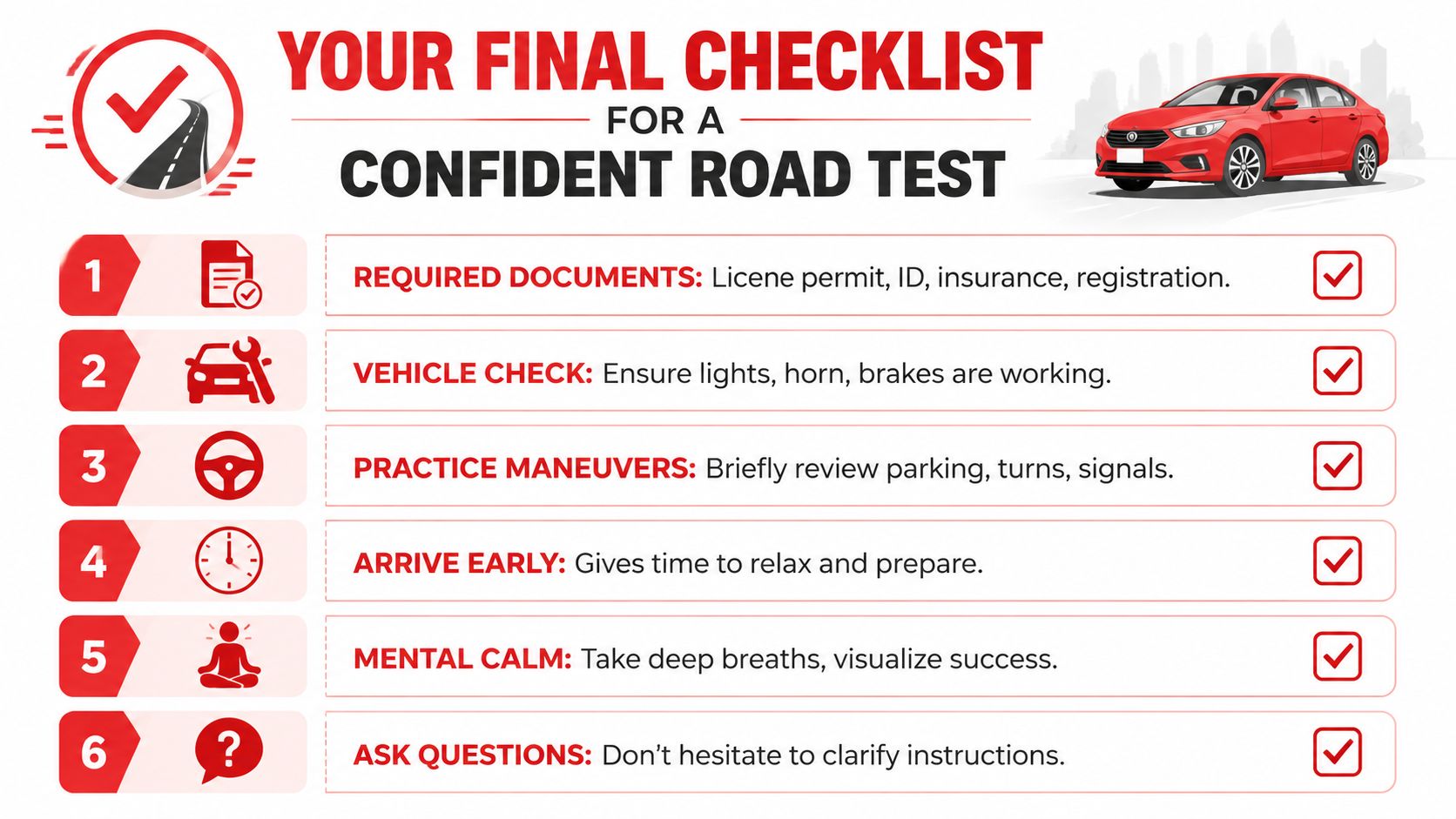
Your Final Checklist for a Confident Road Test
Pressure gets smaller when preparation gets specific. By test day, you don't need more motivation. You need a short list, a steady routine, and enough repetition that your basic skills still show up when you're nervous.
Use a checklist because anxious brains forget ordinary things.
Test day essentials
Before you leave, confirm these items:
- Bring required documents: Your permit, identification, and the items your testing provider requires. If you've completed required coursework, bring any related certificate or confirmation you were told to have available.
- Check the vehicle basics: Make sure lights, horn, brakes, and signals are working properly.
- Review only core maneuvers: Turns, full stops, backing, parking, mirror use, and signaling.
- Arrive with margin: Extra time helps you settle instead of rushing into the seat.
- Use your pre-test routine: Breathe, relax your hands, and narrow your focus to the next task.
- Listen for the actual instruction: Don't guess ahead if the examiner hasn't finished speaking.
A final reminder for nervous drivers:
One imperfect moment doesn't decide the whole drive. Recovering calmly is part of driving well.
If it helps, watch this short video before test day and then leave the studying alone. Last-minute cramming often adds more noise than value.
When you're ready, the smartest next step is simple. Get focused practice on the exact skills that feel shaky, then test in a setting that reduces surprises.
If you want a more structured path from Joshua's Law to behind-the-wheel practice and road test preparation, A-1 Driving School offers Georgia driver's education options, driving lessons and lesson packages, online course formats, and road testing support to help you prepare with less guesswork.