
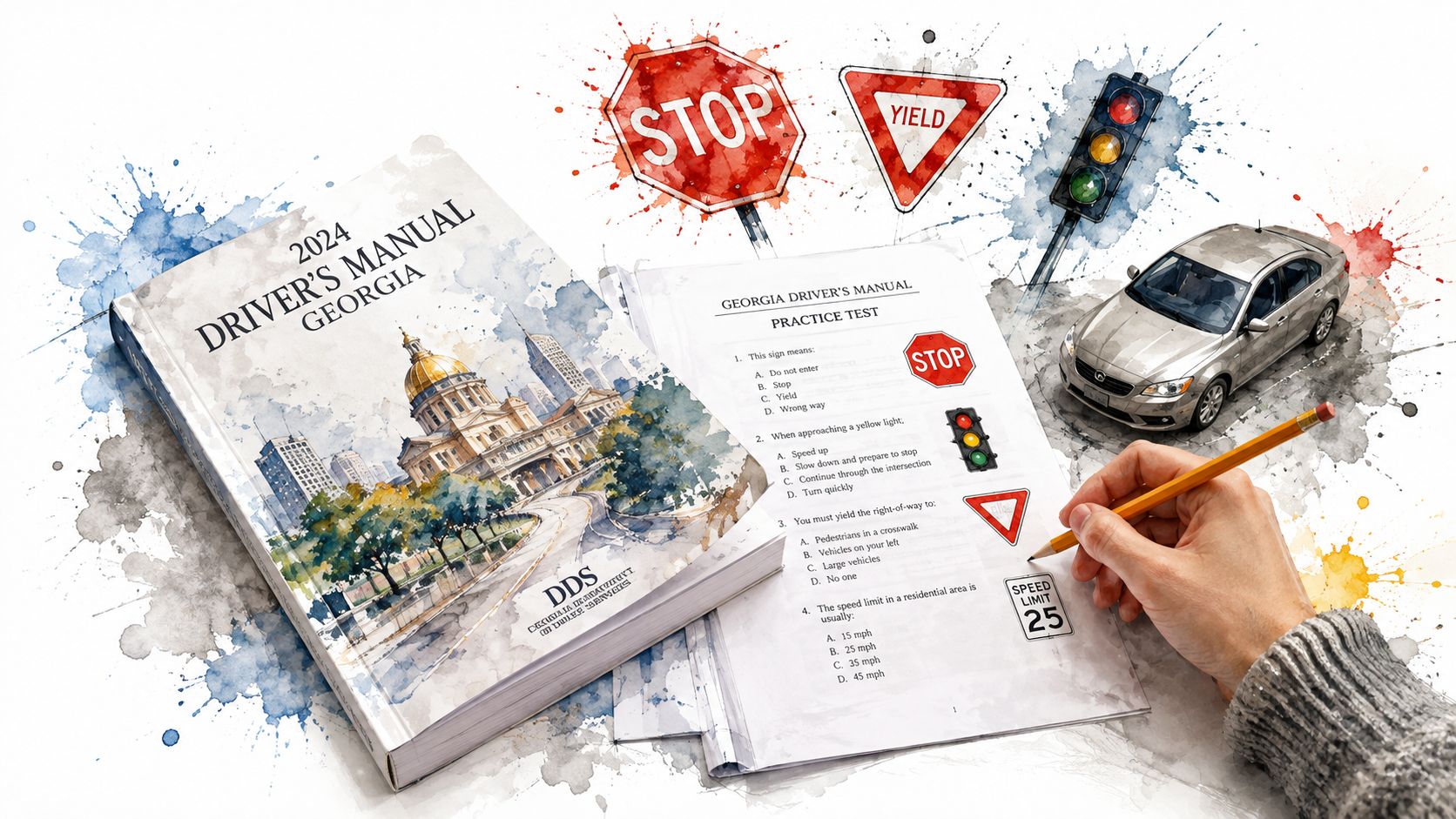
You've read the Georgia Driver's Manual, taken a few online quizzes, and still feel your stomach tighten whenever a road sign question appears. That reaction is common. A practice road rule test can reveal what you know, but it works best as one part of a larger preparation system that combines driver education, focused study, supervised driving, and professional instruction.
For Georgia teens working toward a Class D license, the path also includes Joshua's Law requirements and documented driving experience. The right plan turns a stressful test into a sequence of manageable actions.
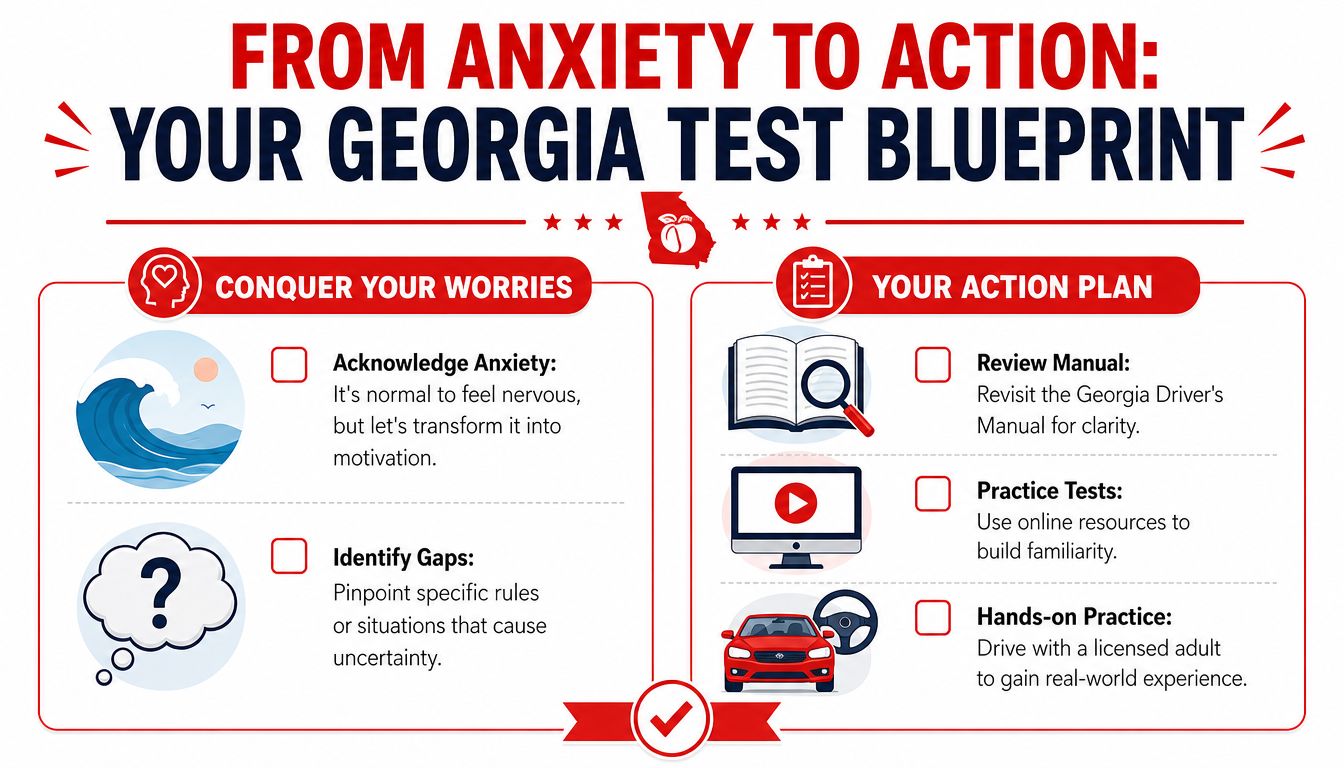
From Anxiety to Action Your Georgia Test Blueprint
Test anxiety often grows when preparation feels vague. You may know you should study, but not know whether to review signs, right-of-way rules, traffic signals, or vehicle-control situations first. The solution isn't to memorize random questions. It's to identify the rules behind the questions and connect them to actual driving decisions.
If worry keeps interrupting your concentration, practical resources on coping with overthinking and anxiety can help you recognize unproductive thought patterns. Georgia learners can also review A-1's guidance on how to overcome driving anxiety while building confidence behind the wheel.
Start with the requirements
For 16- and 17-year-olds seeking a Georgia Class D license, Joshua's Law requires 30 hours of driver education, 6 hours of behind-the-wheel training, and 40 hours of supervised driving with a parent or guardian. 6 of those 40 hours must be completed at night, and a certified online course can satisfy the 30-hour education requirement, according to the Georgia Department of Driver Services Joshua's Law requirements.
The education course gives you the framework for understanding signs, traffic laws, safe decisions, and test terminology. Behind-the-wheel training then gives you an opportunity to apply that knowledge with feedback. Supervised practice reinforces the habits you'll need when an instructor or examiner isn't beside you.
A-1 offers instructor-led and online driver education options designed around Georgia requirements. Choose the format that fits your schedule, but don't treat online coursework as a substitute for driving practice. A screen can explain a yield decision. It can't tell you, in real time, whether you noticed the approaching vehicle soon enough or positioned your car correctly.
Practical rule: Use every practice question to ask, “What would I do with the vehicle?” That question turns memorization into usable judgment.
Build a simple preparation chain
Use this order:
- Learn the rule. Read the relevant material in the Georgia Driver's Manual or your driver education course.
- Test the rule. Take questions without looking at the answer first.
- Explain the mistake. Write down why your choice was wrong and what clue you missed.
- Apply the rule. Discuss or practice the situation during a supervised drive.
- Retest later. Confirm that you can answer without relying on familiar wording.
This process reduces anxiety because each session produces a specific next step. You're no longer asking whether you're “ready” in general. You're checking whether you can handle particular road rules consistently.
Creating a Winning Study Schedule with Practice Tests
Reading the manual once, then taking a quiz the night before, creates false confidence. Familiar pages can feel easy even when you can't retrieve the rule under pressure. A practice road rule test should diagnose your preparation, not merely provide a score.
The wider testing picture supports that approach. The Great Britain car theory test pass rate was 44.8% from April 2025 to March 2026, meaning fewer than half of test sittings resulted in a pass, according to the official DVSA car theory test data. Georgia's exam is different, but the lesson is relevant: passive reading alone doesn't prove readiness.
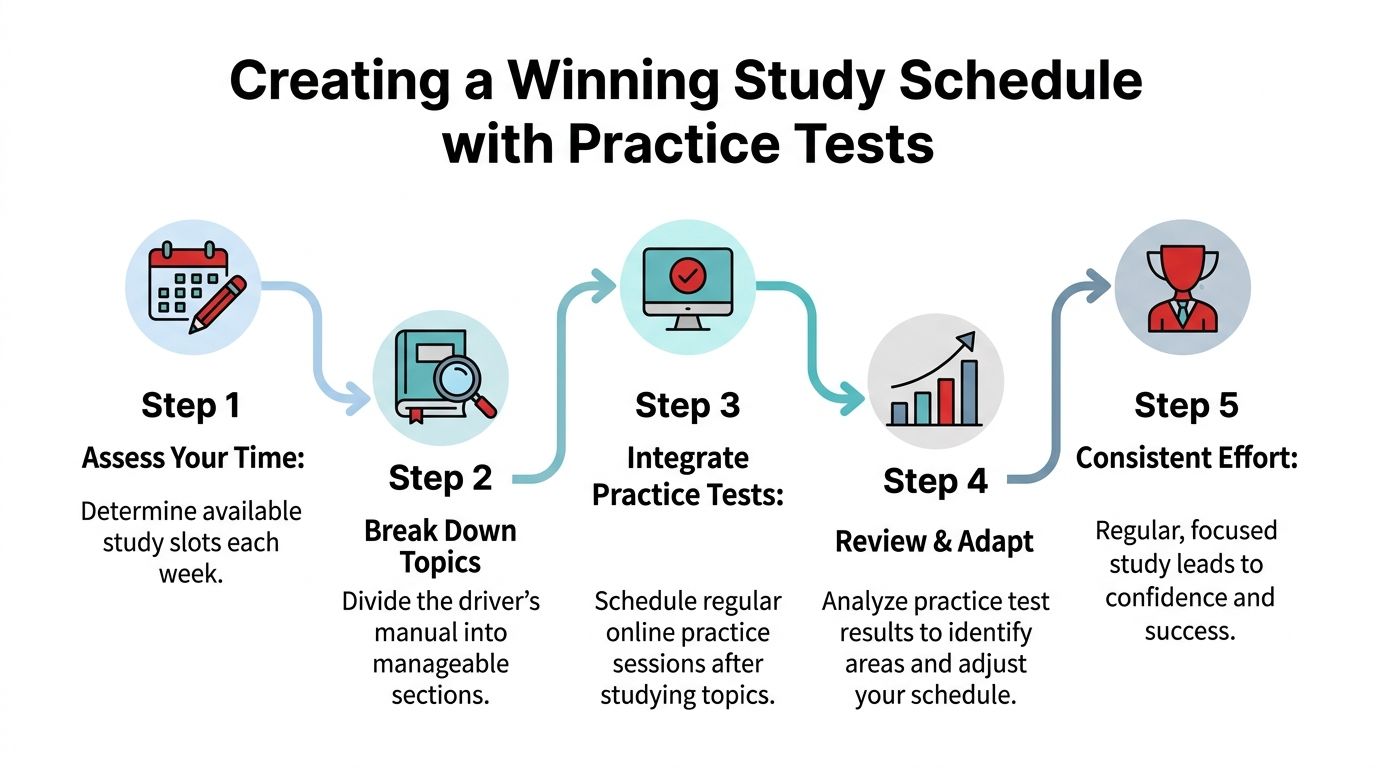
Use a diagnostic cycle
Start with a baseline quiz before intensive review. Don't search for answers while taking it. Mark each question as correct, incorrect, or uncertain. An uncertain answer matters because guessing correctly doesn't mean you understand the rule.
Then sort mistakes into categories:
- Signs and signals: You confuse similar shapes, colors, warnings, or required actions.
- Right of way: You know the wording but struggle to identify who should move first.
- Safe driving decisions: You miss questions involving following space, visibility, weather, or hazards.
- Georgia rules: You remember general driving principles but overlook a state-specific requirement.
- Question reading: You miss words such as “not,” “ except,” or “most.”
Review one category at a time. After studying, take a fresh set of questions that tests the same skill. Tools that support structured quizzes, such as MasteryMind's quiz features, can be useful when you want repeated retrieval rather than another passive reading session.
Make each session purposeful
A workable schedule might look like this:
- First session: Take a baseline practice road rule test and create an error log.
- Next sessions: Study the weakest topic, then complete targeted questions.
- Following session: Mix old weak areas with new material so you don't forget earlier work.
- Final review: Take a full practice test under quiet, realistic conditions and review every uncertain answer.
Keep the error log more detailed than “missed sign question.” Write the sign or rule, your original reasoning, the correct reasoning, and a short example from a real road. A full-length Georgia permit practice test can help you become familiar with road rules questions and explanations, but the value comes from reviewing the reasoning afterward.
Study standard: Don't stop because you recognized the answer. Stop when you can explain why the other options are wrong.
Go Beyond the Screen with Professional Driving Lessons
A computer can show a picture of an intersection. It can't reproduce the pressure of approaching that intersection while monitoring traffic, signs, pedestrians, lane position, and speed. That gap matters because knowing a rule and executing it safely are different skills.
UK practical driving results illustrate the broader issue. Practical pass rates have hovered around 48%, meaning nearly half of candidates fail the on-road portion, according to reported driving test pass-rate data. The figure isn't a Georgia result, but it reinforces an important training principle. Written knowledge must become reliable behavior.
Convert answers into decisions
During a professional lesson, an instructor can connect a missed practice question to a real driving situation. If you repeatedly miss yielding questions, the lesson shouldn't end with another definition. You need to practice approach speed, scanning, identifying the conflict point, and choosing a safe response.
The same applies to signs. If you memorize a sign's name but don't notice it soon enough on the road, the knowledge isn't yet dependable. An instructor can prompt you to scan ahead, explain what the sign changes, and correct your timing while the situation is still fresh.
A-1's benefits of taking driving lessons from an instructor include the central advantage of guided feedback. You don't have to wait until test day to discover that a habit is unsafe or inconsistent.
Choose lessons that match your gaps
Random practice drives can be enjoyable, but they often repeat comfortable routes and familiar maneuvers. Targeted lessons are more efficient when they focus on the weaknesses shown by your practice tests and supervised driving.
Ask your instructor to work on:
- Observation: Scanning signs, intersections, mirrors, and vulnerable road users early.
- Decision-making: Choosing when to slow, yield, stop, or proceed.
- Vehicle control: Maintaining lane position, smooth braking, steering, and speed.
- Test readiness: Performing required maneuvers calmly while following directions.
- Self-correction: Recognizing an error without allowing it to trigger another one.
Driving lesson packages can provide continuity, especially when sessions are spaced to reinforce rather than lose skills. The strongest combination is simple: use the practice road rule test to identify a knowledge gap, discuss it during a lesson, then return to questions to confirm that the rule now makes sense in both formats.
Sidestepping Common Road Rule Test Mistakes
Most avoidable failures come from weak preparation habits or poor question handling, not from a single difficult rule. The first mistake is trusting one website completely. Practice questions can vary in quality, wording, and alignment with the material you're expected to know.
Use online tests to build familiarity, but verify confusing answers against the Georgia Driver's Manual and your driver education instruction. A high score on one familiar quiz may reflect memory of the page rather than flexible understanding.
Watch for these traps
Last-minute cramming creates recognition without recall. Spread review across multiple sessions and revisit missed topics after a delay.
Score chasing hides the reason behind an answer. Record every uncertain response, even when you guessed correctly.
Question-word blindness causes careless errors. Read the full sentence, then identify whether it asks for the safest, correct, incorrect, or least appropriate option.
Answer switching can replace a reasoned answer with a fear-based guess. Change an answer only when you identify a specific rule or detail you originally overlooked.
Sign memorization without interpretation leaves you unprepared for context. Study what a sign requires you to do, not only what it's called.
One large practice-app dataset found that a pedestrian-warning sign question was missed by nearly 59% of users, according to driving test question data. That example shows why broad studying isn't enough. A learner may understand many road rules and still need focused work on one interpretation gap.
Error-log rule: Every missed question should produce an action, such as reviewing a sign family, discussing an intersection, or retaking a targeted quiz.
Your Test Day Game Plan for a First-Time Pass
The final day isn't the time to rebuild your knowledge. It's the time to protect the preparation you've already completed. Finish your last serious review early enough to sleep normally, and avoid taking repeated quizzes until you feel exhausted or start choosing answers impulsively.

Complete the paperwork before leaving
Georgia's road-test process includes more than vehicle handling. Before taking the road test, applicants must sign an affidavit confirming 40 hours of supervised driving, including 6 hours at night, according to the Georgia DDS road-test requirements.
Prepare your documents and confirmations in advance. Check your permit, identification, residency documentation, course records, supervised-driving log, and any forms DDS or your testing provider requires. Requirements can depend on your situation, so confirm current details with DDS or the provider before test day rather than relying on an old checklist.
The vehicle deserves its own inspection. Confirm that it's properly registered, insured, safe to operate, and equipped with working lights, signals, mirrors, seat belts, and other required controls. A technically prepared driver can still lose focus if a vehicle problem creates last-minute confusion.
Protect your attention
Arrive with enough time to park, check in, and settle your breathing. Rushing from traffic or a late arrival can make ordinary instructions feel harder than they are.
Use this short routine:
- Review lightly. Read your error log, not the entire manual.
- Prepare physically. Sleep normally, eat something suitable for you, and bring what you need.
- Arrive calmly. Give yourself time to handle the location and paperwork.
- Listen fully. Let the examiner finish instructions before acting.
- Drive deliberately. Scan, signal, control speed, and make safe decisions rather than trying to look fast.
- Recover professionally. If you make a minor mistake, continue observing and driving safely instead of mentally replaying it.
A-1 Driving School also offers Georgia road testing and preparation assistance. Taking the test in a familiar training environment may help some learners manage nerves, but preparation still matters more than the location. An examiner needs to see safe, consistent decisions, not a memorized performance.
Keep your long-term timing in mind
A road test may occur after a significant wait, especially when demand is high. In Great Britain, 561,000 car practical tests were conducted from January through March 2024, up 25% year over year, while the reported average wait was 20 weeks across Great Britain and 22 weeks in London, according to official driver and rider testing statistics. Georgia scheduling is different, but the preparation lesson is useful: don't finish your practice too early and assume skills will remain sharp indefinitely.
Use occasional maintenance drives and short practice quizzes while waiting. If you qualify, investigate the Georgia Driver's Education Scholarship Grant Program through the current program information and eligibility guidance. Financial assistance may make driver education, lessons, or testing services more accessible, but applicants should verify the latest requirements before enrolling.
The best final plan combines a completed Joshua's Law course, documented supervised driving, targeted practice road rule tests, and professional lessons that address your actual weaknesses. That system gives you more than a hopeful score. It gives you a repeatable process for making safe decisions when the questions become real traffic situations.
A-1 Driving School offers Joshua's Law driver education in online and instructor-led formats, customized driving lessons and packages, Georgia road-test preparation, and road testing assistance. Visit A-1 Driving School to choose the course and driving lesson support that fit your path to a Georgia license.