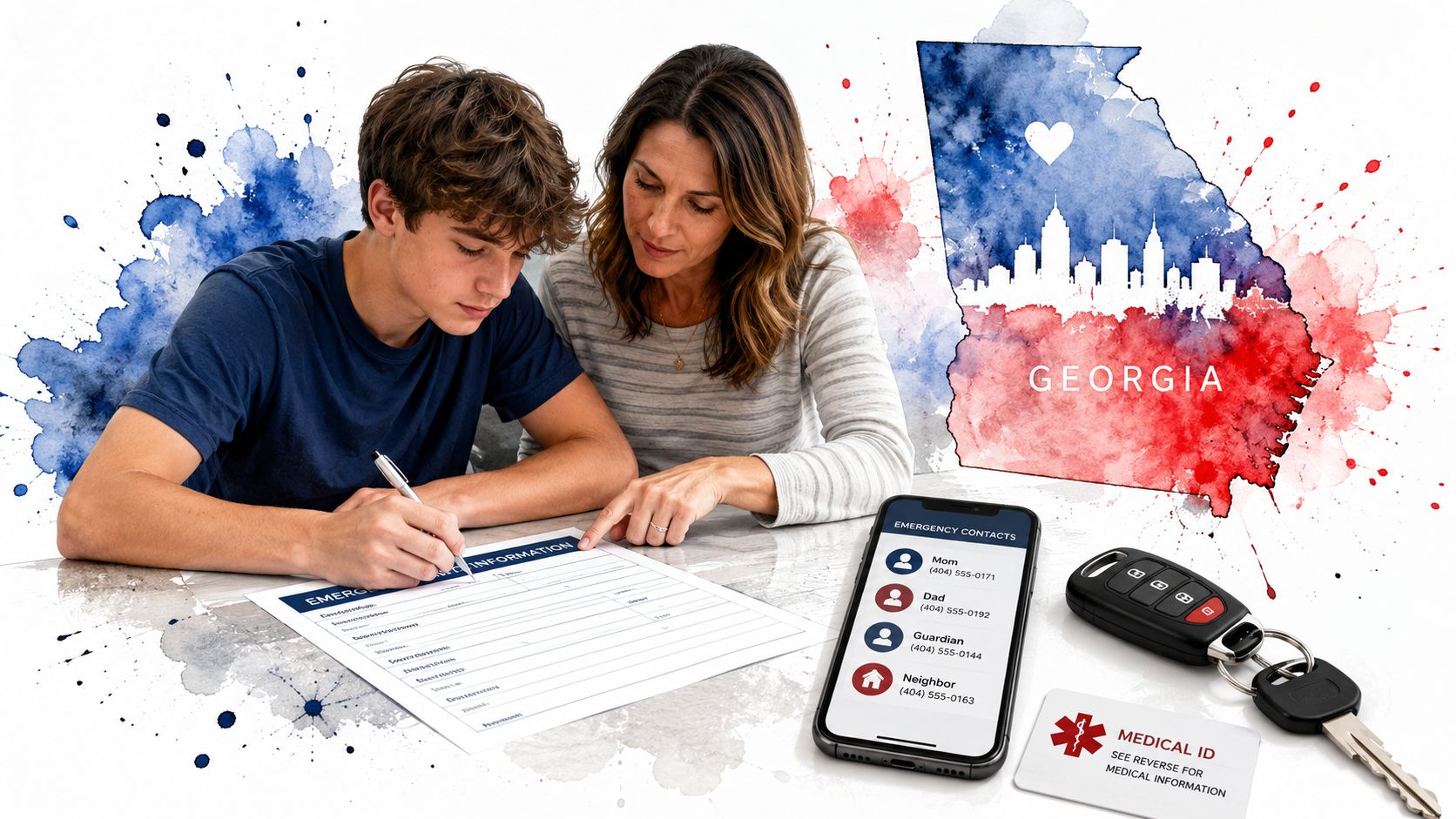
You're probably doing what most Georgia families do when they enroll in driver's education. You've got a teen beside you, a form open on your phone or laptop, and a handful of boxes that look routine. Name. Address. Parent info. Emergency contact.
That last field often gets filled in fast. A parent types one number, maybe adds a second name, and moves on to the exciting part: lessons, the Joshua's Law course, scheduling, and eventually the road test.
That's a mistake.
For a new driver, emergency contact information is part of the safety plan, not just enrollment paperwork. If a student is in a vehicle during a lesson, involved in an incident on the road, or needs urgent help during a school-related driving activity, the quality of that information matters. Correct names matter. Current phone numbers matter. Legal authority matters. In some families, that last point matters more than people realize.
Why Your Emergency Contacts Matter More Than You Think
A teen driver's paperwork usually gets treated like a checklist. Finish the form, upload the documents, move on. In practice, the emergency contact portion is one of the few parts of enrollment that directly affects how adults respond when something goes wrong.
For a beginner driver, those first months behind the wheel involve real risk. New drivers are learning judgment, scanning, speed control, lane position, and how to stay calm under pressure. During that learning window, the adults around them need a clean, reliable path for communication.
It's not just administration
The problem starts with how ordinary the form looks. Families often assume emergency contacts are only there for a minor scheduling issue, like a missed pickup or a dead phone battery.
But emergency contact information serves a different purpose. It tells a school or instructor who should be called first, who can respond quickly, and who can make decisions if the student is a minor and medical care becomes part of the situation.
Practical rule: Fill out the emergency contact section as if your teen won't be able to explain anything in the moment.
That means using full legal names, direct numbers, and people who answer the phone. It also means thinking beyond convenience. The “easiest” contact to list isn't always the right one.
A broader public preparedness issue also sits behind this. A meta-analysis covering 26 countries found that knowledge of emergency numbers ranged from 0.0% to 97.8%, with a global median of 64.3%. The same analysis found higher knowledge in high-income countries at 69.6% compared with 34.6% in middle-income and low-income nations, a statistically significant difference, according to NENA's 911 statistics reference. The lesson for families is simple. Emergency response works better when people know exactly who to contact and how.
A good form creates a better response
Parents often ask what “good” looks like. It looks like a small plan.
- One primary contact: The adult most likely to answer immediately.
- One secondary contact: A real backup, not a duplicate number or someone who travels constantly.
- Useful notes: Anything the school should know if quick decisions are needed.
- A review habit: Recheck details when anything changes at home.
If you coordinate student activities beyond driving lessons, tools like this free emergency template for school trips can help you think through contact chains in a more practical way.
For Georgia families working through Joshua's Law requirements, this is part of teaching responsibility. Safe driving starts before the engine does.
Who Should Be on Your Emergency Contact List
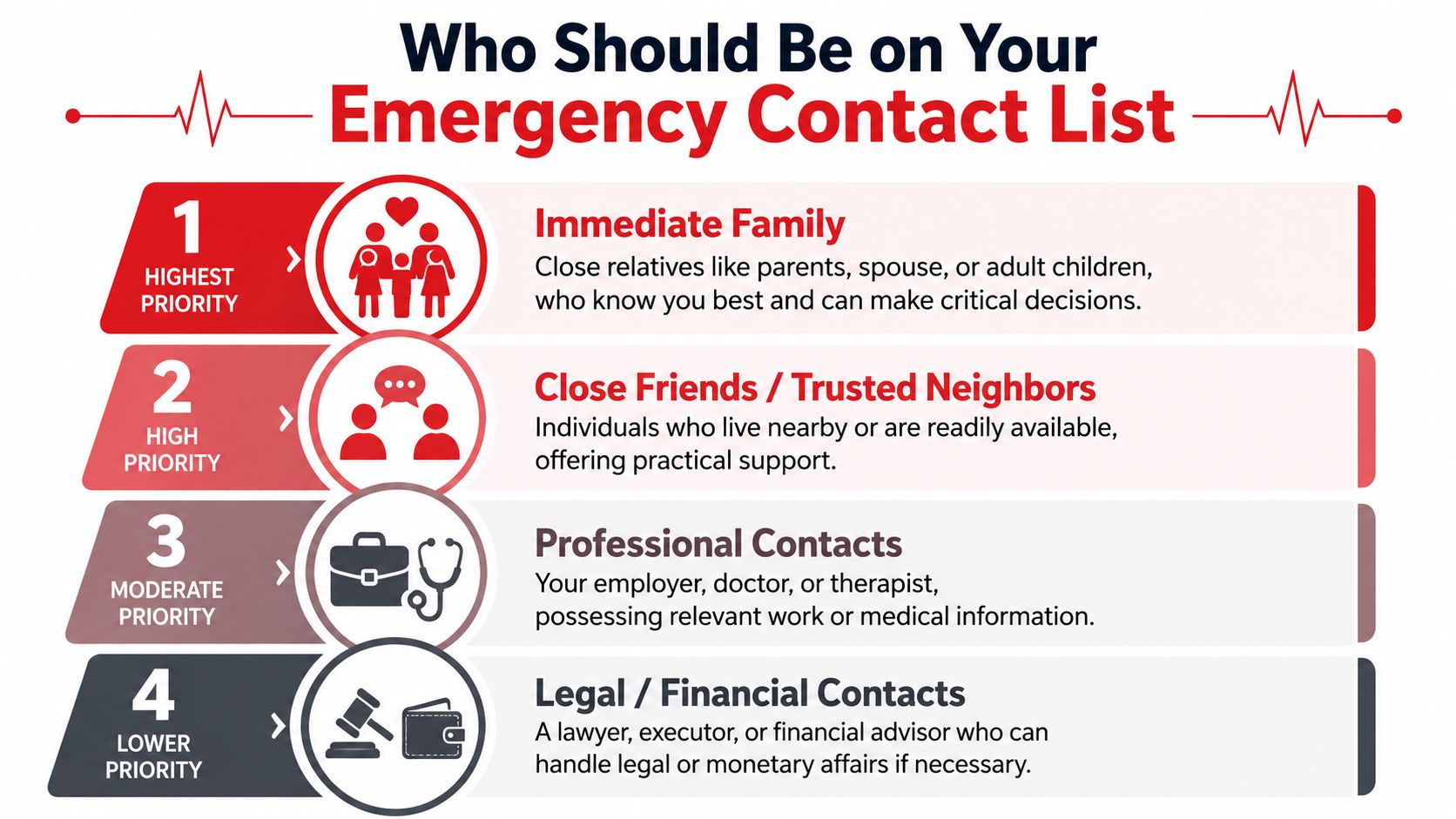
The right answer isn't always “Mom and Dad.” Sometimes it is. Sometimes it's one parent and one grandparent. Sometimes it's a legal guardian and an aunt who lives five minutes away. What matters is whether the list will hold up under stress.
Start with reachability, then check legal authority
Families often choose contacts based on closeness. That's understandable, but it's incomplete. A loving adult who can't answer the phone, doesn't live nearby, or doesn't have authority to consent to care may not be the best first call.
Here's the practical order I recommend families use when deciding:
| Priority | Best fit | Why it works |
|---|---|---|
| First | Legal guardian who reliably answers | Can respond and make decisions |
| Second | Another legally appropriate adult or highly available backup | Prevents delay if the first person is unreachable |
| Third | Nearby trusted adult | Useful for immediate practical support |
| Fourth | Additional professional or household contact if a form allows it | Helps only if the first tier is clear |
That legal piece is where many forms fall apart. A 2024 Georgia Supreme Court review found that 28% of delays in teen driver hospitalizations stemmed from schools and driving schools failing to distinguish between “legal guardian” and “emergency contact,” and that those failures were associated with a 50% higher rate of civil liability lawsuits against institutions, according to the cited Georgia Supreme Court emergency response review reference. That's not a paperwork technicality. It affects medical timing and institutional risk.
Common Georgia family situations
A few examples make this easier.
Divorced parents with shared involvement
If one parent is the legal decision-maker for medical care, that parent should be clearly identified. The other parent may still belong on the form, but the list should not leave staff guessing who can authorize what.
Grandparent raising the teen
If the grandparent is the day-to-day caregiver but doesn't hold legal authority, the form should reflect both the practical contact and the legal one. Those are not always the same person.
Foster care or non-parent household
Generic forms often fail in such cases. The adult bringing the student to lessons may be the right practical contact, but the legally recognized decision-maker still needs to be identified clearly.
The best emergency contact isn't just kind, nearby, or familiar. It's reachable and legally appropriate.
Who usually works best
- A parent or legal guardian: Usually the strongest primary contact for a minor.
- A second adult with dependable availability: This might be the other parent, a guardian, or another authorized adult.
- A nearby relative: Helpful when fast in-person support matters.
- A trusted neighbor: Useful as a secondary practical contact, but not a substitute for legal authority.
- A family friend: Better as backup than as the only listed adult.
A short, honest conversation at home solves most of this. Ask three questions. Who can answer immediately? Who can get there fastest? Who can legally act if needed?
If the same person answers all three, your list is probably in good shape.
The Essential Details Your Driving School Needs
The strongest emergency contact form is boring in the best way. It leaves nothing to guess.
Families run into trouble when they submit partial details. “Dad, same number as above” seems harmless until someone else has to use the form quickly. In an urgent situation, complete entries save time.
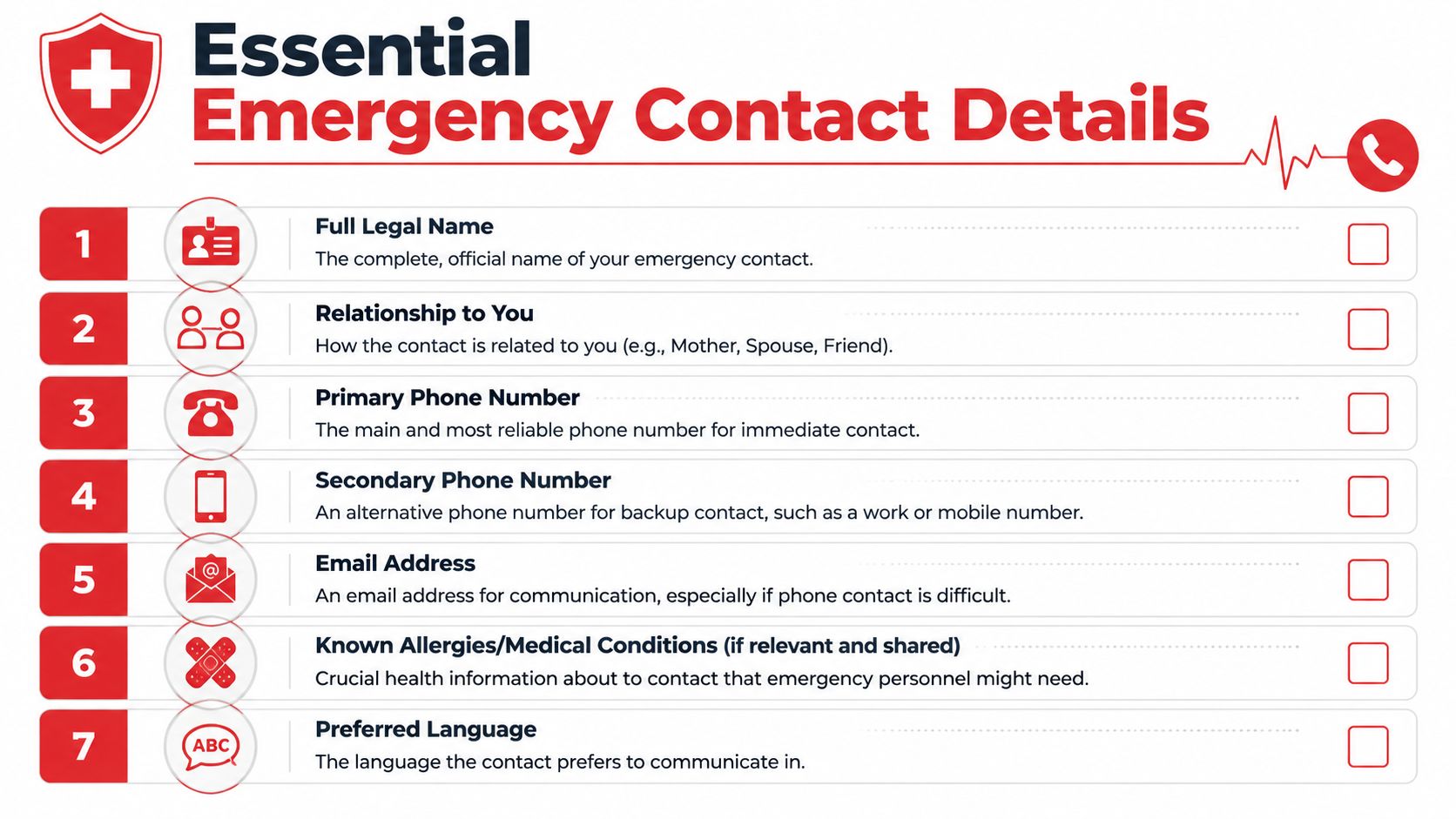
What belongs in each contact entry
Data from workplace emergency planning shows that 68% of organizations rely on a single primary contact without verified secondary backups, leading to a 42% failure rate in locating employees during time-sensitive emergencies. The same guidance recommends collecting primary and secondary contacts with full details, including multiple phone numbers and email addresses, as outlined in this emergency contact setup guide.
For a teen driver, that translates into a straightforward checklist:
- Full legal name: No nicknames only. “Jennifer Elaine Carter” is better than “Jen.”
- Relationship to student: Parent, legal guardian, aunt, grandfather, family friend.
- Primary phone number: The best number for immediate pickup.
- Secondary phone number: Work line, alternate mobile, or another direct number.
- Email address: Useful when calls fail or documentation is needed.
- Home address: Helpful for identity and practical follow-up.
- Preferred language: Important if rapid communication needs to be clear.
- Medical or alert notes if the form allows it: Only what the family chooses to share and what would be useful.
A clean example
Here's what a fully completed entry looks like:
Primary contact
Maria Thompson
Mother and legal guardian
Mobile: 404-555-0182
Work: 404-555-0199
Email: mariathompson@example.com
Address: 123 Main Street, Atlanta, GA 30303
Preferred language: English
And then a second one:
Secondary contact
Daniel Thompson
Father
Mobile: 470-555-0144
Email: danielthompson@example.com
Address: 123 Main Street, Atlanta, GA 30303
Notice what's missing. No vague references. No “same as mom.” No unlabeled numbers.
Before you start enrollment
Gather the details first. It makes online registration smoother and cuts down on corrections later. Families comparing platforms or forms may find this overview of selecting school registration tools useful because good systems tend to prompt for complete, structured records instead of loose notes.
If you're preparing for registration, the enrollment steps in this guide to enrolling in driver's ed can help you organize the rest of the paperwork at the same time.
A good rule is simple. If someone unfamiliar with your family had to use the form, would they know exactly who to call first and second? If not, the form isn't finished yet.
Understanding Privacy and Consent for Teen Drivers
Parents are right to ask what happens after they submit personal information. Emergency contact details include names, phone numbers, addresses, and sometimes sensitive notes. That deserves careful handling.
The baseline standard is confidentiality. Workplace safety frameworks treat emergency contact information as confidential, restricted-access data and call for a clear review cycle and a privacy statement on intake forms that explains storage and usage protocols, as described in this emergency contact information form guidance.
What privacy should look like
At a practical level, families should expect a school to follow a few common-sense rules:
- Limited access: Only authorized staff should be able to see the information.
- Specific purpose: The information should be used for emergencies, safety needs, and necessary operational communication.
- Clear notice: Families should be told what is collected and why.
- Regular review: Old data shouldn't sit untouched for years.
If you want a broader non-school primer on handling personal data well, this article on Pebb on data protection is a useful starting point.
Consent matters for minors
Emergency contact information and legal consent overlap, but they aren't identical. A school can call the listed contact. That doesn't automatically make every listed person the one who can authorize medical decisions for a minor.
That's why parents should read forms carefully and identify legal guardianship accurately. A mismatch between “who answers the phone” and “who can consent” creates confusion at the exact moment when everyone needs clarity.
A strong privacy process protects two things at once. The student's safety and the family's control over sensitive information.
Families should also keep Georgia's teen rules in mind while they're reviewing forms and responsibilities. This summary of Georgia teen driving laws is a good companion read because it puts emergency planning in the larger context of new-driver obligations.
A short privacy notice, a restricted-access process, and clear guardian information don't make forms longer just for the sake of it. They make the record trustworthy when it matters.
Keeping Your Emergency Information Current
Outdated emergency contact information is one of the most preventable failures in teen driver safety. The form may have been correct on day one, but families change quickly. Moves happen. Phone numbers change. Custody arrangements change. Jobs change. People stop answering the line you listed six months ago.
That's why updates matter.
A 2025 NHTSA study found that 34% of fatal teen car accidents involved drivers whose emergency contact lists were not updated within the last year, according to the cited NHTSA teen driver safety study reference. For parents, the takeaway isn't abstract. An old contact can become a dead end at the worst possible time.
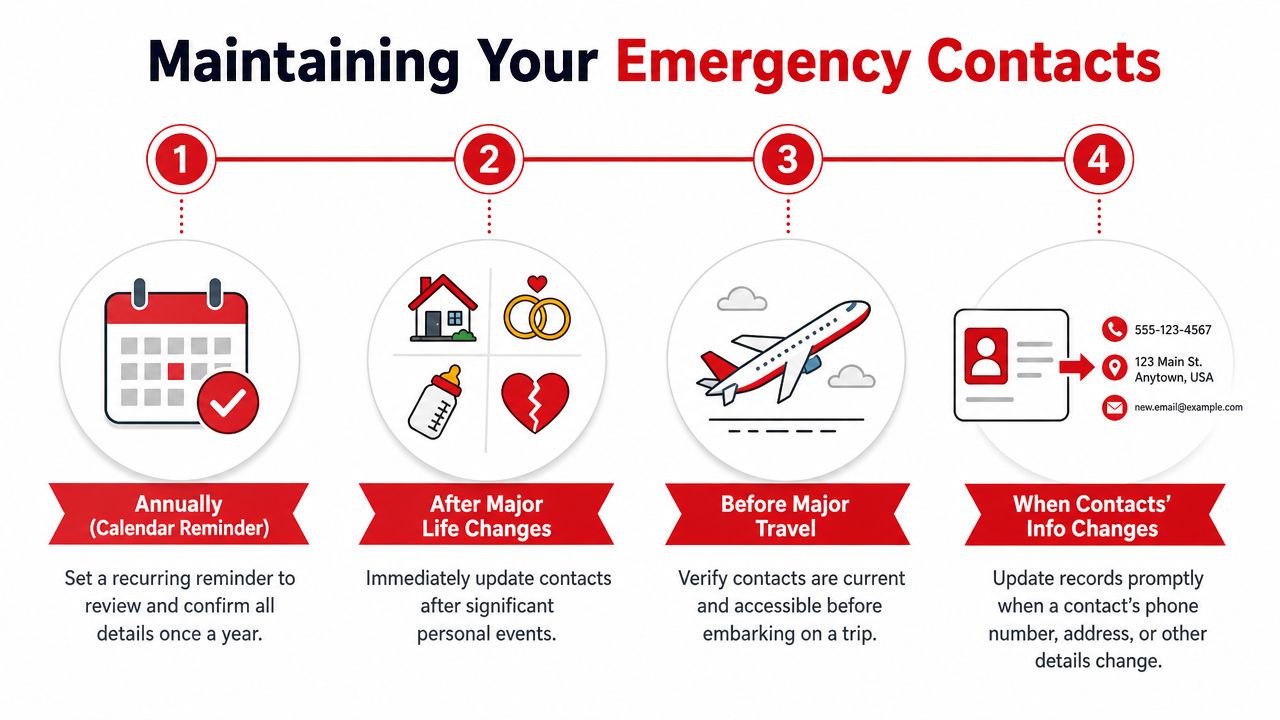
When to update right away
Don't wait for the next course or the next lesson package. Update records as soon as one of these happens:
- A phone number changes: Mobile, work, or home.
- Someone moves: Especially a parent, guardian, or backup contact.
- Custody or guardianship changes: This should be updated immediately.
- A contact becomes unreliable: New work schedule, travel, illness, or separation.
- Your teen starts spending time in a different household: The practical response chain may have changed.
A simple maintenance routine
Most families don't need a complicated system. They need a habit.
Try this:
- Review the list once a year.
- Check it again before a new driving course, lesson block, or road test appointment.
- Update it any time the household changes.
Keep the list current enough that you'd trust it without explanation.
That last part matters. In an emergency, there may not be time for staff to decode family context from an old form.
A final detail that gets overlooked is the teen's side of the process. If your student is old enough to manage a phone, they should know who the listed contacts are, which order they're listed in, and why. That small conversation helps them understand that safe driving includes communication, not just vehicle control.
Ready to Drive Your Path to a Georgia License
Once your emergency contact information is complete, the rest of the process gets easier. You've handled one of the most important safety pieces. Now your attention can shift to the training itself.
For most Georgia teens, that means choosing the learning format that fits the family schedule and the student's learning style. Some students do best in a traditional classroom. Others are more consistent with online coursework. For families meeting Joshua's Law requirements, convenience matters, but so does quality instruction that prepares the student for real traffic situations, not just a certificate.
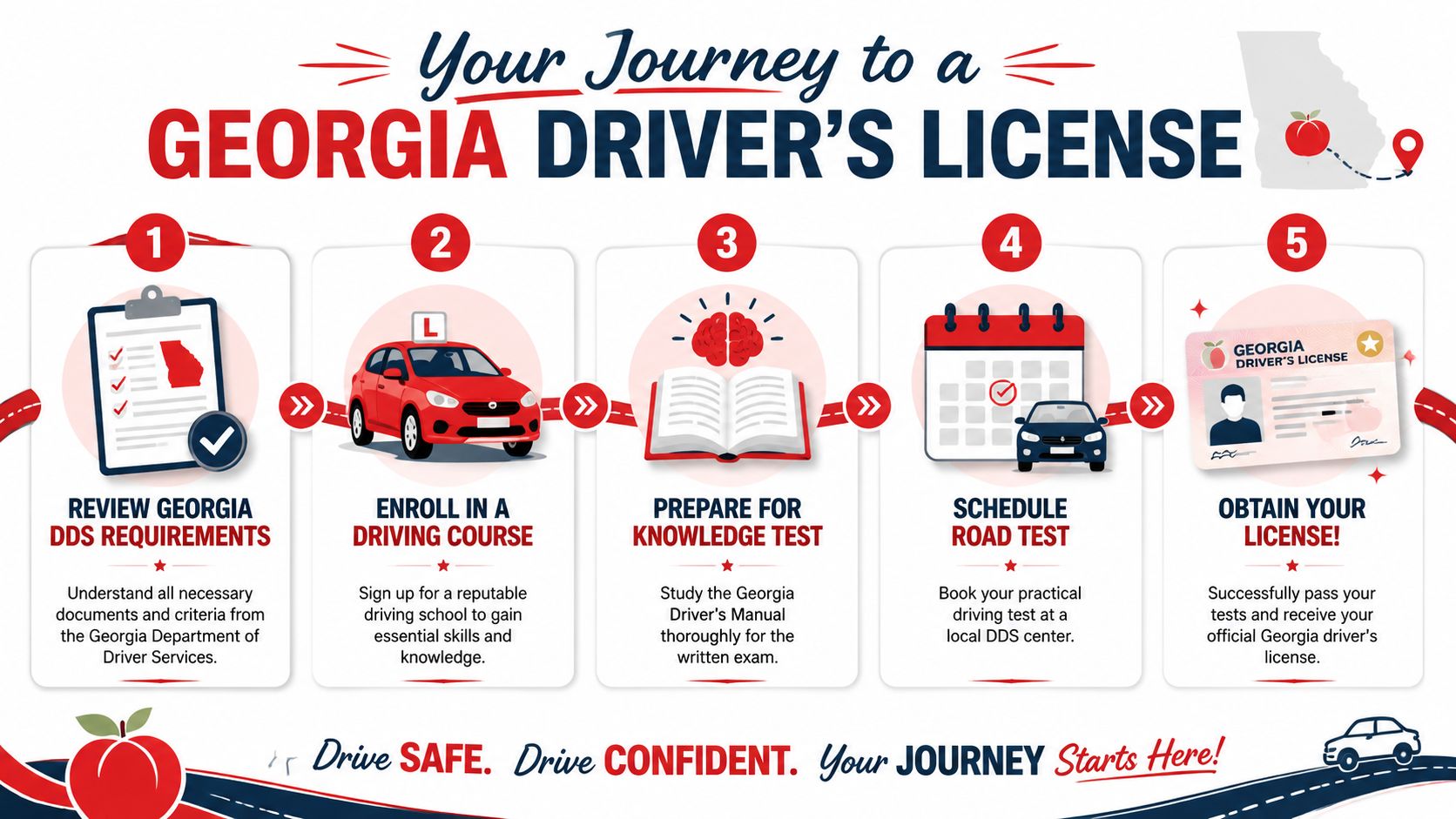
The best next step for most families
If you're planning the path to a Georgia license, focus on the pieces that build actual readiness:
- Joshua's Law driver's education: This is the foundation for many teen drivers pursuing a Class D license.
- Online course options in Georgia: A strong option for busy households that need flexibility.
- Driving lessons and lesson packages: Many students make the biggest leap in confidence and judgment through these.
- Road test preparation and testing support: Helpful for turning practice into a successful test day.
- Scholarship opportunities: Families should check whether they qualify for the Georgia Driver's Education Scholarship Grant Program.
A lot of people spend too much time worrying about the paperwork and not enough time choosing the right behind-the-wheel instruction. That's backward. The course matters, but the driving lessons are where students build habits, correct mistakes, and learn how to handle the actual Georgia roads they'll use after licensing.
What families should prioritize
Not every student needs the same package.
Some teens need a standard path: complete Joshua's Law, take a few lessons, and prepare for the road test. Others need more time behind the wheel with an instructor, especially if they're nervous, have limited practice opportunities at home, or need help with lane changes, turns, merging, parking, and traffic judgment.
For that reason, lesson packages are often the smartest choice. They give the student repetition. They also give parents a clearer structure instead of trying to piece together progress one session at a time.
If your goal is to map out the full licensing process, this page on how to get a driver's license in Georgia is a practical place to start.
The strongest path is usually simple. Handle the paperwork carefully. Choose a solid Joshua's Law course. Add enough driving lessons to build real skill. Get road-test ready. Use scholarship support if your family qualifies.
A-1 Driving School has helped Georgia drivers build those skills since 1987, with family-focused training that includes Joshua's Law courses, online driver's education options, road testing support, and driving lessons and lesson packages built for real progress behind the wheel. If you're ready to move from paperwork to practice, explore A-1 Driving School and choose the program that fits your teen's path to a Georgia license.