
It's a Tuesday night at the kitchen table. One of you has a DDS checklist open on a laptop, the other has a phone in hand, and both of you are trying to answer a question that sounds simple: what does a 16-year-old have to do before driving alone in Georgia?
The birthday is circled on the calendar in red. Everything after it is a blur of course hours, a permit date nobody wrote down, and a road test appointment nobody has booked.
Start with the fact that clears most of the fog. Turning 16 doesn't grant driving in Georgia. It grants eligibility to apply. Georgia driving laws for 16 year olds work as a checklist you complete in order, and the order matters more than the speed.
Georgia Requirements for 16 Year Olds at a Glance
A 16-year-old can't walk into a Department of Driver Services office with a birthday and leave with a Class D provisional license. Age makes a teen eligible to apply. The license itself is the final item on a list of requirements that stack on top of each other.
The table below is the full set of items a parent or teen should confirm before booking the road test. Read it from the top, because every row depends on the row above it.
| Requirement | What It Involves | Minimum or Timing |
|---|---|---|
| Learner's permit | Hold a Georgia instructional permit | 12 months and 1 day |
| Joshua's Law education | Approved course, classroom or online | 30 hours of theory |
| Behind-the-wheel training | Approved provider or parent-taught alternative | 6 hours |
| Supervised driving | Parent or guardian in the car | 40 hours, including 6 after dark |
| Supervised driving verification | Sworn statement from parent or legal guardian | Before licensing |
| Alcohol and Drug Awareness Program | Complete the program | Before licensing |
| Road skills test | Pass the road test | Appointment required |
What the rows actually ask of you
The first three rows are the ones families book and pay for, so they get the most attention. The instructional permit starts the clock, and it's the row that decides the whole schedule. The 30-hour course covers rules of the road, signs and hazard judgment. The 6 hours behind the wheel are where a teen handles a car with a trained instructor, or with a parent under the parent-taught alternative.
The next two rows are where records break down. Supervised driving means a parent or guardian in the passenger seat for 40 hours, and at least 6 of those hours have to happen after dark. Verification means a sworn statement from that parent or guardian, which is why a shoebox of scribbled notes is a bad plan and a dated log is a good one.
The last two rows are gates, not paperwork. The Alcohol and Drug Awareness Program has to be complete, and the road skills test has to be passed at a scheduled appointment.
Practical rule: these hour counts stack, they don't replace each other. Six professional hours don't erase any of the 40 supervised hours, and a completed course doesn't shorten the permit period.
Three checks to run this week
- Count completed rows. Write the seven requirements on one page and mark each as done, in progress, or not started.
- Confirm the permit date. Find the issue date on the permit itself, not the date of the driving test that earned it, and count forward 12 months and 1 day.
- List the open items. Whatever is still blank becomes the family's to-do list for the next few months, in the order the table shows.
Why Turning 16 Does Not Unlock Driving
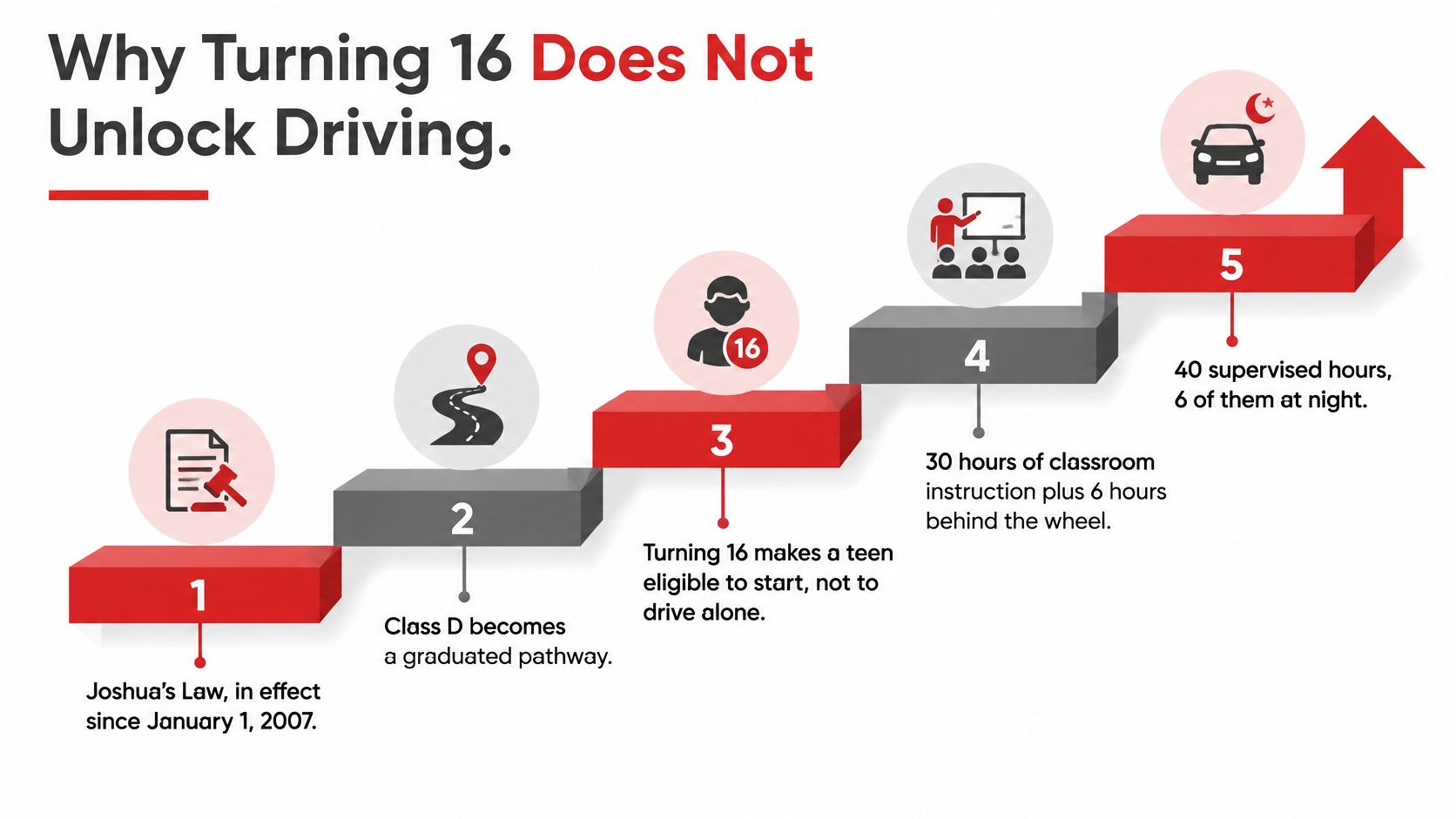
Think of the Class D license as a staircase rather than a door. A door opens once and you're through. A staircase only lets you reach the next step after you've stood on the one below.
Georgia built it that way deliberately. Beginning January 1, 2007, Joshua's Law required applicants age 16 to complete an approved driver-education course and document at least 40 hours of supervised driving, including 6 hours after dark, with sworn verification from a parent or legal guardian, as the Georgia Department of Driver Services explains in its Joshua's Law FAQ. The same guidance sets the instructional component at 30 hours of classroom or online theory plus 6 hours of practical behind-the-wheel instruction.
Each stage exists for a different reason
The 30-hour course teaches what a teen can't safely learn at 45 mph: right-of-way, signage, following distance, and how to read a hazard before it becomes one. The 6 professional hours build physical control, the steering, braking and merging that require a calm adult in the passenger seat the first several times.
The 40 supervised hours add exposure the classroom can't simulate, including the glare and reduced visibility of night driving. The permit period lets all of that accumulate over a year instead of a weekend. The road test then confirms the result.
Sixteen and seventeen-year-olds follow the same rules, so waiting a year doesn't skip a step. The most common mistake is assuming a fast finish on the course moves the finish line. It doesn't. The course, the permit period and the supervised hours each run on their own clock.
Name the stage you're on right now, then name the single stage blocking the next one. That's the only item worth working on this month.
Choosing Between Classroom, Online and Parent-Taught Training
Georgia does not require every family to complete the 30 instructional hours in the same way. The DDS Joshua's Law requirements page recognizes approved pathways, and the main difference is simple: where the theory happens, who provides the 6 hours of driving instruction, and how much time the parent or guardian commits.
Four approved routes side by side
| Route | Classroom or Online Theory | Behind-the-Wheel Training | Who Supervises the Driving |
|---|---|---|---|
| Standard school-based | 30 hours classroom | 6 hours with a certified school | Certified school instructor, plus 40 supervised hours with parent |
| Parent-taught after classroom | 30 hours classroom | 6 hours taught by parent | Parent or guardian |
| Online with certified school driving | 30 hours certified virtual program | 6 hours with a certified school | Certified school instructor |
| Online with parent-taught driving | 30 hours certified virtual program | 6 hours taught by parent | Parent or guardian |
Read the table by column, not by row. The theory column answers where the 30 hours happen. The driving column answers who handles the 6 professional-style hours in each pathway. The last column shows the family time involved. Planning a school project works the same way: the topic, the practice, and the adult support are separate choices, even when one provider helps coordinate them.
Online can fit a teen with a packed schedule who still wants structure, deadlines and quizzes. Classroom can fit a teen who asks better questions when an instructor is in the room. Parent-taught driving depends on a qualified adult who can be steady and consistent, even when a drive is frustrating. If your evenings tend to disappear, the parent-taught route may take more planning than it first appears.
If you are weighing school instruction against parent instruction, this comparison of driving school versus parent-taught training explains where each option tends to fall short.

A-1 Driving School's Driver's Education and Driving Lessons courses include Georgia DMV-approved Joshua's Law and Driver's Education courses, including all education and road testing. The school offers an instructor-led Drivers Education Joshua's Law Course and an online Drivers Education Joshua's Law Course. Students must have a valid Learner's Permit or Driver's License to take a driving lesson, so the permit step comes before behind-the-wheel scheduling.
Before you enroll anywhere, ask one question: does this course cover the full approved pathway, or just the classroom piece? A provider that stops at theory leaves you arranging the driving hours separately.
Cost is another question worth asking early. The Georgia Driver's Education Scholarship Grant Program exists for qualifying families, eligibility is set by program rules, and the school you choose can explain how the application works before your teen is on a deadline.
Logging 40 Supervised Hours With Six at Night
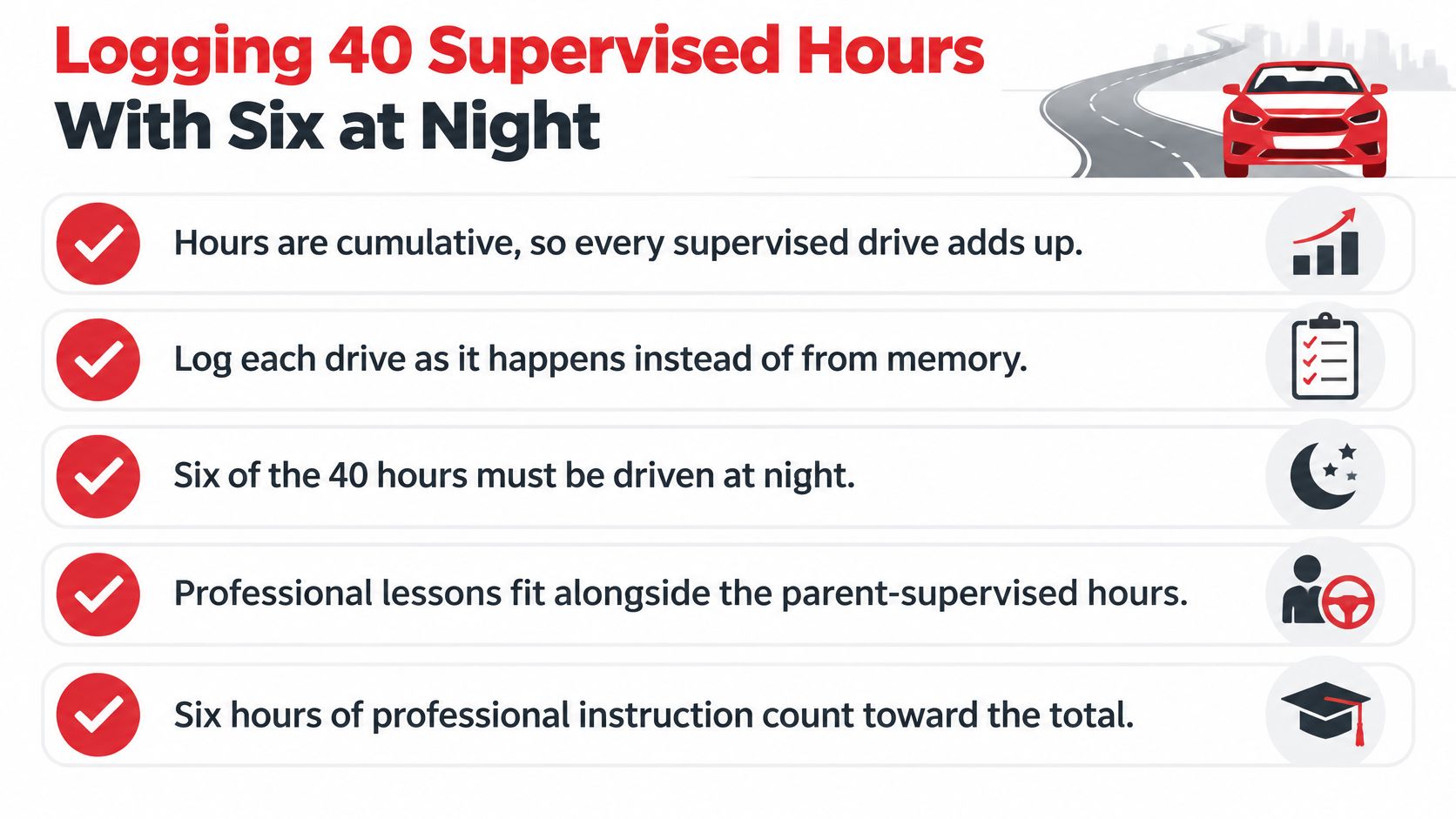
The 40 hours are cumulative, and they're separate from the 6 professional hours. A teen who finishes a lesson package still owes the full supervised total. The family's job is to record it as it happens rather than reconstruct it from memory in the final month.
Six steps to a clean log
- Calendar the permit milestone. Write the issue date on the fridge and mark the 12-month-and-1-day point. That date, not the birthday, controls when an application is possible.
- Log every session the same day. Date, start and end time, weather, road type, and who supervised. Two lines per drive is enough.
- Mark night hours separately. Keep a running count until 6 hours after dark are done, because that column is the one families discover is empty.
- Vary the conditions. Parking lots for low-speed control, neighborhood streets for turns and stop signs, highways for merging, rain and heavy traffic for judgment. Forty identical drives down the same road teach one road.
- Review the log monthly. A five-minute check each month catches missing dates while the drives are still memorable.
- Get the sworn statement signed before applying. Verification happens at the licensing stage, and a gap in the record surfaces at the worst possible moment.
Where professional lessons fit
Parents are good at teaching what they already do automatically. An instructor is good at slowing that down into a sequence a beginner can repeat: mirror, signal, shoulder check, speed match, move. That's the value of a lesson, not the certificate at the end.
A structured lesson plan also targets the specific skills that stall teens: lane changes in traffic, merging at highway speed, unprotected left turns, and parking that isn't guesswork. Lesson packages work better than a single session because the student gets correction, practice time, and a second look at the same skill a week later.
Students need a valid learner's permit or driver's license before any lesson, so the permit comes first. A printable driving practice log keeps the parent-supervised side organized alongside the professional hours.
Keep the log in the glove box. A record that lives in the car gets filled in at the end of the drive, and a record that lives in a drawer gets rebuilt from memory in April.
Teen Road Test Requirements and What to Bring
For applicants under 18, the road test is appointment-based. There is no walk-in option, so a family that drives to the office hoping for a same-day slot is making a trip for nothing.
The order to do things in
- Confirm every Class D requirement is complete, including the permit period and the supervised hours with night driving included.
- Book the appointment in advance rather than assuming availability matches your schedule.
- Arrange the accompanying driver. A licensed driver who is at least 21 years old must come with the applicant.
- Bring the paper registration for the vehicle being used.
- Bring a current valid insurance card for that vehicle.
- Check the passenger rule. Only the applicant and the accompanying driver may be in the vehicle. No other minors, no children, no pets.
- Practice the graded skills. Smooth starts and stops, correct turns, lane changes with mirror and blind-spot checks, early signaling, staying centered in the lane, and matching speed and following distance to conditions.
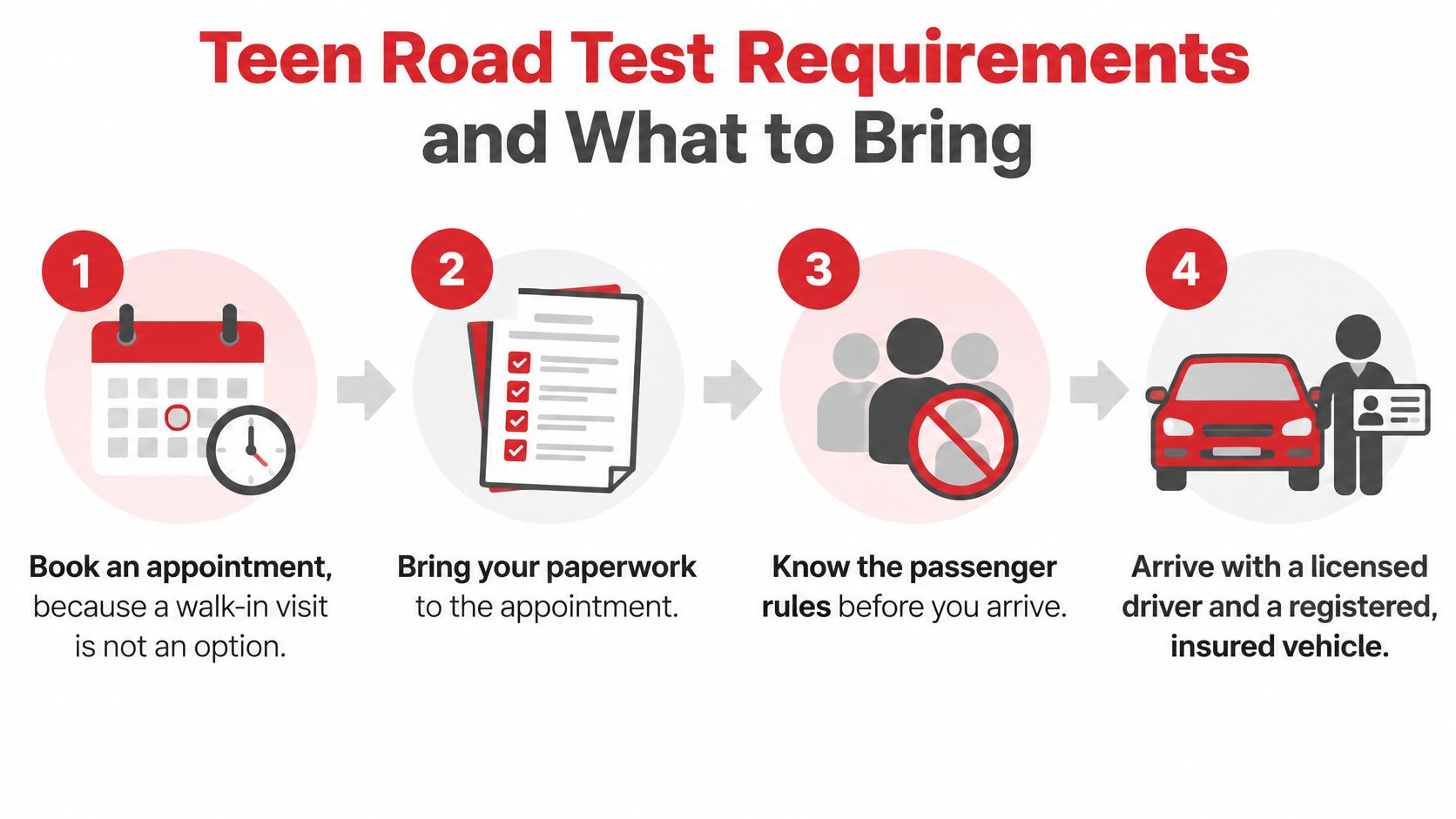
The DDS road test page spells out those conditions, and they're the reason a well-prepared teen can still lose the slot. A missing insurance card or a younger sibling in the back seat ends the appointment before the car moves.
Here's a walkthrough of what the test day looks like in practice.
Night-before check: registration in the folder, insurance card current, accompanying driver confirmed and 21 or older, no extra passengers, and a full tank so the test doesn't start with a detour.
A vehicle that isn't test-ready creates its own delays. Run through this vehicle inspection checklist the week before, not the morning of.
Night Hours and Passenger Limits in the First Year
Passing the road test doesn't end the rules. It starts a new set. These limits attach to the Class D license, not to the teen's age, so they follow the driver until the license class changes.
The midnight to 5 a.m. window
Class D holders may not drive between 12:00 a.m. and 5:00 a.m. The restriction does have limited exceptions, including travel to or from work, school, or religious activities, and driving with a parent or guardian in the vehicle. The DDS teen driving laws FAQ lays out the exact conditions, and they're worth reading before the first late shift rather than after the first late drive home.
The exception list is also narrower than teens assume. A friend's house across town or a social gathering is not on it. The practical move is to plan the ride home before anyone leaves the house, and to treat an exception as a documented, qualifying trip, not a general permission slip.
| Stage Since Issuance | Driving Window | Who Can Ride |
|---|---|---|
| First 6 months | No driving 12:00-5:00 a.m. | Immediate family members only |
| Months 7 to 12 | No driving 12:00-5:00 a.m. | One non-family passenger under 21 |
| After 12 months | No driving 12:00-5:00 a.m. | Up to three non-family passengers under 21 |
Immediate family, defined
The first six months allow family only, and the definition is wider than most teens expect. It covers parents and stepparents, grandparents, siblings and stepsiblings, children, and anyone who lives in the driver's household. A cousin who lives three streets over isn't in that group. A stepsibling who shares a bedroom is.
The stages then widen on a schedule: family only for six months, then one non-family passenger under 21 for the next six, then up to three such passengers after the first year. Younger siblings and children count as family, so they never hit the cap. The count that matters is friends. One friend in month eight is legal. Two friends in month eight is not, and a teen who miscounts by one passenger is still outside the license terms.
The license date is the clock
Say a license is issued on March 3. That date starts the compliance clock, so the family knows the family-only stage runs into early September and the one-passenger stage runs to early March of the following year. The birthday doesn't move these dates, and neither does the test date. Put both stage boundaries in a shared calendar so no one has to do the math in a parking lot at midnight.
Completing driver education doesn't lift any of these limits. A teen with every certificate in the folder still can't drive at 1 a.m. outside a qualifying exception or carry two friends in month three.
Driving outside these conditions carries enforcement and licensing consequences, and the family conversation is cheaper than the citation. Tape a short checklist to the sun visor: the current stage, the passenger count allowed today, and the midnight cutoff. That one card answers the question teens ask at 11:40 p.m., which is whether they can drive this specific trip with these specific people. The visor note turns a guess into a check.
A Sample Timeline From Permit to Class D License
Dates on a calendar make the order of operations easier to grasp than rules on a page, so here is one worked example from permit to license.
Jordan gets his learner's permit on June 1, when he is 15. He turns 16 the following August 10, and his family assumes that birthday is test day. It is not. The permit must be held for 12 months and 1 day, which puts the earliest application date at June 2 of the year after the permit was issued. His 16th birthday only confirms he is old enough to apply once that waiting period ends. Two separate conditions, two separate dates, and both have to be satisfied.
How the year fills up
That fall, Jordan works through a 30-hour course, fitting modules around school and homework. In January he books 6 behind-the-wheel hours with an instructor, spread across three sessions so each one builds on the last.
Through winter and spring he drives with his mother, logging time in parking lots, on neighborhood streets, on the highway, and in rain. By April the log shows 40 hours, 6 of them after dark. His mother signs the sworn verification. He completes the Alcohol and Drug Awareness Program. In June, once the permit anniversary passes, he books the road test and arrives with his mother as the accompanying driver.
Notice the sequence. Nothing sat idle, because the waiting year is exactly long enough to hold every requirement inside it. The teens who lose time are the ones who start the course in month eleven.
What changes on the issue date
The day the Class D license is issued, the first-year restrictions begin running. The first six months are the strictest he will face, and they start on the issue date, not the birthday and not the test date. Passing the test in June but receiving the license in July means July controls the calendar.
That is the lesson worth circling. Two dates govern the entire process: the permit date sets when testing becomes possible, and the license date sets when each restriction lifts. A family calendar needs both, written down the day each one happens.
Start Your Joshua's Law Course and Driving Lessons
Three checks are worth doing today. First, find the permit issue date and count forward 12 months and 1 day. Second, pick the education route from the comparison table, based on who will supervise the 6 driving hours. Third, open the supervised-hour log and confirm how many of the 6 night hours are already done.
Then act on the two items that take the longest to schedule.
For the 30-hour requirement, choose between our instructor-led Drivers Education Joshua's Law Course and our online Drivers Education Joshua's Law Course, both built around the approved pathway. For the driving side, book driving lessons or a lesson package. Lessons are where a teen converts rules into habits, and packages are the most direct way to add hours a parent can't easily cover, like highway merging and heavy traffic. Students need a valid learner's permit or driver's license before a lesson, so the permit comes first.
We offer driving lessons for teens and adults, and lessons run across our Georgia locations. If cost is the obstacle, ask about the Georgia Driver's Education Scholarship Grant Program before you enroll.
Call the Driver's Education Hotline at (770) 603-3320 with your permit date in hand, or browse the course and lesson pages on our site to see the Joshua's Law and driving lesson options. One question settles the next step: which item on the checklist is still open today?
A-1 Driving School has been teaching Georgia families since 1987, and our Joshua's Law courses, online and instructor-led, pair with driving lessons and road test assistance so the checklist gets finished in one place. If your teen is closer to the road test than the classroom, a lesson package is the fastest way to build the merging, lane-change and parking skills an examiner watches for. Visit A-1 Driving School to find the location nearest you and book the next step.