

A six-hour DDS-certified point reduction driving course can remove up to 7 points from a licensed Georgia driver's record, though only once every 5 years and only after you submit the original completion certificate to DDS.
Why do so many Georgia drivers sit through a full class, tuck the certificate into their glove box, and still wonder why their point balance never moved? Many drivers assume finishing the class updates their record automatically, or they mix up the state's separate pathways for pending tickets, existing points, and teen licensing.
Understanding how Georgia separates those routes saves you wasted tuition and missed deadlines. A pending citation handled in court plays by different rules than points already sitting on your license, and neither option substitutes for the driver's education, driving lessons, and road-test preparation new drivers need to earn a license safely.
Georgia Point Reduction Rules at a Glance
In Georgia, a point reduction driving course is a six-hour Driver Improvement or defensive-driving class approved by the Georgia Department of Driver Services. Under O.C.G.A. § 40-5-86, the Georgia DDS points reduction guidelines allow a licensed Georgia resident to request removal of up to 7 points from their driving record once every 5 years, provided they complete the class at a certified school and deliver the original certificate to DDS.
Because the rules are strict and numeric, keeping them in one reference table makes it easier to check your eligibility before you register.
| Rule | Georgia requirement |
|---|---|
| Course length | Six hours, DDS-approved Driver Improvement or defensive-driving course |
| Points removed | Up to 7 points from the driving record |
| How often | Once every 5 years |
| Provider | DDS-certified school only |
| Proof | Original completion certificate |
| Where to submit | DDS Customer Service Center in person, or by mail |
| Fee at regulated clinics | $95 for license reinstatement, point reduction or court purposes |
Think of the five-year interval like a monthly allowance that resets on a fixed calendar date. You can spend it once per cycle, and taking a second class early won't stack extra relief or reset the clock faster. Drivers managing multiple citations need to plan around that ceiling carefully.
Why Provider Certification and Fees Are Regulated
Georgia treats point reduction as a regulated compliance pathway rather than a casual educational workshop. DDS states that only certified driving schools count for licensing, reinstatement, or court purposes, while classes from uncertified providers won't satisfy those requirements. Clinics charging for license reinstatement, point reduction, or court purposes must charge a statewide fee of $95, so your decision comes down to verified certification, schedule fit, and instructional quality rather than bargain hunting.
People also confuse administrative license points with criminal court calculations. Reviewing how states separate a license points vs sentencing scoresheet from Ticket Shield, PLLC helps clarify that DDS tracks driving privileges separately from criminal sentencing formulas. To see how individual moving violations build toward that record in the first place, review our guide on how Georgia driver's license points work.
Before you pay for any class, pull your current driving history and confirm that your points balance and five-year timeline fit inside these limits.
Who Qualifies and Which Course Fits Your Case
The mistake that costs Georgia drivers the most time and money is assuming any driving class counts for every situation. A point reduction class exists specifically for a licensed Georgia driver who already has points on their record, not as a universal starting point for new drivers or teenagers working toward a provisional license.
For younger drivers, Georgia enforces a completely separate training pathway. Beginning January 1, 2007, the Georgia DDS Joshua's Law FAQs explain that 16-year-old applicants seeking a Class D provisional license must finish a state-approved driver-education course and log 40 hours of supervised driving, including at least 6 hours at night, with sworn verification from a parent or guardian. Georgia residents who haven't finished an approved driver-education program generally must wait until age 17 to qualify for a Class D license, and DDS identifies approved training as a requirement for applicants ages 16 and 17.
| Your situation | Course that fits |
|---|---|
| Licensed Georgia driver with points on record | Six-hour DDS-certified point reduction course |
| Driver with a citation before the court date | Six-hour Driver Improvement course completed before court or as ordered |
| 16-year-old seeking a Class D license | Joshua's Law driver education course |
| Teen or adult learning to drive | Driver education with driving lessons from a certified instructor |
Matching Your Course to the Document You Need
Every Georgia driving requirement ends with a specific piece of paper. Choosing the right class starts by identifying which agency is asking for proof and what form it expects to see.
- DDS Point Credit: Licensed adults and teens with existing points need a DDS-certified completion certificate aimed at point reduction.
- Pending Traffic Citation: Drivers whose court date hasn't arrived yet need a court-accepted Driver Improvement certificate presented under the court's timing rules.
- Class D Teen Licensing: Sixteen-year-olds need a state-approved Joshua's Law driver's education completion certificate, paired with verified behind-the-wheel hours, rather than a defensive driving or DUI class.
- Hands-On Skill Building: Teens and adult beginners who want confidence in real traffic benefit most from structured driving lessons and driving lessons packages with a certified instructor, rather than sitting in a compliance lecture meant for ticket holders.
If you don't know which agency needs your certificate, stop before enrolling. The right program always matches the exact document your situation requires.
Write down the specific certificate or training milestone your case calls for before you compare schools or pay tuition.
Court Option Versus DDS Point Removal
A Georgia driver can use a certified Driver Improvement course in two different ways, but the timing changes the job the course performs. The court route applies while a citation is still pending, before the case ends in a disposition. The DDS route applies after points already appear on the driving record.
Here's a quick visual breakdown of how those two paths separate in practice.
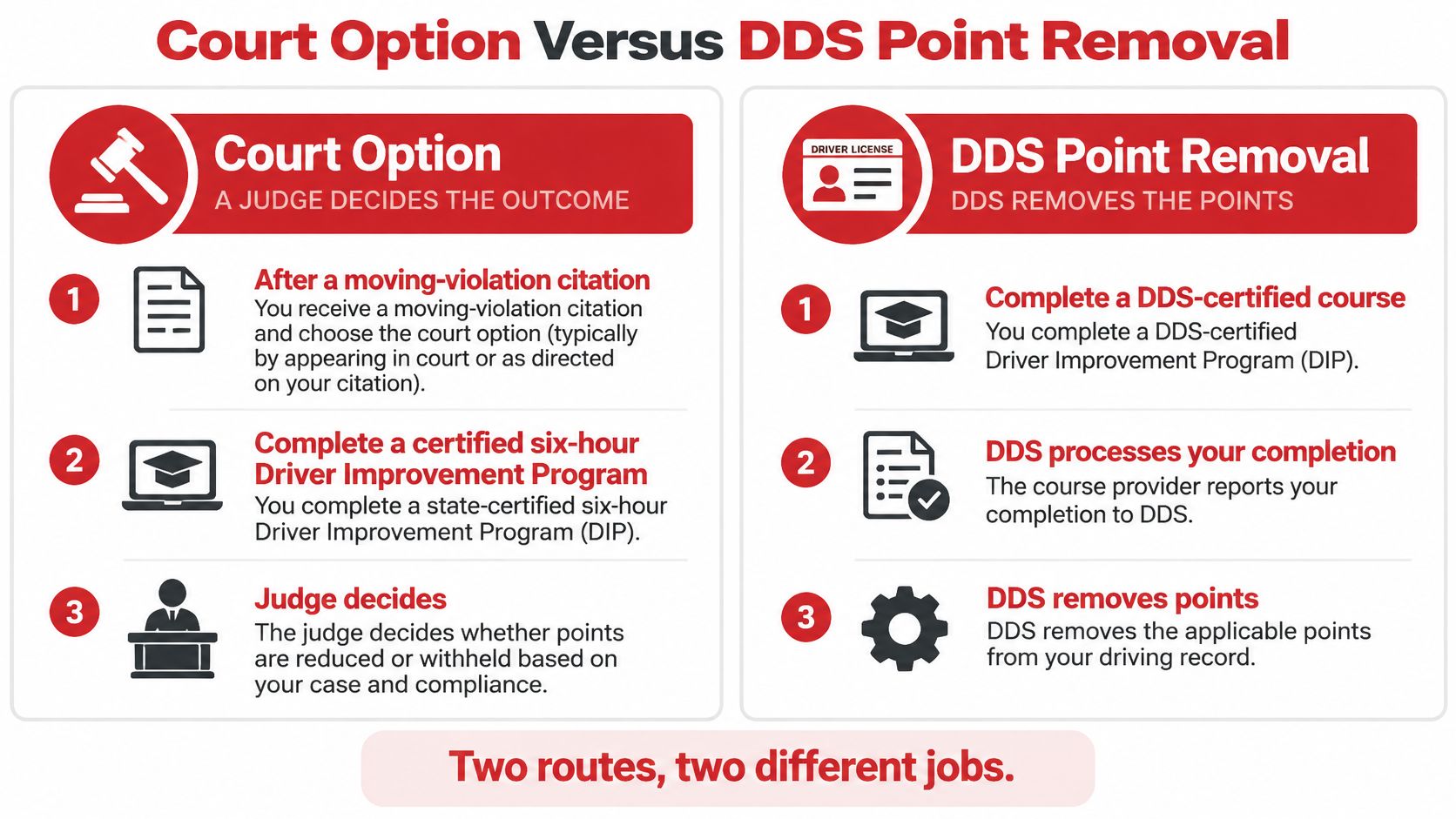
Under the court route, timing is everything. As outlined in the Georgia DDS Driver's Manual section on traffic violations, a defendant who receives a moving-violation citation can complete a certified six-hour Driver Improvement course before the court appearance or when ordered by the court. The key point is that this route asks the court to handle the citation before points become part of the final outcome.
A Driver Improvement certificate can work like a valve installed before the pipe leaks. It gives the court paperwork to consider as part of the citation process. DDS point removal works more like cleanup after the leak has already reached the floor: the points are already on the record, and the driver asks DDS to apply eligible credit under its rules. That distinction matters because finishing a course does not erase a ticket by itself, and it does not update a driving record by itself.
| Route | When you use it | What it does | Limit or proof |
|---|---|---|---|
| Court option | Before the court appearance or when ordered by the court | Gives the court proof of course completion for a pending citation, subject to the court's procedures | Original certificate presented to the court |
| DDS point removal | After points are already on the driving record | Applies eligible point credit to existing points | Once every 5 years; original certificate submitted to DDS |
Why Finishing Class Never Updates Your Record Automatically
A completion certificate doesn't activate itself just because you sat through the final hour. Neither the courthouse nor DDS receives automatic credit unless the original paperwork lands in the right hands. If you're dealing with a pending citation, our breakdown of how to handle a traffic ticket in Georgia explains how court appearances and dismissal requests interact with approved classes.
For a closer look at how Georgia drivers use these two pathways, watch this short walkthrough before deciding your next move.
Before paying a pending ticket online, contact the court clerk to confirm how and when they accept an original Driver Improvement certificate. Ask whether the court wants the certificate before the appearance, at the appearance, or only when the judge orders the class. That prevents a completed course from becoming unusable paperwork because it arrived on the wrong date or in the wrong form.
If points are already posted on your motor vehicle report, verify your five-year eligibility window with DDS before registering. The course can only help after the right certificate is submitted to the right place, so treat the certificate trail as part of the class, not as an afterthought.
How to Apply for Point Credits Step by Step
Think of the process as two keys on one ring. The class creates eligibility, and the original certificate is what lets DDS post the credit. If either key is missing, the record stays where it was.
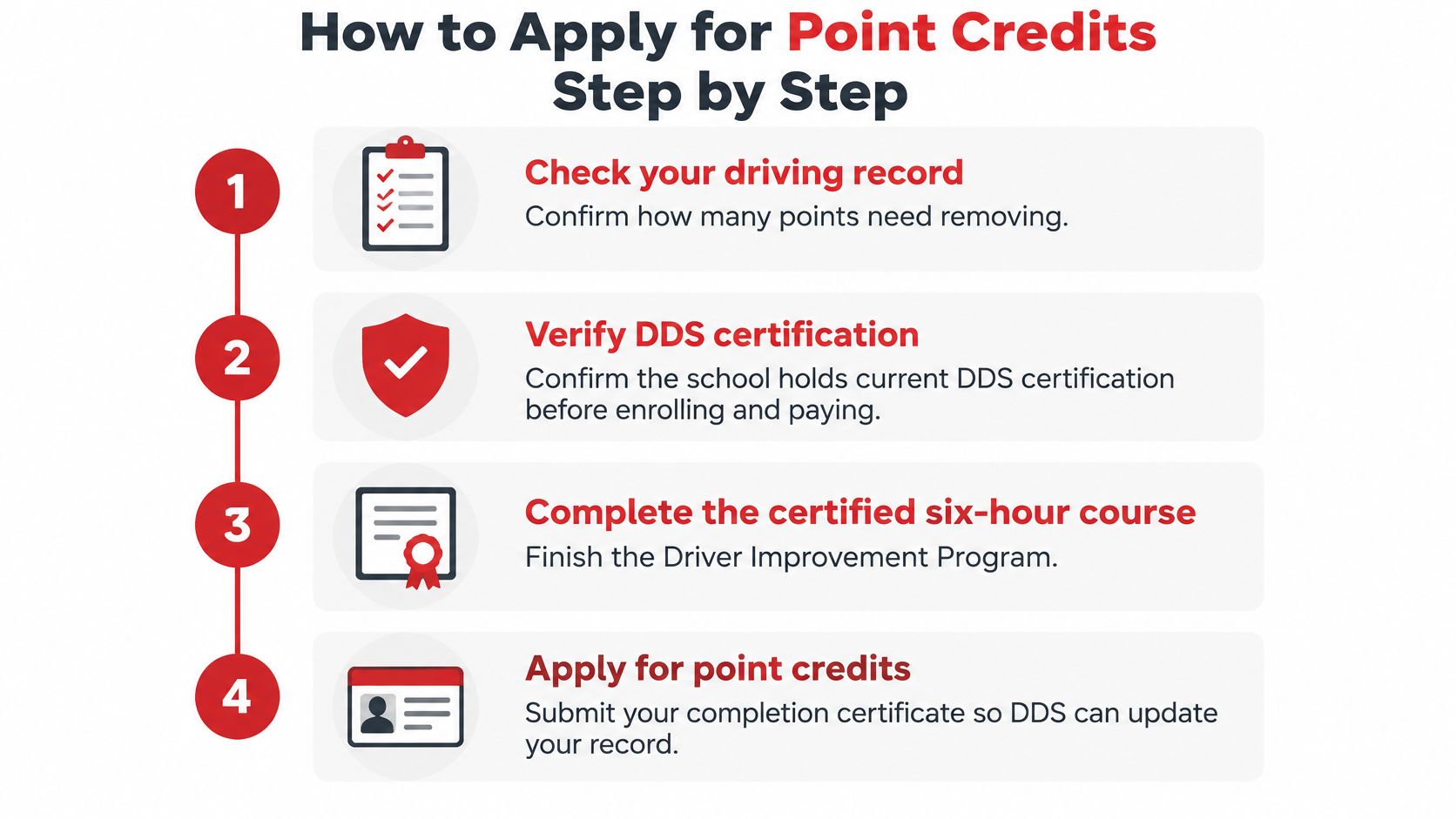
The Georgia DDS Defensive Driving Program FAQs describe an approved curriculum focused on safe-driving attitudes and behaviors. Provider certification matters because DDS rejects classes from uncertified schools for licensing, reinstatement, or court use. Use the steps below in order, especially if your goal is point removal rather than a pending court disposition.
Pull your Georgia driving record first. Check the current point balance before spending time in class. This shows whether you have existing points that may qualify for relief and helps you avoid guessing about your starting position.
Confirm the school's active DDS certification before you pay. Look for state certification numbers, not vague website wording. The Decatur location holds Georgia state certifications #1472 & 819 for A-1/I-285/Memorial Drive Driving & Defensive Driving School and #091 for A-1 Driving School Inc. (Memorial Drive/I-285). That kind of specific information helps separate a compliance course from general driver training.
Confirm the payment and enrollment path. For regulated uses such as point reduction, reinstatement, or court compliance, make sure the payment covers enrollment and official documentation. Ask the school which completion document it issues before class begins.
Attend the full six-hour program and collect your original certificate. Treat the certificate like a receipt for the whole course. A partial attendance record or informal printout does not do the same job. Collect the original completion certificate at the end. If you want a general visual reference for certificate borders, you can browse guilloche certificate designs, but use only the document issued for your course when submitting paperwork.
Deliver the original certificate directly to DDS. Bring the document in person to a DDS Customer Service Center or mail it to the designated DDS processing address. A photocopy or scanned image may be useful for your own files, but it should not replace the original when DDS is the recipient.
Verify the updated balance and check secondary deadlines. Follow up on your driving history to confirm that DDS posted the credit. Ask your court clerk or auto insurer if they require a separate copy under their own rules.
The One Paperwork Mistake That Stops Point Relief
Drivers often finish the class and assume the school sends the credit automatically. The safer habit is to handle the certificate like a package receipt. Keep your own copy, then deliver the original to the office that needs it.
Paperwork rule: Completing a certified course alone never erases a single point from your Georgia record. Keep a personal scan for your files, then hand or mail the original certificate straight to DDS.
Classroom, Online and Driving Lesson Formats Compared
Drivers often compare driver's education with point reduction, then realize the two serve different jobs. Point reduction works on an existing record. Driver's education prepares a teen or new driver for Georgia licensing and real traffic. That is why the format matters. The Georgia DDS Joshua's Law course chart lists the approved classroom and online routes, along with the behind-the-wheel and supervised driving requirements tied to each route.
| Format | Classroom hours | Behind-the-wheel hours | Supervised driving |
|---|---|---|---|
| Traditional instructor-led course | 30 | 6 at a DDS-approved school | 40 hours with parent or guardian, at least 6 at night |
| Online or virtual course | DDS-approved online curriculum | 6 at a DDS-approved school | 40 hours with parent or guardian |
Read the table like a set of train tracks. Both paths reach the same licensing station, but students travel there differently. A traditional course gives the student a live classroom with fixed times and immediate instructor feedback. An online or virtual course gives more schedule flexibility, yet it still needs a clear plan for the instructor-led driving portion and the logged practice at home. Every Joshua's Law route shown here includes 40 supervised hours, so no course table should be read as a way to avoid parent or guardian practice.
Choosing the Right Format for Your Schedule
Compare the time commitment before enrolling. Multi-week driver's education can feel steady and predictable, like a school term with checkpoints. That can help a teen who focuses better with a teacher in the room and classmates working through the same material. The same chart also makes the driving side plain: 6 hours of behind-the-wheel training must be completed at a DDS-approved school.
An online or virtual option may fit a student with sports, part-time work, or family scheduling problems. The flexibility works best when the family confirms two things upfront: the curriculum is DDS-approved, and the program explains how the student will complete the driving portion and supervised log. That comparison is different from the shorter length of defensive driving courses, which serve point reduction and defensive driving needs for eligible drivers rather than the Joshua's Law pathway.
Why Driving Lessons Packages Matter Beyond State Minimums
Minimum hours create eligibility. They do not automatically create confidence. A student can meet the required log and still freeze at a busy intersection, hesitate during a lane change, or feel unsure when merging with faster traffic. Parents often notice this during practice in the family car, where correction can turn into arguments. That is the gap extra driving lessons can fill.
Structured driving lessons packages give the student repeated practice with a calm instructor in a dual-control vehicle. A lesson can focus on lane position, scanning, parking, turns, and highway judgment without turning the family car into the classroom. A-1 Driving School offers Driving Lessons for students and adults, with day, evening, and online class options across its locations. Roswell also offers teen and adult driving lessons on day, evening, and weekend schedules, plus free pick-up from home or work for those lessons.
For many families, the smart sequence is simple. Choose the approved driver's education format that fits the calendar, complete the required hours, then add driving lessons where the student needs more practice. The course handles the rulebook. Extra instruction builds steadier habits behind the wheel.
Joshua's Law and the Class D Road Test
Say a Georgia teen earns a Class CP learner's permit shortly after turning fifteen. A year later, the family starts shopping for a quick weekend driving class, accidentally looking at point reduction or defensive driving courses instead of the driver's education pathway required for a Class D provisional license.
Joshua's Law isn't a point reduction program. It's the structured licensing step that moves a 16-year-old from a learner's permit to independent driving privileges, and finishing the coursework and supervised driving log is only the first half of the journey.

According to the Georgia DDS Class D licensing guide, a 16-year-old applicant must hold a valid Class CP learner's permit for at least 1 year and 1 day and avoid major violations that cause the permit to be suspended. Before testing, the student must also finish Joshua's Law, complete ADAP or eADAP (the Alcohol and Drug Awareness Program), pass a vision exam, and schedule an official road-skills test appointment.
What Happens on Road Test Day
Think of driver's education as the classroom lesson, while the road test is the final exam that proves those habits stuck behind the wheel. DDS administers a Class C or Class D road test only in a four-wheel vehicle supplied by the applicant. That car must carry valid registration or an eligible temporary tag, active liability insurance, and pass a pre-test safety inspection covering lights, horn, brakes, and mirrors. To earn the provisional license, the driver must score at least 75% on the road test.
Instructor note: Many capable teens fail their first road test because of a burned-out brake light, missing insurance paperwork, or test-day nerves rather than poor steering. Preparing in a familiar training structure removes unnecessary surprises.
At A-1 Driving School, our Driver's Education and Driving Lessons courses include Georgia DMV-approved Joshua's Law / Driver's Education courses covering all education and road testing, including the Georgia Road Test. Completing classroom instruction, behind-the-wheel driving lessons, and road testing with one certified provider keeps every document aligned and gives your student a familiar setting when test day arrives.
Counting Backward From Your Teen's Sixteenth Birthday
Working from a simple four-milestone timeline prevents last-minute scrambles when your teenager turns sixteen:
- Permit issued. Record the exact issue date on the Class CP learner's permit so you know when the holding period starts.
- One year and one day reached. Mark the earliest legal date your teen qualifies for the Class D road test, keeping the permit completely free of suspending violations along the way.
- Course and supervised hours finished. Wrap up the approved Joshua's Law program, ADAP or eADAP, and every logged driving hour well ahead of your target date.
- Road test scheduled. Book the road-skills appointment early, inspect the test vehicle thoroughly, and pair final driving lessons with mock road-test maneuvers so your teen walks in ready.
Confirm Your Course Before You Enroll
Before you enter a credit card number or clear a weekend on your calendar, run through this quick three-step check to make sure your time and tuition solve the exact problem in front of you:
- Verify active DDS certification first. Confirm the school holds current Georgia DDS approval before paying, and plan to keep your original completion certificate along with any mail or counter submission receipt.
- Match the class to the paperwork you need. Pick a certified point reduction course if you're a licensed driver clearing existing points, coordinate with the clerk if you have a pending citation, or choose a Joshua's Law driver's education program for a 16-year-old earning a Class D license.
- Lock in behind-the-wheel training for new drivers. For teens and beginners, confirm the format includes the required behind-the-wheel hours, a written supervised-driving plan, and extra instructor-led practice where needed.
Choosing a Certified Georgia Training Partner
Once your checklist is clear, look for a Georgia-certified school that supports the entire path from beginner lessons to licensing compliance. We offer both an instructor-led Drivers Education Joshua's Law Course and an online Drivers Education Joshua's Law Course, making it easy to fit state-approved driver's education around school, sports, and family schedules.
For students and adult learners who want real confidence behind the wheel, our Driving Lessons and driving lessons packages pair one-on-one instruction with day, evening, and weekend availability across Atlanta and Athens, including free home or work pick-up at our Roswell location. Eligible Georgia families can also apply through our Georgia Driver's Education Scholarship Grant Program to access state-funded driver training, and students can complete their Georgia Road Test directly with our team when they're ready.
Keep the distinction front and center as you enroll: a point reduction driving course is designed for licensed Georgia drivers removing existing points from their record, while teens working toward a Class D license should begin with an approved Joshua's Law course and hands-on driving lessons.
Whether you're scheduling teen or adult driving lessons packages, enrolling in an online or classroom Joshua's Law driver's education course, applying for the Georgia Driver's Education Scholarship Grant Program, booking your Georgia Road Test, or taking a DDS-certified compliance course, our instructors guide you through every requirement without guesswork. Visit A-1 Driving School to compare course formats, driving lesson packages, and upcoming class dates across Georgia.