
Your teen just turned 15, and the family calendar is already filling with school, sports, work, and summer plans. You may be wondering whether to schedule the Georgia learners permit test now or wait until life slows down. Waiting can create a licensing delay, because the permit starts the timeline toward a Class D license under Joshua's Law.
Georgia calls the learner's permit the Class CP instructional permit. A teen can receive it at age 15 after passing the required vision and knowledge exams, then begin supervised practice with a qualified adult. The permit isn't the license, but it's the starting point for classroom training, driving lessons, supervised hours, and the eventual road test.
What a Georgia Learners Permit Unlocks and When to Start
Consider a typical family conversation. A 15-year-old wants the freedom to drive to school activities, while a parent wants enough time to build safe habits before the road test. The Class CP permit gives the teen a legal way to practice, but only under Georgia's supervision rules.
The timing matters because Joshua's Law requires a teen to hold the learner's permit for 1 year and 1 day before receiving a Class D license. Georgia DDS also connects the pathway to driver education and supervised driving, so earning the permit early gives your family more room to complete each requirement without rushing. You can review the broader teen-driving rules in this Georgia teen driving laws guide.
The permit has a two-year validity period, according to the Georgia DDS teen-driver guidance. That gives students a practical window to study, take lessons, practice with family, and prepare for licensing, but it doesn't remove the minimum holding period required before the Class D road test.
Think of the permit as a starting line
A permit holder may drive only with an accompanying driver who is at least 21 years old, has a valid Class C license, and sits in the front passenger seat ready to take control if needed. The teen can't treat the permit like an unrestricted license or drive independently between practice sessions.
A sensible timeline looks like this:
- Earn the Class CP instructional permit.
- Complete the required driver education instruction.
- Take structured driving lessons after the permit is issued.
- Practice with a qualified adult and record the required supervised hours.
- Keep the permit for 1 year and 1 day.
- Prepare for and complete the Class D road test.
The practical takeaway: Start the permit process early, complete education while the information is fresh, and begin supervised practice as soon as the permit is issued. The calendar requirement can't be skipped, but good planning can prevent avoidable waiting.
The permit's real value is preparation. It lets a teen turn classroom knowledge into repeatable skills, including smooth stops, lane control, turns, parking, and decision-making in changing traffic conditions.
Eligibility Documents and Fees to Bring to DDS
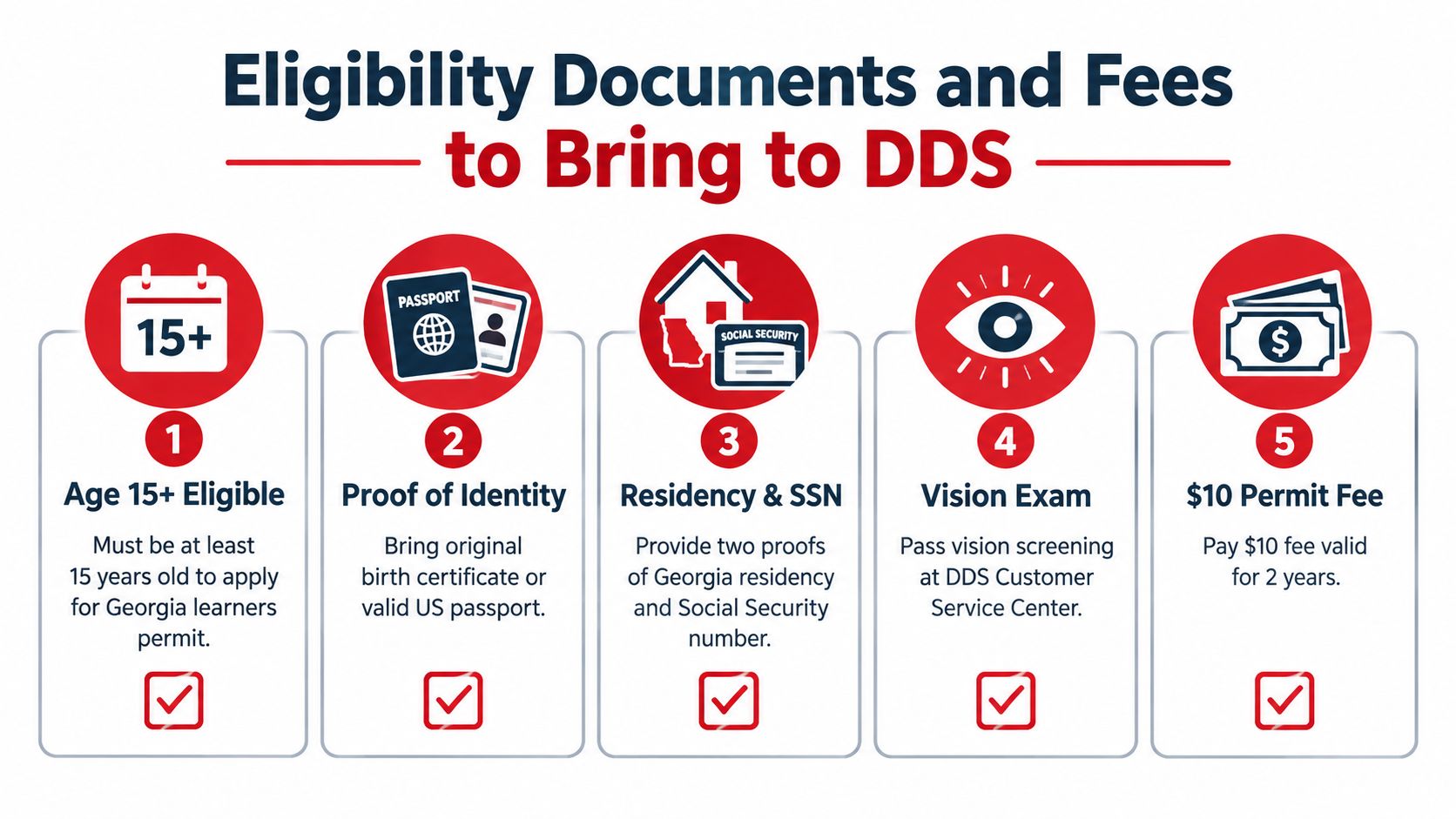
A successful DDS visit starts before test day. At age 15, a teen may apply for the Class CP instructional permit, but the applicant must be ready for both the vision exam and the knowledge exam. Georgia DDS lists the permit fee as $10 in its official permit guidance.
Families should confirm current document requirements before leaving home and organize paperwork in one folder. The Georgia ID requirements guide can help you sort through identification and residency paperwork before visiting a DDS Customer Service Center.
Prepare the application folder
Bring the original documents DDS requires for identity, Georgia residency, Social Security information, and lawful presence or citizenship. The exact document combination can vary by the applicant's circumstances, so check the current DDS list rather than relying on an old family checklist.
Use this preparation sequence:
- Identity documents: Gather an accepted original identity document, such as the document type DDS lists for your situation.
- Residency evidence: Prepare the required proof that establishes Georgia residency.
- Social Security information: Bring the acceptable Social Security documentation listed by DDS.
- Parent or guardian support: Confirm who needs to accompany the teen and complete any required signatures.
- Payment: Have the $10 permit fee ready, based on Georgia DDS permit requirements.
- Test preparation: Study before arriving, because the vision and knowledge exams are part of the issuance process.
Understand the rule that begins immediately
Once DDS issues the permit, the supervision requirement applies every time the teen drives. The accompanying driver must be 21 or older, hold a valid Class C license, sit in the front passenger seat, and remain ready to take control if necessary, as stated by Georgia DDS permit requirements.
That means a parent shouldn't hand over the keys and supervise from another seat. The qualified adult needs to be beside the teen and actively able to respond.
A last-minute document problem can turn a simple visit into another trip. Put the folder together early, verify each item against DDS guidance, and make sure the teen knows that passing the exams and meeting the paperwork requirements are separate parts of the same application.
How to Pass the Georgia Knowledge Test on Your First Try
The Georgia knowledge test has two independently scored sections, Road Signs and Road Rules. A student must earn at least 75% on each section, not an average of both sections combined, according to the state testing benchmark described in the Georgia permit practice test guide.
That distinction catches prepared students off guard. A strong Road Signs result can't compensate for a weak Road Rules result. The Road Rules portion is also identified as the more difficult segment, with a reported 68.02% pass rate in the cited permit-test guidance.
Study the harder section first
Many teens recognize signs quickly because the images feel familiar. Road Rules requires more careful reading because questions often test right-of-way, traffic behavior, and how a driver should respond in a specific situation.
Use a focused study routine:
- Read the Georgia Driver's Manual: Review signs, signals, lane rules, right-of-way principles, and other material covered by the manual.
- Start with Road Rules: Spend your earliest study sessions on the section that commonly creates more difficulty.
- Use active recall: Close the manual and explain a rule aloud instead of only rereading it.
- Take practice tests: Use missed questions to identify weak topics, then return to the manual for clarification.
- Separate the sections: Practice Road Signs and Road Rules independently so you know whether each one is ready.
Study strategy: Don't wait until the final review to work on Road Rules. Front-load that section, then use practice results to decide where your remaining study time belongs.
Before test day, make sure the teen understands the passing structure. Passing one section doesn't finish the knowledge requirement if the other section falls below the threshold.
Avoid preventable test-day mistakes
Students often lose points by reading too quickly, choosing an answer that sounds generally safe instead of the answer supported by Georgia rules, or changing an answer without a clear reason. Encourage the teen to read every question fully and distinguish between what a driver may do and what a driver must do.
The test center experience can also feel unfamiliar. Arrive with the required documents, allow enough time to stay calm, and don't turn a single difficult question into a reason to rush through the rest. A practice session using A-1's Georgia permit test preparation resource can give students another structured way to review before visiting DDS.
Watch the instructional video below after reviewing the manual and practicing both sections.
The goal isn't to memorize isolated answers. It's to understand the rule well enough to recognize how it applies when the wording changes.
Choosing Your Drivers Education Path After the Permit
Once the Class CP permit is in hand, families usually choose between several ways to complete driver education. The right choice depends on the teen's schedule, learning preferences, access to transportation, and need for in-car coaching.
Joshua's Law requires 30 hours of driver education instruction and 40 hours of supervised driving, including 6 hours at night, according to Georgia DDS Joshua's Law requirements. Classroom instruction and behind-the-wheel practice solve different problems. The class builds knowledge and decision-making, while lessons help a student apply those ideas behind the wheel.
A-1 Driving School offers in-person classroom instruction, online courses, and virtual Joshua's Law options, along with behind-the-wheel training, driving lessons, lesson packages, and road-testing assistance. Families should compare the schedule and delivery method carefully instead of choosing based only on whether a course is online.
Compare the available routes
| Program Option | Best For | What It Includes |
|---|---|---|
| In-person classroom | Students who learn well with a live instructor and set class times | Classroom driver education covering the required instruction |
| Online course | Teens who need flexible access around school and activities | Online driver education that can be completed around the family schedule |
| Virtual Joshua's Law option | Students who prefer live remote learning | Virtual instruction with a structured course format |
| Driving lessons package | Families seeking organized in-car practice | Behind-the-wheel lessons designed to build skills for everyday driving and the road test |
| Combined education and lessons plan | Students who want classroom and vehicle training coordinated | Driver education plus scheduled in-car instruction, with the exact package determined by the provider |
The state's Driver's Education Grant Scholarship Program can also address affordability. Eligible recipients must be Georgia residents, actively enrolled in school, ages 15 to 17, and possess a valid Georgia instructional permit or driver's license, according to the Georgia program rules.
Understand what the scholarship covers
The scholarship funds a training course consisting of 30 hours of classroom instruction and 6 hours of behind-the-wheel training. A separate state budget document states that, after completion, a scholarship of up to $500 is payable directly to the course service provider.
Applications go through the state's online process, with directions and deadlines published by the Georgia Driver's Education Commission. Families should check eligibility, application instructions, and deadlines directly rather than assuming every student qualifies or every course arrangement works the same way.
The scholarship's 30-plus-6 structure doesn't replace the broader supervised-driving requirement. A student still needs a plan for family practice and the required logged hours, including nighttime driving. That's why flexible lesson packages can be useful even after the formal course is complete. A student may need targeted help with parking, turns, lane changes, or road-test routines rather than another general lecture.
Permit Restrictions and Building Your Supervised Driving Hours
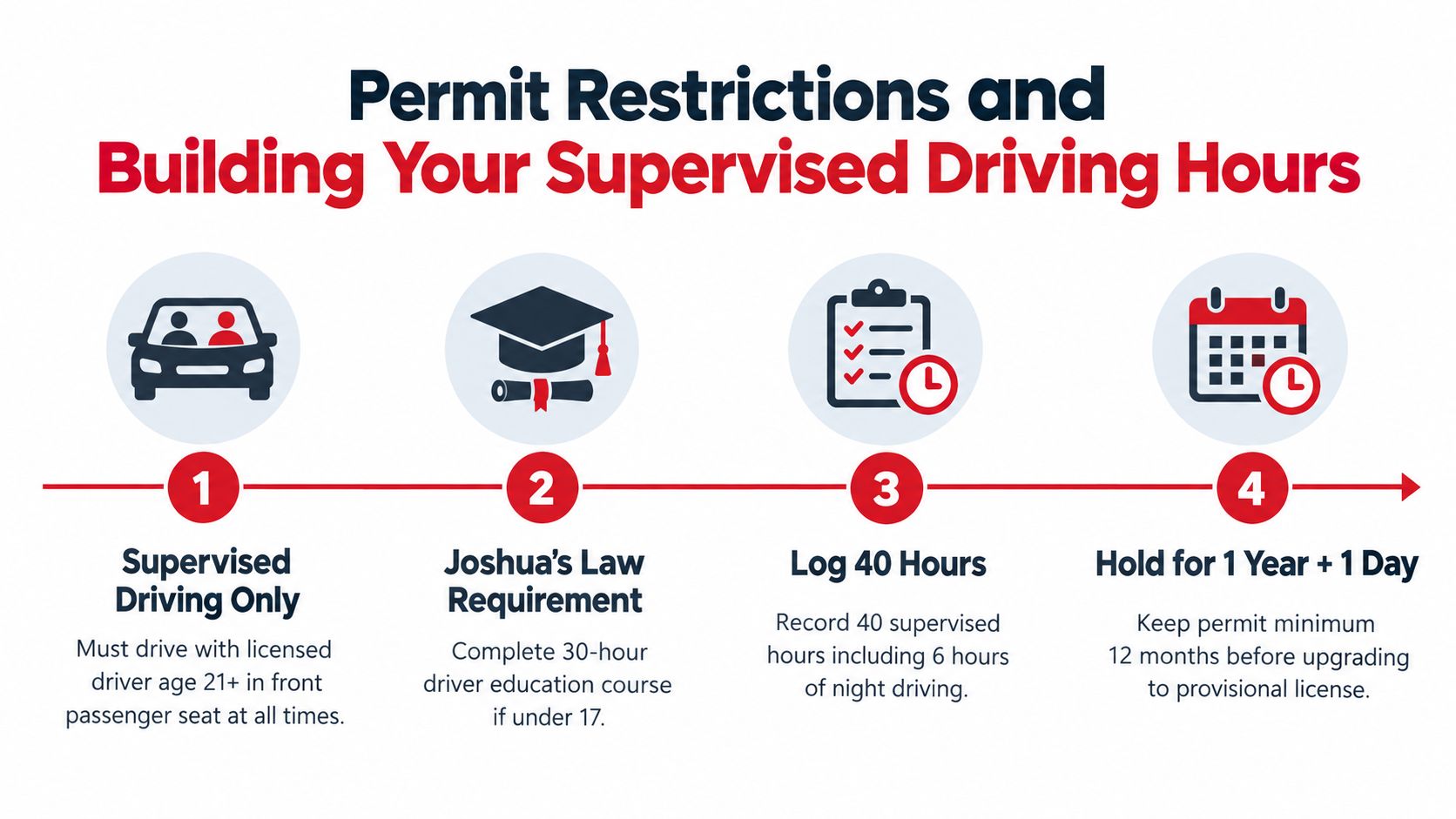
A Georgia learners permit gives a teen supervised driving access, not independent mobility. The supervising adult must be at least 21, hold a valid Class C license, sit in the front passenger seat, and be ready to take control. That rule should shape every practice drive, from the first quiet neighborhood session to later traffic and nighttime work.
Joshua's Law also requires the permit to be held for 1 year and 1 day before a Class D license can be issued. During that period, Georgia DDS requires 40 hours of supervised driving, including 6 hours at night, as part of the teen training pathway. The most efficient approach is to begin logging meaningful practice soon after the permit is issued rather than postponing all driving until the eligibility date approaches.
Build skills in a deliberate order
Early practice should have a purpose. Start with vehicle controls, steering, braking, turns, and lane position. Once those actions become more consistent, add busier roads, intersections, merging, parking, and nighttime conditions.
A parent can make each drive more productive by choosing one or two goals:
- Control: Smooth acceleration, braking, and steering.
- Observation: Mirror checks, visual scanning, and identifying hazards early.
- Traffic decisions: Right-of-way, following distance, lane selection, and turn timing.
- Vehicle positioning: Staying centered, stopping accurately, and maintaining safe space.
- Night practice: Gradually introduce darkness so the student can manage reduced visibility and headlight glare.
Professional lessons can help identify habits that a supportive parent may overlook. A student might feel comfortable driving straight but still need focused work on intersection scanning, speed control, or positioning before the road test.
Practice for the actual test environment
Road-test eligibility depends on completing the Class D requirements and holding the permit for the required period. The vehicle rules also matter. Georgia DDS says the applicant must arrive with a licensed driver age 21 or older, and only the applicant and that accompanying driver may be in the vehicle during the test. No other minors, children, or pets are permitted.
That restriction means families should practice with the same level of focus expected during testing. Remove distractions, use clear directions, and let the teen complete maneuvers without unnecessary coaching. The supervising adult can debrief afterward instead of interrupting every decision.
A complete practice plan combines family drives, formal lessons, education, and consistent hour logging. The permit clock runs in the background, but the student's skill grows only when each drive has enough repetition and feedback.
Your Next Move From Permit to License With A-1 Driving School
The Georgia permit process becomes easier to manage when the family treats it as one connected plan. First, the teen earns the Class CP instructional permit. Then the family completes the education requirement, schedules behind-the-wheel instruction, logs supervised practice, and prepares for the Class D road test after the required permit period.
A-1 Driving School supports that pathway with in-person, online, and virtual education options, driving lessons and lesson packages, and road-testing assistance. The school has 18+ metro Atlanta locations, including Athens, and offers online enrollment for families coordinating school, work, and extracurricular schedules.
The strongest plan depends on the student's starting point. A new driver may need a broader package with foundational lessons, while a teen who has practiced regularly may benefit from targeted road-test preparation. Eligible students should also review the Georgia Driver's Education Grant Scholarship Program and confirm whether the course and application meet current program requirements.
Use this week's checklist
- Confirm eligibility: Make sure the teen is ready to apply at age 15.
- Organize documents: Build the DDS folder and verify the current requirements.
- Choose education: Compare in-person, online, and virtual Joshua's Law options.
- Plan instruction: Select driving lessons or a lesson package that matches the student's needs.
- Start logging practice: Schedule supervised drives and include nighttime practice when appropriate.
- Protect the timeline: Track the permit date so the 1 year and 1 day requirement doesn't become a surprise.
- Prepare for testing: Review the road-test vehicle restrictions and practice without distractions.
The permit is only the first credential. A coordinated education and driving plan helps your teen use the waiting period to become more capable, more comfortable, and better prepared for the Class D test.
Choose a clear path from your Georgia learners permit to your Class D license with A-1 Driving School's Joshua's Law courses, flexible driving lessons packages, and road-testing support. Visit A-1 Driving School to compare course options, check lesson availability, and start building your teen's licensing plan.