
A lot of Georgia parents hear about the Steer Clear Program only after they're already comparing insurance options for a new driver. It sounds simple at first, a discount for being careful, but that surface-level view misses the core purpose. The program is better understood as one part of a broader training path, alongside Joshua's Law Driver's Education, behind-the-wheel lessons, and road test prep, not as a shortcut around real driving instruction.
What Most Georgia Drivers Get Wrong About the Steer Clear Program
A parent sits at the kitchen table with a stack of insurance papers, hears the words Steer Clear Program, and assumes it is just a coupon for good behavior. That assumption is common, and it misses the bigger picture. The program is built around training, tracking, and feedback, with the discount serving as the reward at the end.
For Georgia families, that matters because a young driver still needs the basics, classroom learning, supervised practice, and real-world confidence behind the wheel. Steer Clear can support those goals, but it does not replace formal driver education. State Farm describes the program as a structured process for drivers under age 25, with app-based monitoring of driving behaviors such as acceleration, braking, cornering, speeding, and phone use, and the score helps determine completion eligibility for the discount. State Farm's Steer Clear program details
What the program really asks a young driver to do
A young driver is asked to learn, practice, and show progress. State Farm says participants complete 5 training modules, then log 5 hours of driving across at least 10 trips, and the app scores trips on braking, acceleration, and cornering. State Farm's Steer Clear overview
That makes the program closer to a guided practice system than a one-time enrollment form. Parents often feel more comfortable with that structure than with a bare insurance discount, because the driver has to show consistency, not just sign up.
A good rule for Georgia families is simple. If a program does not help a teen build habits, it is not really driver education, it is paperwork with a reward attached.
The bigger picture still matters. Joshua's Law, behind-the-wheel instruction, and road testing all serve the same goal, helping a new driver become safe enough to drive independently. Steer Clear fits beside that pathway, and families who are comparing options for broader training can also review the scholarship eligibility requirements that sometimes come up during driver-education planning.
How the Steer Clear Program Actually Works
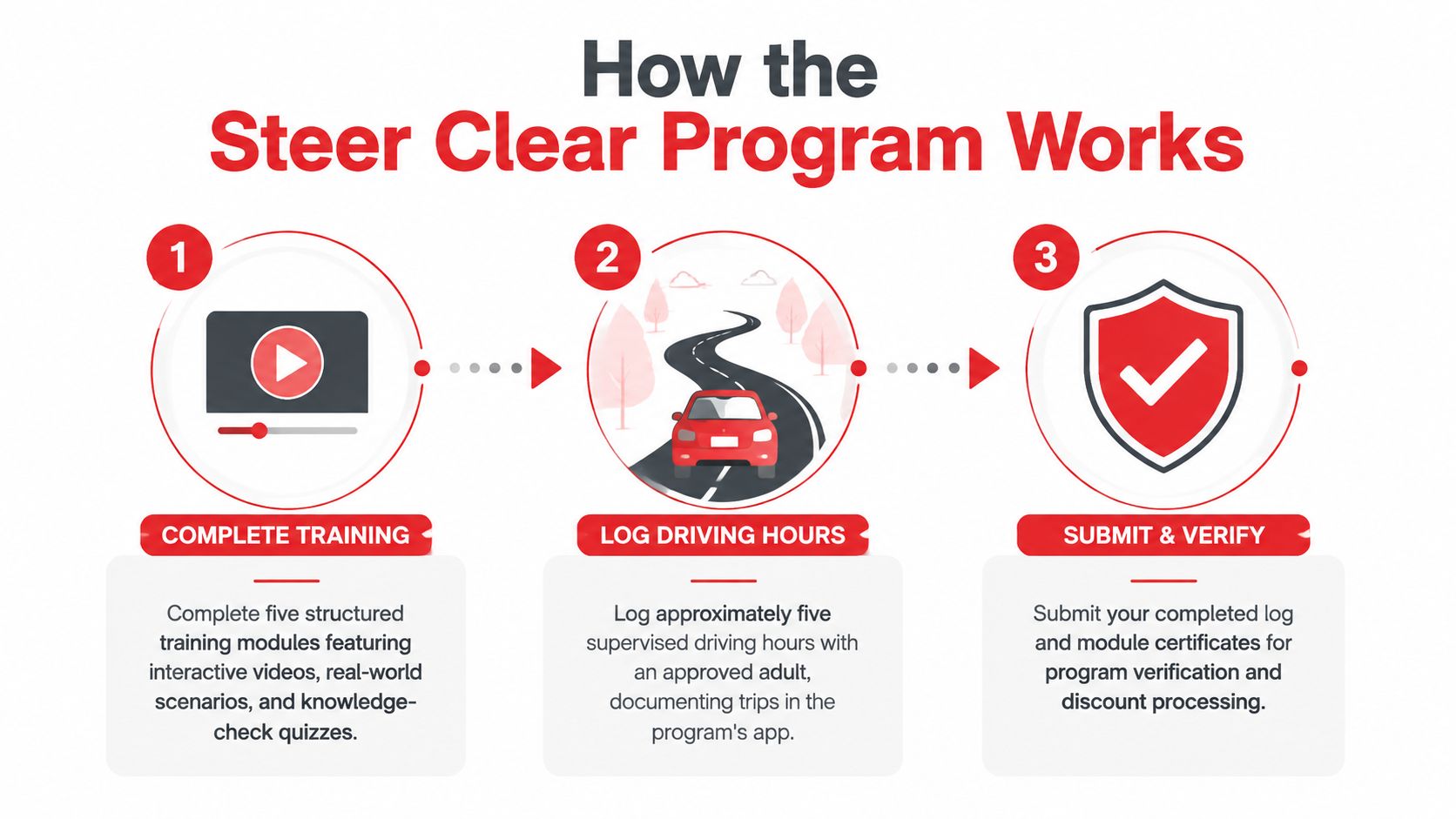
The program is easiest to understand when you break it into steps. First, the driver completes 5 structured training modules with videos, driving scenarios, and quizzes. Then the driver logs supervised driving time, and finally the driver submits the completed work for review and certificate processing. State Farm's materials say the app-based version uses trip data to score braking, acceleration, and cornering, which gives young drivers immediate feedback on habits they may not notice on their own. State Farm's Steer Clear discount page
Step 1, finish the learning modules
The modules are not filler. They're the part that teaches the driver what safe choices look like before the car is moving in traffic. Videos, scenarios, and quizzes are useful because they force the driver to pause and think, instead of guessing.
Step 2, log supervised trips
State Farm says the program asks for 5 hours of driving across at least 10 trips. That structure matters because short, repeated practice is usually easier for a new driver than trying to cram all practice into one long session. A parent or another approved adult can help make those trips regular and calm.
Step 3, submit for completion
After the modules and driving logs are finished, the driver completes the final assessment and certificate process. The app's scoring gives the family a visible record of progress, which can be useful when a young driver needs more than encouragement and wants clear evidence of improvement.
If you're comparing this kind of guided practice with a more general traffic-safety refresher, it helps to look at a broader learning resource like online traffic school BDISchool, especially if you want to understand how structured driver education programs are typically organized. The Steer Clear format is more insurance-specific, but the learning logic is familiar.
Who Qualifies and Where the Program Is Available
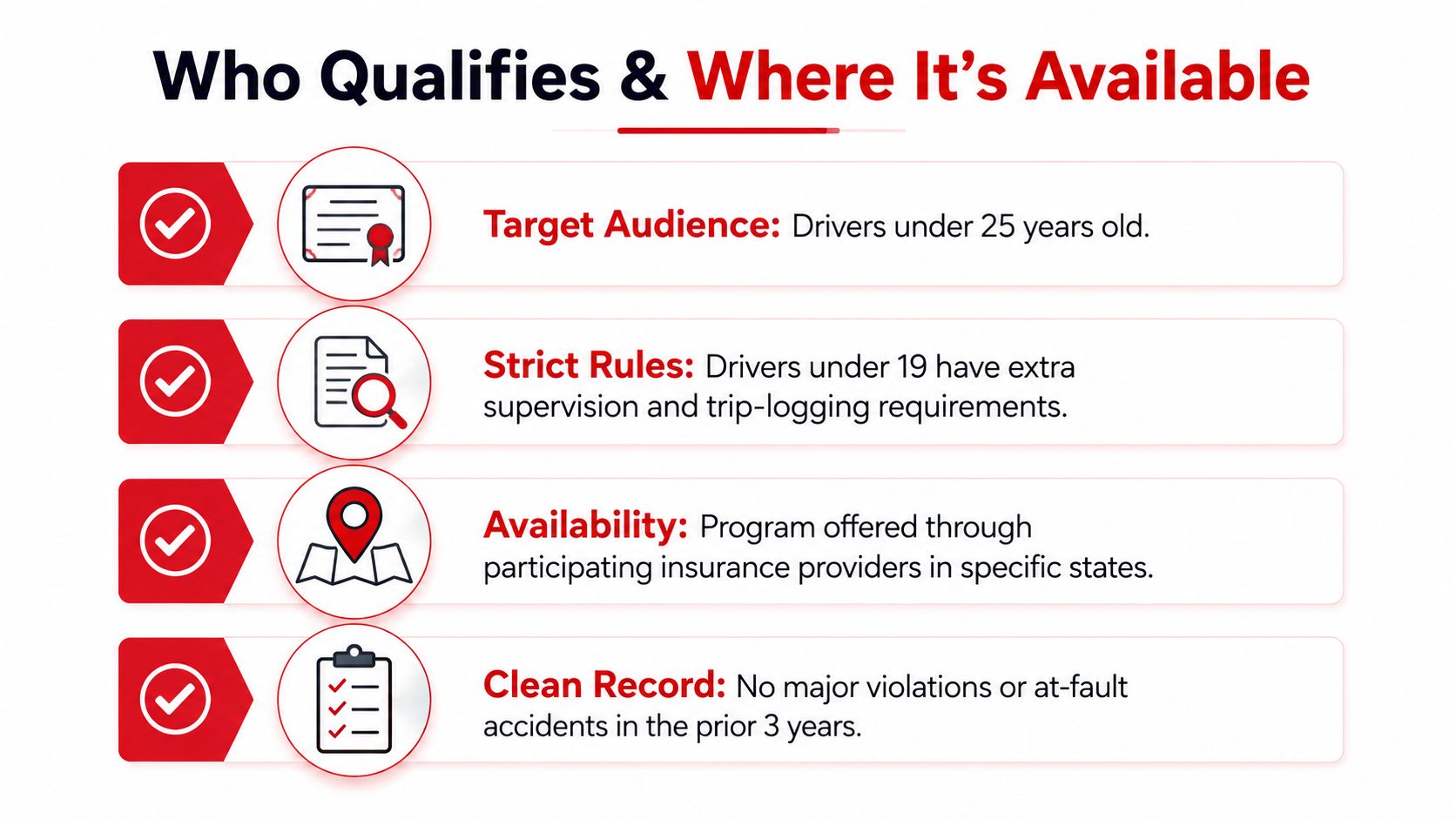
Eligibility is where many families get tripped up. The program is aimed at drivers under 25, but the rules get tighter for younger applicants, and the household insurance setup matters too. If you're trying to decide whether the program is realistic, start with the age track, then check the state and policy details before anything else.
The age rules are not the same for every young driver
State Farm's program overview says under-19 drivers must complete 20 trips in 60 days, with 15 supervised by a licensed driver over 25, and they also need a parent or driver agreement. Drivers 19 to 24 follow a different path, which shows the program is not one-size-fits-all. State Farm Steer Clear program overview
That difference matters because the younger track is built around more oversight. A 17-year-old learning to merge, scan intersections, and handle pressure on busy roads needs more hands-on supervision than a 22-year-old who already has more independent experience. The program reflects that reality by tightening the requirements.
The state and household restrictions are just as important
State Farm says Steer Clear is unavailable in California, Hawaii, Massachusetts, North Carolina, and Rhode Island. It also requires all private passenger vehicles in the household to be insured with State Farm if the discount is to stay in place. LendingTree's summary of Steer Clear restrictions
That means the program won't fit every Georgia household either, especially if the family uses more than one insurer. A multi-car, multi-policy setup can make the discount harder to maintain even when the teen qualifies on paper.
If the household insurance picture is messy, check that first. It's a lot easier to sort out before enrollment than after the driver has finished the work.
For families who need help planning scholarship-related training options, the scholarship eligibility details at A-1 Driving School's scholarship eligibility page can be a useful place to compare support paths. That's especially helpful when you're deciding whether insurance-based training or school-based instruction is the better fit.
Steer Clear Versus Joshua's Law and Georgia Driver's Education
Steer Clear and Joshua's Law serve different jobs. One is an insurer-specific training and monitoring program, the other is Georgia's driver-education pathway for teens who need state-compliant instruction. If you blur those together, you can end up with a young driver who has finished an app program but still hasn't met the education requirement for licensure.
| Category | Steer Clear Program | Joshua's Law Driver's Education |
|---|---|---|
| Purpose | Insurance-related training and discount eligibility | Georgia driver education requirement for teens under 16 |
| Format | App-based, with modules and trip tracking | Classroom or online driver education plus behind-the-wheel training |
| Key work | Videos, scenarios, quizzes, supervised driving logs | 30-hour Driver's Education course and 6 hours of behind-the-wheel training with a certified instructor |
| Outcome | Possible insurance discount after completion | Meets Georgia's driver-education requirement for a Class D license path |
That side-by-side view makes the difference plain. Joshua's Law is about meeting a legal education standard, while Steer Clear is about reinforcing safer habits and possibly lowering insurance costs. One does not substitute for the other.
Where Georgia teens get the most value
A teen who still needs to finish driver education should treat Steer Clear as a supplement, not the starting point. Classroom work builds the rules, instructor-led lessons build technique, and supervised practice builds judgment. Then an insurer's behavior-based program can reinforce what the student already learned.
Families who want a standard Georgia pathway often choose in-person classroom Driver's Education, online Driver's Education, and behind-the-wheel lessons as the core sequence. For a closer look at how Georgia families move from course selection to enrollment, this driver's ed enrollment guide is a practical reference.
Enrolling in Steer Clear and Pairing It With Driving Lessons
The cleanest way to enroll is to treat Steer Clear like a checklist, not a mystery. First, confirm that the policy and household setup are eligible. Then enroll through the app or online, complete the modules, log the supervised trips, and finish the assessment so the certificate can be issued.
A simple path from signup to completion
The process is easier when the teen and parent divide the work. One person can handle the insurance login and policy details, while the driver focuses on module completion and trip logging. That keeps the program from stalling because nobody remembers the next step.
A practical sequence looks like this.
- Check participation first. Make sure the insurance policy and household setup can support the program.
- Enroll through the app. Use the policy information and follow the training prompts.
- Complete the modules. Move through the videos, scenarios, and quizzes without rushing.
- Schedule supervised practice. Spread the driving logs across normal errands and practice sessions.
- Submit for review. Once the training and logs are complete, finish the final assessment and certificate process.
That sequence works best when it sits next to real driver training, not instead of it. If your teen still needs formal instruction, pair the program with classroom learning, behind-the-wheel practice, and road test preparation.
Where Georgia training supports fit in
Georgia families should also look at the Georgia Driver's Education Scholarship Grant Program if they qualify. That option exists separately from Steer Clear, and it can make formal training more accessible for families who need help covering instruction costs. State-funded support, school-based instruction, and insurance discounts solve different problems, so it makes sense to explore all three.
If your goal is practical readiness, don't stop at the app. A teen who learns the rules, practices with an instructor, and prepares for the road test is building skills that travel with them long after the discount ends.
Is the Steer Clear Program Worth the Effort?
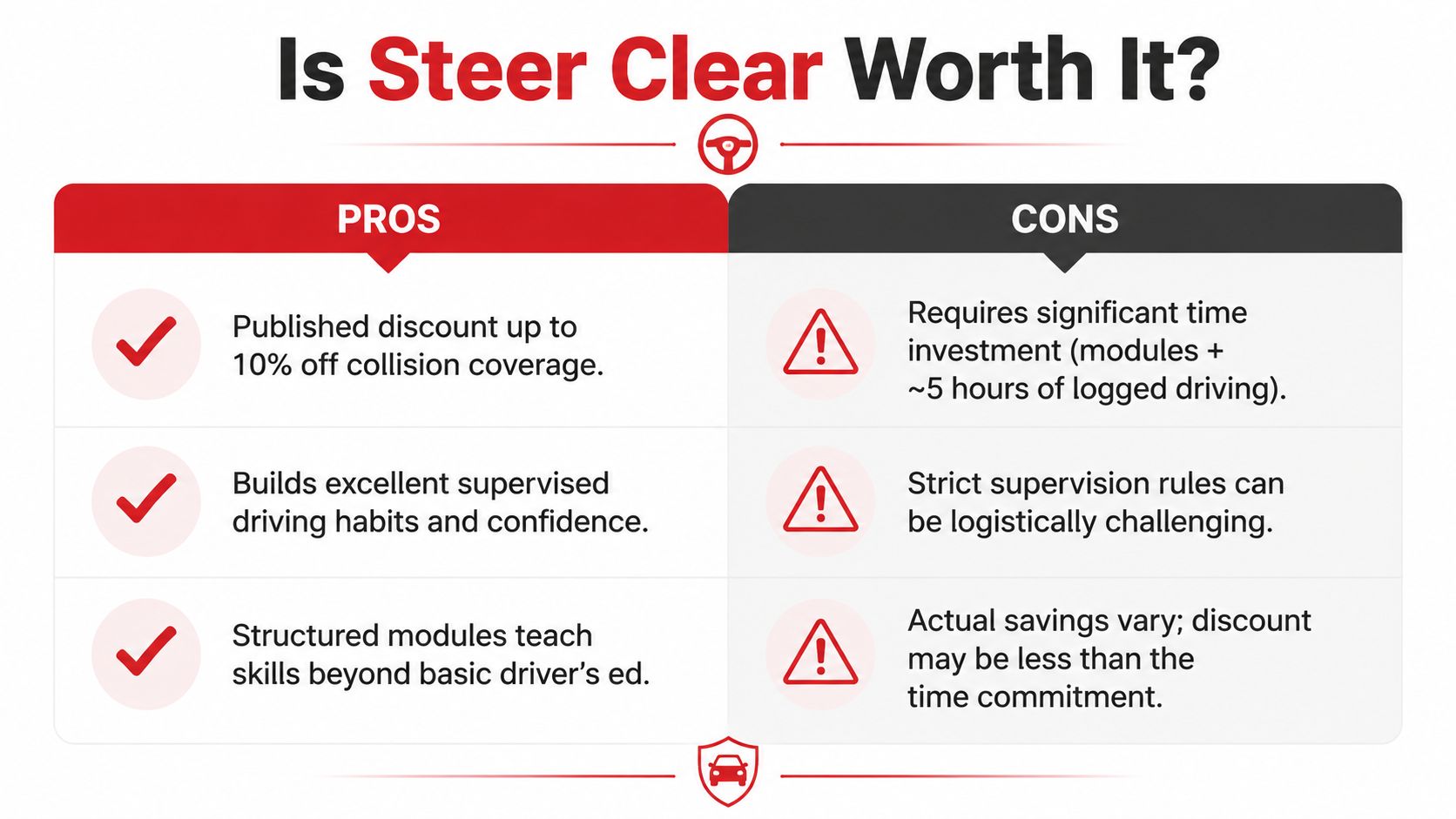
A Georgia parent usually asks this question after looking at the work involved. The answer depends on what you expect the program to do. Published sources report that completion can produce a discount of up to 15% or up to 20%, depending on the state and the policy details. Even so, the savings can be modest once the policy terms are applied, so the value depends on the driver profile and the household's situation.
What families usually gain
The main benefit is the structure, not just the discount. The program gives young drivers a routine for supervised practice, a chance to notice patterns in their own driving, and a reason to keep practicing between formal lessons. For a teen who feels tense behind the wheel, that repetition can make ordinary trips feel less scattered.
It also fits well beside the rest of the Georgia training pathway. Joshua's Law, in-car instruction, and road test preparation each cover a different part of readiness, and Steer Clear adds another layer of practice without replacing those other steps. Families who want a broader cost comparison can also compare insurance savings strategies and see how this program fits into the full picture.
What families need to weigh
The tradeoff is time and coordination. Under-19 drivers face stricter supervision and trip-logging rules, and busy families may find that hard to manage. If the discount is modest and the logistics are heavy, some parents decide that more instructor-led practice is the better use of time.
A teen often benefits more from direct coaching than from another app-based task. Lessons with a professional can help with lane changes, parking, scanning traffic, and the kind of habits that show up on the road test, which is why driving lessons with an instructor remain a smart companion to the program.
For many families, the best choice is to use Steer Clear for the insurance piece while still investing in hands-on training. That approach keeps the discount in perspective and treats driving readiness the way it should be treated, as a set of connected steps rather than a single finish line.
Common Assumptions That Lead Drivers Astray
One common myth is that the discount is always a flat number. It isn't. The published upper range varies by source and circumstance, and the savings can feel much smaller than the headline figure when the policy terms are applied. CarInsuranceCompanies on program savings
Another misconception is that Steer Clear can replace Joshua's Law. It can't. Georgia's driver education requirement is its own path, and the app-based insurance program doesn't meet that legal training standard. A teen still needs the right combination of coursework and behind-the-wheel instruction to move toward licensure properly.
The biggest misunderstandings, cleared up
- “Any teen can join.” Not quite. The program is aimed at drivers under 25, and the state and household rules matter.
- “Finishing is optional.” That's misleading. The training and logging are tied to completion and discount eligibility.
- “It works in every state.” It doesn't. The unavailable states listed earlier are real exceptions.
- “It's the same as driver's ed.” It isn't. Steer Clear is insurance-related training, not a substitute for formal education.
The last myth is the most expensive one because it creates false confidence. A driver may feel “done” after completing the app, but still need instructor time, practice, and road test preparation to be genuinely ready. That's why Georgia families are better off viewing Steer Clear as one useful piece of a broader plan, not the whole plan.
Your Next Steps and Answers to Common Questions
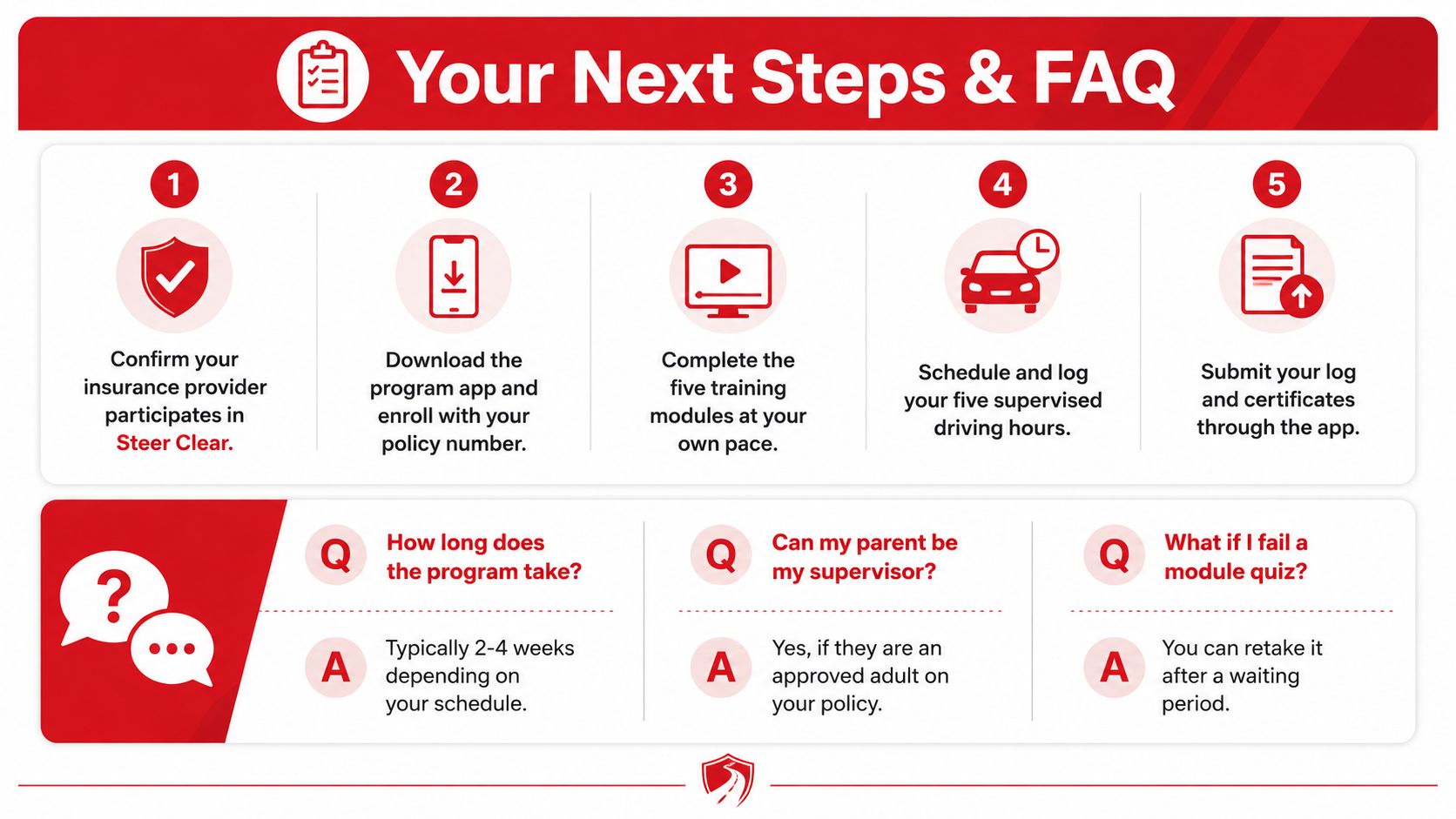
Start with the practical checklist. Confirm that the insurance provider participates, enroll in the program, finish the modules, log the supervised driving, and submit the completion materials. Then line that work up with Georgia driver training, especially if the teen still needs classroom instruction, behind-the-wheel lessons, or road test prep.
Quick answers families ask most often
Does Steer Clear count as Driver's Education? No. It's an insurance-related training and monitoring program, not the Georgia education course a teen needs under Joshua's Law.
Can a permit holder use it? If the household and insurance setup fit the program rules, a young driver can use it as a supervised practice tool. The program still depends on the completion steps and the age track.
How do families coordinate it with Georgia training? The best approach is to use Steer Clear alongside classroom work, behind-the-wheel practice, and road test preparation, not as a replacement.
If you're mapping out the next move for a new driver, look at the full Georgia path first. Then choose the training pieces that best fit your teen's needs, your schedule, and your insurance setup.
A-1 Driving School offers Driver's Education, online courses, driving lessons, driving lesson packages, and road test support for Georgia families who want a clear next step after learning about Steer Clear. If you're ready to connect insurance discounts with real behind-the-wheel preparation, visit A-1 Driving School and choose the course or lesson path that fits your driver's current stage.