Georgia's pedestrian safety snapshot is hard to ignore. In 2016, the World Health Organization reported about 310,500 pedestrian deaths worldwide, and pedestrians accounted for around 23% of all road traffic deaths. In the United States, the CDC reported that pedestrian death rates rose 50.0% between 2013 and 2022, from 1.55 to 2.33 per 100,000 population. For Georgia families, teens, and drivers, that makes everyday walking habits matter more than ever.
These pedestrian safety tips are built for real life in Georgia, where busy arterial roads, school zones, neighborhood streets, and nighttime trips all call for different choices. A child walking to school, a teen crossing near a MARTA stop, and a parent helping an elementary student across a driveway do not face the same risks. That's why good pedestrian safety starts with visibility, timing, and clear judgment, not just memorizing a rule.
A-1 Driving School supports that bigger picture with Georgia driver education, Joshua's Law courses, scholarship resources, road test support, and behind-the-wheel driving lessons that help new drivers understand how pedestrians move and where conflicts happen. If you want a practical way to strengthen road awareness for your family, start with the skills that make every street crossing safer.
1. Make Eye Contact and Be Visible to Drivers
The safest crossing starts before you step off the curb. Drivers are far more likely to notice you when you stand where they expect pedestrians, and when your clothing or gear makes you easy to see. That matters at intersections, in parking lots, and anywhere headlights can fool someone into thinking the road is clear.
A Georgia evening walk can look safe from your side of the street and still be risky from a driver's seat. Headlights don't guarantee that a driver has seen you, especially if you're in dark clothing or standing between parked cars. A reflective vest, an armband, or a backpack strip helps in low light, and bright orange, yellow, or white clothing improves visibility when the sun is low.
Practical rule: If you can't make eye contact, treat the crossing as unfinished.
For parents, this is a good habit to model every time you cross near school drop-off lanes or neighborhood intersections. For teens, it's especially important on the way to practice, football games, or after-school jobs, when distractions are common and drivers may be scanning for gaps, not people.
The safest sequence is simple, and it's worth repeating: stop where drivers can see you, look directly at the approaching vehicle, and wait until you know the driver has noticed you. That's especially useful near right turns, driveways, and multilane roads where one driver may stop while another keeps moving. For nighttime safety ideas that fit these habits, A-1's guide to driving safely at night is a useful companion for families teaching road awareness from both sides of the windshield.
- Choose bright colors: Wear orange, yellow, or white when light is fading.
- Add reflective details: Use strips on backpacks, sleeves, or shoes.
- Wait for acknowledgment: Don't step out until you've seen the driver's attention.
- Avoid dark-only outfits: All-black clothing makes you harder to detect fast.
2. Cross Only at Designated Crosswalks and Traffic Signals
Marked crosswalks and signalized intersections give both sides a shared script. Drivers know pedestrians may be crossing, and pedestrians have clear instructions about when to move. That predictability lowers confusion, especially on busy Georgia corridors where turning traffic and lane changes can create fast-moving hazards.
This is one place where a longer walk is usually the safer choice. The National Highway Traffic Safety Administration says pedestrians should cross at crosswalks or intersections when possible, and if no crossing is available, they should choose a well-lit area and wait for a safe gap in traffic before crossing, while keeping watch for vehicles throughout the crossing NHTSA guidance on pedestrian crossing practices. In plain terms, that means choosing the legal crossing point and staying alert even when the signal says go.
Georgia parents can use this habit to teach children that a painted crosswalk isn't just decoration, it's a safer channel for crossing. Teens should also learn that a flashing don't walk signal isn't a cue to hurry, it's a cue to wait. Drivers can help by slowing down early near crossings, because pedestrians often move at a different pace than vehicles expect.
Georgia intersections reward patience
In many urban areas, a leading pedestrian interval gives people a head start before turning traffic moves. That extra breathing room matters at busy corners where drivers and walkers are both trying to clear the intersection. An all-pedestrian walk phase goes even further by giving foot traffic exclusive crossing time, which can be especially useful near schools, transit stops, and downtown activity centers.
- Use the nearest marked crosswalk: Even if it adds a few steps, it usually cuts risk.
- Follow the walk signal: Only enter on the white walk symbol or walking figure.
- Watch turning vehicles: A green signal for you doesn't cancel a turning driver's responsibility.
- Teach children the routine: Stop, wait, look, then cross with purpose.
3. Stay Alert and Avoid Distractions While Walking
A pedestrian who is looking at a phone, adjusting headphones, or reading a screen has less time to respond when traffic changes fast. That matters on a neighborhood sidewalk, and it matters even more at a curb cut, a parking lot entrance, or a crosswalk near a busy retail center. If your focus is on a device, your body can reach the edge of the street before your mind has caught up.
The distracted driving prevention resource from A-1 Driving School reinforces a point walkers and drivers both need to remember, attention changes how fast you can react. Georgia streets make that easy to see in real time, because one missed glance can matter at a driveway, a curb lane, or a school pickup zone. A driver may be the bigger machine, but a distracted walker still has less time to spot movement and choose a safe path.
If you are walking to class, heading to a bus stop, or leaving a Friday-night game, keep the phone out of your hand until you are away from traffic. If you need directions, stop in a safe place first. If you wear earbuds, take one out or remove them completely so you can hear traffic, bike bells, and a driver calling out. Hearing more does not replace looking, but it gives you another warning signal when a vehicle turns unexpectedly.
Small habits that protect attention
- Put your phone away: Use hands-free navigation only after you are already in a safe spot.
- Scan often: Lift your eyes and check what is happening around you every few seconds.
- Keep ears open: Do not let music or podcasts cover traffic sounds.
- Pause before posting: Step fully off the street before texting or checking messages.
- Match your attention to the setting: A quiet neighborhood block still needs caution, and a crowded parking lot needs even more.
For children, parents should treat this as a house rule, not a suggestion. If children learn that walking and scrolling happen at the same time, they will carry that habit into school corridors, parking lots, and neighborhood roads. Teens need the same reminder, especially when they walk with friends and assume someone else is watching traffic. Adults set the pattern too. A parent looking down at a phone while crossing teaches the exact behavior children should avoid.
4. Understand and Follow Right-of-Way Rules
Right-of-way is about who should move first, but it is never a guarantee of safety. A pedestrian can have the signal and still get caught in the path of a turning car. A driver can legally go first in some situations, but still need to yield when a person is already in the crosswalk.
Georgia families benefit from teaching both the rule and the caution behind it. The rule tells you what should happen. The caution reminds you that traffic doesn't always behave the way it should. That's why a pedestrian should look both ways before crossing even when the walk signal is on, and why a driver should slow down and be ready to stop at crosswalks.
Practical rule: Having the right-of-way doesn't mean it's time to step out blindly.
Turning vehicles deserve special attention. A car with a green arrow may legally move, but that doesn't help a pedestrian who's already in the intersection. Unmarked intersections, roundabouts, and driveways can also be confusing because the movement pattern isn't as obvious as a painted crosswalk. Children need to learn that signals matter, but signals alone don't keep them safe.
Georgia parents can reinforce this with simple language at the curb. Ask children what they see, where the cars are coming from, and whether anyone is turning. Teens should practice the same habit on walks to school, the library, or a friend's house. If a crossing feels rushed, loud, or crowded, waiting for the next cycle is often the smartest move.
A-1's right-of-way guide can help new drivers and families think through these situations from the driver's seat too. That shared understanding is useful in Georgia, where road space is often shared by school traffic, delivery vehicles, cyclists, and walkers at the same time.
5. Never Assume a Driver Sees You and Stay Defensive
Defensive walking means you don't trust the situation until the driver has clearly shown they're stopping. That may sound cautious, but it's the right mindset near driveways, parking lots, and busy corners where a driver's attention can shift in a second. A person can legally enter the crosswalk and still be at risk if a vehicle is rolling, turning, or backing up.
The safest move is to look at the driver, not just the vehicle. Brake lights, a slowing front end, or a clear pause can tell you more than the presence of a traffic signal. If you can't tell whether a driver sees you, wait. That's especially important near places where Georgia drivers often focus on merging, parking, or turning instead of scanning the sidewalk.
A defensive pedestrian also watches for common failure points. Driveways create short, quick conflicts. Parking lots create mixed movement from every direction. Turning vehicles create blind moments, especially when one lane stops and another lane keeps moving. In those places, the words “I have the right-of-way” don't protect you if a driver never noticed you.
- Look at faces, not just headlights: You want confirmation, not guesswork.
- Watch for stopping cues: Brake lights and slower wheel movement matter.
- Be extra careful at corners: Turning vehicles are easy to miss.
- Trust your instincts: If it feels wrong, wait for a better gap.
For teens, this habit is worth practicing in daylight first, because it becomes easier to use at dusk or in rain. For parents, the best lesson is consistent modeling. Kids copy what they see more than what they're told, so if adults step out fast and hope for the best, children learn that unsafe pattern fast.
6. Increase Visibility at Night and in Poor Weather Conditions
Nighttime walking demands more than confidence. It demands visibility, because drivers have less time to notice a person in dark clothing, and weather can make that even worse. Rain, fog, and darkness all shrink the window between seeing a pedestrian and stopping safely.
Georgia neighborhoods often look calm at night, especially on side streets with light traffic. That calm can be misleading, because a single car turning from a driveway or a vehicle exiting a parking lot can appear with very little warning. Reflective clothing, a small flashlight, or LED clip-lights on a jacket or bag give drivers a better chance to notice you before you enter their path.
The World Health Organization has reported that pedestrian deaths rose 12.9% from 2013 to 2016, nearly twice the increase for other road users, and that the burden is uneven across regions, including a 40% share of road deaths in the African Region and 14% in the South-East Asian Region WHO pedestrian safety report. That global picture doesn't map directly onto a single Georgia street, but it does show how much pedestrian safety depends on conditions, infrastructure, and driver behavior.
Simple night rule: If a driver has to work hard to see you, your clothing isn't doing enough.
Use bright colors whenever you can, then add reflective gear on top of that. If you're walking after dark to a neighbor's house, a community event, or a late practice, don't rely on the glow of nearby storefronts. Choose a route with better lighting if one is available, and give yourself extra time so you're not rushing across the street.
For families, a reflective vest in the car or backpack is one of the easiest habits to build. It's practical, low effort, and useful for surprise walks home after a change in plans. It also teaches children that visibility is a choice, not luck.
7. Walk Predictably and Avoid Sudden Movements
Predictable movement helps drivers judge where you'll be next. When you start, stop, swerve, or reverse direction without warning, drivers have less time to react and more reason to brake hard or make a risky move. That's true at a quiet neighborhood crossing and even more true on a multilane road where one unexpected motion can trigger a chain reaction.
Cross the street directly, at a steady pace, and keep your path straight. Don't zigzag around puddles in the roadway, don't sprint halfway and slow down suddenly, and don't reverse direction after you've already entered traffic. If you notice you made a mistake, keep moving to the nearest safe point rather than backing up into the path of a vehicle.
Children need extra help here because their movement is often less controlled and less predictable. Adults can make the crossing safer by grouping children together, keeping them close, and setting one simple pace for the whole group. That helps drivers understand the shape of the crossing and reduces confusion at the curb.
What steady movement looks like
- Walk straight across: Don't angle through lanes unless the crossing design calls for it.
- Keep a natural pace: No sudden bursts or abrupt stops.
- Signal your intent: Confidence makes your path easier to read.
- Keep children together: One steady group is easier to see than scattered movement.
This tip matters on Georgia neighborhood streets where drivers may be looking for mailboxes, turn lanes, or parked cars instead of pedestrians. It also matters near school zones, where a child darting forward for a dropped item can surprise even a careful driver. Teaching steady movement early helps children build the kind of crossing habits they'll use for years.
8. Teach Children Pedestrian Safety and Model Good Behavior
Children need more than a list of rules. They need repeated practice, calm coaching, and adults who show the same habits every day. Young walkers also have a harder time judging speed and distance, so a car that looks far away to them may be closing in much faster than they expect.
Start with plain language they can remember. “Stop at the curb,” “look both ways,” and “listen for traffic” give a child clear actions to follow, the way a short checklist helps them finish a task without guessing. Walk with them across quiet intersections before moving to busier ones, and keep holding hands until they can show steady judgment and follow the routine without help.
Georgia parents can turn school drop-off zones, neighborhood walks, and trips to the park into practice time. Children learn more from a parent who waits at the curb than from a lecture after the fact. They also notice quickly when adults put phones away during walks and stay focused on the crossing themselves. If your family wants extra peace of mind during crowded outings, a practical child ID option like this toddler ID bracelet guide can help.
- Teach early: Start with basic walking rules around age 3 or 4.
- Practice slowly: Use quiet crossings before busy roads.
- Explain, then repeat: Children need repetition to build habits.
- Praise safe choices: Positive reinforcement helps the lesson stick.
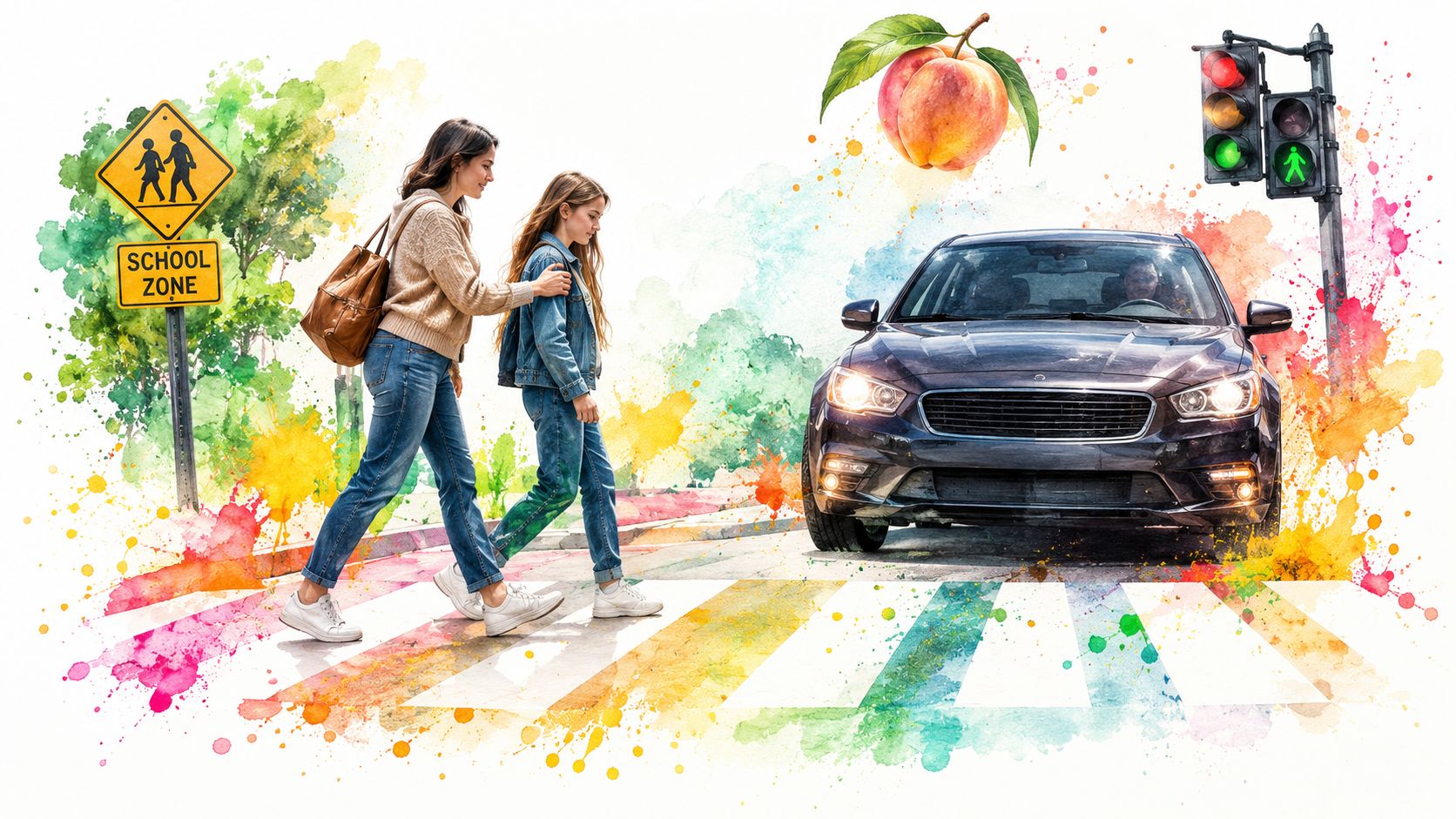
School-aged children often learn best when the lesson matches a real situation. If you are walking near a Georgia school zone, point out the curb, the signal, the crosswalk, and the cars that may be turning. That kind of step-by-step coaching helps a child connect the rule to the street in front of them, instead of treating safety as an abstract idea.
A parent's habits matter just as much as the words they use. Adults who cross only when it is safe, stay off their phones, and keep a steady pace show children what careful walking looks like. Families who want more structured practice can also look into local driver education and scholarship resources through A-1 Driving School courses, which can support safer habits for both young pedestrians and future drivers.
For children, consistency is the real lesson. The same routine, the same language, and the same example from adults make safe walking feel normal instead of optional.
8-Point Pedestrian Safety Tips Comparison
| Safety Tip | Implementation Complexity | Resource Requirements | Expected Outcomes | Ideal Use Cases | Key Advantages |
|---|---|---|---|---|---|
| Make Eye Contact and Be Visible to Drivers | Low | Minimal, bright/reflective clothing, positioning | Increased driver acknowledgment; fewer "failure to see" incidents | Intersections, low-light hours, areas with parked cars | Immediate, low-cost, empowers pedestrian control |
| Cross Only at Designated Crosswalks and Traffic Signals | Low–Moderate | None to moderate, extra walking/time to cross at signals | Legal right-of-way, more predictable interactions, reduced conflicts | Urban intersections, busy roads, signalized crossings | Clear driver expectations; legal protection |
| Stay Alert and Avoid Distractions While Walking | Low | None, behavioral change (store phone, remove earbuds) | Faster hazard detection and reaction; fewer distraction-related incidents | High-traffic areas, intersections, blind corners | Improves situational awareness; reduces device-related risk |
| Understand and Follow Right-of-Way Rules | Moderate | Time to learn local laws; attention to signage/signals | Predictable traffic behavior; legal clarity; fewer misunderstandings | Unfamiliar roads, mixed-use intersections, roundabouts | Reduces confusion; supports lawful interactions |
| Never Assume a Driver Sees You, Stay Defensive | Low–Moderate | Low, sustained attention, possibly visibility aids | Compensates for inattentive/driving violations; fewer collisions | Poor visibility, busy intersections, turning vehicles | Proactive protection against driver error |
| Increase Visibility at Night and in Poor Weather Conditions | Low | Low cost, reflective gear, lights, bright clothing | Greater detection distances; reduced nighttime/poor-weather collisions | Dawn/dusk, rain, fog, nighttime walking | Dramatic visibility improvement; inexpensive solutions |
| Walk Predictably and Avoid Sudden Movements | Low | None | Easier driver prediction; reduced evasive maneuvers and secondary accidents | Crossings with children, group walks, busy streets | Enhances driver reaction time; lowers confusion risk |
| Teach Children Pedestrian Safety and Model Good Behavior | Moderate–High | Time, supervision, educational materials | Long-term safe habits; reduced childhood pedestrian injuries | Families, schools, community programs | Establishes lifelong safety culture; reduces vulnerability |
Your Next Steps to Safer Streets
Good pedestrian safety is built one crossing at a time. It starts with choosing visible clothing, using crosswalks, staying off the phone, understanding right-of-way, and walking with steady, predictable movement. For Georgia families, those habits matter on school routes, neighborhood streets, downtown sidewalks, and every place people and vehicles share space.
The larger road-safety picture makes the case for urgency. The CDC reported that U.S. pedestrian death rates rose 50.0% between 2013 and 2022, and NHTSA recorded 7,388 pedestrian deaths in 2021 along with about 60,577 injuries CDC pedestrian mortality data. Those numbers don't mean you should panic, they mean you should practice the basics until they're automatic. A cautious crossing, a clear hand signal, or one extra pause at the curb can make the difference between a normal trip and a life-changing mistake.
Georgia drivers should also remember that pedestrian safety isn't only a walker's job. The CDC says drivers should slow down and be ready to stop at crosswalks, yield to people in crosswalks, not pass vehicles stopped at a crosswalk, and slow down in places where children may be present, such as school zones and neighborhoods CDC driver safety guidance. When drivers and pedestrians both use safer habits, the whole street becomes easier to get around.
A-1 Driving School can help families turn those habits into real-world skills with Joshua's Law driver education, online course options in Georgia, road test preparation, driving lessons, and driving lesson packages built for teen and adult learners. Scholarships may also be available through the Georgia Driver's Education Scholarship Grant Program for qualifying students, making training more accessible when safety matters most. If you want to strengthen road awareness at home and help a new driver understand pedestrians better, visit A-1 Driving School and choose the course or lesson path that fits your family.
Ready to build safer habits for every walk and every drive in Georgia? A-1 Driving School offers Joshua's Law courses, behind-the-wheel driving lessons, road test support, and flexible online options that help teens and adults learn how to share the road with confidence. Visit A-1 Driving School to explore driving lessons, lesson packages, and scholarship-friendly training that supports safer streets for everyone.