

If you fail a Georgia driving test, you can retake the failed portion the next day after a first failure, after 7 days after a second or later failure, and after 30 days if the failure involved an accident or traffic violation, and you need at least 75% to pass. You might be sitting in the parking lot right now, score sheet in hand, replaying one turn or one stop and wondering whether the whole process starts over.
It doesn't. What happens if I fail my driving test in Georgia is mostly a question of timing, paperwork, and one or two habits you can fix. The helpful part is already in your hand, because the examiner's marks tell you exactly what to practice before you book again.
What Happens Right After a Failed Georgia Road Test
A failed test doesn't permanently block your license. It pauses your timeline, adds another appointment, and gives you a specific list of faults to correct.
The Georgia Department of Driver Services test information states that a first-time failure requires waiting until the next day, a second or later failure requires 7 days, and a failure involving an accident or traffic violation requires 30 days, whether or not a ticket was issued. That same guidance sets the passing score at at least 75%, requires a new appointment and the applicable permit fee for every retest, and states that no refund is issued when any part of the test is failed.
Georgia Retest Waits by Failure Type
| Situation | Wait before retest | Extra steps |
|---|---|---|
| First failure of a knowledge or road test | Next day | Retake failed portion, new appointment, permit fee |
| Second or later failure | 7 days | Same appointment and fee, no refund for failed test |
| Failure involving an accident or traffic violation | 30 days | Applies with or without a ticket, new appointment and fee |
| Score below 75% | Repeat failed portion only | No license until a passing score is earned |
Notice the wording in that last row. You repeat the failed portion only, not the parts you already passed. If your road skills score fell short, the road portion is what you redo. That distinction matters because it keeps your preparation narrow and manageable.
The wait itself is only part of the delay. You also need an available appointment, plus time to fix the fault that caused the failure. Booking the earliest possible slot sounds efficient, but it isn't helpful if you return with the same blind-spot habit or the same rolling stop.
Practical rule: Treat the waiting period as the minimum time before you're eligible, not as proof that you're ready.
For teens, a failed attempt doesn't reset your separate permit timeline or erase the practice you've already logged. You keep building from where you are. The examiner reviews the score sheet at the end of the test, so you leave with a concrete record rather than a vague impression that things went badly.
Today, do three simple things. Find the row above that matches your result, mark the earliest date you can rebook, and pull out your score sheet. Don't decide yet whether you need one practice drive or several lessons. Let the marks on that sheet answer that question first.
Why Applicants Fail and What the Examiner Scores
Most failures don't come from being unable to drive. They come from a small set of repeated habits that show up under pressure, often more than once in the same short drive.
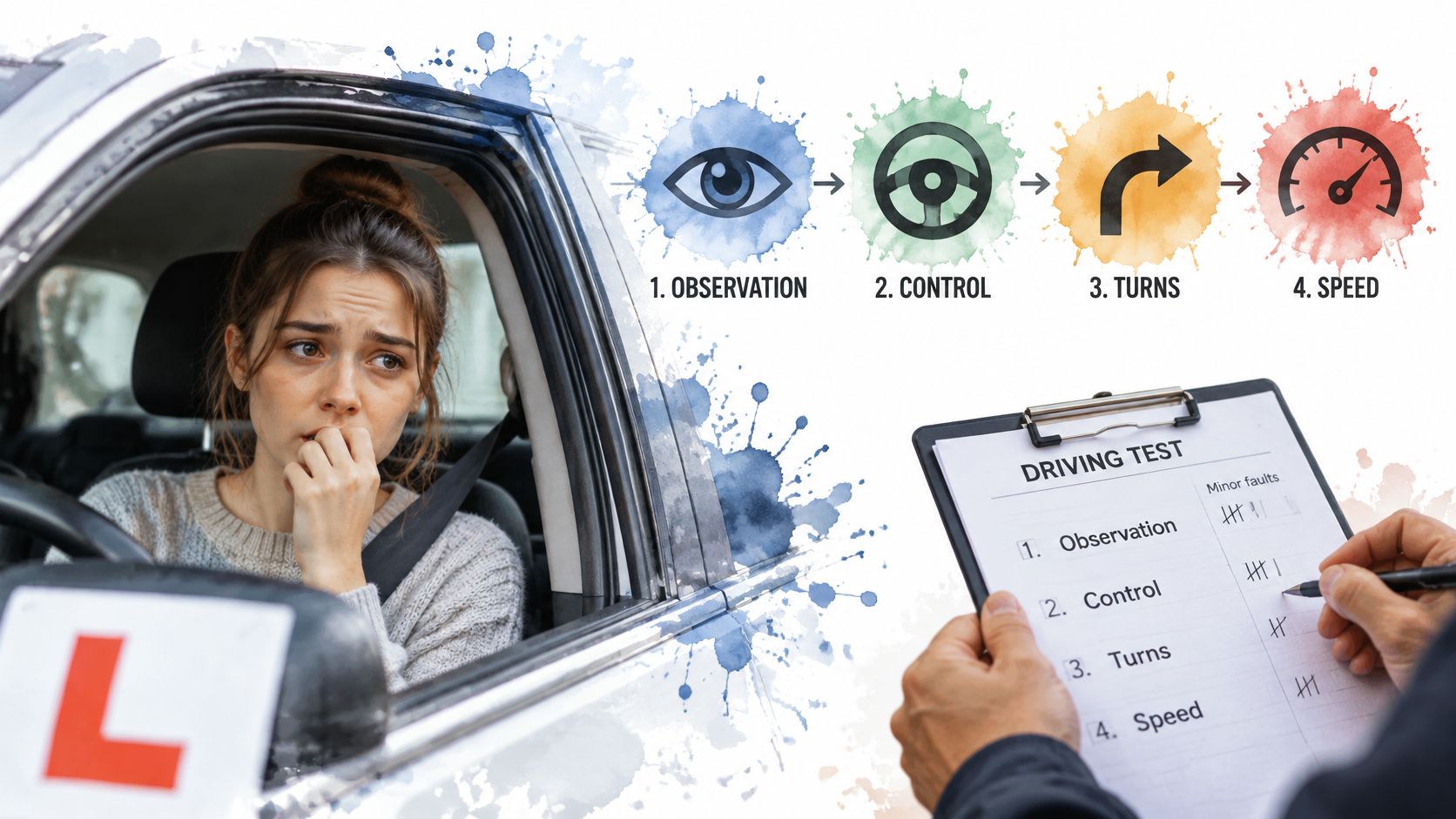
The Areas an Examiner Watches
- Basic control: Smooth starts and stops, steady steering, and staying centered in your lane without drifting toward the curb or center line.
- Observation: Mirror checks, shoulder checks for blind spots, and watching for pedestrians and cyclists before turns and lane changes.
- Turns and intersections: Full stops at stop signs, correct yielding, and turning into the proper lane instead of swinging wide.
- Lane changes: Signalling early, checking, then moving smoothly rather than drifting or cutting across.
- Speed: A pace that fits traffic, weather, and the road, neither holding everyone up nor creeping over the limit.
- Parking: The method used at your test site, done slowly with checks before and during the maneuver.
Say a learner rolls through a stop sign, then changes lanes a minute later without a shoulder check. That looks like two unrelated slips, but the score sheet will record both, and both point to the same root problem. The driver is rushing the sequence. Looking at how faults are grouped, which you can explore in the Georgia driving test rubric breakdown, turns a discouraging list into one fixable pattern.
Panic adds a second layer. A learner makes a small error, assumes the test is already lost, and then rushes the next turn. The first mistake costs a few points. The reaction to it often costs more, because attention shifts from the road ahead to the error behind.
Reading Your Score Sheet and Drilling the Fix
Go through the sheet line by line and group each deduction under control, observation, turns, lane changes, speed, or parking. Then rank the groups by how often each one appears. The two largest groups become your practice plan, and it helps to review the driver's handbook before testing so the rule behind each fault is clear before you drill the maneuver itself.
Match a drill to each group. For observation, do a shoulder check on every turn and lane change until it feels automatic. For control, repeat smooth start and stop drills in a quiet lot. For intersections, count to three at every stop sign. For lane changes, run a signal, check, move routine on a multi-lane road. For speed, practice matching traffic flow on varied roads, and for parking, repeat the exact method your test site uses. Pick your top two categories and fix those before you rebook.
Retake Steps and Eligibility Checklist
Work through these steps in order. The eligibility checks come before booking on purpose, because a missing document or an unsafe vehicle can stop a test before your driving is ever judged.
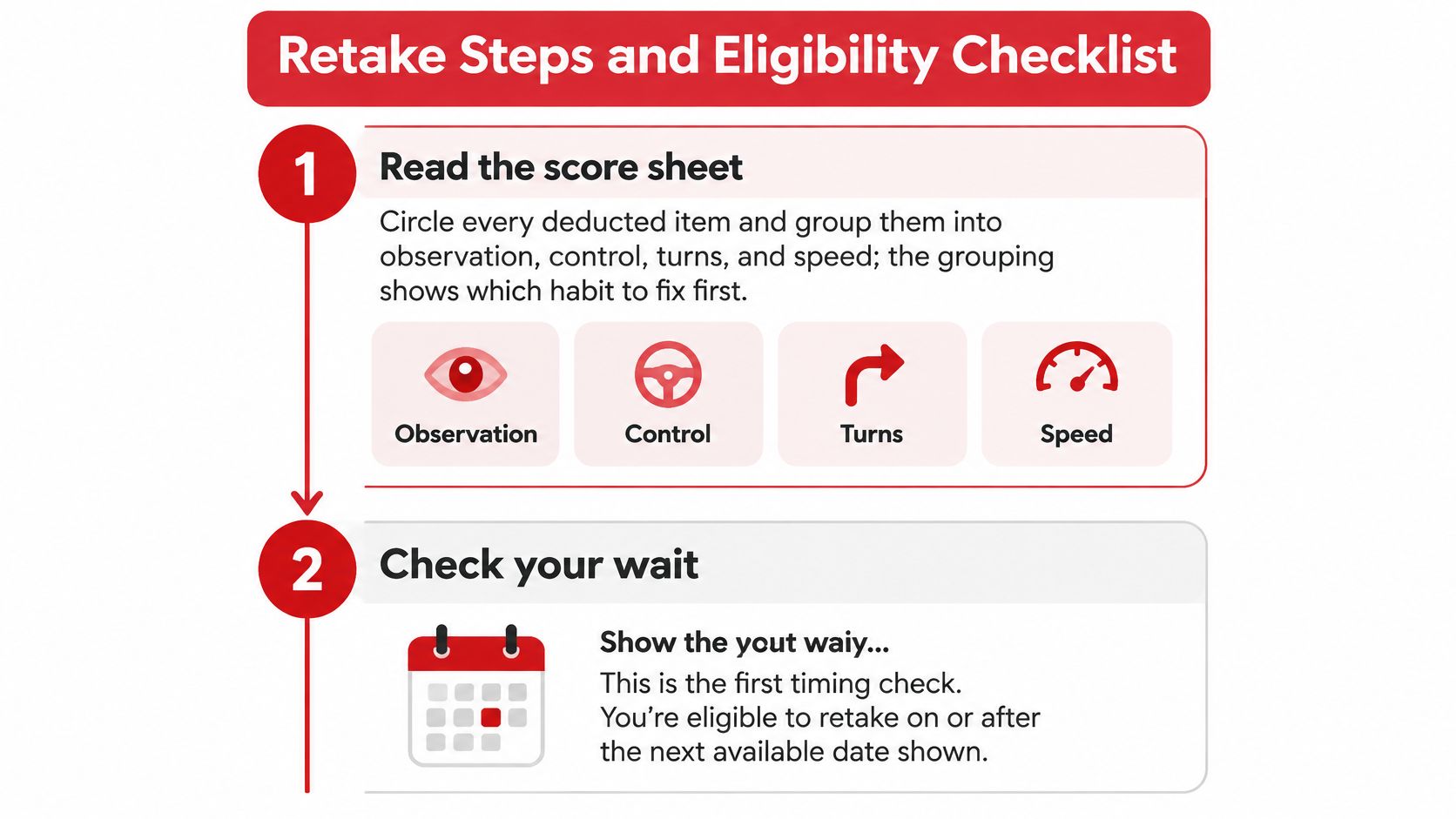
- Read the score sheet. Circle every deducted item and group them into observation, control, turns, and speed. The grouping shows which habit to fix first.
- Check your wait. The Georgia DDS testing standards page confirms the next day after a first failure, 7 days after a second or subsequent failure, and a minimum of 75% to pass. Count the 30 days if an accident or violation was involved, since booking early wastes an appointment and a fee.
- Practice the top two faults where you'll test. Blind-spot checks learned on empty streets often disappear in busy traffic, so drill them in conditions that resemble the actual test.
- Confirm teen eligibility. The Georgia DDS road test appointment guidance requires an appointment with no walk-ins for under-18 tests, a valid Georgia non-commercial learner's permit, Class D documents, a licensed driver age 21 or older, a vehicle that passes a DDS safety inspection, and a signed affidavit for 40 hours of supervised driving including 6 hours at night. Teens also need the permit held for 12 months and one day.
- Check your Joshua's Law record. Confirm your classroom or approved online hours and behind-the-wheel hours are complete and documented, not just nearly finished.
- Book and pay. Reserve the new appointment and pay the permit fee that applies to every attempt. When you're ready, you can schedule a Georgia road test appointment rather than showing up and hoping for an opening.
- Review the new score sheet afterward. If you don't pass, return to step one with the fresh marks instead of relying on memory.
A vehicle with a cracked windshield, a missing document, or the wrong accompanying driver can end your test day before you turn the key.
Two slips cause most wasted trips. Learners book before the wait ends, or they practice only in quiet areas and feel ready too soon. Also remember that students must have a valid Learner's Permit or Driver's License to take a driving lesson, so check your permit before scheduling practice as well.
Retest Support Options That Target Your Weak Spots
The right support depends on why you failed. A driver who missed shoulder checks needs something different from a teen who is short on theory hours, so read your score sheet first and match the help to the marks on it.
The Georgia DDS driver education guidance describes the traditional 30 and 6 pathway as at least 30 hours of classroom instruction or an equivalent approved virtual course plus 6 hours of instructor-led behind-the-wheel training, alongside 40 total supervised-driving hours including 6 at night.
Retest Support Options Matched to the Weakness
| Support Option | Best For | What It Targets |
|---|---|---|
| Individual driving lessons | Failures caused by on-road errors | Specific maneuvers from the score sheet |
| Road-test preparation session | Good driving skills but unsure of the test routine | Test-day routine and examiner expectations |
| Online Joshua's Law course | Teens still needing theory hours | Theory component only, not road practice |
| Parent-supervised practice log | Teens needing 40 supervised hours | Documented supervised hours, including 6 at night |
Individual driving lessons suit one or two clear on-road errors. Each marked fault on the score sheet names the skill to rebuild, and an instructor works on those exact maneuvers while watching for the moment the old habit creeps back. That's hard to do alone, because you can't see your own missed mirror check. A-1 Driving School offers lessons for both students and adults, so this option fits whether you're 16 or 46.
A road-test preparation session fits a different problem. Your driving is sound, but the test format unsettles you. The session covers what the examiner expects and how the test runs, so nerves have less to feed on.
The online Joshua's Law course covers theory only. It doesn't replace on-road practice or supervised hours, so it helps a teen who rushed past the classroom requirement rather than a driver who stalled during parallel parking. An instructor-led classroom version of the same course exists if self-paced online study didn't stick the first time.
Pick the option that matches your fault, then set one measurable goal, such as five clean blind-spot checks in a row. A second attempt fails the same way when practice stays generic, so aim every session at the exact line the examiner marked. The Georgia Driver's Education Scholarship Grant Program may reduce cost for qualifying drivers.
Retest Rules for Adult Applicants and Repeated Failures
Adults often assume the teen rules apply to them, or the opposite, that no rules apply at all. Neither is quite right, so here's your own checklist.
You follow the same core retest timing and passing standard described for other applicants. What you don't face are the teen permit duration requirement and the supervised-hours affidavit. That makes your checklist shorter, but not empty.
Your Adult Checklist Before Booking
- Permit validity: Confirm your permit is current, since an expired permit stops everything.
- Documents: Gather the identification and paperwork you'll be asked for, and check them the night before.
- Vehicle condition: Make sure lights, signals, brakes, and tires are in working order if you're supplying the car.
- Appointment and fee: Each attempt needs a new appointment and the applicable permit fee, and a failed test isn't refunded, so confirm the current fee with DDS before you book.
Adults returning to driving after years away often fail on habits that felt normal in everyday driving, such as rolling stops or late signals. Those aren't knowledge gaps. They're ingrained routines, and they need deliberate repetition to replace.
When Failure Repeats
Keep a single log for every attempt. Write down the date, the score, and each fault from the score sheet. After two attempts, the log shows you something memory won't, which is whether the same fault keeps returning or whether each failure has a different cause.
A simple test of readiness: If you can't name the specific fault you fixed since your last attempt, you're probably not ready to rebook.
After two failures, plan at least a week of focused practice before testing again, because the mandatory wait is only a minimum. If the same fault appears on three score sheets, solo practice has likely taken you as far as it can. At that point, a driving lessons package gives you repeated, corrected practice with progress tracked across sessions, which is exactly what a stubborn habit requires.
Repeated failure feels personal, but the log usually tells a calmer story. One habit, repeated under pressure, is a training problem with a training solution.
Book Driving Lessons Before Your Retest
A retest booked with no practice in between tends to produce the same score sheet twice. The date changes. The habit stays. So the order matters: lessons first, test appointment second.
The three moves are straightforward. Fix the top two faults on your score sheet, confirm your eligibility and documents, then choose the support option that matches the fault. Everything else is detail.

We're A-1 Driving School, a Georgia driving school serving teens and adults in Atlanta and Athens. We offer driving lessons for both students and adults, plus Road Testing, including the Georgia Road Test. If your score sheet points to specific maneuvers, our road test focused driving lessons let an instructor work through those exact skills with you before your next appointment.
Teens who still need their education hours can choose our instructor-led or online Joshua's Law Driver's Education courses, then pair that theory with behind-the-wheel time. Learners who keep failing for the same reason usually benefit from several individual lessons focused on those faults, so each session can target the exact skill the examiner marked down. Our Scholarship Grant Program may also help qualifying drivers cover the cost of training.
If you're unsure which option fits your score sheet, call the Driver's Education Hotline at (770) 603-3320 and describe the faults listed on it. We'll help you match the lesson or course to the problem. Bring the score sheet to your first session along with your valid learner's permit or driver's license, because that sheet is the most useful document you own right now.
Your next step is small and concrete. Book your first lesson before your next test date, and walk into the retest having already fixed the thing that stopped you last time.
Bring your score sheet to A-1 Driving School and we'll turn each deducted item into a focused practice plan, whether you need a single correction lesson, a series of lessons on one stubborn skill, a Joshua's Law course, or road testing when you're ready. Book your first session today so your next attempt measures how far the practice has taken you.