

Does finishing driver's education mean your teen is ready to get a Georgia license? Not necessarily. Georgia driving laws separate education, supervised practice, permit timing, testing, and independent-driving privileges, and completing one doesn't automatically satisfy the others.
For families, the easiest approach is to match each requirement to the correct licensing stage. Professional driving lessons then become more than test preparation: they give teens specific skills to practice with a parent before they drive independently.
Georgia Driving Laws at a Glance
| Stage | Minimum age | Core requirement | Main limit |
|---|---|---|---|
| Learner's permit | 15 | Pass the knowledge test on road rules and signs | Must drive with a licensed adult in the front seat |
| Class D intermediate license | 16 or 17 | Hold permit 1 year and 1 day, complete Joshua's Law, pass vision exam and road-skills test | Night and passenger restrictions |
| Class C full license | 18 or older | Meet the applicable requirements | No graduated restrictions |
Read the table from left to right: identify your age, check the license you currently hold, and list what's still unfinished. Age establishes eligibility to apply, not automatic permission to drive independently. A course certificate doesn't change the privileges printed on your permit or license.
For a permit holder, the immediate task is learning vehicle control with supervision. For a Class D applicant, the task is bringing education, practice, timing, testing, and driving history together. For someone approaching full licensure, the task is confirming eligibility and completing the applicable upgrade process.
Keep separate records for separate requirements
Create a licensing folder containing:
- Permit information: Keep the issue date visible so you can plan around the required holding period.
- Education documents: Save course certificates and practical-training records.
- Practice records: Track supervised driving and nighttime practice separately.
- DDS correspondence: Keep notices affecting eligibility or driving privileges.
Joshua's Law determines the education pathway, while the practice log and permit date determine whether the experience requirements are complete. Passenger restrictions apply after intermediate licensure, and the points rules can affect eligibility throughout the process.
Confirm your individual eligibility with the Georgia Department of Driver Services before booking a course or road test. A driving-history issue or missing document can change an otherwise sensible schedule.
How Georgia's Graduated Licensing Works
Say a teen earns a permit on their birthday and finishes driver's education promptly. That's useful progress, but it doesn't let the family skip the experience-building period.
Georgia established its graduated licensing system in 1997 through the Teenage and Driver Responsibility Act, or TADRA, creating an instructional-permit, intermediate-license, and full-license pathway for drivers ages 15–18, according to the DDS teen driving laws guide. Under that framework, a teen who receives a permit at 15 generally must hold it for 1 year and 1 day before qualifying for Class D, pass a vision examination and road-skills test, and avoid disqualifying major violations.
The stages serve different purposes. A permit allows supervised learning. An intermediate license allows independent driving under restrictions. Full licensure removes the graduated restrictions after the driver meets the applicable requirements.
Planning principle: Finishing instruction early creates more time to practice. It doesn't move the earliest licensing date forward.
The safety context matters. The Georgia Department of Transportation reported 1,340 road deaths in Georgia in 2025, with 81% of crash fatalities caused by unsafe driving behaviors, such as distraction, impairment, or excessive speed.
Those statewide figures don't isolate teen drivers or prove the effect of any particular restriction. They do explain why learning to drive must include judgment, not just steering and parking.
Keep the permit start date, practice record, and course completion certificate together. Families can then schedule training around actual readiness rather than discovering a timing problem just before a planned test.
Class D Restrictions by Period
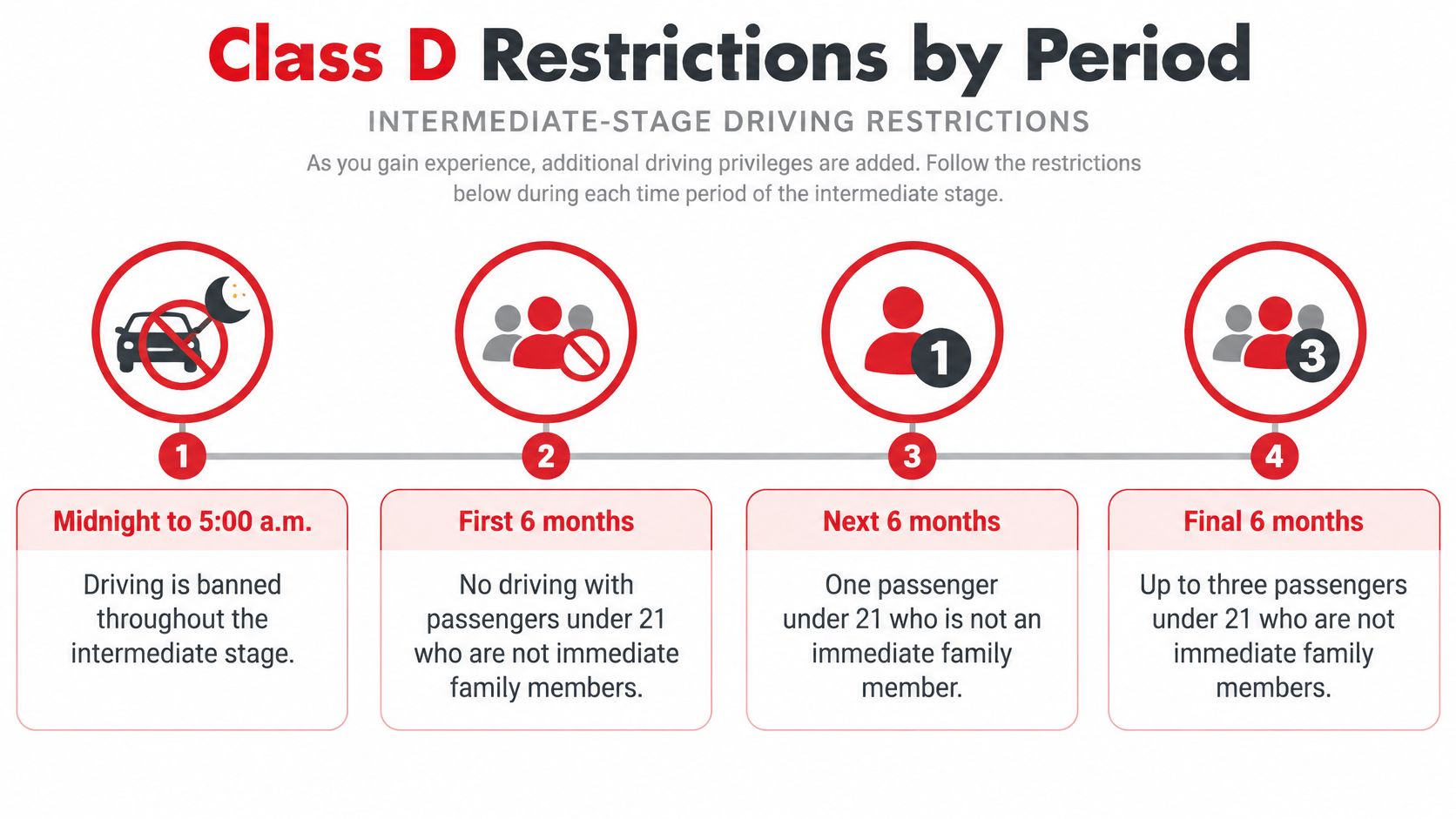
A Class D license works like a permit with the training wheels partly off: your teen drives alone, but Georgia still controls who rides along and during which hours. The passenger timeline starts when the Class D license is issued, not when driver's education begins or the learner's permit is obtained. That issue date is the anchor for every row below.
| Period | Passengers allowed | Driving hours |
|---|---|---|
| First six months | Immediate family only | No driving midnight to 5:00 a.m. |
| Months seven to twelve | Immediate family plus one unrelated passenger under 21 | No driving midnight to 5:00 a.m. |
| After one year | Immediate family plus up to three unrelated passengers under 21 | No driving midnight to 5:00 a.m. |
The overnight limit is not absolute. According to the DDS teen driving laws guide, the midnight-to-5:00 a.m. window carries listed exceptions, including trips tied to school, work, religious activity, and emergencies. Each exception comes with its own conditions, so confirm a specific trip with DDS before relying on it.
Use the visual below as a reminder, but follow the table's after-one-year wording rather than treating the final passenger allowance as a separate, fixed-length stage.
Situations families should settle before departure
A sibling generally counts as immediate family. A sibling's friend doesn't become immediate family because they're joining a family trip. When the relationship is uncertain, confirm it with DDS before arranging the ride.
School, sports, and work schedules still need advance planning even though exceptions exist. A regularly scheduled activity may fit a listed exception, while a one-off late pickup may not. When a trip doesn't clearly qualify, arrange another driver rather than treating the reason for travel as permission.
A serious violation can affect the driver's license status, so the timeline isn't a guarantee that someone remains eligible to drive. Check any DDS notice rather than relying only on elapsed time.
This video provides another format for reviewing the restrictions.
Before handing over the keys, ask:
- Who's riding? Check family relationships and the applicable passenger allowance.
- When will the trip finish? Include delays, not just the expected departure time.
- When was the license issued? Use the actual issue date to identify the current passenger period.
Joshua's Law Education Requirements
Joshua's Law combines formal instruction with practical training. It isn't just the name of an online course.
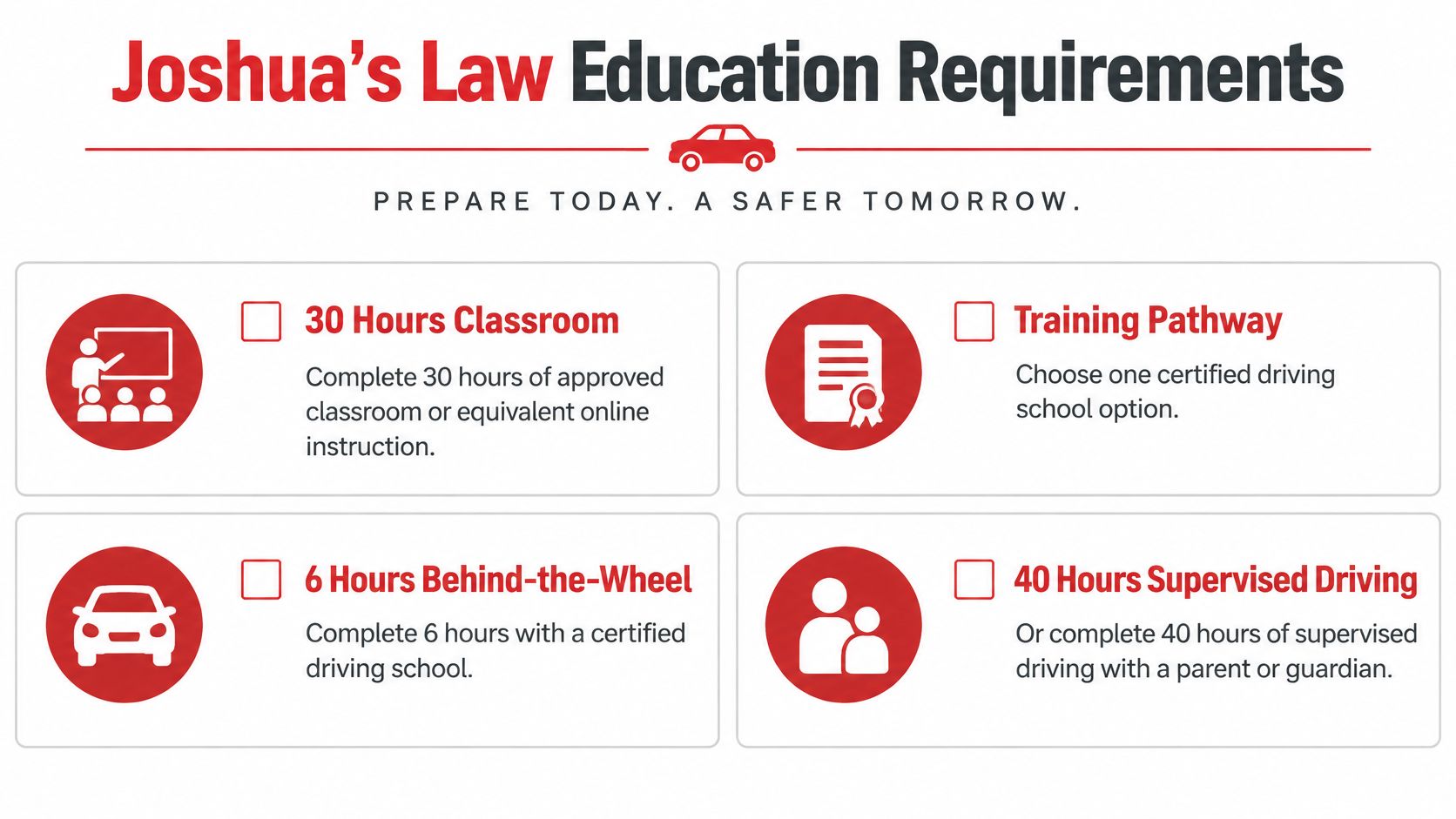
Enacted through Georgia Senate Bill 226, the requirements apply to 16- and 17-year-olds applying on or after July 1, 2021, according to the DDS Joshua's Law requirements. Applicants complete 30 hours of approved classroom or equivalent online instruction, then follow an approved practical pathway involving 6 hours with a certified driving school or documented parent-taught training through the state's Parent/Teen Driving Guide.
Complete the requirements in a workable order
- Choose approved theory instruction. Select classroom or online learning based on how the student learns and when they can complete the work.
- Obtain the learner's permit before driving instruction. Behind-the-wheel training requires the permit first.
- Choose the practical pathway deliberately. Professional instruction provides structured teaching and outside feedback. Parent-taught practical training requires the family to follow and document the state's approved guide.
- Keep the supervised-practice obligation separate. Every applicant must also complete 40 supervised hours with a parent or guardian, including 6 at night.
The checklist below summarizes the education components, but its “or” wording shouldn't be read as permission to replace supervised practice with professional lessons.
At A-1 Driving School, our DDS-approved Joshua's Law Driver's Education courses, driving lessons, and Georgia road testing help families coordinate the education-to-testing process. Confirm the contents of the selected course or package rather than assuming every enrollment includes the same services.
Keep the completion certificate and practical-training record together. Your family should also retain a clear practice record so the person attesting to completion can do so accurately.
Important distinction: Professional instruction teaches and evaluates skills. Parent-supervised practice gives the student repeated opportunities to apply them.
Online Versus Classroom Driver's Education
Online and classroom instruction can satisfy the same theory requirement, but they suit different learners. Classroom students follow scheduled sessions with an instructor; online students work through web-based material and need to manage their progress.
The DDS driver education FAQs allow either approved format for the minimum 30-hour theoretical component. Neither format removes the practical-training requirement, 40 supervised hours, 6 nighttime hours, or applicable permit-holding period.
| Format | Delivery | Approval | Theory hours covered | Still required after the course |
|---|---|---|---|---|
| Classroom | Scheduled sessions with an instructor | DDS approval required | Yes, minimum 30 hours | Behind-the-wheel or parent-guided training, 40 supervised hours, 6 night hours, permit period |
| Online | Web-based and self-paced; check pacing requirements | DDS approval required before paying | Yes, minimum 30 hours | Same practical requirements as classroom |
Course material typically addresses road signs, traffic laws, safe driving techniques, distraction and impairment risks, and basic vehicle knowledge. Review the syllabus rather than assuming every provider organizes those topics identically.
Choose for completion, not just convenience
- Verify approval: Confirm the specific course is DDS-approved before paying.
- Check the pace: Compare access and completion rules with the student's school schedule.
- Review support: Find out how students get clarification when a concept is confusing.
- Save the certificate: Confirm how completion documentation is delivered and retained.
A student who procrastinates may benefit from classroom appointments. A student who works steadily and needs flexibility may prefer online study. Neither choice substitutes for learning how to respond to real traffic.
Supervised Driving Hours and Permit Timing
Build the practice log around what the teen drove, not how long the family was away from home. Record the date, driving duration, supervising parent or guardian, conditions, and skills practiced.
Keep daytime and nighttime entries distinguishable. Before the first night session, confirm DDS's applicable definition of night so you don't rely on a family interpretation of dusk.
Make the log useful for teaching
A practical log should show more than a total:
- Residential driving: Practice smooth braking, lane position, scanning, and controlled turns.
- City streets: Add intersections, pedestrians, parked vehicles, and changing traffic signals.
- Parking areas: Work on low-speed control, reversing, and observation.
- Higher-speed roads: Introduce merging and lane changes when basic control is dependable.
- Changing conditions: Add darkness and suitable wet-weather practice gradually.
For example, a completed log might meet the required total and nighttime component while showing experience across these environments. That's more informative than repeated entries for the same easy route.
The permit calendar runs separately from the practice log. A teen who receives a permit shortly before their next birthday can't treat that birthday as an automatic Class D eligibility date. Count from the permit's actual issue date.
Record driving time after each trip, while the duration and conditions are still easy to remember.
If a parent can't supervise, don't substitute paid lessons for the parent-or-guardian practice obligation. Resolve the supervision plan before buying instruction or arranging a test.
At a monthly review, compare the log with the permit calendar, identify missing nighttime practice, and choose the next skills to develop. This makes practice intentional and prevents a last-minute rush to complete unfinished requirements.
Driving Lessons Packages That Cover Required Hours
A lesson package is most useful when it connects professional feedback with practice between appointments. Buying instruction without a plan for reinforcement can leave the student repeating the same corrections each time.
For the certified-school pathway, select a package including the required behind-the-wheel component. Then consider whether the learner needs additional instruction for particular skills rather than assuming the minimum will suit everyone.
Match the package to the learner
| Learner's situation | Useful package focus |
|---|---|
| New teen driver | Basic controls, steering, observation, turns, and intersections |
| Driver uncomfortable in traffic | Lane changes, following distance, speed adjustment, and route progression |
| Student approaching testing | Consistent performance, parking, signaling, and independent decisions |
| Adult returning to driving | Assessment of current skills and targeted rebuilding of confidence |
Lessons should progress from starting and stopping smoothly to lane positioning, intersections, lane changes, parking, and adjustments for traffic and weather. A nervous learner may need familiar routes before tackling a busy multilane road. A confident learner may need closer attention to observation and decision-making rather than more speed or complexity.
Before committing, compare:
- Included instruction: Check the actual driving time, not just the package name.
- Skill priorities: Identify what the student needs to improve before the next appointment.
- Scheduling: Choose intervals that allow meaningful practice between lessons.
- Testing arrangements: Confirm whether testing is separate and who provides the vehicle.
Professional lessons and family practice should complement each other. After a lesson focused on lane changes, for example, a parent can reinforce mirror use, blind-spot checks, signaling, and gap selection on an appropriate route.
Choose enough instruction to build dependable skills, not merely to collect a completion certificate. Readiness means the student can repeat safe decisions without constant prompting.
Road Test Vehicle and Passenger Rules
A prepared driver can still lose a testing opportunity if the vehicle or paperwork isn't ready. Check the administrative details before concentrating on the final practice drive.
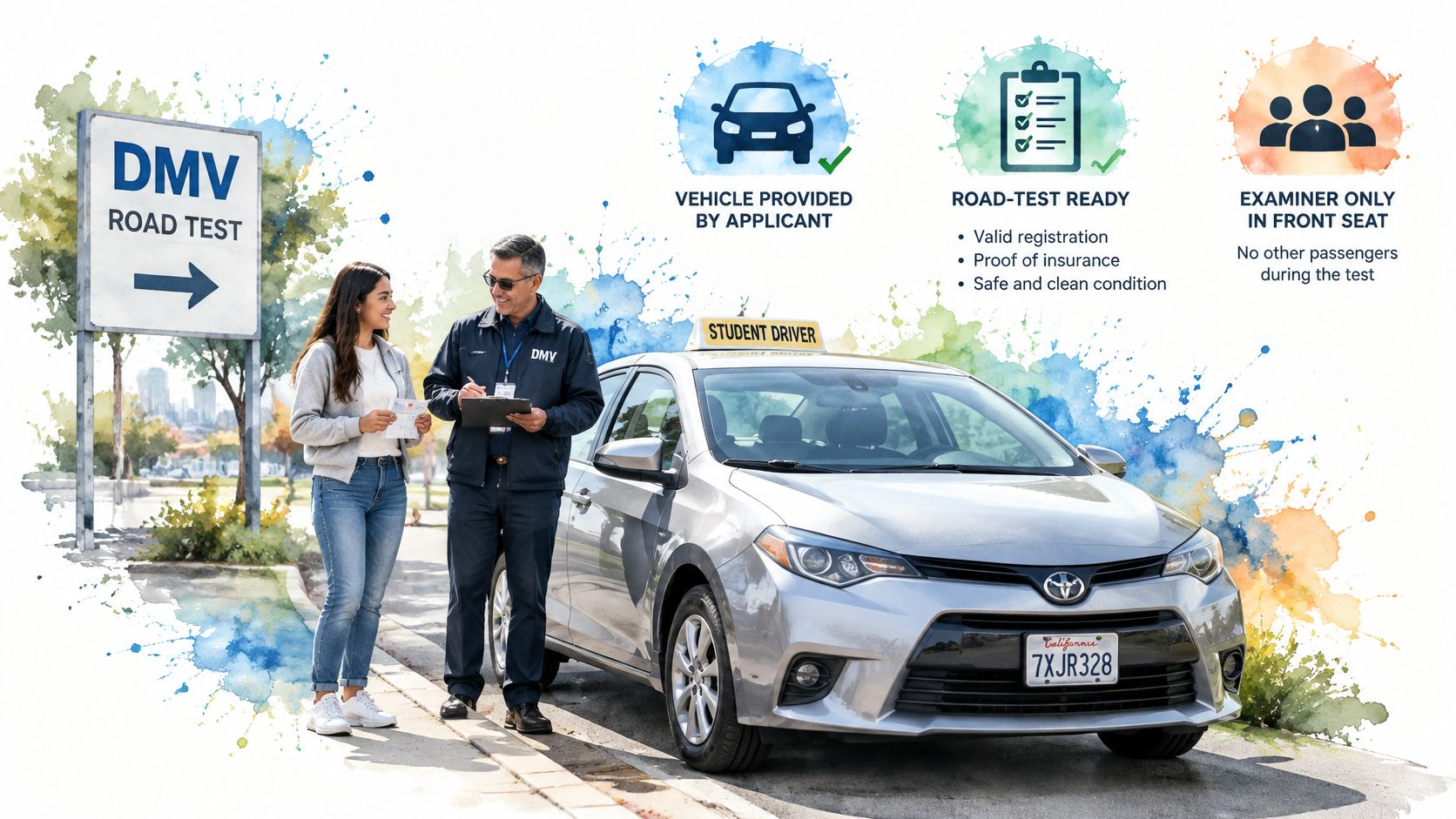
The DDS testing information guide requires a four-wheel vehicle supplied by the applicant, valid registration and a license plate, and a passenger who is a parent, guardian, or responsible adult at least 21 years old. For a temporary dealership tag, bring a bill of sale showing purchase within the last 30 days, or 7 days for a third-party purchase.
Use the vehicle-document review as part of your test preparation.
Complete the pretest check
- Confirm the vehicle arrangement. Make sure the vehicle is appropriate for the appointment and that you understand who supplies it.
- Gather documents. Keep registration and any required purchase paperwork accessible.
- Arrange the adult passenger. Don't leave this responsibility unresolved until test day.
- Check familiar controls. The student should know the signals, lights, wipers, mirrors, and parking brake.
- Practice complete maneuvers. Include observation before movement, controlled execution, and a safe finish.
Rolling stops, missed signals, incomplete blind-spot checks, and rushed decisions are habits to correct before testing. If the student makes a small mistake during practice, teach them to recover safely rather than stop thinking about the road.
Testing may be arranged through DDS or an authorized school. Review our road-test vehicle information before making vehicle plans, and confirm the instructions for your specific appointment.
Seat Belt, Phone and Distraction Rules
Good habits should start during supervised driving, not after the student earns independent privileges. Treat buckling up, putting the phone away, and setting navigation as part of starting the vehicle.
- Seat belts: Every front-seat occupant must buckle up, and back-seat passengers under 18 must buckle up too.
- Hands-free operation: Georgia prohibits holding or supporting a phone while driving and prohibits texting. A single touch or swipe to start or end a call is allowed.
- Overlapping restrictions: The phone rules apply to Class D drivers alongside their passenger and nighttime limits.
Our Georgia cell phone driving law guide explains the hands-free requirements and practical situations drivers should recognize.
Resolve phone situations before moving
A dashboard mount makes navigation easier to view, but it doesn't make every interaction appropriate. Enter the destination before departure, set the audio volume, and avoid adjusting the route while handling traffic.
A red light isn't a good opportunity to accept a phone from a passenger. Ask the passenger to manage the message instead. If directions become confusing, find a safe place to stop rather than dividing attention between the screen and an unfamiliar intersection.
Don't assume that being stationary with the engine running settles whether a phone-use exception applies. Distinguish being safely parked from temporarily stopped in traffic, and verify the applicable rule if your situation is uncertain.
Family habit: Everyone buckles up before movement, and the driver's phone stays out of their hands.
Parents can reinforce this routine by following it themselves. Consistent behavior is easier for a new driver to copy than a rule that changes depending on who's driving.
Points, Speed Rules and Insurance Consequences
Georgia applies different suspension thresholds to different age groups. A young driver shouldn't use the general adult threshold to judge whether a conviction is serious.
The DDS points schedule sets the following thresholds and point-reduction conditions.
| Driver group | Trigger | Time window | Note |
|---|---|---|---|
| Drivers generally | 15 or more points | Any 24 months | Triggers license suspension |
| Driver under 21 | Single conviction carrying 4 points | At the conviction | Suspension possible |
| Driver under 18 | 4 points | Within 12 months | Suspension possible |
| Licensed Georgia resident | Up to 7 points reduced | Once every 5 years | Requires DDS-certified 6-hour course |
A look-back period isn't the same as a calendar year. Review the conviction dates and the applicable window rather than assuming a new year resets the record. Qualifying out-of-state convictions can also add points to a Georgia resident's record.
Reduction doesn't erase the conviction
For an eligible point reduction, the driver must complete the certified course and submit the original completion certificate to DDS. The underlying conviction remains, and a court-ordered course may have separate requirements and deadlines.
For example, completing instruction doesn't mean a driver can assume their record has already changed. Confirm that DDS has processed the required documentation before relying on a reduction.
Our guide to driver's license points provides additional context for reviewing a record. Start with the official history, identify the relevant conviction dates, and verify your current status.
Speed decisions matter before any ticket occurs. Leave enough following space to slow smoothly and adjust to visibility, traffic, and weather rather than treating the posted limit as a target in every situation.
Tickets and convictions can affect insurance pricing, so ask your insurer how it evaluates your record. If a collision also creates an insurance dispute, car accident claim strategies from AskLegally offer a separate resource for understanding claim-related decisions, not a substitute for checking licensing status.
Impairment cases can involve separate administrative consequences. Get case-specific DDS guidance rather than treating them as ordinary point-reduction matters.
Book Your Georgia Driving Lessons Next Step
Start with your current permit or license, not the date you'd like to drive alone. A realistic plan combines legal eligibility with enough instruction and practice to make independent driving manageable.
Use this order:
- Confirm your stage. Check your current privileges and outstanding DDS requirements.
- Review the calendar and log. Compare the permit issue date with completed supervised practice.
- Select the education pathway. Choose approved online or classroom instruction and decide how practical training will be completed.
- Plan lessons around skill gaps. Leave room for practice between appointments.
- Arrange testing when ready. Confirm eligibility, documents, vehicle arrangements, and the required adult passenger.
We have 18 Georgia locations, including Atlanta, Athens, and Decatur. Families can use the location closest to home, school, or work when planning their next step.
Call our Driver's Education Hotline at (770) 603-3320 with licensing-stage questions before booking. Have the permit issue date and any education documents available so the discussion starts with your actual progress.
Before enrolling, confirm whether you qualify for assistance through the Georgia Driver's Education Scholarship Grant Program. Don't assume eligibility or funding approval, and establish how any award applies before making payment arrangements.
Book early enough to allow thoughtful instruction and steady practice. The permit-holding requirement sets the earliest possible Class D date, but the student's ability to drive safely should guide readiness.
A-1 Driving School offers DDS-approved Joshua's Law education, online and instructor-led options, teen and adult driving lessons, and Georgia road testing. Visit A-1 Driving School to choose a course or discuss a driving lessons package that fits your licensing stage, practice needs, and testing plans.