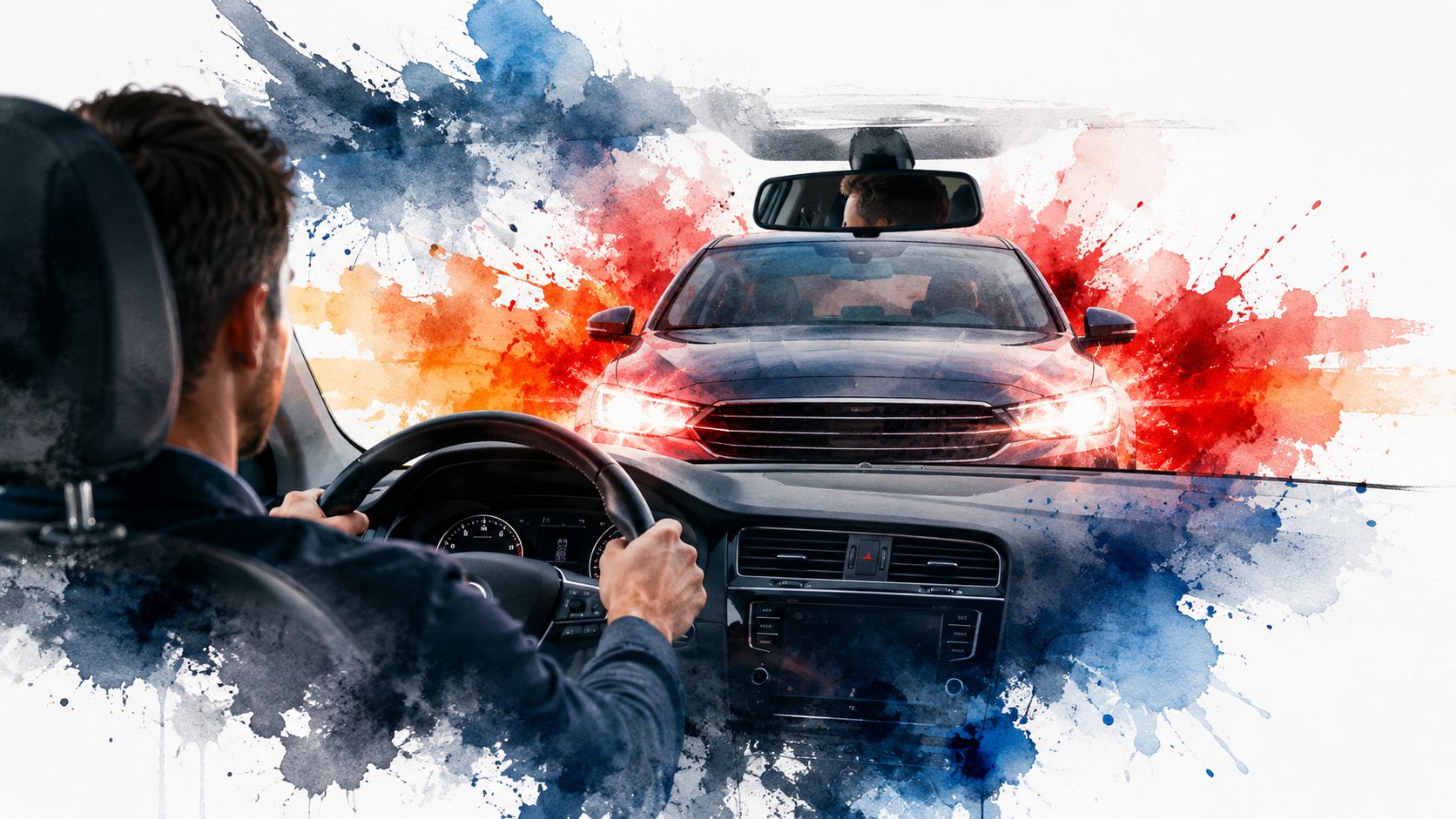
A car fills your rearview mirror faster than it should. The headlights sit too close. You start checking your speed, then your mirrors, then your hands on the wheel. New drivers often think the answer is to speed up, tap the brakes, or somehow signal, “Back off.”
That's the wrong mindset.
If you are being tailgated, you should think about control, not pride. The safest response is calm, predictable driving that gives you more room to work with. That means protecting the space in front of you, avoiding sudden moves, and creating a safe chance for the other driver to go around. When students practice this properly, the situation feels less personal and much more manageable.
That Too-Close-for-Comfort Feeling
Tailgating rattles people because it creates pressure from behind, where you have the least control. You can't make the other driver patient. You can't force them to leave space. What you can do is stop letting their impatience dictate your decisions.
A common scene looks like this: you're on a city road, already driving with traffic, and a vehicle closes in until you can barely see its front grille. Then your attention starts splitting. Part of you watches the road ahead. Part of you keeps checking the mirror. That split attention is where mistakes begin.
New drivers feel this pressure the most. At night, it feels worse. In traffic, it feels even tighter. The key is to recognize that the stress is real, but the response still needs to be simple and deliberate.
The goal is not to “handle” the tailgater. The goal is to keep your own car stable, predictable, and easy to read.
That shift matters. Once you stop trying to correct the other driver, your next steps become clearer. Hold your lane. Keep your speed steady. Give yourself more room ahead. Then look for a safe opening to let them move on.
This is one of those moments where good driver training pays off long after the lesson ends. A practiced driver doesn't need a dramatic escape move. A practiced driver needs a calm routine.
Your Immediate Actions for On-Road Safety
The first half-minute matters most. If you are being tailgated, you should resist the urge to react emotionally and follow a short checklist you can remember under pressure.
What to do first
Start with the one move that works best in real traffic. Increase the space ahead of your car. Official guidance recommends a 2-second gap below 35 mph, a 3-second gap at 36 to 45 mph, and a 4-second gap at 46 to 70 mph, with extra seconds in bad conditions, according to this tailgating safety explanation. That extra room lets you brake more gradually, which gives the driver behind you more time to react.
Here's the sequence I teach:
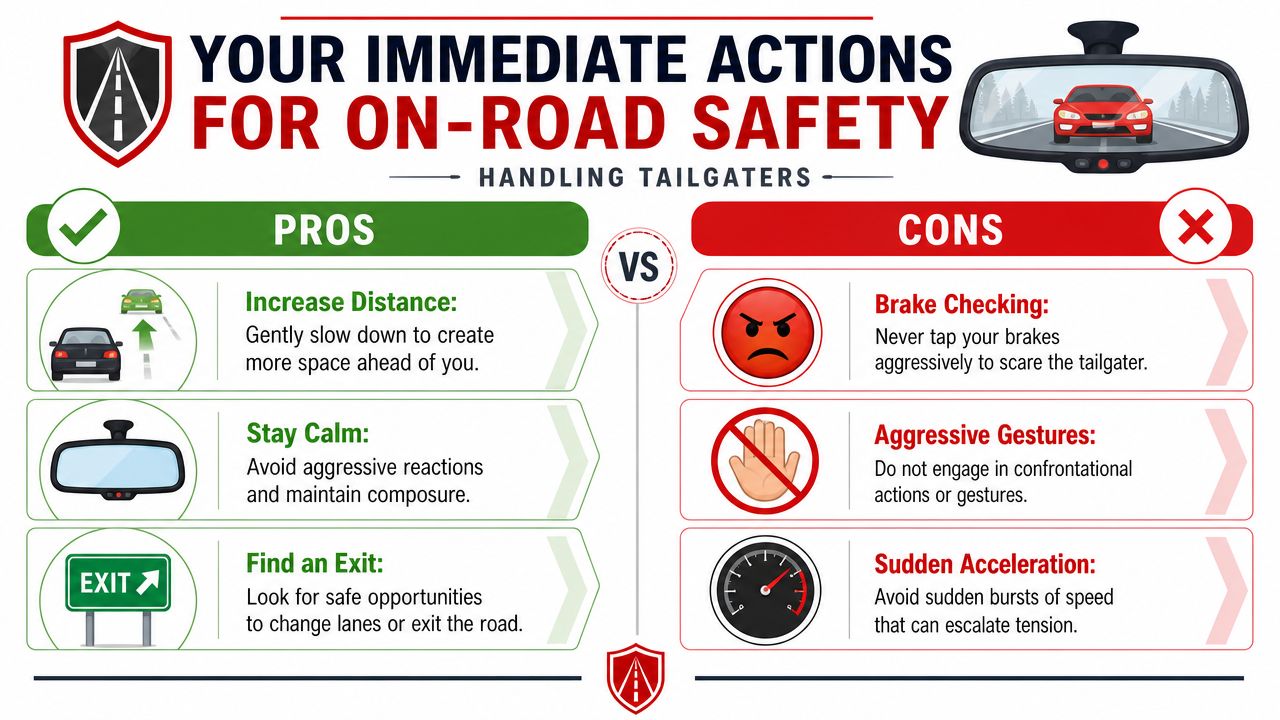
- Steady your hands and vision. Look well ahead, not only in the mirror.
- Hold a predictable speed. Don't surge forward out of panic.
- Open the gap in front. Ease off enough to create room, not enough to invite confusion.
- Scan for an exit path. A right lane, turnout, or upcoming turn may solve the problem.
- Signal early. Give the other driver time to understand what you're doing.
Students often think easing off the accelerator will anger the tailgater. Done correctly, it isn't a punishment. It's a safety buffer. You're creating more stopping distance for yourself so you won't need a hard brake.
What makes the situation worse
Never brake-check a tailgater. Never gesture. Never turn a traffic mistake into a contest.
Those reactions feel satisfying for a second and dangerous after that. Abrupt braking shortens the tailgater's reaction window. Gestures can escalate tension. Sudden acceleration creates a different problem because now you're driving faster while stressed.
A useful comparison comes from G1ready.ca's defensive driving guide, which emphasizes space management and calm, anticipatory driving. The principles carry over well here because the issue isn't only the car behind you. It's your reduced margin for error if something changes in front.
A simple memory rule
Use this short do-and-don't list:
- Do create room ahead. That gives you smoother braking options.
- Do stay boring. Predictable drivers are safer than dramatic drivers.
- Do prepare to move over. If a legal, safe opening appears, take it.
- Don't teach lessons. The road isn't the place for that.
- Don't weave between lanes. That adds risk without solving the problem.
If you want more guidance on the broader pattern of aggressive behavior, A-1's article on how to handle aggressive drivers is a useful follow-up because tailgating often comes with the same pressure and poor judgment.
Create a Safe Opportunity to Let Them Pass
Once the car is stable and you've stopped feeding the stress, the next job is to remove the hazard. That usually means letting the tailgater get ahead of you in a safe, legal, predictable way.
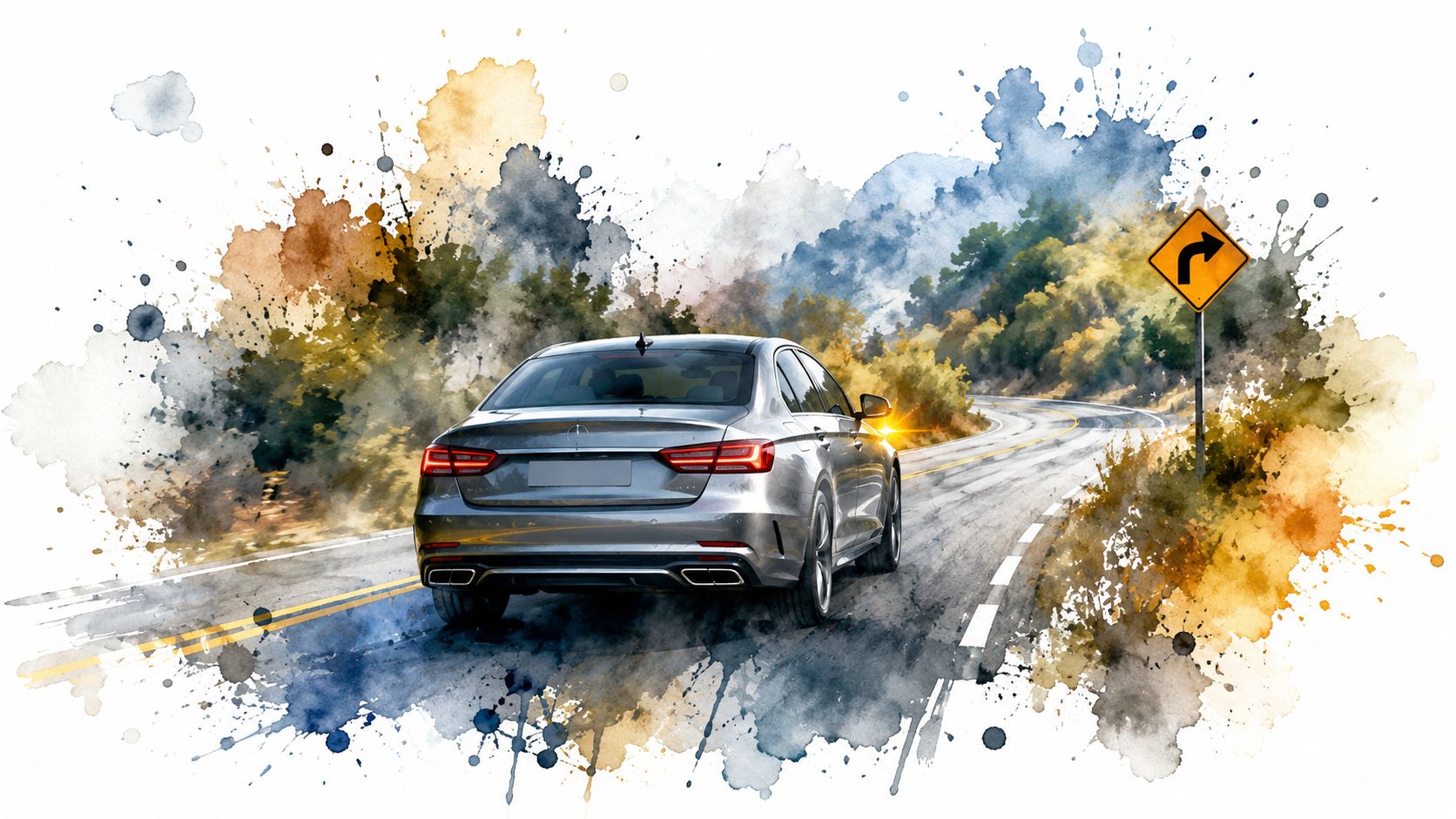
The California DMV puts it plainly. Drivers being tailgated should maintain a steady course and speed, then merge into a right-hand lane when it is safe to do so, allowing the other driver to pass, as explained in the California Driver Handbook safe driving guidance.
On multilane roads
If there's a lane to your right, don't dive into it. Check mirrors, check your blind spot, signal early, and move over only when the lane is clearly open. The key is not speed. The key is clean timing.
That process is much easier for drivers who've practiced lane position and mirror routines consistently. If that skill still feels shaky, brushing up on how to merge lanes helps because the same habits apply here.
On two-lane roads
Two-lane roads require more patience. You usually can't make the problem disappear immediately, so your job is to stay smooth and look for a safe, legal chance for the other driver to overtake or for you to turn off.
That might mean taking the next right turn, pulling into a parking lot entrance, or using a wider shoulder area only if it's safe and legal to do so. It does not mean dropping your speed suddenly to “invite” a pass where sight distance is poor.
Letting someone pass is not surrender. It's hazard removal.
A short visual demonstration can help if you're trying to picture how predictable movement looks in real traffic.
When not to move over
Sometimes the safest choice is to wait a few more seconds. Don't change lanes into a tight gap. Don't rush onto an exit you aren't prepared to take. Don't steer onto an unsafe shoulder because another driver is impatient.
A controlled delay is better than a desperate move. Your job is to create a safe opportunity, not an immediate one at any cost.
Tailgating and Georgia Driving Law
It helps to know that your frustration is justified. Following too closely isn't just bad manners. It's treated as a traffic offense and recognized as aggressive driving in state guidance. The legal standard is that a driver must leave a distance that is reasonable and prudent, taking into account speed, traffic, and road conditions, as described by the Wisconsin DMV's tailgating guidance.
That phrasing matters because it reflects how safe driving works. There isn't one magic number that fits every road, every speed, and every condition. Context changes what safe spacing looks like.
What that means for Georgia drivers
Georgia drivers should think of this in practical terms. If somebody is glued to your bumper, that driver is creating a hazard. But your safest move still isn't confrontation. Your safest move is de-escalation.
That's why I tell students not to become amateur traffic cops. Don't block the lane to make a point. Don't slow down to punish. Don't assume being “right” protects you from a rear-end crash.
A related Georgia concept worth understanding is lane discipline. Drivers often create tension by lingering in the wrong lane or not adapting to surrounding traffic flow. A quick read on the Georgia Slowpoke Law helps put that piece in context, especially on faster multilane roads.
The useful takeaway
Knowing the law can calm you down because it confirms the tailgater is the one making the unsafe choice. But the law doesn't steer your car for you. Technique does.
So keep the legal point simple. Yes, following too closely is a real offense. No, that doesn't change your mission in the moment. Your mission is still to stay predictable, preserve space, and disengage safely.
Build Confidence to Manage Any Road Situation
The biggest difference between a tense driver and a confident one usually isn't courage. It's preparation. Drivers who've practiced stressful situations don't freeze as easily when someone crowds them from behind.
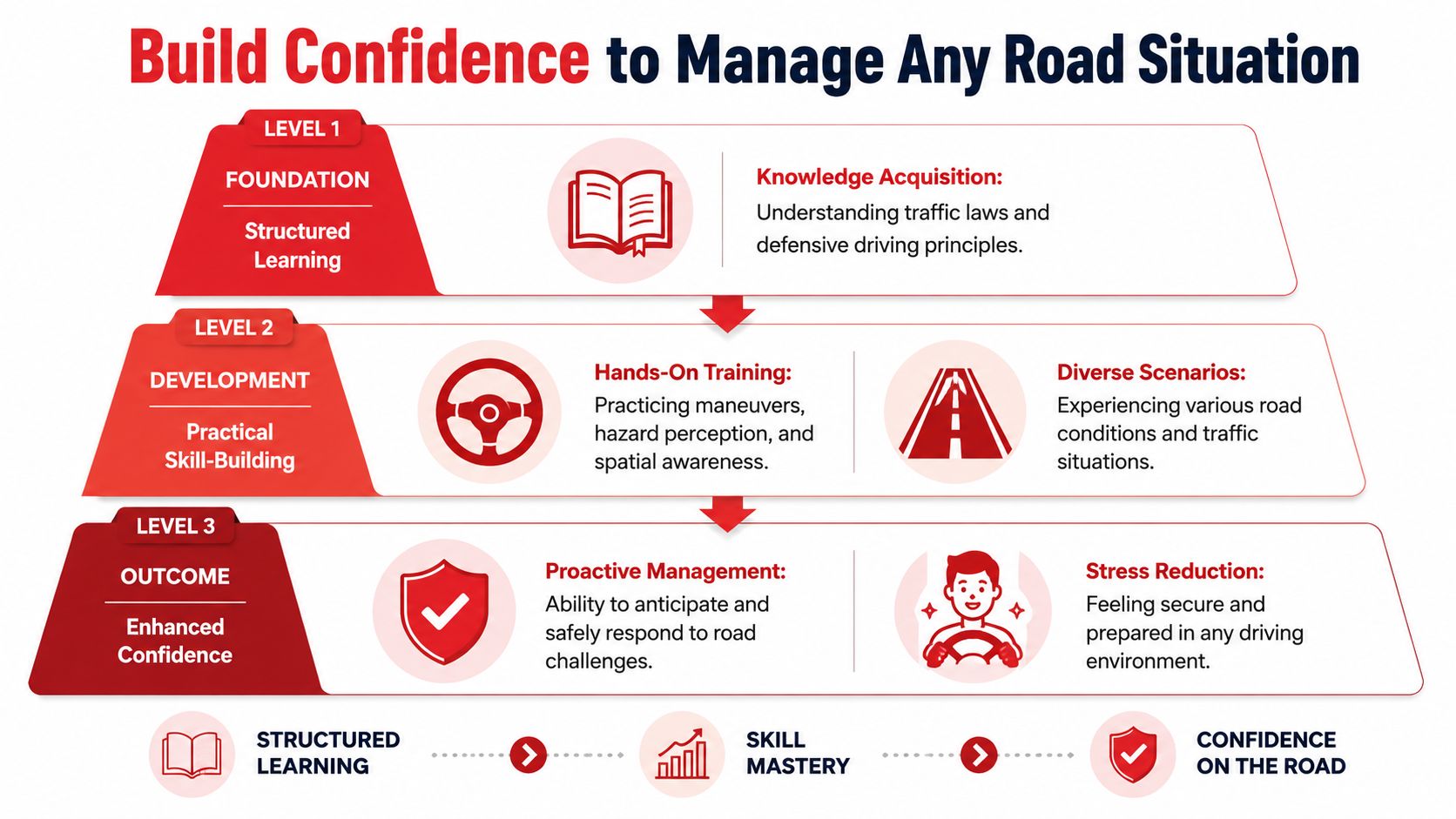
That matters because standard advice often misses the emotional side. New and teen drivers know they're supposed to “stay calm,” but that's hard to do when another driver is applying pressure. Guidance for permit test prep recognizes that this kind of situation requires more than a slogan. It takes confidence, awareness, and the habit of creating more space ahead so braking stays smooth, as noted in this discussion of what to do if you are being tailgated.
Confidence is a driving skill
Confidence on the road isn't bravado. It's built from repeated, coached decisions like these:
- Keeping your eyes far ahead. You stop obsessing over the mirror and start managing the whole traffic picture.
- Holding a steady lane position. The car behind you can predict you.
- Choosing patience over reaction. You don't let another driver set your tempo.
- Reading escape options early. You notice the right lane, side street, or turnout before you need it.
Those habits don't show up automatically. Drivers develop them through repetition in different traffic environments, with feedback that turns vague advice into something usable.
Why lessons help more than reading
A lot of people understand the rule but still struggle with the moment. That's normal. Reading “increase the gap” is one thing. Doing it calmly while another car crowds your bumper is another.
Professional lessons give drivers a place to rehearse these moments before they matter. Students can practice spacing, lane changes, mirror timing, turns under pressure, and road scanning until the response becomes familiar instead of emotional.
Calm driving is learned behavior. It gets stronger when you practice it under supervision, not just when you read about it.
That's especially important for teen drivers working toward independence, and for adults who haven't had formal coaching in years. The long-term win isn't only handling one tailgater. It's becoming the kind of driver who doesn't get pulled off balance by common road stress.
Master the Road with A-1 Driving School
A driver crowds your rear bumper, your pulse jumps, and suddenly a simple trip feels harder than it should. The right response in that moment is a skill. Skills get stronger with coached practice, not guesswork.
A-1 Driving School works with Georgia teens and adults who want more control behind the wheel. Its programs include driving lessons and lesson packages, Joshua's Law courses, online driver's education options, road testing, and information on the Georgia Driver's Education Scholarship Grant Program.
For tailgating situations, in-car instruction is usually the best fit. Students get to practice the decisions that matter under pressure: managing following distance ahead, checking mirrors without fixating on them, changing lanes at the right time, braking early and smoothly, and setting up safe turns when another driver is impatient. That kind of repetition helps replace tension with a clear routine.
I have seen the difference practice makes. Drivers who start out rattled by aggressive traffic often become much steadier once they have worked through the same situation with an instructor beside them. They stop reacting to the car behind them and start managing the road ahead.
That confidence carries past one stressful encounter. Teens build a stronger base before driving on their own. Adults can correct habits they picked up years ago and never had a chance to refine. Online course options also help families fit training into a busy schedule, and road testing can make the final licensing step more straightforward.
Cost matters for many families. The Georgia Driver's Education Scholarship Grant Program can help qualifying students get access to training that might otherwise be delayed.
Handling a tailgater is not only about getting through one bad moment safely. It is part of becoming a driver who stays calm, makes good decisions, and keeps control of the car even when traffic around them does not.